Filed Under:
Democrats pull off a Southern sweep
Shocking upsets in Texas, Georgia, and the Carolinas led to a total annihilation of Republican candidates, while Republicans held on by thin margins in Florida

Alexandra Martinez
Real journalists wrote and edited this (not AI). Independent, community-driven journalism survives because you back it. Donate to sustain Prism’s mission and the humans behind it.
Across the South, where voter suppression and gerrymandering has shaped a comfortably red region, voters and organizers last night accomplished what was once thought impossible: a “blue tsunami.” Republicans faced total annihilation–and many of these candidates were longtime incumbents or otherwise handpicked by President Donald Trump.
As of Nov. 4, some races remain too close to call, though the mere idea of Mississippi’s Senate seat being neck-and-neck already defies the odds of the region. Voters in the state are still awaiting the results of the race between Republican incumbent Sen. Cindy Hyde-Smith and challenger Democrat Scott Colom. If elected, Colom would be Mississippi’s first Black senator since the Reconstruction era.
Republicans held on in Florida, but surprisingly thin margins may have Democrats reconsidering their lack of investment in the state.
Texas toast
Among the most shocking wins of the midterms came from Texas, a place where Democrats had not won in decades. Just two years ago, Trump carried the state by double digits. On Tuesday, voters elected their first-ever Latina governor and the first Democrat to hold the seat since 1990.
Without significant support from the national party, Democrat Gina Hinojosa’s groundbreaking victory against longstanding Republican incumbent Gov. Greg Abbott, signals the transformation of Texas into a potential battleground state.
Claudia Muñoz, a longtime Texas organizer who in 2021 sounded the alarm on Abbott’s unprecedented use of taxpayer funds to target migrants with state violence, characterized the election results as “shocking.”
For decades, Texas has felt like a “hopeless and desolate” place, she said, one where immigrants were forced to live “under the rule of a man and a party who used their office to terrorize people.”
That reign of terror came to an end last night.
“Those of us who live here have refused to believe we didn’t deserve better,” Muñoz said. “While there’s much harm to be undone, what excites me the most is the actual possibility of what could be new and different.”
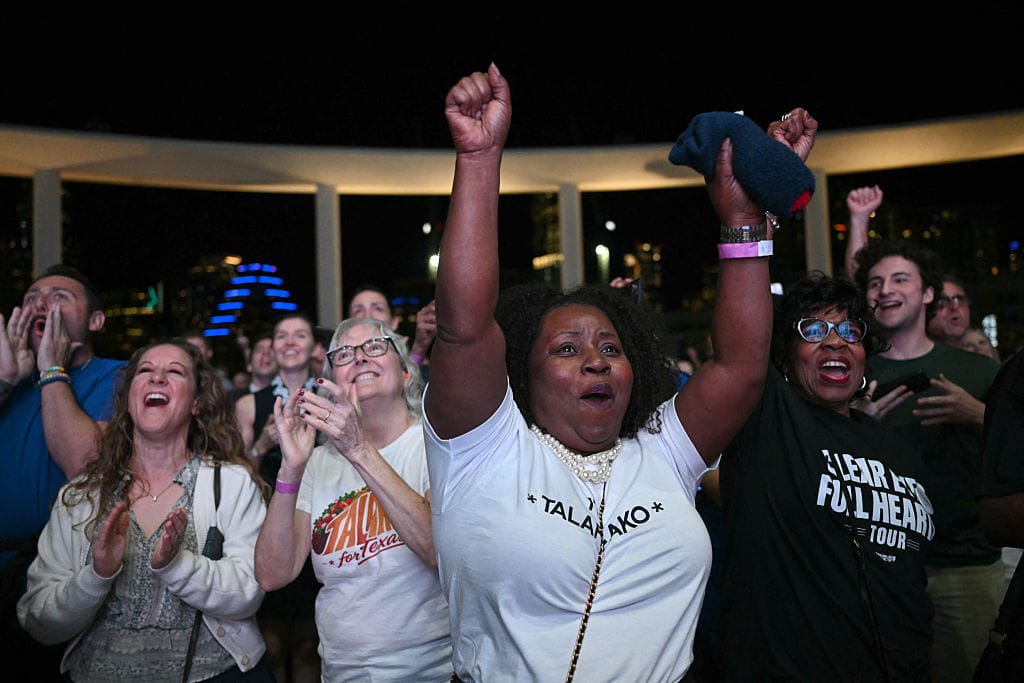
The once-inconceivable idea of a blue Texas was further bolstered by the election of progressive Democrat and newcomer James Talarico, who defeated Trump-approved Ken Paxton in the Senate race, ending a 38-year Republican streak.
Democrats also won other statewide races in Texas, including lieutenant governor, attorney general, comptroller, and railroad, land, and agriculture commissioner positions. Democrats also flipped the State House, taking control of the lower chamber of the legislature, and flipped several seats on the State Board of Education. While it’s too early to tell if the party will gain full control of the board, it will no longer resemble the Republican-dominated body that ushered in an Islamophobic rewrite of social studies lessons, mandatory bible readings in public schools, and the downplaying of slavery, according to the Texas Tribune.
North Carolina’s blue wave
In North Carolina, where every seat in the state General Assembly was up for grabs, voters flipped both chambers that Republicans have controlled for 16 years. In 2027, there will be 70 Democrats, 49 Republicans, and one unaffiliated representative in the House. On the federal level, North Carolina House District 5 results are so close they may require a recount. But potentially on the outs is longtime Republican incumbent Virginia Foxx, who has served in the House since 2005, winning by 18.9 percentage points in 2024. The 83-year-old election denier, known for inflammatory comments about LGBTQIA+ communities, appears to have fallen out of favor with voters in her district that includes Boone and Greensboro.
More broadly, Democrats also made considerable gains in the North Carolina Senate, where Democrat Roy Cooper was elected over Trump’s pick Michael Whatley, helping to bring the Republican supermajority to an end.
South Carolina upset
In a stunning South Carolina upset, voters in one of the most staunchly conservative states in the nation flipped a Senate seat for the first time in almost 30 years.
Democrat Dr. Annie Andrews beat Republican Darline Graham, who came strongly endorsed by Trump despite her total lack of legislative experience. Graham, who has held the seat since the death of her brother Sen. Lindsey Graham in July, announced that same month that she would seek a full six-year term.
In her victory speech on Tuesday, Andrews noted that the voters of South Carolina “sent a clear message that this Senate seat does not belong to one family, one party, or to Washington, D.C.”
Georgia “bloodbath”
The people of Georgia also delivered what The Atlanta Journal-Constitution characterized as a Republican “bloodbath,” ending decades of GOP dominance and reshaping the political landscape of the state.
Democrats won every statewide office, including races for lieutenant governor, secretary of state, attorney general, agriculture commissioner, insurance commissioner, state school superintendent, and labor commissioner. The party also gained unprecedented ground in the House, where incumbent Democratic Sen. Jon Ossoff kept his seat by defeating District 10 Rep. Mike Collins.
As the backbone of the nation’s Democratic coalition, Black women also experienced a historic night in Georgia, where they took some of the state’s highest offices for the first time. This includes the election of former Atlanta mayor Keisha Lance Bottoms, the first Black woman ever elected governor in Georgia and the first Democrat to capture the Governor’s Mansion in nearly 30 years.
Florida Democrats come close
Despite blue sweeps elsewhere in the South, Florida stayed red, though the margins were shockingly close. Democrats held their ground despite a 6-1 financial disadvantage and gerrymandering, ending Republican’s supermajority and giving a glimmer of hope for a 2028 blue wave. In a nail-biting night, Florida Democrats watched Senate candidate Angie Nixon and Governor candidate David Jolly hold leads for much of election night as early returns came in from across the state. But by the end of the night, Republicans had held both major statewide contests, with Byron Donalds defeating Jolly and Ashley Moody defeating Nixon.
“We brought together Democrats, Republicans, Independents—hell, a libertarian said he voted for me. Folks who never believed politics had anything to offer them,” said Nixon during her concession speech. “Because of the work you all did, we gave people something to believe in again. We reminded people that their voices matter, that their lives matter.”
Nixon also announced that she will run again in 2028.
Nixon’s person-to-person grassroots approach, combined with platforming populist economic policies, helped push the state left. But the loss raised questions about whether more investment from national Democrats could have changed the outcomes.
Donalds defeated Jolly by a slim margin of 107,686 votes. In the Senate race, Moody defeated Nixon with 50.9% to Nixon’s 48%, a difference of approximately 239,000 votes. South Florida also saw a remarkably close congressional contest. Donald Trump-backed Republican Rep. María Elvira Salazar narrowly defeated Democratic challenger Eliott Rodriguez in Florida’s 27th Congressional District, receiving 50.2% of the vote to Rodriguez’s 49.8%. The difference of just 1,116 votes triggered a recount.
For years, national Democrats have treated Florida as a lost cause, directing money and resources toward other battleground states as Republicans consolidated their influence. But Tuesday’s results may force the party to reconsider that strategy. Despite what Democrats have described as limited national investment, their candidates mounted competitive campaigns across the state.
Nixon’s campaign raised approximately $11.3 million and spent $8.1 million, compared to Moody’s $14.5 million raised and $13.7 million spent. The Republican Party of Florida provided approximately $643,000 in coordinated spending for Moody, while outside Republican-aligned groups spent roughly $4 million supporting her and millions more opposing Nixon. Specifically, including pending notices, the race saw $27.84 million in reported outside spending, of which Stronger Safer Nation, a pro-Ashley Moody group, reported $13.5 million in outside spending, including $10.46 million opposing Nixon and $3.05 million supporting Moody.
Meanwhile, coordinated spending by the Democratic Party of Florida in support of Nixon totaled just over $211,000. The Democratic National Committee and the Florida Democratic Party did not immediately respond to Prism’s request for comment.
No region better reflects the state’s shift left than South Florida’s Miami-Dade County and Doral. The two areas turned blue after voting for Trump in 2024. Democrats may be regaining ground among Latinx voters who played an important role in Trump’s gains in the region but have become disillusioned with current anti-immigrant policies.
New and blue
Nationally, Republicans woke up to a very different political reality, one where their stronghold on the South was no longer a guarantee. Part of the reason for this, according to experts, are the Latinx communities who are reshaping the region. These “swing voters” previously embraced Trumpism. For the midterms, Latinos harnessed their growing political power in a decidedly different direction, showing that their votes remain up for grabs.
Longtime Texas abortion rights activist Nancy Cárdenas Peña told Prism on Wednesday that she was still “reeling” from the profound impact of the elections in Texas, where Paxton sued to block federal emergency abortion protections and targeted outside providers for providing legal abortion medication to Texans.
“I never imagined I would see Texas turn blue in my lifetime and I’m excited to continue working to ensure people have access to abortion care,” she said. “One of the most powerful things we’ve been given—not just new and blue Texas leadership—is hope. This work is far from over, but in true Texas fashion, we’re going to celebrate these wins when we can get them.”
Editorial Team:
Sahar Fatima, Lead Editor
Carolyn Copeland, Top Editor
Rikki Li, Copy Editor
Alexandra Martinez
Filed Under: