Filed Under:
New documentary tracks the fight against the right-wing takeover of New College of Florida
In 2023, Gov. Ron DeSantis tried to reshape the progressive liberal arts institution. “First They Came for My College” explores what it means for higher education in Florida
Alexandra Martinez
Real journalists wrote and edited this (not AI). Independent, community-driven journalism survives because you back it. Donate to sustain Prism’s mission and the humans behind it.
Real journalists wrote and edited this (not AI)—independent, community-driven journalism survives because you back it. Donate to sustain Prism’s mission and the humans behind it.
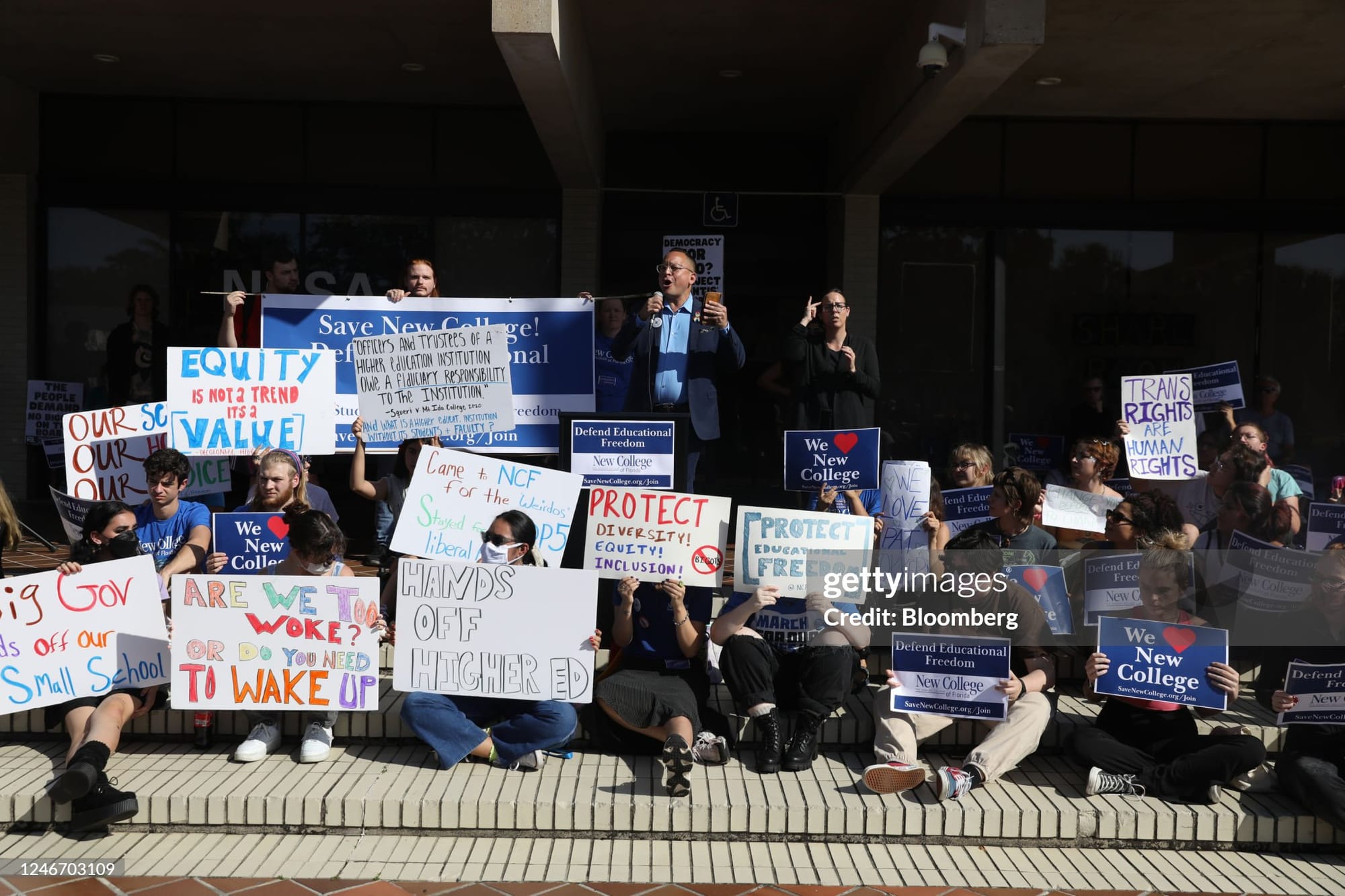
When Florida Gov. Ron DeSantis moved to reshape New College of Florida in January 2023, the takeover set off a sweeping transformation of an institution known for its progressive academic culture and welcoming environment for LGBTQIA+ students. The small public college in Sarasota offered a rigorous liberal arts education at an unusually affordable price. Its unofficial slogan captured that promise: “An Ivy League education for the price of a good stereo.”
“First They Came for My College” chronicles that transformation through the experiences of the students, faculty, and community members who lived it. The documentary captures the takeover’s devastating emotional toll on students and faculty as they fight to preserve the school’s traditions of academic freedom and open inquiry against a hostile backdrop.
For Harry W. Hanbury, one of the film’s producers and a New College graduate, the project is also deeply personal. He credits the school with helping shape his intellectual outlook and giving him the space to come out as gay. Ahead of a Nov. 7 screening at Subtropic Film Festival in Lake Worth, Florida, Hanbury spoke with Prism’s senior news reporter Alexandra Martinez about what New College meant to him. Hanbury also discussed how students helped tell their own stories, what the fight over the institution reveals about the broader assault on higher education, and why he believes collective resistance can be an antidote to despair.
This interview has been edited for clarity and brevity.
Alexandra Martinez: You graduated from New College in 1993. What was your experience like, and what made the school so important to you?
Harry Hanbury: My standard line is that New College saved my life. It gave me an amazing set of intellectual tools to make sense of the world, but it also helped me come out of the closet. I came from a Catholic all-boys military high school, and I was extremely conservative at the time. I had read pretty much all of Ayn Rand, I was a big Milton Friedman fan, and I came in ready to argue with people. But I never felt condescended to or ostracized. People were willing to engage me in conversation—often long into the night—and over time, my views changed pretty dramatically.
New College was extraordinarily welcoming to LGBTQ+ students, even before we had that acronym. It was also a remarkable academic environment. I got a degree in philosophy and sociology, and the school emphasized intellectual curiosity and mastery of a subject—instead of grades, we received written evaluations.
I found myself at a school with eight students for every faculty member, and faculty who had come from some of the best universities in the world because they wanted to teach in an environment dedicated to learning for its own sake.
Martinez: When did you realize the takeover was something you needed to document?
Hanbury: I think the first warning that this was an urgent issue was the date Ron DeSantis chose to launch his takeover: Jan. 6, 2023, the two-year anniversary of the insurrection at the U.S. Capitol. It was as if to say, “We couldn’t take over your country, but we’re going to take over this little school that is basically defenseless and show you what we can do.”
It became clear pretty early that this was a team of far-right education reformers who intended to radically change an institution we loved. Some people in DeSantis’ circle said they wanted to make New College the “Hillsdale of the South,” referring to Hillsdale College, a conservative institution in Michigan.
I’d made documentaries before, mostly short films, but I knew I couldn’t do this alone. It took a huge team, and really an entire community, to make this film. We were in the field for two and a half years and spent about a year editing. What we could do in the film was show people the emotional, lived experience of those going through this, especially the students.
We gave students iPhones with large hard drives so they could document their own stories. About 100 hours of the 300 hours of footage shot came from students themselves. They captured things that would be very difficult to convey in writing and that hadn’t been conveyed elsewhere.
I think the film helps people understand what it feels like when their programs are cut, their curricula are censored, and their educational environment is transformed around them. And it shows that people have taken action in response.
Martinez: How did you decide which students to follow, and what made their individual stories particularly important in telling the larger New College story?
Hanbury: We tried to give a representative sample of students. We started by filming the Catalyst, the student newspaper, which was really the nerve center of what was happening on campus. Professor Maria Vesperi, an anthropology professor who had been the Catalyst’s faculty adviser for 29 years, allowed us into her journalism class. We filmed dozens of those classes, which gave us an extraordinary vantage point on campus life.
We also filmed students putting on “The Rocky Horror Picture Show,” working in the food forest and garden, and participating in other parts of campus life.
One of the most interesting stories was that of Josh, a very conservative student who had arrived prepared to do battle in the culture war. He’d written about how he was going to take on the people he saw as his ideological opponents. But he discovered that the students he’d previously demonized were interesting, curious people who wanted to talk about film and philosophy.
He went through a pretty profound transformation. He became involved in theater productions, including Shakespeare, and formed friendships with students he might never have expected to connect with.
That was important to us because we wanted to show the complexity of the community, not simply divide everyone into opposing camps.
Martinez: The film also captures the chilling speed with which a campus culture can change. What was it like to witness that transformation as an alum?
Hanbury: It was deeply personal. New College was the place that, more than any other experience in my life, made me who I am. To have people come in and say that place was all wrong was painful.
When I first returned to campus, I walked into the Gender and Diversity Center. It was a big, comfortable room filled with books and sofas, furnished and built up by generations of students and professors. I immediately knew it was on the chopping block.
I’ve never had this experience before, but I just started sobbing. I felt pride and gratitude for all the work that had gone into creating a space that hadn’t even existed when I was a student. I wished I’d had it then. My life would have been easier and more comfortable.
Ultimately, the administration destroyed it during the summer, when students were away.
These weren’t just administrative changes. They were attacks on the spaces, relationships, and traditions that made the college what it was.
That moment captured what was at stake. These weren’t just administrative changes. They were attacks on the spaces, relationships, and traditions that made the college what it was.
Martinez: The documentary shows students responding to the takeover in different ways, from openly confronting administrators to trying to maintain relationships across ideological divides. What did you learn from watching those responses unfold?
Hanbury: One of the things I found most meaningful was the experience of collective resistance. I’ve made films about social movements before, but I’d never been part of a naturally arising social movement in this way. It was like turning lemons into lemonade. Even in the middle of something painful, people found meaning and joy in working together.
One of the biggest things I want people to take away from the film is that joining forces with others can be an antidote to despair. So many people are trying to do good work to protect our democracy from authoritarian attacks. When you link arms with them and get involved, it can be deeply gratifying and even fun.
That’s one of the reasons the New College community’s response matters. The students and faculty didn’t simply roll over and give up. They pushed back with their creativity and spirit, and I hope that inspires people at other schools to do the same.
Martinez: How much has New College changed since filming began, and is there hope that it could return to its former identity?
Hanbury: It’s almost as if there are two schools at New College now. There are remnants of the old school: professors who are still trying to uphold its best ideals, defend academic freedom, teach about gender and LGBTQ+ issues, and tell the truth about race and racism.
There’s also a story of resistance that has helped hold the line. Students and faculty have pushed back. There have now been four alternative graduations—we chose not to include footage of them in the film, partly because we couldn’t cover them as fully as we’d have liked and partly because it would have given the film two endings. We ultimately had to make difficult choices about what story we could tell in the time we had.
I completely understand the people who decided to leave for other states or leave academia altogether. Those were incredibly difficult decisions. But I also want to celebrate the people who stayed and tried to preserve the best traditions of the school.
It’s possible that New College as we knew it will be gone forever. But I think the ideas of New College—the vision of higher education that was defended and upheld there for six decades—will live on. I don’t think it’s out of the question that New College itself could be revived, but Florida and the country will have to change quite a lot for that to happen.
Martinez: What do you hope audiences understand about the broader political significance of what’s happened at New College?
Hanbury: What happened at New College is a microcosm of what’s happening in our society. Institutions that have played important roles in public life are coming under destructive attack.
The film shows how quickly an institution can be transformed when political power is used to target it. It also shows that these attacks are not inevitable and that resistance can be effective.
One example that has stayed with me is the organizing that took place after the Trump administration proposed its Compact for Higher Education. Universities pushed back, and none of the nine institutions initially asked to sign it did so. That kind of resistance matters because it demonstrates that the people attacking higher education may be less powerful than they want us to believe.
Grace Keenan, a student who served as a representative on New College’s board of trustees, put it beautifully when she reflected on the experience: “We greatly overestimated them, and they greatly underestimated us.”
Martinez: What can people do if they want to resist attacks on higher education in their own communities?
Hanbury: Our website has a take-action page with dozens of ideas. Faculty members can get involved with the American Association of University Professors. Students can join or build organizations, organize on their campuses, and find creative ways to make their voices heard.
When I was at New College, I was a member of ACT UP, and I remember the famous pink triangle poster with the slogan, “Silence equals death.” Underneath it was the line, “Turn your anger, grief, fear into action.”
I want them to understand the magnitude of the assault on higher education, but also to see that they have a chance to defend against it.
That’s my biggest hope for this film. I want people to see it and recognize that what happened at New College could be their future. I want them to understand the magnitude of the assault on higher education, but also to see that they have a chance to defend against it.
The students and faculty at New College showed that you can fight back, preserve important traditions, and make a difference, even when the odds seem stacked against you. I hope people carry that lesson with them.
Editorial Team:
Sahar Fatima, Lead Editor
Carolyn Copeland, Top Editor
Lauren Hardie, Copy Editor