Filed Under:
A free speech fight is playing out on college campuses where student radio stations are disappearing
Cleveland State University’s recent transfer of its radio station’s broadcast license to a conglomerate is the latest blow to independent student media

Britta Shoot
Real journalists wrote and edited this (not AI). Independent, community-driven journalism survives because you back it. Donate to sustain Prism’s mission and the humans behind it.
Real journalists wrote and edited this (not AI)—independent, community-driven journalism survives because you back it. Donate to sustain Prism’s mission and the humans behind it.
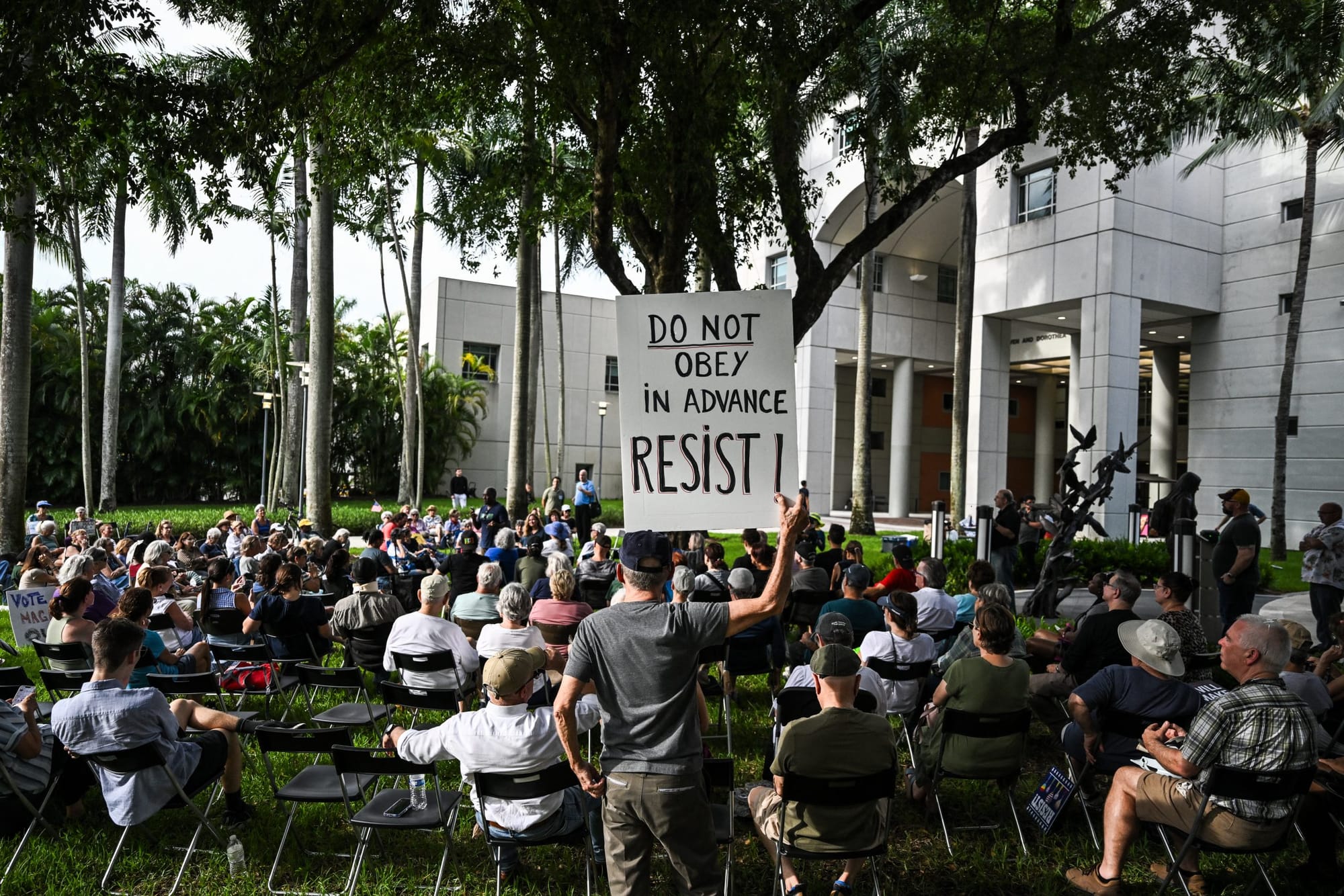
Campus police escorted student staff out of Cleveland State University’s campus radio station on the morning of Oct. 3, 2025. The day prior, as part of a closed-door agreement, university administrators transferred control of the station’s programming to Ideastream, a public media conglomerate that operates numerous radio and television stations in northeastern Ohio. Protests in support of the students erupted not long after.
Students had run Cleveland State University’s independent campus station WCSB 89.3 FM for nearly 50 years. The shutdown came on what happened to be World College Radio Day.
Brian Bardwell, the lawyer representing WCSB’s former student staff and alumni, said university administrators mishandled the agreement that transferred programming control to Ideastream, among other allegations included in a lawsuit filed in January. Broadly, the suit accuses the university of taking away students’ right to free speech and making the Ideastream decision without public comment or debate.
“We filed the lawsuit shortly after the university shut down the station, stole the students’ property, and threatened to arrest them if they came back,” he told Prism.
The WCSB license handoff happened at a time when Gen Z students are fueling a passionate resurgence in college radio. One recent analysis of music discovery trends found that people ages 16 to 24 are turning away from algorithm-driven music services. Instead, they are cultivating third spaces based on a shared love of music and terrestrial radio, or traditional AM and FM broadcasting from ground-based towers.
Eclectic, human-created radio programming is made possible not just because of student devotion, but also because many campus stations house irreplaceable collections of physical media. For example, Cleveland was once considered the city with the second-largest Hungarian population after Budapest, and WCSB was home to thousands of Hungarian records, a culturally significant collection regularly played during the station’s long-running “Hungarian Hour.”
What troubles experts about Cleveland State University’s campus radio station and similar situations is that, similar to other extirpations, losing a license is often final. FM bandwidth is finite. Once a license is transferred or relinquished, it is almost impossible to reclaim or repurchase. The case of WCSB is part of a simmering, troubling trend that serves as a warning to students who are in for a major fight if they want to save independent campus radio.
College radio as a bellwether
Campus radio formally began with the Communications Act of 1934, which established the Federal Communications Commission (FCC). In 1948, the FCC introduced 10-watt FM broadcast licenses to encourage the expansion of educational broadcasting. At such low power, these licenses effectively limited a signal’s range to a high school or college campus. As FM radio grew in popularity, more educational institutions invested in licenses.
According to Katherine Rye Jewell, a historian of college radio in the U.S., by 1967, colleges and universities operated 200 educational FM signals. Campus radio stations became a magnet at high schools, community colleges, and universities, attracting a wide array of young people interested in journalism, sports, and sound engineering. Some stations have hundreds of students working on programming.
When the FCC stopped granting 10-watt licenses in 1978, another era of college radio began. Previously low-power signals either expanded in range or consolidated with other public broadcasters, most notably National Public Radio (NPR) stations.
In a way, this consolidation continues today.
When campus radio stations’ FM broadcast licenses are sold or transferred, communities lose media made by and for young people—programming that is full of flaws, irregularities, and the experimental weirdness imbued in the very experience of being a college student.
When campus radio stations’ FM broadcast licenses are sold or transferred to popular NPR affiliates, campuses and communities lose media made by and for young people—programming that is full of flaws, irregularities, and the experimental weirdness imbued in the very experience of being a college student.
College students, often living away from home and free from parental supervision for the first time, need space to process and share how they’re experiencing the world on their own, according to Bardwell.
“That experience creates really weird, really great stuff,” he said. “Nobody has to like it, but nobody has to listen to it. We should still have a space carved out for that, and you’re never going to get that by handing over airwaves to a corporate entity.”
The challenge, Bardwell said, is that a lot of people who care about student broadcasting, student-run radio, and free speech are not inclined to be angry at NPR or local public media. However, Cleveland residents are universally opposed to the university’s actions, noting that the WCSB license transfer is part of a trend of regional media consolidation. In 2021, Ideastream entered a similar agreement with Kent State University’s WKSU 89.7 FM, another station formerly operated by students.
In recent years, there have been so many transfers and sales of legacy campus station licenses, it can be hard to keep track. Campus radio losses often happen quietly, noticed mainly by devotees who study these increasingly rare organisms.
In 2025, Des Moines Public Schools sold the 70-year-old KDPS 88.1 FM to a conglomerate operating over 100 stations that broadcasts religious programming. Also last year, Eastern Washington University sold its 75-year-old station license, KEWU 89.5 FM, to an oldies music preservation group. In 2021, Indiana’s Purdue University transferred the license for WBAA 101.3 FM, the state’s oldest continuously operating station, to a public broadcasting company.
Making the atmosphere more challenging is the impact of the second Trump administration on everything from the independent media landscape to enrollment and free speech issues at higher education institutions in the U.S. College radio is uniquely positioned at the nexus of free speech, student activities, and federal oversight and interference.
Administrators are choosing to attack culturally vibrant, low-cost campus radio stations as student enrollment is down nationwide, with a particular dip in international students fueled by visa restrictions. Lower enrollment can cause lower tuition and student fees, which impacts funding for student activities. Furthermore, there have been severe crackdowns on campus protests at schools across the country. In response, some colleges are defunding student newspapers.
At the same time, public media is also facing major funding cuts. In 2025, the Corporation for Public Broadcasting (CPB) announced that it would cease operations, following U.S. Congress defunding the 58-year-old organization established by the Public Broadcasting Act of 1967. Because of the enduring popularity of PBS and NPR stations, which are largely supported by the CPB, industry officials and the public decried the nonprofit’s defunding and closure.
What was given considerably less attention was how the end of the CPB impacts student media, especially campus radio stations.
Anabella Poland is the general manager of WMSC 90.3 FM at New Jersey’s Montclair State University. She also serves as president of the board of College Broadcasters Inc. (CBI), an organization focused on furthering educational and professional opportunities for students active in high school and college terrestrial radio. At age 22, Poland came to the U.S. from Argentina, “where things were not so kind to journalists that cover the truth of corruption,” she said.
Poland’s mission is training students to become ethical journalists while adhering to the FCC’s broadcasting standards. Accidentally broadcasting obscenities can result in high federal fines, for example, whereas printing offensive content in a student newspaper may not jeopardize the paper’s existence. It’s the weight of on-air regulations and responsibilities that makes FM broadcasting such a rich educational environment. Unfortunately, she said, “Experiential learning outside of a college radio station is harder to come by.”
That’s why it’s invaluable that her radio students cover critical stories in the region, such as the ongoing crises inside—and protests outside—the Delaney Hall detention center in nearby Newark, New Jersey.
Sean McDonald serves as CBI’s board treasurer and is the director of Neumann Media, the radio and television department at Aston, Pennsylvania’s Neumann University. He noted that student activities fees often help fund station operations, though the actual value produced by student media budgets can be unclear.
“Not all numbers tell the same story,” McDonald said, noting that decisions to get rid of student-run radio stations have ripple effects on campus and among alumni. For example, radio stations are part of student recruitment and retainment, as well as fundraising. Even if the absolute value is difficult to quantify, McDonald said losing these assets affects campus culture.
Bardwell added that similar to other campus stations, WCSB had long organized its own fundraisers, bringing in tens of thousands of dollars annually to help cover operating costs, which included making up potential losses following the dissolution of the CPB.
Media deserts and irreplaceable culture
License transfers and consolidation begin but rarely end on a campus. Experts note that selling a building is one thing. While expensive, it’s possible to reacquire property. McDonald explained that trying to buy a tower and frequency again in a crowded media market can be difficult, if not impossible.
When local media outlets dissolve or consolidate, communities can lose sources of locally produced news and information, resulting in media deserts.
Since the 1960s, Grinnell College station KDIC 88.5 FM has served Central Iowa. In August 2020, a derecho toppled the station’s tower, which remained without repair for several years. In the meantime, the FM broadcast license lapsed. In 2024, Hayden Suarez-Davis took over as general manager, but by then KDIC had become an online-only station.
“In a small town in particular, local radio is unique and powerful,” he said. If administrators maintained KDIC’s FM license, Suarez-Davis said he would have programmed more public information news during drive time as well as farm reports and other local news. The town of Grinnell also recently lost its one remaining local station when KGRN 1410 AM ceased broadcasting this past June.
While not every station holds media collections as unique as WCSB’s Hungarian music archive, many play an important role on a wider cultural scale.
Campus stations have historically offered a jumping-off point for DJs, musicians, and bands. College radio has long been where beloved artists find and cultivate their fanbase, and in turn, college radio station listeners fuel the rise of major acts and sometimes even entire genres.
In New York City, Columbia University’s WKCR 88.9 FM was the early home of the influential “Stretch Armstrong and Bobbito Show,” which ran from 1990 to 1998, the year The Source magazine named it the “Best Hip Hop Radio Show of All Time.” Artists such as Public Enemy’s Chuck D, who was a DJ on Adelphi University’s WBAU 90.3 FM, credit college radio as part of their creative formation.
College stations have also been essential to the rise of bands such as R.E.M. and Nirvana, a symbiosis so powerful that Geffen Records released Nirvana’s “Nevermind” on Sept. 24, 1991, when most colleges would be back in session.
Chris Walla, the founding songwriter and guitarist for rock band Death Cab for Cutie, initially attended Central Washington University in Ellensburg, Washington state, where he was a DJ at what was then KCAT 91.5 FM and is now KCWU 88.1 FM.
“It was there that I first heard so much of the independent music that made my own musical impulses seem possible,” he told Prism in an email. When he dropped out of college and moved to Bellingham, he gravitated toward Western Washington University’s KUGS 89.3 FM, which he called a “social hub.” There, he sat in on shows that his future bandmates were DJs for and eventually used the station’s resources to record Death Cab for Cutie’s early demos.
In her 2023 book, “Live From the Underground: A History of College Radio,” Jewell described how Massachusetts Institute of Technology students in Cambridge claim to have broadcast the first punk radio programs on WMBR 88.1 FM, a station still known for live broadcasts of punk shows.
Jewell’s book was inspired by her alma mater, Vanderbilt University, selling its broadcast license for WRVU 91.1 FM to Nashville Public Radio in 2011. WRVU was a place of belonging for students who didn’t fit into Vanderbilt’s narrow, conservative culture, she told Prism, and the sense of community contributed to the outrage at its sale.
“WRVU had fantastic reach across Nashville and had numerous established community programs, which gave students not only a lot of good experience doing radio but also in seeing how radio could function as a community institution,” she explained in an email. “Vanderbilt often had a reputation as being closed off from greater Nashville, but the radio station was one key point of connection. The sale felt like not just a betrayal of former DJs, but of the community who depended on the radio signal for service they couldn’t get on commercial radio.”
Many college radio stations retain vast stores of media on computers. Grinnell College is famous for its free concerts, often booking international acts and drawing concertgoers from neighboring states. KDIC’s computers contained irreplaceable digital promos, interviews, and other recordings from artists and acts that had visited the station over the decades, a trove of archival media now perhaps lost forever.
Institutions relinquish a key way to connect with the areas and communities in which they reside when they sell these signals.
Katherine Rye Jewell, historian of U.S. college radio
“Institutions relinquish a key way to connect with the areas and communities in which they reside when they sell these signals,” Jewell said. “Radio is a way to develop local community connections, as well as a way to provide forms of radio that are not often available.”
Even though he managed an online-only station rather than a terrestrial signal under FCC regulation, Suarez-Davis still had the rare experience of overseeing the work of fellow students and even friends.
“You learn a lot that way,” he said, explaining the balance of managing and working alongside peers. “You’re thinking on your feet a lot, and managing a lot of people with vastly different experiences and tastes,” he said.
Suarez-Davis credits his time in college radio with landing his first job, a role with a podcast agency in Los Angeles. “That shared experience [in college radio] allowed me to meet a lot of people,” he explained.
These are opportunities Cleveland State University students will no longer have access to. The week before the new license agreement with Ideastream took effect, students’ keycards to the WCSB studio stopped working.
Jewell said that at Vanderbilt’s WRVU, the administration began winding down the station by first letting go of volunteer community DJs before moving on to staff affiliated with the school.
Institutions of higher education are supposed to promote seeking knowledge and support cultural creation, the historian said, but “cutting off radio service severs a key place for innovation.”
As a member of multiple bands bolstered by college radio, Walla said that campus stations rally people together. “An approachable college radio station, in close community with local artists, is gold,” he said. “It gives everyone a sense of purpose, a thing to aim for or support, whether you’re a DJ or a band or a listener-slash-fan.”
Poland acknowledged that the nation’s thousands of college radio students may not ultimately pursue full-time careers in broadcasting or audio production, but a well-rounded education isn’t always about where you end up professionally.
“[College radio] is a pathway to cultivate [yourself] as a person, for you to find out who you are, to find your voice, to be a critical thinker, to multitask,” she said. “The things that you learn in college radio while you’re having fun with your friends are transferable to pretty much any career that you have.”
Editorial Team:
Tina Vasquez, Lead Editor
Carolyn Copeland, Top Editor
Rashmee Kumar, Copy Editor