Filed Under:
In Gaza, even going to class can be deadly
After losing a long stretch of education to war, a Palestinian university student returned to class only to flee an Israeli strike that killed three
Caitlin Gaffin
Real journalists wrote and edited this (not AI). Independent, community-driven journalism survives because you back it. Donate to sustain Prism’s mission and the humans behind it.
Real journalists wrote and edited this (not AI)—independent, community-driven journalism survives because you back it. Donate to sustain Prism’s mission and the humans behind it.
I woke up early on the morning of Oct. 25, 2026, to attend a lecture at the Islamic University of Gaza. This was the first semester we were studying in person since the war began in 2023. Despite how mentally and physically difficult it was to reach the university in Gaza, I decided to keep attending my lectures after being deprived of our education because of the war.
Earlier this month, while at a university lecture, the sound of Israeli drones grew louder than my professor’s voice. In Gaza, when we hear intense aircraft activity, we know a strike is coming. A classmate next to me said, “What is stopping Israel from bombing the university over our heads? If they bombed al-Ahli Hospital and other hospitals, then bombing a university full of students would not be difficult for them either.”
I didn’t say anything, but I kept thinking about what he said. Then my thoughts were interrupted by the sound of a nearby strike. The students in the classroom were distracted for a few seconds, but then the professor continued with the lesson, and we turned our attention back to him. After class, I learned that the strike had targeted a car on the main road and two female students from Al-Azhar University were injured.
On Oct. 25, I was scheduled to attend a 9 a.m. lecture. I arrived at the university late because of difficulties with the local roads. I passed the site previously targeted by the drone strike and then made my way to the classroom for the lesson. As the class began discussing the course material with our professor, a loud and powerful explosion shook the room. We saw flames, and then glass began falling on us.
There were around 60 students in the classroom. Everything happened so suddenly that I didn’t understand what was going on. We heard screams and calls for help outside. Chaos spread through the classroom. Some students threw themselves under the plastic desks, while others, like me, stood frozen in shock, not knowing what to do.
It took us a few seconds to process the bombing. A classmate, who at first sat frozen, was now calling for his sister, who had a class in the building next to ours, a few meters closer to the explosion.
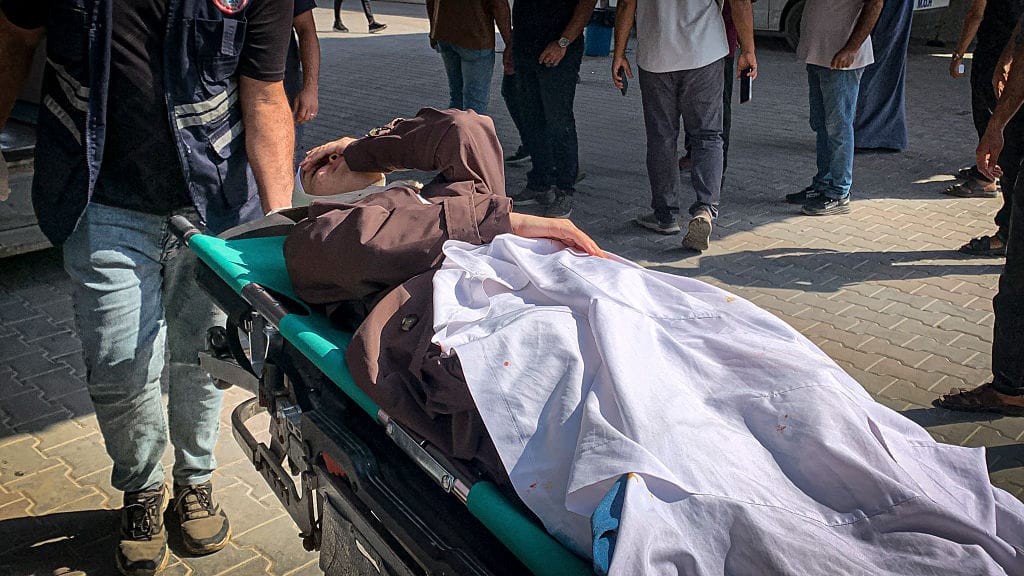
We left the classroom and went down to our building’s entrance, where we found ourselves at the site of the strike. There were many injured people. I saw a female student being carried away on a stretcher. The strike hit an area always packed with students waiting for their classes to begin.
Before we were told to evacuate the area, one of the students standing around asked, “What danger do 20-year-old students pose to the occupying state?”
I followed the evacuation order and left the university. My classmate later learned that his sister was safe, but shortly after we left, the same location was struck again, killing three university staff members.
This was not the first time Israel bombed the Islamic University of Gaza. All of its buildings were targeted during the first days of the war, and only four remained. Israel also targeted several university academics, including physicist and Islamic University of Gaza President Sufyan Tayeh.
That morning, I went to university because I did not want to lose another day of my education. The war had already taken a year from me, and I was trying to make up for what I lost. I went to class to learn something new and to take another step toward the future I still hope to have. I never imagined that I would end that morning running for my life.
I keep thinking about how ordinary that morning was. We were students sitting in a classroom, listening to our professor, discussing our courses, and thinking about our exams. In a matter of seconds, we were looking for somewhere to hide. We were simply trying to study, yet we feared for our lives.
I still want to have a future, and I want to finish my degree. But after the bombing, I don’t know how I am supposed to build that future if I am not even safe sitting in a university classroom. We have all lost so much time to this war, and we don’t want to lose our education, but we shouldn’t have to risk our lives in pursuit of it. Going to university should be a step forward, not something that could cost us our lives.
Editorial Team:
Lead Editor, Carolyn Copeland
Top Editor, Tina Vasquez
Copy Editor, Lauren Hardie