Domestic workers have secured landmark protections, but claiming them remains a gamble for immigrants
The National Domestic Workers Alliance helps nannies, house cleaners, and home care workers with labor rights, but enforcement is elusive and migrant workers remain vulnerable

Nathalie Levey
Real journalists wrote and edited this (not AI). Independent, community-driven journalism survives because you back it. Donate to sustain Prism’s mission and the humans behind it.
For seven years, Teresa tended to another family’s children inside a Manhattan home. She now calls it the worst job of her life. They kept meticulous logbooks of the hours she put in, an unwitting manifestation of a household that tallied everything and answered for none of it.
Teresa first began working in Mexico when she was 13 years old, yet in all those years, no employer wore on her like this one. It was the family’s rule that she could not even speak to the other nannies at the playground. So through long afternoons she was mostly mute, laughing without a word and saving what she wanted to say for when she was out of sight. And beneath this stranglehold, the family wasn’t even paying her what she was owed.
Help arrived when a friend mentioned that the National Domestic Workers Alliance (NDWA) ran free training sessions for nannies. There, she learned a worker holds incontestable rights no matter their immigration status. And she realized the family’s ongoing pattern of underpayment was wage theft. Organizers told her she could fight back, but a claim lives or dies on proof through documentation of hours worked, cash receipts saved, and money exchanged as it passed from their hands to hers.
Then she remembered the logbooks.
“It occurred to me to grab the books without permission, knowing that they trusted me,” she said. “I took them home, took copies for the years I was there, 2017 until 2024. Then I returned the books to their place and didn’t touch anything else.”
“That’s been my most powerful weapon now to confront them,” she said.
Teresa, who is using a pseudonym for fear of retribution, moved to New York in 2003 and has made her living through housecleaning and childcare, which enabled her to put her own children through private school in the U.S. She knew the wealthy family whose logbooks she copied could destroy her, and she dreaded going to court, but she persevered with her claim “to show that it can be done.” Her former employer even agreed to an early settlement until the family’s lawyer went silent, forcing Teresa’s attorney to bring the case before a judge.
Teresa is one worker living through a pivotal moment for American domestic work, a national reckoning about whether existing protections translate into substantive security. Over the past 15 years in cities and states across the East Coast, nannies, house cleaners, and home care workers have secured once-impossible protections that promise minimum wage, written contracts, and safeguards against retaliation. But while these rights have been codified, exercising them safely is a fraught prospect for those whose livelihoods are jeopardized once they speak out.
Marrisa Senteno, director of NDWA’s New York chapter, has spent a decade building New York’s enforcement program, and recognizes that a statute does not guarantee instantaneous progress. “A law being passed isn’t a magic wand. You pass it, and things don’t just appear,” she said.
For immigrant workers, a household withholding wages can resort to more dangerous forms of retaliation, weaponizing their legal status to sidestep accountability. Nicole Kligerman, who founded the Pennsylvania chapter of NDWA in 2018, has witnessed a single reprisal hush an entire workforce. “That happens to one person, and everybody knows about it immediately,” she said. And when the city is sluggish in its investigation and a claim stalls, Kligerman added, “that’s a real chilling effect.”
Changing the definition of workplaces
When New York passed the country’s first Domestic Workers’ Bill of Rights in 2010, the measure was billed as a national model for bringing labor law into the private home. The state’s domestic workforce—roughly 328,000 people in 2021, 63% of them immigrants and 92% women—gained overtime pay, a weekly day of rest, and protection from harassment. But six years later, Senteno could count the claims filed under the law on one hand, and she recalled state officials concluding, “Well, there must not be cases.”
Enforcement at the state labor department is complaint-driven, Senteno said, meaning an investigation typically begins only when a worker comes forward. Isolated inside their employers’ homes, domestic workers rarely have someone who can help them recognize a violation as it happens, and many have “zero knowledge” of how the process works to file a complaint, Senteno explained. Excluded from the National Labor Relations Act, domestic workers have no federally protected right to unionize, meaning there’s no shop steward to confide in or union meeting to air grievances.
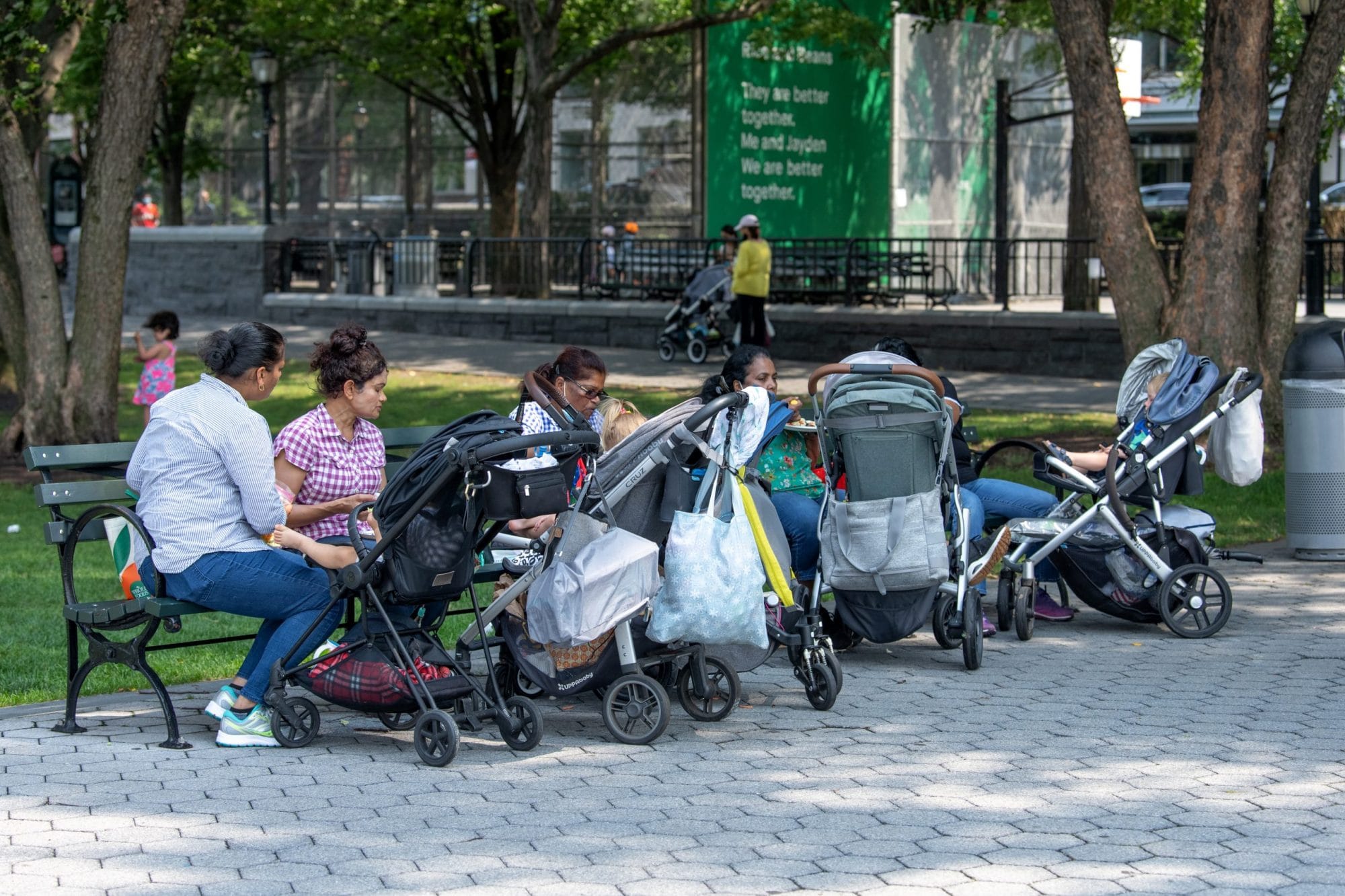
So Senteno’s New York City chapter of NDWA set out to find the communal spaces where nannies and housekeepers already cross paths, settings where word of a missed overtime payment or a successful claim could pass from one worker to another. “Let’s change the definition of workplaces,” she suggested. “Those are the parks. Those are the libraries. Sometimes it’s a laundromat.” The chapter then trained domestic workers as enforcement fellows—using a curriculum Senteno likened to “law school 101”—and sent them out to do the talking, guided by the program’s mantra that “workers know each other the best.”
Leydis Muñoz is a member of NDWA’s NY-based enforcement program and a former fellow. She spent 18 years as a nanny and finds that workers rarely want to pursue a claim against a current employer because they fear losing steady work. Some employers retaliate online, posting photos beside warnings to other families and making allegations against specific workers. Muñoz now combs social media to reach those pictured. And for many, the Trump administration has sharpened a deeper fear tied to their immigration status. “If you don’t want to do it right now, it’s OK,” Muñoz tells them. “But now let’s prepare you … so when you are ready, you are ready to move.”
Even with this support, a worker filing a claim must still face the household they are accusing. Typically, a legal service provider reviews the worker’s case and sends the employer a demand letter laying out the violations they found. Once that letter arrives and the employer realizes someone is holding them accountable, Senteno said, their “shame and embarrassment turns immediately into anger,” which bears down on the worker through phone calls, texts, and threats until they are “paralyzed.”
Teresa’s employers tried stonewalling her well before she filed a complaint, when she returned after a brief job elsewhere and requested a written contract. “They told me, no, no contract. We know each other,” she recalled, and she let it slide. Once she took records to NDWA, the organization connected her with a lawyer, who found the family had recorded their own theft.
“A law is nothing without its enforcement”
The challenges domestic workers face in labor disputes aren’t unique to New York.
In Washington, D.C., Mayor Muriel Bowser’s fiscal year 2027 spending plan proposed wiping out the attorney general’s grants to community groups, including NDWA’s DMV chapter, which serves the D.C. metro area. The suggested cut seems to be due to a drop in revenue. “That’s the only explanation that we really have,” said Alana Eichner, the DMV chapter co-director. “But everything about a budget is a choice.” By June, after a vigorous campaign by grantees, the D.C. Council’s Committee on the Judiciary and Public Safety restored the full $1.1 million to its budget recommendations.
The grants were seeded in 2018, when legal aid lawyers challenged a nanny’s firing over her pregnancy and discovered the District’s Human Rights Act shielded all employees from discrimination “except domestic servants.” Organizers spent four years fighting to purge the statute of language Eichner referred to as “archaic, racist, and sexist.” Finally, in 2022, the District passed a measure requiring employers to provide domestic workers with a written contract and establishing a program in the attorney general’s office to help enforce the new law.
But asserting that right can be a delicate maneuver, so DMV organizers rehearse with workers how to request a contract. Some workers assure organizers they asked, Eichner said. “And then we find out later, they actually did not do it.” The specter of backlash silences them, she explained, and all the more since the federal takeover of the city’s police in August 2025 and the surge in immigration enforcement that followed. Eichner recalled a worker who asked to be paid for all her hours, only to have her employers invoke her undocumented status and threaten to call Immigration and Customs Enforcement (ICE) if she kept pushing.
Though New York pioneered the Domestic Workers’ Bill of Rights that was replicated in DMV, Senteno said she now takes her cues from Philadelphia.
Kligerman’s chapter there retooled the city’s labor enforcement mechanism after Philadelphia’s 2020 Domestic Worker Bill of Rights proved too lax. At the time, workers took complaints to the city’s Office of Worker Protections, where an employer found to have stolen wages only had to repay them, with little in the way of fines or damages. Among those it failed was an undocumented Black Caribbean nanny in one of the city’s wealthiest, whitest neighborhoods. The nanny asked to negotiate a contract with her employer, and she was fired on the spot, then blacklisted through word of mouth and social media. The nanny waited months for word on her complaint, Kligerman recalled. “A law is nothing without its enforcement,” she said.
The worker-led overhaul arrived in 2025 with the POWER Act, which was passed unanimously and covers 750,000 Philadelphians. Sponsored by Councilmember Kendra Brooks, a former domestic worker herself, the law allows the city to open investigations without waiting for a complaint, pays damages directly to those harmed, strips repeat violators of business licenses and city contracts, and enters them into a public “Bad Actors” database.
From there, Brooks and Councilmember Rue Landau led the charge to address the Trump administration’s immigration crackdown directly, helping to pass the “ICE Out” package by a veto-proof majority. The package of seven bills restricts federal immigration enforcement in the city. Six of the bills went into effect July 7, though a lawsuit from the Trump administration halted one that banned the use of face coverings by ICE agents and law enforcement.
“There’s not a functional distinction between worker injustice and immigration injustice,” Kligerman said of the city’s efforts to limit immigration enforcement.
“A care provider is not a lawnmower”
In the South, winning labor protections for low-wage workers remains painfully slow.
Jewel Gatling, who grew up in Portsmouth, Virginia, remembers her grandmother heading out to clean houses whenever a child fell sick, or the family needed extra income. Gatling now organizes for Care in Action, NDWA’s political affiliate in Virginia—a state that did not extend the minimum wage to domestic workers until 2020 and that still denies live-in workers any overtime protections.
A bill to address that gap, guaranteeing domestic workers time and a half for every hour beyond 40 a week, passed both chambers with bipartisan support in 2024 and 2025, but Virginia Gov. Glenn Youngkin vetoed it both times. His second rejection simply copied and pasted the explanation from his first. “Not a comma was different,” Gatling said.
This year, Gov. Abigail Spanberger finally signed Senate Bill 28 into law, though its protections won’t take effect until July 2028—and only if the 2027 legislature reenacts it. To strip the bill of any fiscal impact and smooth its passage, advocates carved out home care workers paid through Medicaid, counting on a separate collective bargaining proposal to give them a path to overtime, though Spanberger vetoed that measure. The outcome especially stings for Gatling, whose organization knocked on doors to elect the officials who delivered it. “We value you for your endorsement,” she said. “We value you for pictures and photo ops. But we’re going to give you a pat on the head and ask you to still wait.”
If you lived on the property, they see you as property. A care provider is not a lawnmower. A care provider is not a washing machine. They are a person. Jewel Gatling, Virginia Organizer for Care in Action
“This is where the first enslaved landed,” Gatling said of Virginia. “If you lived on the property, they see you as property. A care provider is not a lawnmower. A care provider is not a washing machine. They are a person.” Immigrants face an added hazard, she noted, as some employers “will absolutely use immigration status to manipulate workers,” a tactic lawmakers banned in the same session. “It’s just now … you have an environment that condones it.”
Starting in 2023, workers who stood up to such employers could turn to the Department of Homeland Security’s Deferred Action for Labor Enforcementprogram, which granted more than 7,700 immigrants involved in labor investigations temporary deportation relief and work permits. However, last year the Trump administration scrapped the program without public notice.
Even if people have never hired a domestic worker, Eichner believes that caring about their labor rights is part of a well-functioning democracy. “If you have a society where people’s rights are regularly being violated, and laws are not being enforced, that undermines your whole society,” she said. “There are many, many laws that end up only existing on paper.”
In October, NDWA confirmed Teresa’s case had been resolved, though it did not share the terms. She kept a personal ledger of what the ordeal was worth. “Winning the case is important, but the most important part has been learning how to use my voice, being heard, and pursuing my justice,” she said. “Whatever comes from that verdict, the money isn’t the goal.”
Teresa said that word has spread among nannies in Brooklyn that families are bringing in childcare workers from countries such as Colombia, El Salvador, and Mexico on live-in contracts for a fraction of the standard rate. She said she met one earning just $5 an hour. “That’s robbery,” Teresa told the young woman, offering to introduce her to NDWA. But the worker declined, wary of burning a bridge with the only people she had in the country.
“I wish they would open their eyes,” Teresa said.
Nathalie Levey
Filed Under: