Black and queer groups fill the gap in Kentucky as Trump cuts food aid
As the Trump administration’s SNAP cuts deepen food insecurity in Kentucky, mutual aid organizations step up to feed neighbors while warning that community support cannot replace federal funding
Real journalists wrote and edited this (not AI). Independent, community-driven journalism survives because you back it. Donate to sustain Prism’s mission and the humans behind it.
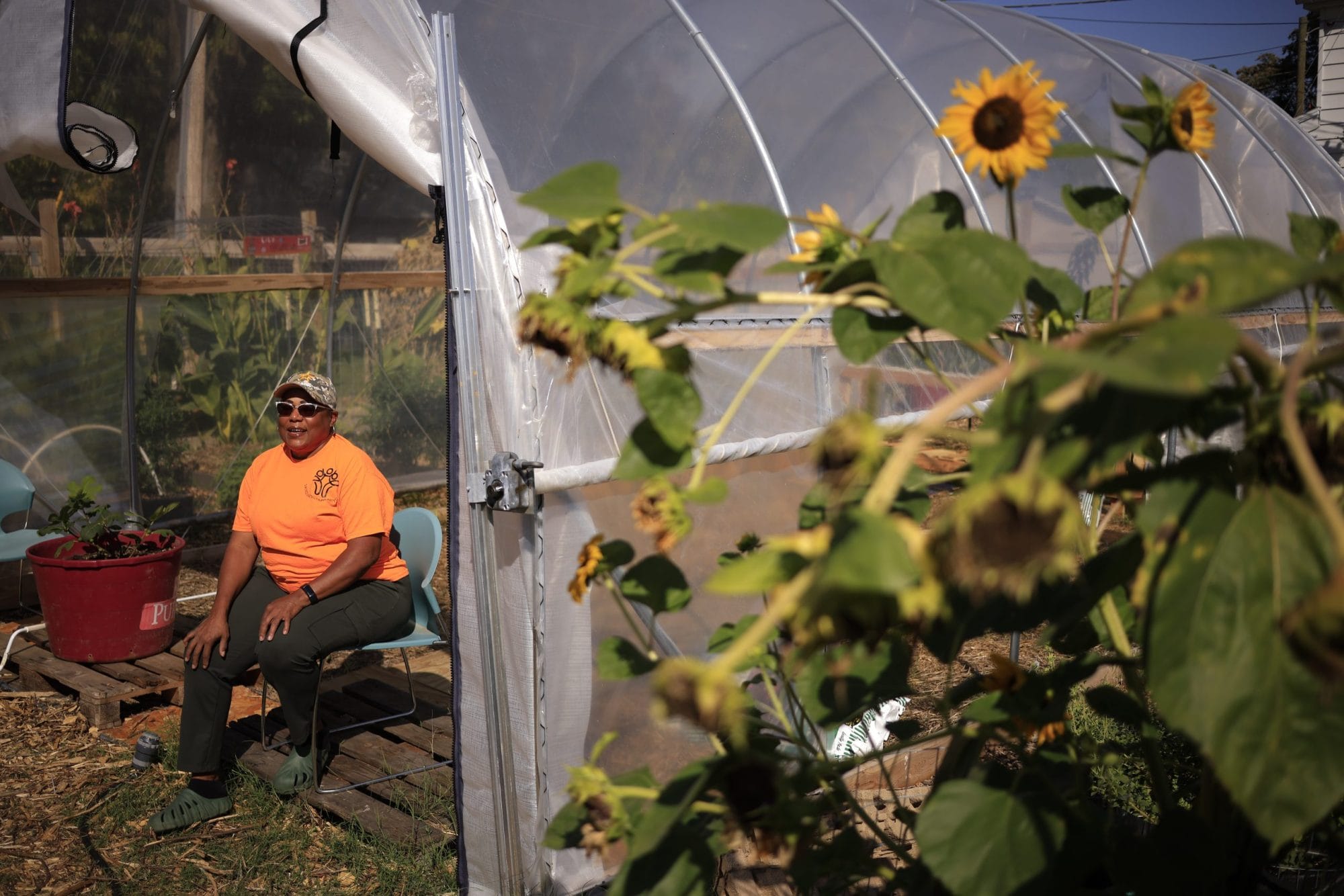
In the foothills of the Appalachian Mountains, Tiffany Bellfield El-Amin rekindles Kentuckians’ agricultural roots.
El-Amin is the founder and director of the Kentucky Black Farmers Association(KBFA) and the owner of Madison County’s Ballew Estates, a fifth-generation farm in Central Kentucky where her family once grew tobacco. She and her two partners are raising their family and managing food education programs through her farm and KBFA.
“We still had gardens,” El-Amin said of her childhood in Kentucky. “We lived off the land; canning, preservation, my grandparents were [Great] Depression survivors.”
El-Amin grew up in a single-mother household, where her grandparents also played a role in raising her. While she now grows her own food, she knows what it’s like to need help making ends meet. After the birth of one of her children, she was a recipient of the Special Supplemental Nutrition Program (SNAP).
“I was on SNAP up until I started working at the hospital with my degree. And even then, I had to get back on it when I injured my back and couldn’t work for a year and was on a disability check,” she said.
According to the Kentucky Cabinet for Health and Family Services, 546,542 peoplein the state were enrolled in SNAP as of September 2026. Feeding America reports that one in five Kentuckians experiences food insecurity. Critics have likened the Trump administration’s cuts to federal programs as widespread, organized abandonment, and many Kentuckians are now turning to their neighbors for help putting food on the table.
Expanding the food system
The need for food assistance is more urgent than ever, now that the most recent changes to SNAP went into effect last month.
The cuts are the result of President Donald Trump’s One Big Beautiful Bill Act enacted in July 2025. Before Trump’s bill, able-bodied people between ages 18 and 54 who did not have dependents under 18 had to work a minimum of 20 hours a week or only get benefits for a maximum of three months over three years. Now, people ages 18 to 64 who do not have a dependent under 14 have to perform paid or volunteer work for at least 20 hours a week. And beginning last month, states now have to cover 75% of SNAP administrative costs; previously they only covered half. The Trump administration’s changes to the program will force states to spend two to three times more to keep the food assistance program running, leading many to “cut funding from other programs or further restrict access to SNAP,” NPR reported.
The White House claimed the legislation is the most “pro-family” and “pro-American worker bill in history.” However, 5 million Americans have been pushed out of the program due to restrictions imposed by the administration, forcing “more people to seek help from food banks or go hungry,” The Guardian reported. With the new rule in effect, the federal government will make $16.9 billion in reductions to federal spending on SNAP over the next five years.
According to an Oct. 15, 2026 letter Kentucky Gov. Andy Beshear sent to the United States Department of Agriculture (USDA), Trump’s spending bill “has resulted in 80,622 Kentuckians losing SNAP, including 24,655 kids and 6,572 seniors who are hungrier today because of the President’s actions.”
Kentuckians like El-Amin were prepared for this moment.
“We knew that something like this was going to happen, and we had been urging our families to learn the community source ways of gathering food and doing it in a systematic way,” El-Amin said.

In November 2025, a 43-day shutdown in the federal government resulted in a slew of Americans losing their benefits and access to vital food resources. KBFA and Louisville’s food justice organization Change Today, Change Tomorrow leveraged their own resources to buy leftover produce and other goods from farmers for community food sites. The organizers’ broader goal was simple: Work together to create an ecosystem so local communities were taken care of and had enough to eat.
Kentucky is most widely known for bluegrass and bourbon, but for locals, the state is synonymous with hunger.
Kentucky is most widely known for bluegrass and bourbon, but for locals, the state is synonymous with hunger. Kentucky is ranked second in the nation for hunger, “and it’s only getting worse,” according to the Kentucky Center for Economic Policy. In large part, this is due to increasing grocery prices and Trump’s cuts to vital programs. Home to an estimated 168 food distribution programs, Kentucky’s food banks, community pantries, and mutual aid initiatives are now being asked to fill the void as state and federal safety nets retract even further.
In online forums, people discuss items that they can not access at local food banks, such as milk and vegetables. In an effort to lessen the harm caused by funding cuts to SNAP, community organizers are now building partnerships with agricultural associations and local farmers to provide Kentuckians with what they need.
“Those partnerships are great because people always need fresh fruits and vegetables—and those are the only non-store-bought things we can accept, too,” said Missy Spears, executive director of Queer Kentucky and co-founder of one of Kentucky’s community fridges.
Research shows that sustainable food solutions are imperative for fighting hunger, and organizations across the Bluegrass State are working to make these solutions more of a reality.
This includes Southern Black land stewards and farmers, who operate much like alchemists, transforming meager resources into nourishing food to address food insecurity. Historically, the same can be said of organizers in urban centers. One prime example is the Black Panther Party’s Free Breakfast for School Children Program, which fought child hunger and brought to light the neglect of government agencies. Ultimately, the program shaped American food policy and expanded federal breakfast assistance—where the first of such government programs were originally piloted in Kentucky.
This work continues in the state. Locals like El-Amin provide food to community members through KBFA while also teaching people longer-term solutions to food access.
“You could be growing your own things and seed saving,” El-Amin said of her efforts.
As a Black, queer farmer in a rural area, El-Amin is also keenly aware of how unwelcome marginalized people can be made to feel at places such as farmers markets, where otherwise important education, information, and connections can be made with farmers.
While religion, sexuality, and gender identity should have no bearing on where you access food and what you eat, El-Amin said, “those biases are very much real and alive.”
The farmer chooses to focus on what she can fix, as opposed to what she can’t. For her, that means building community as “African cultural people just being together, doing things together, [and] building actual legal cooperatives.” The ultimate hope, El-Amin said, is to build a new food system.
LGBTQIA+ organizations in Kentucky are operating under a similar framework.
Kentucky Health Justice Network’s Trans Health Program provides financial assistance for both gender-affirming care and food. Due to an increase in client assistance, the organization reported in the spring that it provided $975 in food assistance to 11 trans people over the course of one month.
Organizations such as The People’s Market in Lexington and Louisville Pride Foundation are also taking action in Kentucky to combat hunger in LGBTQIA+ communities as inflation increases and SNAP changes go into effect.
As executive director of Kentucky’s only LGBTQIA+ newsroom, Spears saw a need in her community. Kenton County, where Covington is located, is home to nearly 13,000 people who are receiving SNAP. The area is also becoming more expensive as it becomes further gentrified.
In 2016, Covington saw a mass expansion of businesses across the city. This included a $22 million restoration project, with a central focus on a luxury hotel. But the arrival of these businesses pushed out vulnerable populations, and relocated the Emergency Shelter of Northern Kentucky, which used to be near the new hotel.
Not too long before this, Spears was a SNAP recipient living off an annual income of $17,000 with her former partner, who was on disability.
In 2021, she met community organizers across the river in Cincinnati, Ohio, who started the Free Fridge, which provides farm-fresh food, canned goods, and local products for free to local community members. Inspired, she decided to bring a community fridge to Covington.
One of the biggest challenges, according to Spears, was finding a property to place the fridge.
Kentucky law states that leaving a fridge on public property could lead to a Class B misdemeanor, which made finding a location to house the community refrigerator a tedious process.
“The hardest fucking thing to find is land because you can’t put it on public property,” she said. “Churches were not a great option, and there are no laws created around this. So it’s either if you ask for permission, you have to sit and wait for decades while the legislature figures out what they’re gonna do—if they ever do anything.”
She finally found a partner to work with, a local who owned a house off Scott Street. They joined their skill sets—fundraising, marketing, and engineering—and built the entire operation themselves.
“We made it happen in like, six months,” Spears said.
Now known as COVUnity Fridge, the community fridge operates on a neighbor-run structure, where community volunteers drop off food donations, organize items, and clean up inside and around the fridge. There is nobody on site, and only specific items can be donated to the fridge and the pantry that sits beside it—including fruits, vegetables, and labeled meals from a commercial kitchen.
To get the word out, communication happens on their Facebook page. “The reason that the fridge works is we’ve kind of set it up to be as low maintenance as possible,” Spears told Prism.
The fridge runs on a 24-hour, 7-day-a-week structure, allowing community members to drop off food whenever they have time. Spears estimates that nearly 30 people a day make use of the donated food.

When systems fail
Spears and others who spoke to Prism said that when SNAP cuts worsen over the next few years as states decide they cannot afford to support the program, community-led food programs may be the only saving grace for hungry families nationwide.
This isn’t a good thing.
“[The] scariest thing for us is that we’re gonna have to start supplying everything,” Spears said of the mounting pressure to feed community members as government systems fail. While she has little faith the federal government will reverse course, she said that anyone can provide a free resource. “Most people don’t realize that you don’t need permission to do shit. You just see a need in your community,” she said.
Making a free, community food resource also doesn’t have to be as complicated as coordinating the logistics of a community fridge or owning a farm. It’s really as simple as offering a meal, gathering food items for pickup, or starting a community garden.
The act of gathering for a meal or watching out for your neighbors are touchstones of Kentucky culture. But while mutual aid is critical and demonstrates the resilience of people in the state, it cannot replace the benefits people are entitled to, according to Vincent James, president and CEO of Kentucky’s Dare to Care Food Bank. “Food banks exist to respond to moments of crisis,” James said in a recent interview. “We were never intended and never designed to be able to replace programs like SNAP.”
For now, Kentucky’s pantries and mutual aid networks are holding the line, but supplies are thinning, and community needs are continuously growing, according to organizers.
In today’s political landscape, taking care of your neighbors cannot be a temporary gesture; it’s a survival strategy—and locals like El-Amin are in it for the long haul.
We knew when we built KBFA that it was going to be a creation of building systems … We [need to] lean on each other. Tiffany Bellfield El-Amin, Founder and Director of Kentucky Black Farmers Association and owner of Ballew Estates
“We knew when we built KBFA that it was going to be a creation of building systems,” she said. “We [need to] lean on each other.”
Mo Viviane
Filed Under: