Filed Under:
Another way out: All of us are in danger as long as the empire stands
As people across the U.S. left react to attacks on Venezuela, Iran, and Cuba, canned rhetoric and sectarianism remain the priority
William C. Anderson
Real journalists wrote and edited this (not AI). Independent, community-driven journalism survives because you back it. Donate to sustain Prism’s mission and the humans behind it.
Real journalists wrote and edited this (not AI)—independent, community-driven journalism survives because you back it. Donate to sustain Prism’s mission and the humans behind it.
“The world has really posed some new challenges that demand a lot of new thinking from those of us who are still on the planet, especially the younger generation. … And the old ideologies, to me, are petering out. They were formulated in times that were different from these.” –Eusi Kwayana
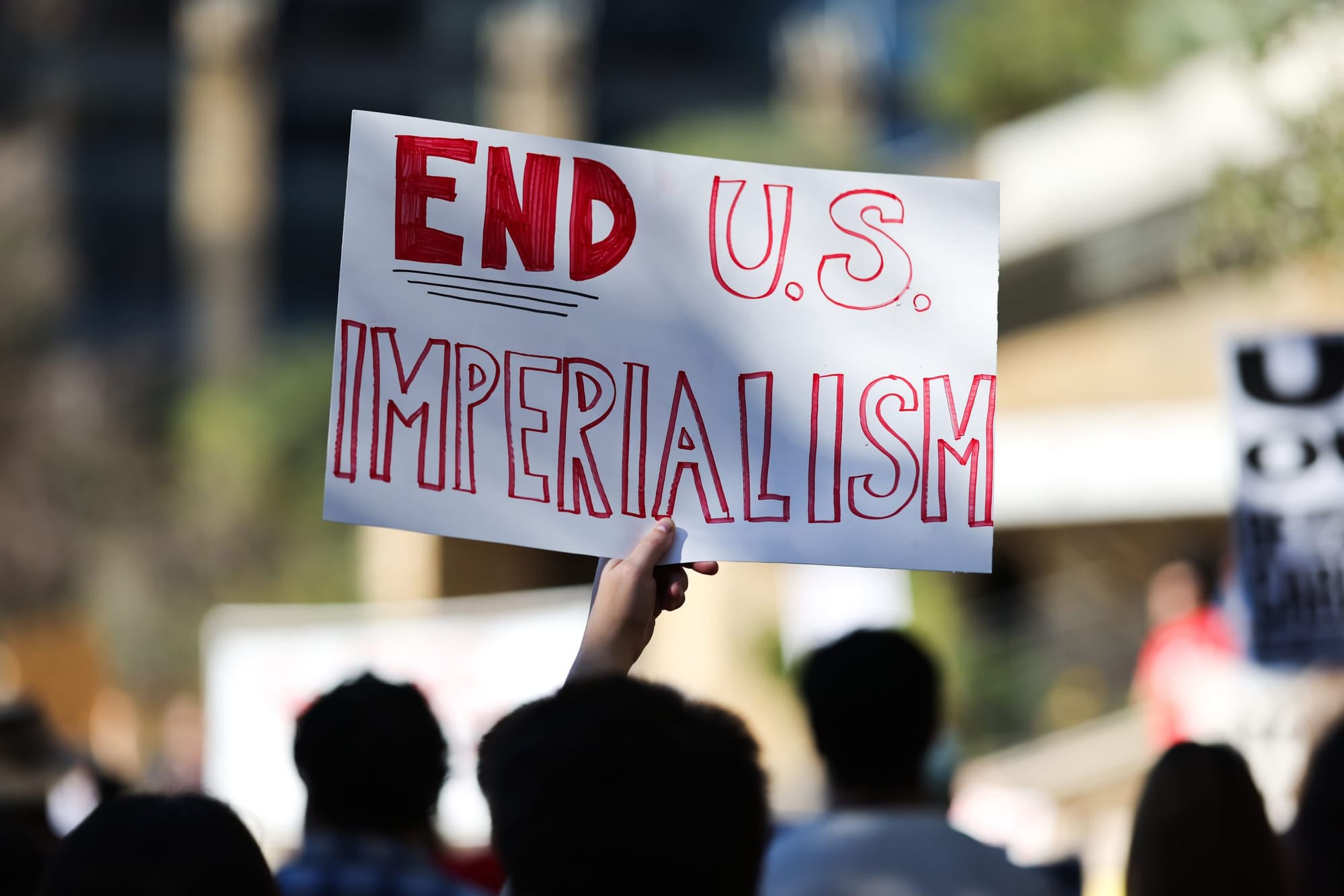
Those in power and the authorities that operate on their behalf don’t have to work hard to sabotage those who sabotage themselves. Loud, unfocused leftism is easy to predict, and we’ll have to act accordingly to make strategic decisions now. As people across the denominations of the U.S. left react to attacks on Venezuela, Iran, and Cuba, it’s clear that canned rhetoric and sectarianism remain the priority for many. However, time is ticking before the next escalation. So, to come to grips with reality, those who want to be smart right now will first learn to sit with failure and assess the situation crushing us. Beyond expired Cold War platitudes and demands that aren’t backed up by action, empire is the common target we should have in our sights. To analyze it requires us to cast off the yoke of self-sabotage far too often mistaken for radical politics.
A number of those among us would notice much of their own activity is obsolete or useless if they first asked themselves the question, “What does this build and who does this help?” The engagement-driven self-centeredness that social media encourages pervades the discourses plaguing the left’s sects. None of it seems to be creating a generative examination of all failures around us. We have failed to stop the genocide in Palestine. We have failed to build a liberatory society at home. We have failed to bring an end to imperialism, intervention, and regime change. We have failed to have substantive solidarities that provide more than rhetorical aid to people struggling against state violence and repression abroad. We have to be able to hold failure in order to learn from it. Though when you look around, so much of what we see is people blaming one another while continuing to fail in their own respective ways. Much of this is occurring because things are becoming increasingly out of touch.
Applying vintage copy-and-paste Cold War analysis to everything that happens in the world has impaired left politics. The planet is not at a standstill, allowing us to repeatedly drop generations-old conclusions onto varying populations, governments, and conflicts. Things change even if we don’t. To stop failing, we have to change our approach, our words, our thoughts, our capabilities and much more to adjust. What we have witnessed U.S.-based fascism accomplish in a very short time should lead us to reassess everything. From the tea party movement to now, it’s only taken the reactionary right a relatively short amount of time to upend hundreds of years of blood, sweat, and struggle for progressive institutions. Their speed and effectiveness have been dizzying—so dizzying that it sends many distraught onlookers into a spiral.
We do not know what’s best for the rest of the world just because we’re from the U.S., and hegemony makes our output and opinions hypervisible.
As the seriousness of it all sinks in, a number of distressing reactions occur. Right now, I’m focused on how much more delusional and detached people can become without proper introspection. Geopolitics may, more than anything else, show the unbelievable disconnect that much of the U.S. left is wallowing in. What’s baffling to see is factions of leftists determining from their armchairs what uprisings are or aren’t real elsewhere globally, while failing to foment the one needed to topple the empire they reside in. High on self-appointed vanguardism sprinkled in a blunt of exceptionalism, fragmented U.S. leftists that can’t even seize a city block have no right to lecture or condescend people putting their lives on the line to change their own situations. We do not know what’s best for the rest of the world just because we’re from the U.S., and hegemony makes our output and opinions hypervisible. Our focus should be on understanding our own lives and conditions instead of ideologically projecting onto other predicaments, both past and present. This is what ineffective people who aren’t accomplishing anything do: They take up symbolic fights that don’t require much more risk than online influencer wars. The authority about what should or shouldn’t be done comes from praxis, not leftist identity, followers, and proselytizing.
Uruguayan journalist and theorist Raúl Zibechi lamented similar issues with the South American left. He stated, “The problem I see with the left … is the lack of debate and self-criticism, the lack of a concrete analysis of what is happening, a task they replace with a simplistic view of reality: you’re either with me or with the enemy. Nothing lasting can be built that way. Too much pragmatism and zero spirituality.” His diagnosis applies here, too, and feels stingingly familiar. He also noted that “we might need to seriously consider whether it makes any sense to continue identifying with the ‘left,’ no matter how many adjectives we add. … We’re not here to succumb to intellectual and political laziness.” Please understand that my criticisms and any I reference about leftism and failure are not a criticism of the political direction that is to the left. Instead it’s a call for a recommitment to revolutionary travelers to go further left, led by study, practice, and daringness, instead of the increasingly dogmatic pretentiousness that has become “leftism.” We need an intercommunal “mosaic” movement, like former Black Panther Party member and Black Liberation Army soldier Russell Maroon Shoatz once described, that can bear the weight of differences and separate interests while remaining collective-minded.
In the shadow of the Cold War, we find ourselves in what the Zapatista Capitán Insurgente Marcos, formerly known as Subcomandante Marcos, once described as a “Fourth World War.” The concept, first introduced to me by geographer Linda Quiquivix’s work, details an era in which tech rules, and, since the state-socialist projects of the Soviet era have been defeated, “humanity is now the enemy.” He said, “What matters is the law of the market, and that is what establishes how much you produce, how much you are worth, how much you buy, how much you are worth. Dignity, resistance, solidarity all disturb. Everything which prevents a human being from turning into a producing and purchasing machine is an enemy, and it must be destroyed.” The enemy lording over us is ruthless and powerful in ways that challenge us to think through resistance with new ideas, planning, and motivation. We won’t achieve that with the clubhouse politics surrounding us now.
All of us, in the U.S. or abroad, are in danger as long as the empire stands. The caricature of leftists I describe here will possibly have to settle their quarrels in a grave, a cell, or on a deportation flight if this all continues. They will escalate their persecution more, and as ineffective as all this nonsense is, it will still lead many to destruction. The ability to speak as openly and critically about the U.S. will not last. Censorship, unlike we’ve ever experienced, will still come as narrow sectarian beefs rage on and people turn on each other instead of the ruling establishment. Not only is much of this a waste of energy, but it’s also a self-defeating security threat drawing unnecessary attention. It highlights the tensions within circles, making them easy to manipulate and destroy. There was a time when authorities used to send fake correspondence between rival factions to provoke conflict. Now, social media gives us the opportunity to voluntarily derail ourselves while training algorithms that billionaires profit from for free. And don’t be surprised if, as the coming crackdowns grow, many have no plan other than fundraising and waving signs that say to “free” whoever gets detained.
Be vigilant and be smart. Don’t sabotage yourself first; do something that’s worth marking you as a threat to the empire. The legendary Zen monk Linji Yixuan lamented seeing his students stuck in cyclical traps over a thousand years ago:
First-rate fellows who don’t draw a first-rate fellow’s breath, you’re unwilling to trust to what you have at home and instead go looking for something outside, letting yourselves become taken up with the idle words and phrases of the men of old, clinging to the shade, relying on sunshine, never able to stand on your own.
You encounter a certain environment and are swayed by it, you encounter a bit of dust and clutch at it, everywhere stirred and led astray, lacking any fixed standards of your own.
In the same vein, we have to stop clinging in the ways that Linji points out here. Let go of the usual and decide to recognize failure, reassess, and fight for better days renewed by the standards we discover by living and embodying radical actions.
Editorial Team:
Lara Witt, Lead Editor
Lara Witt, Top Editor
Rashmee Kumar, Copy Editor