Filed Under:
The Indigenous leader using AI to protect endangered languages
Michael Running Wolf co-created a program to empower Indigenous communities to learn and preserve their languages

Costa Beavin Pappas
Real journalists wrote and edited this (not AI). Independent, community-driven journalism survives because you back it. Donate to sustain Prism’s mission and the humans behind it.
Real journalists wrote and edited this (not AI)—independent, community-driven journalism survives because you back it. Donate to sustain Prism’s mission and the humans behind it.
The United Nations estimates that one Indigenous language goes extinct every two weeks.
However, some researchers have increasingly framed AI as a potential life raft for language revitalization and preservation. Even Big Tech is expanding language models to include Indigenous languages such as Cherokee, Yucatec Maya, Mam, and Zapotec.
Simultaneously, Indigenous communities are largely absent from the tech workforce. One report found that Indigenous people make up about 1% of the workforce for the largest U.S. tech companies. Meanwhile, there has been a rapid expansion of AI data centers that intersect with Indigenous land, leading to a tremendous strain on water and energy systems for local communities.
These conflicting facts reveal the gray area in which AI now operates, especially as it relates to the new digital frontier for language education and sovereignty.
Language preservation
Michael Running Wolf is one of the architects working to build AI-led tech to protect endangered languages.
Running Wolf is a North Cheyenne AI researcher and former software developer at Amazon, where he worked on projects such as the voice assistant Alexa and founded the first Indigenous at Amazon affinity group. He’s now the co-founder and lead architect of First Languages AI Reality (FLAIR), a research and developmental program aimed at reversing the loss of Indigenous languages in North America through community-centered AI development. This means that community-sourced support is at the forefront of all decisions about using AI technology to capture language.
“I’m actually an AI skeptic,” Running Wolf told Prism, explaining that modern machine learning has practical applications, though he also warned that the technology’s perceived power of preservation is often dangerous. But what happens if Open AI disappears? What happens if Microsoft turns off application programming interface that enables software to function. “You’re giving up a lot of agency,” he said.
For Indigenous communities, linguistic agency and the threats against it are built upon centuries of external control and violation. In 1819, Congress passed the Civilization Fund Act to “civilize” Indigenous people. As part of this work, the federal government partnered with white missionaries and church leaders to establish schools on Indigenous lands, with the goal of replacing children’s tribal practices with Christianity. The use of Native languages was banned in these schools, and students who violated the rule faced severe abuse. Many children died in these facilities, and all were subjected to linguistic genocide.
Today, the majority of Indigenous people in the U.S. no longer speak their ancestral language.
“Since there are only a few speakers, everyone is kind of stuck at an early level—almost like baby talk,” Running Wolf explained. “They have the fundamentals, but they can’t advance.” For teachers, he said, it’s demoralizing when most students are not learning as much as they could because they don’t have the right resources.
“You may only have a handful of teachers and thousands of tribal members who want to learn,” he said. “It’s just really hard to keep up.” To Running Wolf, this shortage of fluent speakers and teachers creates a structural gap that traditional classroom models alone cannot fill.
This is where AI can play a role. “AI lets us scale pronunciation guidance and practice so the burden isn’t all on those few speakers,” Running Wolf told Prism.
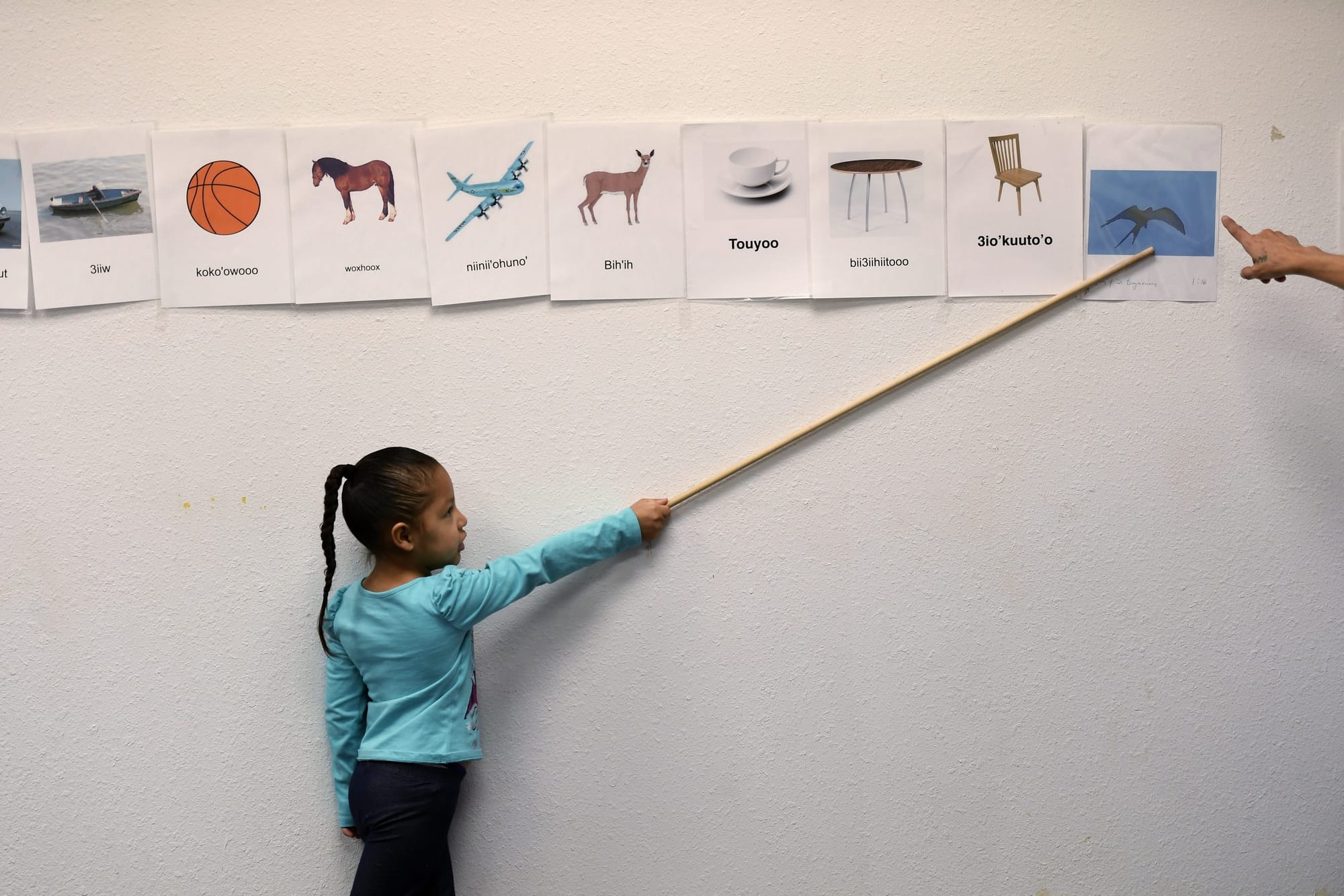
Crucially, FLAIR is designed for in-person instruction rather than shifting the lesson module to between the student and AI. “This isn’t meant to supplant in-person education,” Running Wolf explained. “The goal is for students to go with the class, then go home and practice.” This is what he described as a “development loop,” which is AI that supports the curriculum outlined by the tribe.
FLAIR is also built with linguistic challenges in mind. Because there’s no universal path to learning, the AI has to be personalized depending on the tribe’s language. This way, the program can flag which aspects of language acquisition are most challenging for new learners, such as how speech changes when addressing an elder versus a peer, for example.
Beyond building the technology itself, Running Wolf has focused on building a system that communities can take ownership of. This means training local members to document their own languages and learn AI tools so that language preservation and curriculum development remain self-governed and, eventually, locally driven. This also means that relying on Big Tech as a safeguard for preservation isn’t a necessity and a tribe’s data is not automatically ceded.
“Data is the new oil”
Broadly speaking, tech companies are one of the biggest threats to personal data. But according to Running Wolf, Indigenous data faces an even bigger risk.
“The biggest offender are universities,” Running Wolf said. “Terabytes of tribal data isn’t accessible to tribes within university data sets.”
The way this precious data usually finds its way into universities, according to the FLAIR co-founder, is through Ph.D. students writing their thesis. These academics go into a community with good intentions and collect data, but then that data becomes the property of the university. “We have heritage locked away in academia,” he said. “Data is the new oil.”
International frameworks such as UNESCO emphasize the importance of Indigenous participation in research, data control, and access to results. But this often isn’t done in practice—especially not when the subject of the research is Indigenous communities. For example, a 2024 research study found that from 2001 to 2015, there was 20 times more environmental research conducted within Indigenous communities and on Indigenous land, and in two-thirds of those projects collected data was not returned.
This tech-led phenomenon is “data colonialism—a voracious drive to consume not just land, natural resources, and human labor, but a new kind of colonial resource: human life and its rich social connections,” said Ulises A. Mejias in an email. The critical theorist and communication studies professor at the State University of New York Oswego is also the co-founder of the Non-Aligned Technologies Movement, a coalition that advocates for the purposeful design and deployment of digital technologies.
Mejias told Prism that Big Tech’s grip on cultural, linguistic, and social data must be combatted. “We will need the decolonial knowledge contained in the languages and cultures that are disappearing due, in part, to the data centers Big Tech insist[s] on building,” he said.
These losses amount to cultural theft. Running Wolf said this is akin to an Indigenous person approaching a university to regain priceless connections to their family and people, only to be turned away.
“Someone comes along and says, ‘You have the voice of my grandmother, can I have it?’” Running Wolf explained, while universities see the request as, “I don’t know who you are, and we don’t have to give it to you if we don’t need to.”
For decades, data collection has moved in one direction: away from communities and into data centers and institutions. Scholars, educators, and activists have increasingly relayed concerns that the modern digital economy risks further harming communities previously impacted by industrial waves from the fur trade to the push for green energy transition. One writer for Tribal College Journal described this modern-day data theft as “the new colonialism of the digital era.” Better known as “datafication,” the process turns human life into “the pursuit of data” from enrollment and environmental data to sociocultural data sets focused on language, art, and photography.
At the center of Running Wolf’s business model is an attempt to rectify this history by establishing a new standard for data collection that is grounded in consent.
“I want communities to know that we’re a trusted partner, and it’s not a one-way door,” Running Wolf said. Within this ethical framework, all linguistic and cultural data remains the property of the tribe. The data is licensed strictly for research purposes, and the full rights are retained by the community who can withdraw consent at any time. If consent is withdrawn, no justification is required. All the tribe’s data will be deleted, and the tribe will be given a copy. Running Wolf hopes this approach will become more of a norm.
At the same time, Running Wolf is careful to avoid positioning himself—or his organization—as the only option for this work, which could create a massive bottleneck. With over 500 tribes across the U.S., it simply isn’t feasible for a single team to build and maintain language AI for every Indigenous community.
The challenges of this work are compounded by longstanding structural barriers facing Indigenous communities. A 2023 report found that only about 59% of Native American and Alaska Native students attended schools that offer any computer science classes, and just 20% of high schools on reservations offered any computer science coursework. And just over half of schools on tribal lands have consistent broadband access. Meanwhile, federal data shows that about 24% of people living on tribal lands lack broadband at home, in comparison with roughly 7% of Americans overall. These gaps also appear in higher education, where Indigenous student enrollment remains extremely low, at less than 1% for all postsecondary education, as of fall 2021.
FLAIR sits at the intersection of two historical exclusions: that of Indigenous people from the technology field, and Indigenous languages from modern technology. Digital tools such as keyboards and speech recognition were designed around dominant languages. By design, Indigenous languages were largely incompatible with these systems—until now.
Our languages have survived for thousands of years. What do we do now so it works thousands of years in the future?
Michael Running Wolf, co-founder and lead architect of First Languages AI Reality
“Our languages have survived for thousands of years. What do we do now so it works thousands of years in the future?” Running Wolf said.
The FLAIR co-founder is dreaming big, imagining the potential for a device similar to Alexa that is built specifically for Indigenous languages. Initiatives such as FLAIR do not aim to join big tech, but rather want tribes to create their own technology and standards of ethics.
But this technology does not exist without a cost.
Who should control AI?
The rapid expansion of AI has wreaked environmental and societal havoc. Training large AI systems requires enormous computing power, leading to enormous facilities filled with servers that run continuously, consume large amounts of electricity, and require significant water resources for cooling. A 100-word prompt generated using Chat GPT-4 was found to use over a bottle of water. In Memphis, Tennessee, an AI data center owned by Elon Musk consumes water and electricity on the level of whole cities, while also producing untold and unregulated air pollutants.
The effects are already being felt by marginalized communities. Power that was marketed to data centers as “cheap” led to the Navajo Nation’s loss of power. Tribal members are now relying on canned goods and boiled water for showers, and many are going without heat during winter. These environmental impacts disproportionately burden marginalized communities, leading many impacted communities to wonder why they must ultimately bear the cost of a technological advancement such as AI.
AI has also opened a new door for imperialism. Regions with minerals needed for AI expansion are increasingly the subject of Trump administration talks regarding American expansion for the purpose of furthering the country’s AI infrastructure.
Greenland, which already contends with a colonial link to Denmark, has become an obsession of President Donald Trump, who says he wants to make the island the 51st state. Underneath Trump’s facade of “needing” Greenland for national security is something more nefarious. The Nordic country holds a significant deposit of critical minerals that have aroused interest from billionaire tech moguls interested in mining projects.
These developments mirror earlier extractive cycles, such as the growth of the tobacco industry and industrial mining. Industrialized “innovations” have always depended on resources drawn from lands with limited power to contest the terms. AI is just the latest frontier, and the underlying power dynamics are strikingly familiar.
According to the U.N., Indigenous communities contribute the least to global warming—they only make up 5% of the world’s population—and they protect 80% of the world’s biodiversity. By contrast, Big Tech—Amazon, Google, Microsoft, and Meta—hold the largest control over the AI market, and these companies’ data centers drive environmental turmoil on a global scale. This begs the question: Should the only people with a proven track record of responsibly stewarding resources not be given access to AI?
There are Indigenous technologists who are actively working to address the environmental issues posed by AI. One example is Dean Bittner, the CTO of RUNWITHIT Synthetics, a company that addresses the issues wrought by complex digital systems.
Richard Tuck, the CEO of the Wakopa Financial Workers’ Co-operative that offers funding and mentorship to entrepreneurs from historically excluded communities, told Prism that Bittner is a prime example of why “Indigenous governance is so important.”
“He built his AI modelling to work on a tiny fraction of energy that a big tech would use to do the same thing,” Tuck said in an email. “When you think about the Earth Mother and our effects on her from the outset, you build differently.”
This approach aligns with Running Wolf’s long-term vision of what he calls “low tech.” After years of working for Amazon, he grew wary of how tech systems depend on constant updates while devices have short life cycles. Instead of joining this “rat race,” the FLAIR initiative is building an educational device for Indigenous language learning with speakers and mics inside. The product, described as a “chat box” similar to Alexa or Siri, would live in classrooms and eventually homes. Understanding the gap in internet access for Indigenous communities, the device would also work entirely offline without updates or the need to regularly replace it with a new gadget.
“I want something that will exist a decade from now,” Running Wolf said. He said he envisions a grandmother opening her cabinet drawer to take out a box for her grandchildren to practice their language with. It is his hope that the device will play a role in permanently preserving Indigenous languages. “If something was ever to happen to the language, there will always be these devices floating around as an insurance policy,” he said.
Slowly, FLAIR is taking steps to make Running Wolf’s dream a reality. This year, the company will introduce its AI to communities. From there, FLAIR will open source their code and methodology—without audio or cultural content—so that anyone can pick up the technology for their own tribe. “I want there to be an ecosystem of research,” Running Wolf said. “I don’t want us to be the only ones doing this. I don’t want to have control over their AI destiny. I want tribes to take over their own destiny.”
Editorial Team:
Tina Vasquez, Lead Editor
Lara Witt, Top Editor
Rashmee Kumar, Copy Editor