Filed Under:
Immigrants report poor conditions in notorious unit at Louisiana’s ‘Angola’ prison
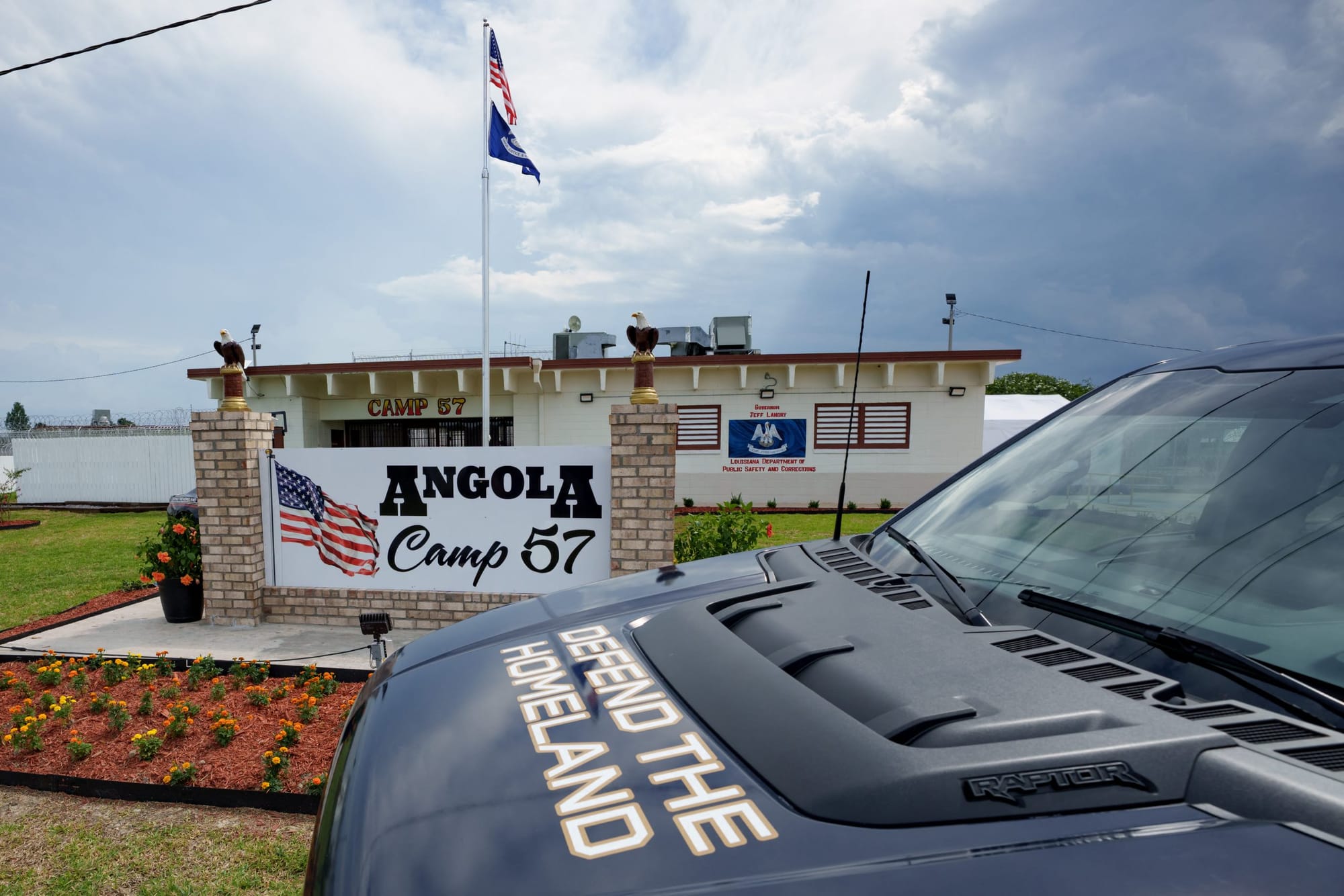
Louisiana Gov. Jeff Landry re-opened “Camp 57” in September at the site of former “Camp J,” the solitary confinement unit at the Louisiana State Penitentiary that was built on a slave plantation

Victoria Valenzuela
Real journalists wrote and edited this (not AI). Independent, community-driven journalism survives because you back it. Donate to sustain Prism’s mission and the humans behind it.
Real journalists wrote and edited this (not AI)—independent, community-driven journalism survives because you back it. Donate to sustain Prism’s mission and the humans behind it.
Chanthila Souvannarath was attending an immigration check-in appointment in August when he was detained by Immigration and Customs Enforcement (ICE). He was sent to a county jail in Alabama, where he said he was denied his medications and suffered withdrawals, while also lacking access to soap, blankets and pillows.
Souvannarath didn’t think things could get worse. Then he got sent to Louisiana State Penitentiary, often referred to as “Angola,” the name of the slave plantation it was built over.
There, Souvannarath said he was housed in a notorious solitary confinement unit where conditions were so dangerous, it was closed down in 2018. Louisiana Gov. Jeff Landry reopened the unit for immigration detention in September.
Souvannarath was one of the first people to arrive at “Camp 57,” formerly known as “Camp J” when it was used for solitary confinement for people serving state sentences in Angola. He recalled small, dirty cells that the guards would lock at the end of the night, small portions of “disgusting” food, terrible smells, toilets flooding, no cameras, and cruel guards.
“That place is not made for ICE detainees,” Souvannarath said. “It’s a super maximum prison. We’re not criminals, … [but] we were being treated like criminals.”
From the 1970s to 2018, the unit at Angola was notorious for suicides, fighting, extreme heat, and isolation. After its closure, it briefly served as housing for incarcerated individuals infected with COVID-19 during the pandemic. When Landry reopened the unit to hold immigrants, he said it was reserved for “the worst of the worst.”
Souvannarath doesn’t believe he fits that description. He was born in a refugee camp in Thailand but was granted lawful permanent residence in the U.S. before his first birthday, according to The Associate Press. While he got on ICE’s radar following a four-year prison sentence ending in 2006, he said he is a U.S. citizen and had brought the documents to prove it at his immigration check-in. In the 18 years between his release from prison and arrest by ICE, he worked a construction job, got married, and had six children. He cared for two of them as a single father when he moved to Alabama, up until his ICE check-in.
After more than a month in Angola’s Camp 57, Souvannarath was deported to Laos, where he hadn’t been since he was 10 months old, despite a judge’s order blocking his removal.
“I’ve been out since 2008. I haven’t gotten into any trouble with anyone,” Souvannarath said. “I don’t even drink alcohol. I’m considered the worst of the worst?”
The Department of Homeland Security and Louisiana’s Department of Public Safety and Corrections did not respond to Prism’s requests for comment.
An ICE spokesperson told Prism, “No lawbreakers in the history of human civilization have been treated better than illegal aliens in the United States.”
“Any claim there are subprime conditions at Camp 57 in Angola, Louisiana is false,” the ICE spokesperson said. “ICE facilities are bound by the National Detention Standards and Family Residential Standards—rigorous, federally enforced guidelines that prioritize safety, medical care, and detainee rights. These standards are not optional—they are mandatory and strictly monitored.”
A history of violence and deaths
Camp J was built in Angola, the largest maximum security prison in the country, in the 1970s. It was built when former Louisiana Gov. Edwin Edwards, who later went to federal prison for corruption, decided the state needed a maximum security unit for what the prison considered the most dangerous and violent incarcerated people. The unit is located away from the rest of Angola prison, near a lake where incarcerated people are not allowed to go.
Harry Johnston was in his 20s when Camp J first opened and he was moved to the unit. He remained there, off and on, until it was closed in 2018 when he was in his 70s. Johnston had spent seven years on death row before that, but he said his experience at Camp J was worse. The guards, he said, would wake them up at 5 a.m., feed them “the least amount of food,” keep them in their cell 23 hours a day, only give them 15 minutes to shower and take them to the yard three times a week.
Johnston also said that the guards wouldn’t let the people inside talk to each other—if they got caught, the guards would beat them, he said. Additionally, Johnston said there were staff members, called “the goon squad,” who would brutalize people.
Suicides happened frequently, Johnston said. Eventually, he said, the warden implemented a rule that guards had to check on everyone at least once an hour. That policy came too late for the person in the cell next to Johnston’s, who had spent 11 years at Camp J before ending his life. Johnston said it took hours before a guard responded.
“We called for the officer. … I’m calling, I’m making noise, and he … wouldn’t come,”Johnston said.
Edward Johnson, who also was incarcerated at Camp J before it closed down, remembered “guys howling and screaming back there” and it being a traumatizing experience.
Johnson said there was no circulation, and it was hard to breathe. It would get so hot that people would put water on the floor and lie naked on it to try to cool down.
“I feel sorry for people who are still incarcerated in that place, dealing with that,” Johnson said.
Double jeopardy
Nora Ahmed, legal director of American Civil Liberties Union (ACLU) in Louisiana, said that many people in Camp 57 have been in the U.S. for typically a decade or more, released on an order of supervision, requiring regular immigration check-ins, because they could not be removed to their birth country at the time. They developed lives, got jobs, found partners, and had children during that time, but got detained at their immigration check-in, like Souvannarath.
Ahmed said this is a violation of the Code of Federal Regulations, and that many people in Camp 57 have had their orders of supervision wrongfully revoked, which ACLU Louisiana is challenging in the Middle District Court of Louisiana.
Additionally, Ahmed said that people were being held in Camp J indefinitely, which is unconstitutional and was brought as a means to continue to criminally punish people with prior criminal records. In October, the ACLU Louisiana filed a writ of habeas corpus to challenge indefinite detention, saying it violates the “double jeopardy” clause of the Constitution, which prohibits punishing someone twice for the same offense. Souvannarath said that he knew someone who spent six months at Camp J.
“It doesn’t matter if they have a previous criminal record, because immigration detention is civil and cannot be used as a form of criminal punishment,” Ahmed said. “This notion of the six-month period, once that presumptive period is over, continuing to detain people appears to amount to a form of indefinite detention because there’s no end in sight.”
She said that Camp J is problematic because it is meant to criminally punish people who have already been punished. She said it is impossible to separate Angola prison from the ICE holding facility on its property.
“Our ultimate, gigantic problem with Camp 57 is that it is in existence on the grounds of the largest maximum security penitentiary in the country, and that runs roughshod against what immigration detention can be used for,” Ahmed said.
Now in Laos, Souvannarath hopes to return to the U.S. and reunite with his family after the Trump administration is out of office. He has a GoFundMe to raise money for emergency housing, legal expenses, and efforts for a lawful return.
“I’ve already served my time for my crime,” Souvannarath said.
Editorial Team:
Sahar Fatima, Lead Editor
Lara Witt, Top Editor
Stephanie Harris, Copy Editor