Dear Reader,
Imagine everything around you is in flames. There is smoke billowing up from the dorms, and the academic building, medical unit, library, and commissary are all ablaze. Picture incarcerated people running wild and wreaking havoc with their faces covered in towels and T-shirts.
Now, place yourself behind the razor-wire fence with nothing to do but watch.
That’s the situation I found myself in on Aug. 21, 2009, when the costliest riot in Kentucky history broke out here at the Northpoint Training Center. Though 15 years in the prison’s past, the riot still sends a chill through the spine of anyone who was here for it. No one died, and I still find myself thinking about how much worse it could have been.
The aftermath was about more than property damage and taxpayer dollars. After the riot, prison officials changed everything about Northpoint. Even more fences were erected, and the disconnect between us and prison staff widened even further.
We lost a lot in the fire—buildings, belongings, our sense of safety. But we also lost our community, something that’s hard to explain to people who weren’t at Northpoint before the riot.
When I first arrived at Northpoint back in 2006, it felt like a multiracial village of more than 1,000 people with different backgrounds and beliefs. Yes, it was still a prison, but the yard was wide open back then, devoid of all of the fences and razor wire that now snake around the facility.
The mere ability to walk outside the dorms and stroll around the prison complex gave all of us a greater sense of freedom, and because this freedom of movement allowed the riot to spread like wildfire, it was the first to go.
The riot lasted less than three hours, but the ramifications are still being felt today. Northpoint now runs more like a maximum-security prison. We are segregated, and every movement is controlled. We are only given five minutes to get from one place to another. These “enhanced security measures” are intended to ensure that nothing like the 2009 riot ever happens again.
For those of us incarcerated at Northpoint, we didn’t just lose the illusion of freedom. We actually lost our ability to mix and mingle with people across dorms and to spend all day on the yard in the sunshine.
At the time, I didn’t know if I’d live to see another day. A correctional officer pointed her shotgun at my head and screamed at me to get on the ground or she’d shoot me in the face. Then came additional officers, who zip-tied our hands together.
The riot was over just as quickly as it began. We actually spent more time seated on the softball field with our hands strapped behind our backs than we did in the chaos. None of us knew what would happen next. It was unlike anything we’d ever experienced. There were grown men all around me trying to process the devastation. I still remember hearing someone say, “Look what they did to our home.”
We spent the night in the field, and then part of the next day. It was a lot of time to think about how the retaliation would take shape.
I didn’t get relocated to another prison because of my good behavior during the uprising and my willingness to perform cleanup and other labor in the days that followed. I thought once the excitement died down, things would get back to normal. I was wrong. While I played no part in the riot, some officers made a point of treating me like I had.
Northpoint steadily went downhill after the riot. There always seemed to be more restrictions, more policies, more rules, and even more ways to surveil us.
Still, I always try to look on the bright side, and something good did come from the riot. Like the phoenix rising from the ashes, the prison experienced a rebirth—sort of.
Northpoint was previously seen as a sort of gladiator school, where the roughest and toughest criminals rested their heads at night. But after the riot, the prison became a “program-focused institution.” Over the years, this has meant that Northpoint now offers incarcerated people programs focused on things like employment, life skills, anger management, substance abuse, parenting, and trauma. It’s an imperfect system. As I wrote for The Appeal, Northpoint doesn’t allow us to participate in programs until we are fewer than four years from our parole board date. As a person serving 25 years, this means I had to serve 16 long years before I was even considered for a program that taught me new skills or expanded my worldview beyond the bars.
I spent a lot of time being angry about this, but then I realized all of the time on my hands was an opportunity to reinvent myself.
The riot inspired me to put what I saw and felt into words and to share those words with others. It was only through writing that I realized so many of the limitations I once believed held me back from a successful life were largely self-imposed. I learned how to better manage my own pursuits. Sacrificing sleep for writing time, I established a schedule where I would wake up at 4 a.m. to claim one of our wing’s two tables so that I could spend a few hours each day writing and studying. My fellow imprisoned people started coming around, curious to know what I was up to.
“I’m going to be a writer one day,” I told anyone inquisitive enough to ask.
“Let me see if you’re any good,” they’d say.
“Have at it,” I’d say, handing over my piece of paper.
After a quick scan of a paragraph or two, they’d hand back my work. “Keep practicing.”
The constant criticisms from my peers soon turned to advice, and then shifted to belief in me.
“You’ve really gotta give this a go, Trumbo,” they’d say. “Keep it up. One day you’ll be a writer.”
“I have to. It’s all I have.”
I’ve been in prison for almost two decades now, and I’ve learned that time isn’t always harsh and slow moving. It can be gentle, like a calm wind—and things are easily forgotten if you’re distracted by other matters. In time, many men at Northpoint focused less on the riot and all the changes and more on how they could better themselves through prison programs.
Although I couldn’t participate in programs for years, I could still volunteer for a playwright’s workshop and help others through mentoring. Because I was sidelined by the prison’s program policy, I felt compelled to work even harder to find ways not to become bitter or waste my time—the very characteristics felt by the men who participated in the riot.
In 2022, 13 years after the uprising, the prison was treated like a true city upon the hill because of its focus on change. Northpoint became one of just two Kentucky prisons to offer incarcerated people Second Chance Pell grants. Established in 2015, these grants allow incarcerated people to attend college. At Northpoint, the HBCU Simmons College of Kentucky provides education, and I was among the first to sign up for classes to pursue my general studies associate degree. The ability to pursue an education has made every minute I’ve spent worthwhile.
Fifteen years after the conflagration, those who were present that day made it through the fire and survived. Some were reborn in the blaze, restored by the knowledge of what could have been.
Back on Aug. 21, 2009, when I watched the flames engulf everything in sight, I had no idea what my future held. Honestly, I didn’t even know if I had a future. Now I can say that I, too, look forward to emerging from the fire.
The Right to Write (R2W) project is an editorial initiative where Prism works with incarcerated writers to share their reporting and perspectives across our verticals and coverage areas. Learn more about R2W and how to pitch here.
Author
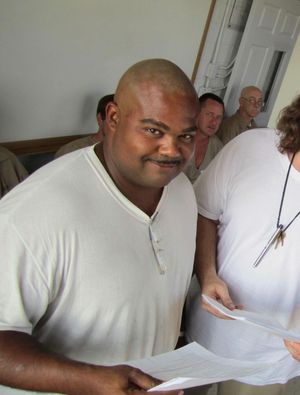
Derek R. Trumbo, Sr., a multiple-time PEN Prison Writing Award winner, is an essayist, playwright, and author whose writing has been featured in "The Sentences That Create Us: Crafting A Writer's Life
Sign up for Prism newsletters.
Stay up to date with curated collection of our top stories.