Dear Reader,
Prison teaches many valuable lessons. If you don’t have tools in your toolkit, such as patience, understanding, and empathy, you will—if given enough time. Prisons and their staff have ways of testing your patience, exhibiting next to no understanding, and for the most part utterly lacking empathy for the imprisoned. Despite what you may have heard, prisons are not day care centers, five-star hotels, or pleasant places to be. That is by design, of course.
So what is one to do when imprisoned? My advice is to attend programs. Any programs. Enrolling in and completing programs gets you out of your cell and moving toward purposeful decision making. Prison only serves a purpose if you make it serve a purpose. My favorite program has been anger management. I learned how to look at my anger and make it useful. I made anger a tool for reflection, like a mirror. This journey has motivated me to change what I didn’t like about myself—and there was a lot I didn’t like.
I have a little disclaimer for this column on anger management: Prison is a patchwork quilt, colored in various hues that contrast the stagnant blue-black uniformity of authority. Not all prison staff resemble the kind I’m about to discuss, but some choose to play these roles.
The anger management instructor stared me in the eye. Part of his tactic was to turn whatever you said around on you, partly to upset and partly to give perspective. I guess the point was that every story has more than one side to it.
“Are you saying that you purposely left your shirt untucked?” he asked.
“Yes,” I said. “I’m a maintenance worker, and I’m allowed to leave it untucked.”
“So you think you’re better than everyone else?” It wasn’t a question.
“No. If I’m allowed to do it, why not make the most of it?”
The instructor smirked. He thought he had me.
“Were you working?” he asked.
“I was on my way to work.”
“Tell me again what happened,” he said.
The story was that two corrections officers ran up to me from behind as I headed down the narrow prison tunnel on my way to work. “Hey! Hey!” they yelled. I stopped and pressed myself against the wall to give them clearance. They were after someone. One of the two officers, a short man with beady rodent eyes, screamed into my face, his spittle landing on my glasses and cheek.
“I know you fucking heard me! Why is your goddamn shirt untucked?” he screamed.
The instructor raised a hand to stop me as I retold the story.
“You could have untucked your shirt once you got to work, right?”
I nodded.
“Continue,” he said.
I showed the officer the maintenance tag on my prison identification.
“I’m a worker,” I said. “I’m allowed to have my shirt untucked.”
“Did I fucking ask you where you worked?” the short officer spat. I noticed the officer next to him kept one hand on the pepper spray clipped to his belt.
“I said tuck your motherfucking shirt in!”
“Yes, sir,” I said as I tucked in my shirt and wiped his spit from my face.
The two officers snickered as they moved off in the opposite direction.
“Were you upset?” the instructor asked.
“Yes.”
“Why?”
I glanced around the classroom. All eyes were on me.
“Because I don’t like confrontation,” I said.
“Carry on,” said the instructor.
A little while later, I was forced to pass by the short officer who screamed at me. He didn’t even acknowledge me.
“How did that make you feel?”
“I felt like he didn’t care about getting in my face earlier,” I said.
“He was just doing his job, right?”
I frowned.
“What happened after that?”
Later, while on the way to my college ethics class, I passed the officer again. This time he was telling an elderly man on crutches to hurry it up and get where he was supposed to be. I was reminded of the Golden Rule and how reciprocity dictates that we get what we give. I understand that, in order to truly become a free man, I must first free my mind.
The officer glared my way, and I smiled. The courtesy wasn’t returned.
“Did that make you feel disrespected?” the instructor asked. “I’d feel disrespected.”
“Did I feel disrespected? No,” I said. “I felt sorry for the guy, actually. Like, how miserable must he really be? I mean, he gets to go home each day. He can sit down to whatever meal he desires, not the slop we’re fed—beaks and feet. Chicken bone meal is the only choice we have. If he wants a steak, he can have a steak. Why is he so upset? He should be taking this class, not me.”
The instructor grinned.
“What if he can’t afford steak? What if he’s paying off two mortgages? What if his wife left him for his best friend, and the family dog died?”
“I’d feel bad for him,” I said.
“So, you feel like you don’t need this class?”
“I didn’t say that, did I?”
“You said he needed this class, not you.”
“I meant … ”
“You were upset,” the instructor interrupted. “You were indignant. You felt like you didn’t deserve to be treated badly because you were doing what you were supposed to be doing, right? He felt the same way. He didn’t feel like your shirt should have been untucked, and he thought the old guy on crutches was loitering. How do you even know if there was really something wrong with the old man? He could have stolen those crutches.”
“You weren’t there,” I said. “And you always take up for the officers.”
“It’s my job.”
“Not every inmate is out to pull the wool over your eyes,” I argued.
“You’re in prison, are you not?”
I immediately recognized the error in my argument when the instructor then asked me if I was “stating facts or feelings.” I’d justified my stance based on feelings.
“What did you do after that?” the instructor asked. “Think hard before you answer.”
“I let the situation eat me up for the next week or so.”
“Because you were angry.”
“Because I was angry.”
The instructor motioned for me to step outside the classroom. My testimony was over. Before I made it to the door, the instructor stopped me.
“What would you do differently if you could?” he asked.
“I would have tucked my shirt in before I headed for work, smiled more, and told the officer to have a nice day,” I said.
“Step outside, sir.”
I stepped out and contemplated my testimony. I was still upset, but a little less angry. I spoke my mind, and truth be told, the instructor—a former corrections officer himself—essentially told me I had to eat shit when dealing with guards. They’re the enforcers, and I am the enforced. After all of these years I am still learning that I have to give the prison whatever it demands of me: many years of my time, my dignity, and my self-respect. If I truly want to survive this place, I must eat slice after slice of humble pie.
My response can no longer be anger; it’s about turning my anger into something useful. That’s what anger management—and prison—has taught me.
The Right to Write (R2W) project is an editorial initiative where Prism works with incarcerated writers to share their reporting and perspectives across our verticals and coverage areas. Learn more about R2W and how to pitch here.
Author
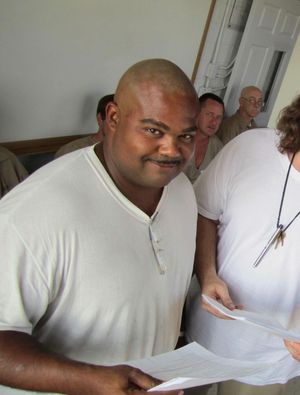
Derek R. Trumbo, Sr., a multiple-time PEN Prison Writing Award winner, is an essayist, playwright, and author whose writing has been featured in "The Sentences That Create Us: Crafting A Writer's Life
Sign up for Prism newsletters.
Stay up to date with curated collection of our top stories.