Why don’t humanitarian aid groups call it a genocide?
Activists, academics, and consultants say humanitarian aid and global development groups want to appear neutral, but many are funded by governments that do not recognize Palestine as a state
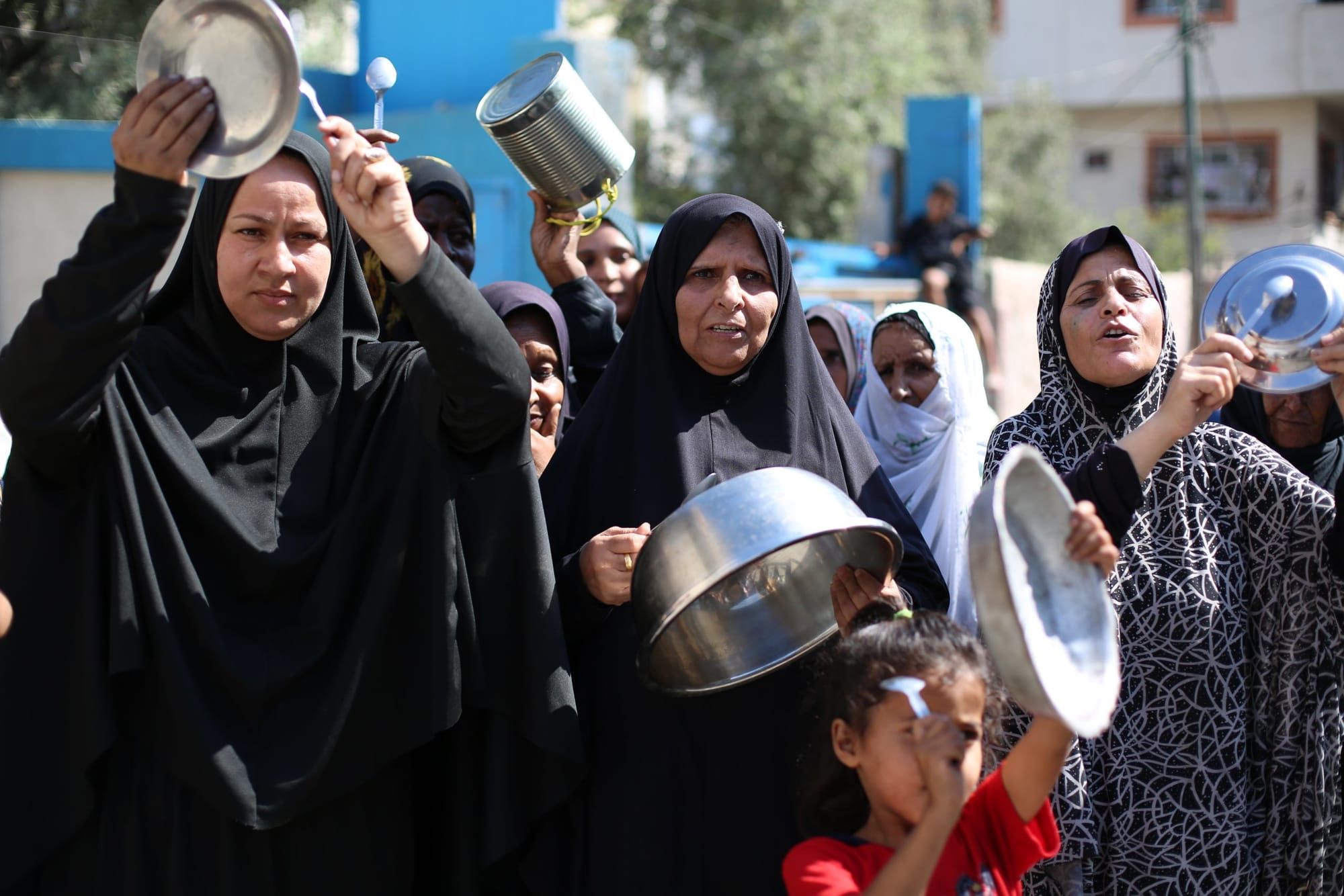
The genocide in Gaza is one of the most urgent humanitarian crises in the world, yet organizations, workers, and funders in humanitarian aid and global development have largely opted to use politically neutral language while Israel slaughters Palestinians.
Some, however, have chosen not to abide by these unspoken rules—and it’s exposing the very shaky ground upon which aid organizations have built their work for decades.
Prism spoke to activists, academics, and consultants across the humanitarian aid and global development fields, highlighting the hurdles they face in advocating for and organizing around Palestinian freedom. Sources who spoke to Prism say their fields effectively operate as neocolonial structures that are inherently supportive of Israeli colonization of Palestine and have very little motivation to halt humanitarian crises globally, as more human suffering leads to more funding.
Explicit political positioning
After nearly two years of Israel’s genocide of Palestinians in the Gaza Strip, the United Nations is now warning of “catastrophic hunger” in the territory. At least 66,000 Palestinian people have been killed by the Israeli military since Operation Al-Aqsa Flood on Oct. 7, 2023, and almost 169,000 others have been injured, with little to no access to medical treatment as Gaza’s infrastructure continues to collapse under Israel’s indiscriminate shelling and bombing.
Israel’s blockade of humanitarian aid to the Strip is also worsening famine; at least 440 Palestinians have died of starvation so far. On July 30 alone, Israeli forces killed at least 49 and injured up to 150 hungry Palestinians who were waiting for humanitarian aid across Gaza, part of a larger pattern of soldiers opening fire on crowds of people desperate to feed their families. Humanitarian organizations estimate that nearly everyone in Gaza is in need of humanitarian assistance, as Israel’s attacks have left nearly 2 million people without access to sufficient water, food, and medical care.
Against this backdrop of mounting famine and worsening conditions, some in the humanitarian aid and global development fields have tried to challenge the industry’s silence. As an organizer and consultant in these sectors, Farah Mahesri has followed the developments in Gaza closely since the beginning of the genocide.
In October 2023, Mahesri connected with friends and colleagues to discuss the humanitarian crisis unfolding in Gaza. Despite doing work dedicated to aiding people in times of crisis, Mahesri and her colleagues felt despair watching the scenes of extreme violence and suffering quickly escalating in Gaza.
“All of us were just saying, over and over again, that we felt helpless,” Mahesri told Prism in a phone interview. “If we’re all asking the same questions, maybe we should just form a Signal group, so we can at least be asking each other and brainstorming ideas.” Mahesri created a group chat on the encrypted messaging app Signal in November, hoping it would lead to ideas for interventions that could help halt the genocide.
What began as Mahesri’s small effort to connect colleagues soon evolved into a broader organizing hub. Using LinkedIn as part of her outreach efforts for like-minded people in her line of work, in early November 2023, Mahesri invited Priya Dhanani, a queer social justice activist working in global development, to join the Signal group. Dhanani often posted about the genocide on LinkedIn. At the time, Dhanani was already compiling a resource library about Palestine, which was later incorporated into Global Development for Palestine, or GlobalDev4Palestine, the website that emerged from the Signal group’s organizing efforts.
The initial Signal group of seven decided to write a public statement and continue communicating to facilitate further organizing. While the fields of humanitarian aid and global development field have a mission to respond to systemic social issues via long-term projects that focus on economic, social, and political development, it became immediately clear to Dhanani that many people in the sector did not know what to do in the face of an unfolding genocide.
The goal of the newly formed group was to “call out the silence of the sector,” Dhanani explained. “It was a way to also be safe, to be behind a name. This isn’t an entity, it’s not an NGO, it’s just a group of people who care and believe in Palestine’s liberation.”
As Global Development for Palestine, the group launched an open letter in November 2023 that, as of August 2025, gained at least 5,500 publicly disclosed signatures in a sector of hundreds of thousands. The letter called for a ceasefire, condemned the unfolding genocide, and demanded “an end to the Israeli occupation of Palestine.” It also invited people in the field to join the Signal group, which grew over the next few months.
“People came and went over time,” Mahesri said in a text message. “I’d estimate we’ve had somewhere between 180 to 200 people total overall in the Signal group.”
The group also broke off into sub-groups with specific organizing tasks, including drafting petitions to deliver to leaders, creating a memorial website for murdered aid workers in Gaza, planning and agitating social media action, organizing teach-ins, and developing op-eds and opinion columns about Palestinian liberation.
Our community has existed since the post-World War II era as a neutral actor that isn’t supposed to think politically. We wanted to break that and say actually we’re part of the political system.
Farah Mahesri, humanitarian aid and global development consultant
Perhaps most importantly to the sector as a whole, the initial open letter also called for explicit political positioning from workers, consultants, and organizations working in the field.
“We wanted it to be short, to be very clear that the statement wasn’t just a watered-down ‘everyone should get along’ statement but to explicitly say ‘genocide,’ ‘occupation,’ naming what was happening,” Mahesri said, adding that the letter also called on the humanitarian aid and global development sectors to break with their tradition of neutrality. “Our community has existed since the post-World War II era as a neutral actor that isn’t supposed to think politically. We wanted to break that and say actually we’re part of the political system.”
Soft power
While groups like Global Development for Palestine push back from the margins, the broader system they’re criticizing is vast and deeply entrenched in neocolonialism.
The modern humanitarian aid and global development sector solidified after World War II with the creation of the U.N., the founding of international nongovernmental organizations (NGOs), and the funneling of donations from government donors like the United States Agency for International Development (USAID) and the World Bank. The biggest donor to the sector, up until President Donald Trump’s systemic defunding, was USAID, which in 2023 disbursed $44 billion in aid across 160 countries and regions around the world.
While the defunding of USAID could potentially result in millions of deaths in the next five years due to starvation, malnutrition, and preventable diseases, some experts argue that the federal agency has historically played a big part in depoliticizing complex geopolitical conflicts, especially in occupied Palestine.
In an April piece for Al Jazeera, researcher Samer Jaber noted that between 1994 and 2018, USAID provided more than $5.2 billion in aid to Palestinians in the West Bank and Gaza Strip, funding initiatives in infrastructure, health, and education. But a portion of this funding was funneled through civil society organizations seeking to “depoliticise the Israeli-Palestinian conflict, and to cultivate a network of civil society actors who would promote this agenda,” Jaber wrote. “This approach addressed Palestinian economic and humanitarian problems in isolation—detached from their primary cause: Israeli occupation.”
This enforcement of neutrality, helped by other government bodies like the World Bank and the European Union, is not unique to the colonization of Palestine and the genocide of Palestinians. However, Mahesri believes the current situation in Gaza undeniably exposes the neocolonial structure of the sector.
“These sectors were very much situated as being neutral [in] newly independent states, [so] former colonial countries would let [them] into their borders and forward what I personally believe to be a very political agenda,” Mahesri said. Experts have long said that the exchange of humanitarian aid resources for U.S. political influence in underdeveloped countries is a kind of “soft power” that works in favor of American foreign interests.
In the specific case of Israel’s colonization of Palestine, the neutrality manifests in the mythology of two equal nations that are engaged in a war, when the reality is that Israel, the occupier, is committing genocide against an occupied people, the Palestinians. This neutrality has been reinforced over time and has likely resulted in leaving the humanitarian aid and global development fields without language, strategy, or motivation to take action that could aid in halting the slaughter of Palestinians in Gaza.
And people in the field say they feel the pressure to appear neutral.
Mahesri received multiple requests from workers who wanted to sign the letter anonymously for fear of losing their jobs in organizations funded by USAID. Others requested that the group soften the messaging by broadly condemning all violence everywhere. These requests were denied by the larger organizing group.
While the number of signatures represents a very small percentage of the sector as a whole, Mahesri told Prism that the letter successfully sparked conversations about cracks that had been evident across the industry for at least two decades—especially concerning neutrality. The letter is specific about how feigned objectivity paved the path to the genocide of Palestinians, citing “the international community’s silence” on the forced displacement of ethnic Armenians from the Nagorno-Karabakh or Artsakh region as a precedent to the mass displacement of Palestinians in Gaza. The letter also noted the “nearly endless drone bombings of Pakistan by the U.S.” that helped normalize the use of drones by Israel.
“We acknowledge that our sector’s silence enables dangerous new precedents for future contexts,” the letter reads.
Perhaps most striking, the letter prompted people to consider the more existential questions that have plagued the field.
“People started to really question, why are we doing this work? This idea that we’re supposed to always be neutral clearly filtered down into the organizational level,” Mahesri said Mahesri noted that thus far, no one who signed the letter has reported losing employment.
“Neutrality isn’t going to save us”
Now that USAID has been gutted by the Trump administration’s funding cuts, Mahesri said many now seem to be wondering if the “blanket of neutrality ever was saving anyone’s job.” Citing former USAID Administrator Samantha Power—who continuously denied that Israel’s attacks on Gaza constituted a genocide despite being known as an “anti-genocide crusader” who shaped her career around humanitarianism—Mahesri noted that USAID was dismantled and defunded despite government bureaucrats’ reluctance to call Israel’s systematic violence against Palestinians a genocide.
“I hope that there is a moment where we all reflect that this game of neutrality isn’t going to save us,” Mahesri said.
Prism reached out to Power, who now teaches public policy at Harvard Kennedy School, to clarify her stance on whether the mass slaughter of Palestinians in Gaza constitutes a genocide. The media relations team for the university said Power was “unavailable” for a response.
Prism also reached out to USAID about whether the agency still stands behind its decision not to describe Israel’s offensive in the Gaza Strip as a “genocide,” but received no response.
Mahesri’s larger argument that the sector has a habit of ceding political ground in exchange for lifesaving funding has become especially evident during Trump’s second term. But if the sector broadly acknowledged the inherent imbalance of power tethered to this funding structure, Dhanani said it would serve as a strong indictment of all the work done so far in the name of humanitarian aid and global development.
“I think people don’t want to make that connection between colonialism and the violence we are seeing now because I think it means that we all would have to hold a mirror to our own actions and our role within colonialism,” said Dhanani, further explaining that making these connections would also require individuals to reflect on how colonial dynamics are replicated by the nonprofit industrial complex and the wider development field. “What does that mean, when you identify this thing that you also might be a part of?”
False narratives, real erasure
Among the many urgent issues swirling in Gaza, gender-based violence is one of the most serious—it’s also received the least amount of attention. Women often pay the biggest price in war. Still, the silence from women’s rights organizations, advocates, and experts who work in the field of gender-based violence (GBV)—a sub-field of the development sector—is particularly striking.
Similar to other humanitarian aid and global development groups, those who work in the GBV sector—which is undeniably infected by the broader field’s neutrality—have largely used apolitical, passive language to discuss the violence suffered by Palestinian women and girls.
In the past two years of Israel’s genocide in Gaza, experts estimate that 67% of the tens of thousands of Palestinians killed were women and girls. Experts reporting from the region also describe the crimes inflicted on Palestinian women and girls by Israeli forces as “so extreme that existing concepts in legal and criminal frameworks can no longer adequately describe or capture them,” a July U.N. report said. In the same report, the U.N. special rapporteur on violence against women and girls, Reem Alsalem, described the situation as an unfolding “femi-genocide”.
“What is happening to Palestinian women and girls is not collateral damage of war,” Alsalem said. “It is the intentional destruction of their lives and bodies, for being Palestinian and for being women.”
The absence of advocacy for Palestinian women and girls has also strengthened the claim that mass sexual violence against Israeli women occurred on Oct. 7, 2023—an allegation that has not only been thoroughly disputed, but is also widely used to cast Palestinians as inherently dangerous to Israeli women.
Israel’s attacks on the Strip and the resulting societal collapse have also meant that women experiencing sexual or domestic violence now have nowhere safe to go.
Even before Israel’s attacks, 51% of women were victims of GBV due to patriarchal traditions and as a consequence of Israel’s illegal occupation of the land. According to a U.N. commission report, since Oct. 7, 2023, there has also been a significant increase in sexual and gender-based crimes perpetrated against Palestinians by members of the Israeli security forces. The U.N. determined that Israel has “systematically used sexual, reproductive, and other forms of gender-based violence,” including deliberately destroying women’s health care facilities in the Strip.
For almost two years, Gaza-based women’s organizations and Palestinian feminists have called for the GBV sector to help protect women and girls in Gaza by recognizing and reckoning with the colonization of Palestine and demanding an end to the occupation and the apartheid.
However, the GBV sector’s commitment to neutrality and reluctance to acknowledge Israel’s colonization of Palestine has left Palestinian women and girls to fend for themselves.
Inherent neocolonialism
In December 2023, Dhanani and a group of women of color who came from the original global development organizing group launched a petition. The intended signers were professionals working on gender-related issues who wanted to demand a ceasefire. The petition explicitly connects colonialism to rising rates of gender-based violence. Dhanani, who has worked in the GBV sector since 2006, providing technical support to international nonprofit organizations, also consults with organizations on how to best support sexual violence survivors’ needs across a number of countries in the Global South.
Many who do this work say that their mission is to combat gendered oppression, but Dhanani told Prism that people in her field appear afraid to wade into Israel’s treatment of Palestinian women and girls. As of this September, the petition has garnered just over 400 signatures.
Despite the group’s efforts to call out the ineffectiveness of international nonprofits and funding bodies to recognize the inherent neocolonialism in the field, there are obvious limitations to what this work can achieve in a sector that is essentially controlled by moneyed funding bodies with political agendas that do not support Palestinian liberation.
In October 2023, at the beginning of the genocide, one source who spoke to Prism anonymously for fear of professional retribution said that they heard colleagues at a meeting with USAID and an organization that does conflict-related work “talking excitedly about the amount of work that would come their way after because of this conflict in Gaza.”
“It was very clear [they were saying that] as soon as Israel finishes retaliating, we’re going to get a whole influx of humanitarian aid dollars, we’ll get to do some more conflict work and should start hiring people right now in anticipation of it,” the source told Prism. “That really made me consider the sector as a whole. Are we any better than Lockheed Martin if [when] we see violence, people see dollar signs and not loss of life, not a moral obligation to do something to stop it?”
Much like the nonprofit industrial complex, there seems to be no motivation to stop the genocide and similar atrocities, as there is work and money that follow after human suffering. In the meantime, grassroots organizers unaffiliated with big funding systems have been physically blocking arms shipments to Israel, campaigning for the end of investment in Israel bonds locally, and sailing to the Gaza coast to deliver aid as Israel threatens legal action.
Additionally, the uninspiring response to Dhanani and Mahesri’s efforts pales in comparison to what women in the GBV organizing group for Palestine describe as overwhelming support for Israeli women.
The limitations of Western white feminism
The debate over gender-based violence in Gaza also exposes deeper tensions in the GBV field itself, particularly how Western feminism dominates the conversation. A controversial New York Times story, titled “Screams Without Words,” alleged a systematic campaign of sexual violence by Hamas during the Oct. 7 attack, but the article’s sourcing, evidence, and editorial process have been widely questioned and criticized by journalists, experts, and some families of the victims. For Gabriella Nassif, a gender and development specialist who has worked in the Middle East for over a decade, the Times story used sexual violence to manipulate the public into accepting Israel’s attacks on Gaza.
“As advocates, we never want that to happen,” Nassif said. “You don’t take survivor stories and use them to get sympathy. That’s gross and it’s manipulative and it’s exploitative.”
The seriousness of the allegations in the Pulitzer-winning report and the subsequent documentary by “Lean In” author Sheryl Sandberg put pro-Palestine GBV practitioners in an impossible position. How could they make sexual violence against Palestinians more visible in a sector that insists on ignoring it? And the Trump administration’s widespread weaponization of antisemitism can make the work all the more tricky.
At a virtual teach-in the GBV subgroup held in February 2024, three specialists discussed the realities of GBV in Palestine through a feminist lens. The panelists—Nassif; Kifaya Khraim, a Palestinian attorney with the Women’s Center for Legal Aid and Counselling in Ramallah in the West Bank; and Nahed Habiballah, the director of the conflict studies department at the Arab American University in Jenin, West Bank—rejected an approach that framed sexual violence as happening on both sides. Instead, they confronted how Israel weaponizes GBV to justify violence against Palestinians.
“We tried to build this body of evidence,” Nassif explained, adding that the group attempted to disseminate information about sexual violence in Palestine both on social media and during the virtual event, in hopes that advocacy would change the tide in the field. “[But] nobody ever took that seriously.” She told Prism that it’s hard not to draw parallels between the overwhelming response that came as a result of the Times reporting and the relative silence that comes when experts in the field attempt to highlight the daily realities on the ground for Palestinian women surviving the genocide.
“It’s this idea that there is a perfect survivor. There is a survivor that fits a narrative that is consumable,” she said.
While the experts who spoke to Prism said the genocide has made the difficulties of working in a field that privileges Western white feminism feel insurmountable.
“I was always aware of the strong fissures within feminism, the white and Western feminist domination of the discourse,” said Arab-American feminist activist and author Lina AbiRafeh, the daughter of a Palestinian pharmacist and a Lebanese engineer, who has worked in the humanitarian aid and development field for nearly 30 years. “I always felt that discrimination, but never as strongly as I have since this issue came to light.”
AbiRafeh has her own consultancy business, which has enabled her to speak out freely on behalf of Palestinians in Gaza. But her advocacy has not been without consequences.
“I got backlash from friends, from some colleagues … [who were shocked] at my anger and my strong-wordedness,” AbiRafeh said. The activist told Prism that she lost job opportunities and was criticized by some feminist circles in large part because the majority of the field seems eager to “appease both sides.”
“As if there are both equal sides to this story,” AbiRafeh said.
But she also received private messages from people in the field thanking her for speaking out. “[They were] saying, ‘I wish I could do it, I can’t speak out, my organization has banned us from saying anything,’” AbiRafeh said.
“The death of radical thought”
Comparing the trauma of Israeli survivors to Palestinian survivors of sexual violence is a race to the bottom. At the same time, practitioners find themselves confronting a growing body of well-documented evidence showing the Israeli military’s widespread gender-based violence against Palestinians, versus claims of mass rape on Oct. 7, 2023 that have yet to be independently verified or publicly documented beyond contested reporting.
The pro-Palestine GBV organizing subgroup does not contest that sexual violence occurred during Operation Al-Aqsa Flood, but notes how little attention widespread sexual violence committed by Israeli soldiers in Palestine has gotten across the GBV field.
I imagined that the feminists would be at the forefront. They were not just absent, but at the beginning of the genocide, they were actively complicit in enabling the genocide.
Hala Shoman, researcher at Newcastle University
“I imagined that the feminists would be at the forefront,” said Hala Shoman, a Palestinian Ph.D. researcher in sociology at Newcastle University in the U.K., who is a part of the group. “They were not just absent, but at the beginning of the genocide, they were actively complicit in enabling the genocide.” Shoman referred to how most Western white feminists uncritically believed and repeated the claims of mass rape by Hamas and the now-debunked story that Hamas beheaded 40 babies on Oct. 7. In Shoman’s opinion, most Western feminists have chosen to ignore the sexual violence against Palestinians.
Prism reached out to U.N. Women, the U.N. High Commissioner for Refugees, and the Women’s Refugee Commission for comment on allegations of the sector’s complicity with the genocide. None of the groups responded.
Originally from Gaza, Shoman spent 10 years researching how domestic violence and colonial violence intersect in Gaza. Beyond Israeli soldiers’ near-constant colonial sexual violence against Palestinian women, Shoman also reports that GBV has risen due to societal collapse, as poverty and food scarcity motivate arranged marriages and fuel domestic and sexual violence. Shoman told Prism that feminist community leaders she has worked with in Gaza have been killed, kidnapped, or otherwise disappeared. An estimated 28,000 Palestinian women and girls have been killed by the post-Oct. 7 Israeli military operations so far. But Shoman said the GBV field overwhelmingly still talks about “the colonizer group,” while “the colonized are totally erased from the conversation.”
The GBV field has long been criticized by women of color for its Western and white feminism, but the lack of solidarity and attention to Palestinian women’s suffering more broadly reveals the limits of apolitical work on gender inequality and violence.
Discussions about GBV in humanitarian and development sectors are often technical and apolitical, focusing on individual and community safety. This approach can serve a purpose in cases in which victims need to be moved into safer environments, for example, or when designing practical safety plans for survivors. But this approach can also fail to take into account power dynamics beyond the relationship between a singular victim and their abuser, and it often fails to name colonialism as a root of GBV. This widespread approach in the field can limit progress to rhetorical advancements, rather than spur radical changes in the lives of women and girls.
“We have made some very big advancements, but a lot of it is more rhetoric,” Nassif said. “It’s very difficult to find donors who’re actually invested in radical change, especially because these [groups] are often driven by public donors. That’s what happens when you professionalize a field. Institutions are the death of radical thought.”
At the same time, local organizations doing lifesaving work on the ground for marginalized communities are “desperate for funding,” Nassif said, which also encourages depoliticization of grassroots organizations.
“At the end of the day, what’s worse: We do this work but tempered down and cooled off, or we just don’t exist at all? It really had a horrible effect on these grassroots organizations,” Nassif told Prism.
The depoliticization of the field ultimately serves to support Israel’s propaganda against Palestinians, as practitioners, consultants, and organizations are bound to apolitical work, mostly funded by governments that do not recognize Palestine as a nation-state.
A prime example is the continued insistence by Israeli authorities that Hamas ordered systematic sexual violence on Oct. 7, 2023, which the U.N. has repeatedly refuted because there is no evidence to substantiate the claim. Still, a report by the Israeli organization the Dinah Project that repeated these false allegations was published on the U.N. website in July among the U.N.’s other reports on sexual violence and global conflict.
Rather than providing new evidence showing that systematic sexual violence occurred as promised when the report was teased to the media before its release, the report’s authors argue for a legal framework that lowers the threshold of proof for conflict-related sexual violence. Arguing that the harm of the alleged sexual violence was communal—meaning it was Hamas versus Israelis rather than individual, flattening identities such as race, class, and indigeneity—the authors risk “instrumentalizing women’s bodies for nationalist projects,” Dhanani said. Ultimately, the U.N.’s position to platform the report—and consequently, the perspective of the colonizer—demonstrates the fallible nature of work in the GBV field.
Prism reached out to the Dinah Project about whether the proposed legal framework for conflict-related sexual violence would apply to Israeli soldiers who have sexually assaulted Palestinian women, but received no response.
“A disgrace to the world”
For AbiRafeh and others, the professional risks of speaking out highlight a deeper contradiction: If even seasoned experts are silenced, what does that say about the industry’s ability to confront mass atrocities at all?
Broader questions now hang in the air. This is especially true now that U.N. experts are urging Israel to dismantle the Gaza Humanitarian Foundation (GHF). The Israeli organization, founded in February and financially backed by the U.S., was ostensibly created to distribute aid to Gazans. However, there is mounting evidence that the organization may be a cover for allowing Israeli forces and foreign military contractors to indiscriminately open fire on Palestinians seeking aid at distribution sites.
Citing the 1,400 Palestinians recently killed while trying to get aid, U.N. experts declared that calling GHF aid “‘humanitarian’ adds to Israel’s humanitarian camouflage and is an insult to the humanitarian enterprise and standards.”
But as the genocide nears its two-year mark and images of Palestinians starving to death flood social media, another question persists: Why are fields dedicated to helping people in crisis not able to intervene as Israel massacres, starves, maims, and imprisons thousands of Palestinians?
“It’s a disgrace that the world, the feminist charitable organizations, the U.N. are still not doing enough to stop these crimes, to stop sexual, physical, gender, and reproductive violence against the Palestinians, basically to stop the genocide,” Shoman said. “They should have stopped it two years ago.”
Editorial Team:
Tina Vasquez, Lead Editor
Carolyn Copeland, Top Editor
Rashmee Kumar, Copy Editor
Author
Nicole Froio is a writer and researcher currently based in Rio de Janeiro in Brazil. She has a doctorate in Women's Studies from the University of York. She writes about gender in pop culture, social
Sign up for Prism newsletters.
Stay up to date with curated collection of our top stories.