Supreme Court could decide if disabled people must meet a higher standard in discrimination cases
Ruling in A.J.T. v. Osseo Area Schools could make it harder for all victims of disability discrimination to sue, despite protections under the Americans with Disabilities Act and Section 504
Update, June 12, 2025: The Supreme Court unanimously ruled on June 12 that students who bring disability claims against their schools do not have to meet a higher standard. The court held that discrimination claims related to students’ education brought under the Americans with Disabilities Act and the Rehabilitation Act do not need to demonstrate “bad faith or gross misjudgment”; instead, they are subject to the same standards that apply in other disability discrimination contexts.
The Trump administration’s threats against the disability community have not let up since the beginning of the president’s term. Executive orders have led to cuts to necessary services, as well as widespread confusion and stress for disabled Americans. As disabled people navigate these issues, the Supreme Court is set to decide on a case later this month that could make it harder for all disabled people to sue for discrimination, despite protections guaranteed under the Americans with Disabilities Act (ADA) and Section 504 of the Rehabilitation Act.
A.J.T. v. Osseo Area Schools centers on a disabled student with a rare form of epilepsy who can’t attend classes before noon, since she often has seizures in the morning. She and her family requested that the school district organize evening classes, so she doesn’t fall behind the rest of her class. The district refused to do so, instead suggesting options that would lead to less time with her classmates. The family sued the school district, and the district and circuit courts sided with the school district due to a precedent set in Monahan v. Nebraska. But not all circuit courts agree. In accordance with Monahan, five circuit courts require students—and only students—to show that school officials demonstrated “bad faith or gross misjudgment,” a much higher standard than the language under the ADA and Rehabilitation Act, both of which only require showing that the defendant acted with “deliberate indifference.”
In plain English, the higher standard requires the plaintiff to show that the defendant acted with animus, a motivation to hurt the victim of discrimination. This standard is incredibly difficult to satisfy, experts say, and is only required in elementary, middle, and high school settings.
“For the past 50 years, the ADA and Section 504 of the Rehabilitation Act have protected the rights of disabled Americans,” Casey Doherty, policy analyst for the Disability Justice Initiative at the Center for American Progress, told Prism in an email. “Why should it be harder in 2025 to hold institutions accountable for discrimination than it was years ago? We should be moving forward, not stripping away civil rights.”
Doherty, who is not involved in the case, explained that the ADA is structured similarly to the Civil Rights Act, protecting “the rights of disabled people in all aspects of public life—employment, transportation, public accommodations, the internet, and more.” Before its passage, the Rehabilitation Act of 1973 was the precursor to the ADA and provides protection for disabled people against discrimination in employment and services related to the federal government or federally funded programs. Doherty said that Section 504 in particular “states that federally funded programs and services can’t discriminate against disabled people. Examples of these services and programs include Head Start, health care providers that receive federal funding, and public schools.”
In the plaintiff’s original brief, lawyers for the student and her family asked for the Supreme Court to resolve the lower courts’ conflict on whether to apply the higher standard from Monahan or whether the textual rules of the ADA and Rehabilitation Act should apply across the board for all disability discrimination suits.
The school district’s lawyers initially argued that this case was narrow and not important enough to bring to the Supreme Court. But in a later brief, they changed their argument, leading to a decision with potentially higher stakes.
“Monahan is the correct standard across the board, both in schools and out, because every textual and contextual indication demonstrates that Section 504 and Title II cover only intentional discrimination,” the lawyers wrote. “The statutes do not impose liability for nondiscriminatory, good-faith denials of requested accommodations.”
Based on their lawyers’ new argument, the school district argues that all ADA cases should meet Monahan’s more stringent standard.
Prism reached out to Lisa Blatt, one of the counsels for the defendant, who declined to comment.
Lawyers for the plaintiff wrote in a brief that if the Supreme Court sides with the school district, it would “impair the rights of all victims of disability discrimination.” This would make disabled people suing for discrimination face undue burdens in fighting for their rights.
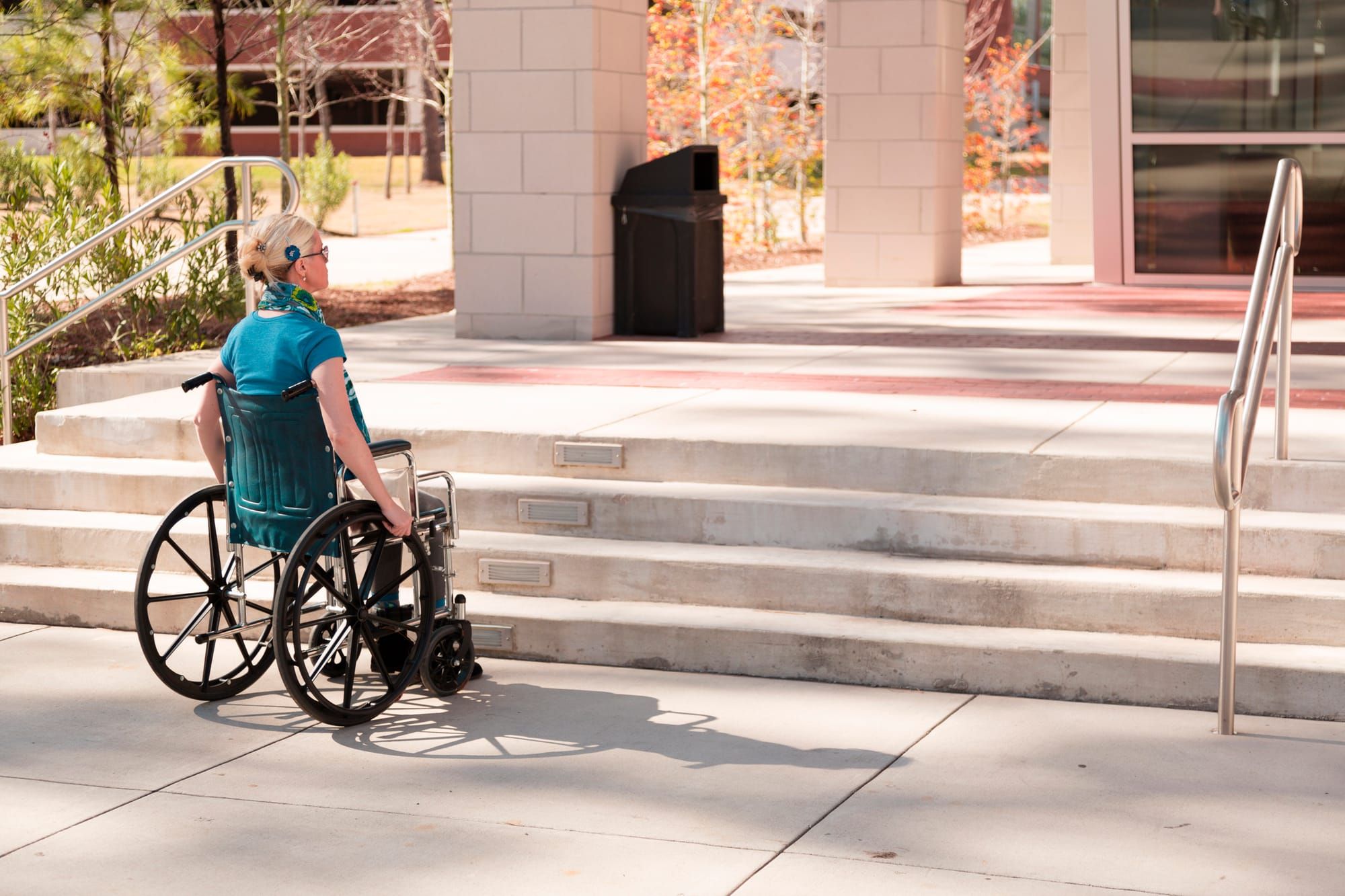
“People ‘who use wheelchairs for mobility’ could not establish a statutory violation when a courthouse has ‘no elevator’ or other means of access—even if forced to ‘crawl up two flight [sic] of steps’—unless they could prove that the architectural design constituted intentional discrimination,” the lawyers wrote as an example in the plaintiff’s response brief.
Doherty said these undue burdens would be devastating for disabled people across the country. But this is not the only protection currently being threatened or stripped away.
“The administration has already decimated the Department of Education’s Office for Civil Rights, meaning that families of disabled students have little to no recourse if their children face discrimination at school,” Doherty said. “I am concerned that unfairly raising the bar for proving discrimination in all areas of life would be yet another way to strip important rights and protections from the disability community.”
The potential ramifications of this case don’t stop with the disability community. In their reply brief, the plaintiff’s lawyers brought up that the anti-discrimination laws Title VI and VII of the Civil Rights Act of 1964 and Title IX of the Education Amendments of 1972 all use materially identical language to the ADA and may also be affected by a decision in favor of Monahan’s higher standard of “bad faith or gross misjudgment.”
“If you take seriously what the district is saying,” Roman Martinez, a lawyer for the plaintiff, told Prism, “then it would seem to imply that the bad faith or gross misjudgment test would apply to those other statutes too.”
Editorial Team:
Sahar Fatima, Lead Editor
Carolyn Copeland, Top Editor
Rashmee Kumar, Copy Editor
Author

Reina Sultan is a Lebanese Muslim movement journalist and one of the co-creators of 8 to Abolition. You may have seen her work in Vogue, VICE, ELLE, Business Insider, SELF, Prism, Yes! Magazine, and m
Sign up for Prism newsletters.
Stay up to date with curated collection of our top stories.