Filed Under:
‘It took a non-Palestine-related arrest for Columbia to activate’: Pro-Palestine activists call out disparate responses to student arrests
After Columbia swiftly denounced the immigration arrest of Elmina Aghayeva, Mahmoud Khalil referred to university’s mistreatment of activists as “the Palestine exception”
Biplob Kumar Das
Real journalists wrote and edited this (not AI). Independent, community-driven journalism survives because you back it. Donate to sustain Prism’s mission and the humans behind it.
Real journalists wrote and edited this (not AI)—independent, community-driven journalism survives because you back it. Donate to sustain Prism’s mission and the humans behind it.
The recent arrest of a Columbia University student by federal agents and the university’s swift denunciation of it have further exposed the school’s mistreatment and neglect of Palestine solidarity activists who were arrested or disciplined in the past year, some students say.
Elmina Aghayeva, a student from Azerbaijan, was arrested by Department of Homeland Security (DHS) agents on the morning of Feb. 26, after agents entered her university-owned apartment building claiming to be looking for a missing person, Columbia’s Acting President Claire Shipman said in a statement soon after the arrest.
“We are working to gather more information, working to reach the family, and providing legal support,” Shipman said.
By the afternoon, Aghayeva was released after New York City Mayor Zohran Mamdani made a call to President Donald Trump.
“We are all so relieved that our student, Ellie Aghayeva, has been released from federal custody,” Shipman said in a video message that evening. “I know our thoughts are with Ellie, her roommate, and all the affected students and staff tonight.”
For some students, the university’s response to Aghayeva’s arrest was in sharp contrast to its actions when Palestinian students and pro-Palestine activists on campus were arrested by federal agents last year. Aghayeva does not appear to have participated in the Palestine demonstrations.
“Unfortunately we did not see the same response for Palestinian students and ‘Free Palestine’ activists who had been detained,” said Cameron Jones, a student organizer with Columbia’s chapter of Sunrise Movement who has been part of Palestine demonstrations since 2023. “Columbia refused to say Mahmoud [Khalil]’s name for so long and did not provide any real, meaningful support.”
Columbia’s Office of Public Affairs did not respond to a request for comment by the time of publication.
Khalil, a Palestinian Columbia graduate and green card holder, was arrested last March by federal agents due to his involvement as an organizer in the 2024 Gaza solidarity encampment, during which students demanded the university call for an end to Israel’s genocide in Gaza and divest from companies that profit from Israeli apartheid.
The first time any Columbia official mentioned Khalil publicly was during Shipman’s commencement speech in May—over two months after his arrest. Khalil was released in June, but the Trump administration continues its efforts to deport him.
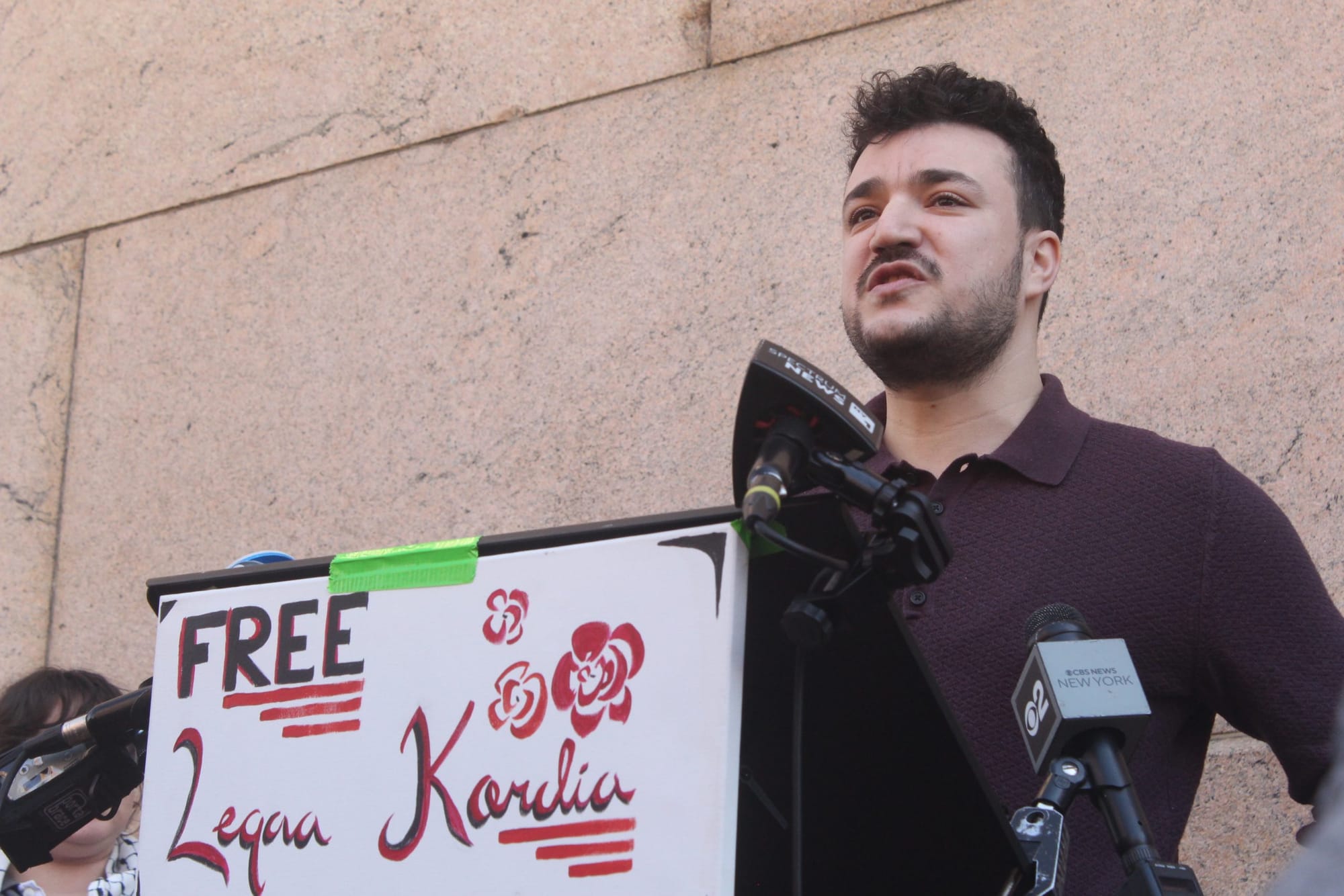
“I am very grateful that Ellie is safe and out because no one should be targeted the way that she was and we all were,” Khalil said at a press conference outside Columbia’s gates on Monday to mark one year since his arrest. “But it only took a non-Palestine-related arrest for Columbia to activate. And this is what we have been protesting since day one on this campus: the anti-Palestinian racism rooted in the Columbia administration.”
“The Palestine exception”
In the weeks after Khalil’s arrest, several Columbia students and encampment protesters were also arrested or threatened with detainment by Immigration and Customs Enforcement (ICE). Mohsen Mahdawi, a Palestinian student, spent more than two weeks in April in ICE detention. Before his arrest, Mahdawi had reportedly sought the university administration’s help to find a safe place to live. He did not receive a response.
Last spring, Ranjani Srinivasan and Yunseo Chung fled the university after learning that ICE agents were seeking to arrest and deport them for their participation in the encampment. And this week marks a year in ICE detention for Leqaa Kordia, a Palestinian activist who was arrested at a pro-Palestine protest outside Columbia. Calls for Kordia’s release have ramped up after she was hospitalized for a seizure last month.
In a statement posted the day after Aghayeva’s arrest and release, Khalil described Columbia’s reaction to ICE’s targeting of him and the other students: “No contact, no name spoken, no relief expressed, no resources offered, only months of institutional silence while we faced deportation and detention alone.”
“The shameful treatment of me and other Palestinian students … is not accidental. It has a name: the Palestine exception, and Columbia should be ashamed of it,” said Khalil.
Khalil’s and Aghayeva’s arrests both appear to have been carried out without a judicial warrant. The DHS agents who entered Aghayeva’s building did not have any kind of warrant, according to Shipman. Khalil’s wife recorded a video of her husband’s arrest that showed ICE agents handcuffing him inside his off-campus apartment building without a warrant. Court filings in Khalil’s case against the Trump administration later showed that the government did not have a warrant.
In Shipman’s video message after Aghayeva’s release, she said, “Misrepresenting identity and other facts to gain access to a residential building is a breach of protocol. All law enforcement agencies must have a judicial warrant or judicial subpoena to gain access to a Columbia residential building.”
“If Columbia activated all this support to me when I was arrested, maybe I would have been there for the birth of my child,” said Khalil, whose wife gave birth while he was in detention, at the press conference.
Shipman also said the university administration has never provided DHS or ICE assistance with arresting its students.
However, student activists said that when it comes to suppressing pro-Palestine speech, the school has shown that it will bend its knee to the Trump administration.
Sunrise Movement’s Columbia chapter posted a video last month that showed students questioning a university public safety officer who allegedly let ICE agents enter Chung’s dorm last March. The officer first denies knowing who the agents were, before saying he is not at liberty to discuss their identity and whether they showed any warrant before entering her apartment. A statement from the university later said that a warrant was shown, but attorneys have argued that the entire basis for that warrant was wrong.
In July, Columbia agreed to pay $221 million to the federal government in order to settle investigations into the university and restore its federal funding. As part of the settlement, Columbia also agreed to take steps to address purported widespread antisemitism on campus.
Aghayeva’s release is a testament to how strong Columbia’s resources are. It’s not a matter of capacity—it’s a matter of choice to not support its Palestinian students.
Tamara Turki, a Columbia Graduate who is Palestinian
Some Palestinian students expressed skepticism over whether Columbia’s public criticism of the DHS agents who arrested Aghayeva would extend to a larger push to hold the Trump administration accountable for how it has conducted immigration arrests.
“Yes, she is free,” Mahdawi said in an interview with “Democracy Now.” “But will Columbia University file a lawsuit based on this scam that DHS have done?”
“Aghayeva’s release is a testament to how strong Columbia’s resources are,” said Tamara Turki, a Columbia graduate who is Palestinian. “It’s not a matter of capacity—it’s a matter of choice to not support its Palestinian students.”
Punishing student protesters
The university has gone to extraordinary lengths to discipline its pro-Palestine student activists.
Since 2024, the school has expelled, suspended, and revoked the degrees of dozens of students. The university also established an Office of Institutional Equity to investigate all reports of discrimination and discriminatory harassment at the school. The office reportedly investigated students for putting up posters criticizing Israel.
Twenty-two of the students who were disciplined over their involvement in the Hamilton Hall (“Hind’s Hall”) occupation in 2024 sued the university last year. A state judge ruled earlier this month that the university’s action against these students was “arbitrary and capricious.” The court ordered Columbia to revoke its punishments.
“Columbia has no problem throwing out its students. But it will go out and use those very students to advertise its liberalism, its support for protesting, and the fact that its campus has a robust history of students who have been protesting, who have ended up being on the right side of history each and every time,” said Tahanie Aboushi, a New York attorney who represented the students in the lawsuit.
The university’s own archive of student protests shows that in 1985, about 300 of its students blockaded Hamilton Hall for about three weeks, demanding that Columbia divest from its investments in South Africa. Columbia divested from South Africa’s apartheid regime later that year.
To some pro-Palestine students, Columbia has done an about-face in its response to protests.
“The university is looking to target the most vulnerable protesters and get the U.S. government to use state violence against them, because they’d rather have that than have an honest conversation on divestment,” said Aharon Dardik, a senior at Columbia and co-founder of Columbia Jews for Ceasefire.
Jones, of Sunrise Movement, said he cannot imagine Columbia responding to the ICE arrests of its pro-Palestinian students with the support they showed Aghayeva. “The harassment that pro-Palestinian students face, the death threats, the doxing, rape threats—Columbia has done nothing to support us, nothing,” Jones said. “Because of that, I do not see any world in which the university will help its pro-Palestinian students.”
Editorial Team:
Rashmee Kumar, Lead Editor
Lara Witt, Top Editor
Kyubin Kim, Copy Editor