Filed Under:
I don’t want AI to do my laundry
Corporations are selling us a future free from mundane tasks. But there is meaning in the everyday maintenance of our lives
Adrienne Brown
Real journalists wrote and edited this (not AI). Independent, community-driven journalism survives because you back it. Donate to sustain Prism’s mission and the humans behind it.
Real journalists wrote and edited this (not AI)—independent, community-driven journalism survives because you back it. Donate to sustain Prism’s mission and the humans behind it.
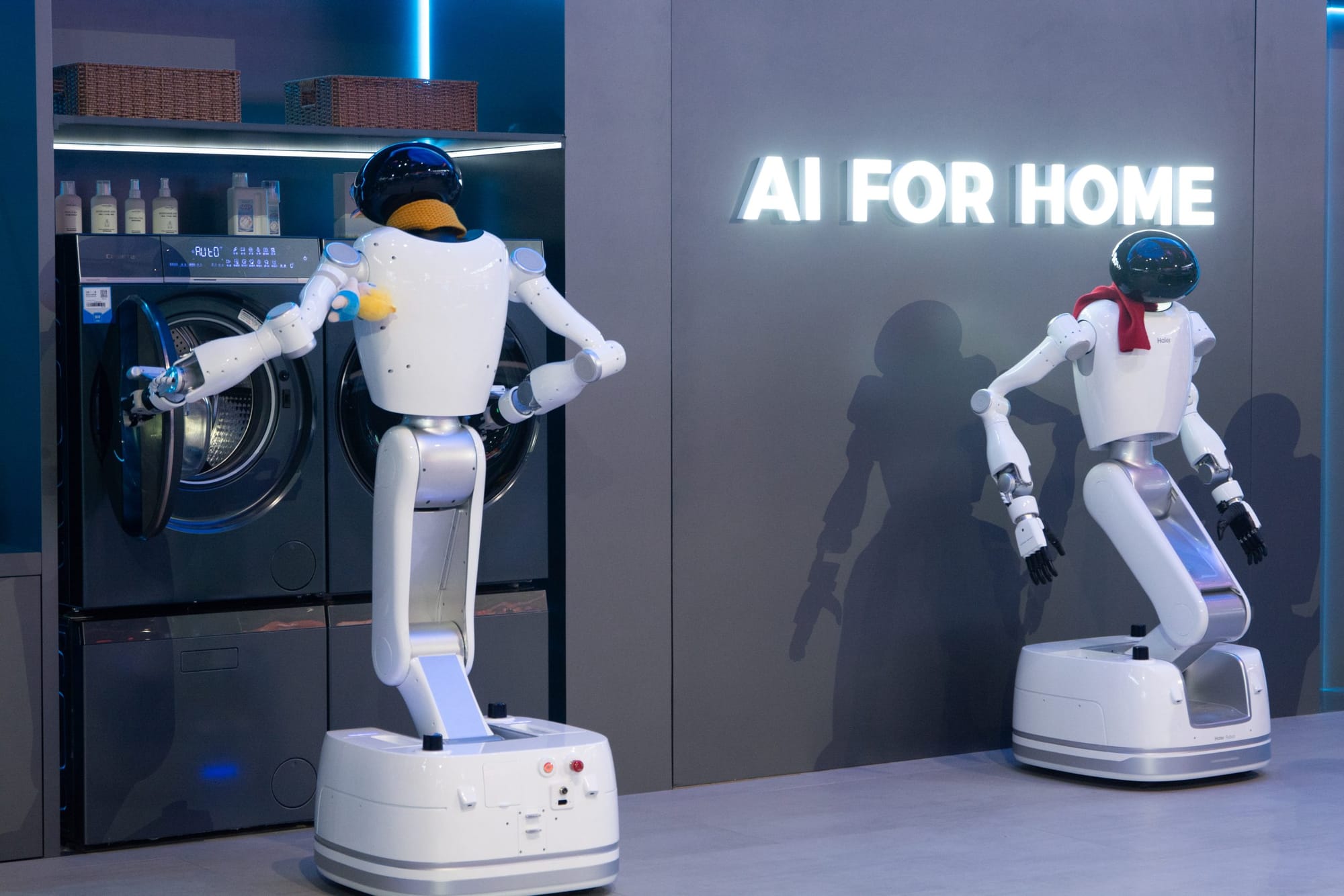
Earlier this year, LG Electronics unveiled a new physical artificial intelligence as part of their vision for a “zero labor home.” The AI “home robot” can fold laundry, prepare basic meals, and take on other household chores. The company’s promise is that it will finally allow “people to rest, enjoy themselves, and spend their time on more valuable activities.” Around the same time, first lady Melania Trump introduced Figure 03, a humanoid robot that can do chores and, chillingly, may soon be able to homeschool children.
“Imagine a humanoid educator named Plato,” the first lady said when introducing Figure 03. “Plato will provide a personalized experience adaptive to the needs of each student.”
There has been growing skepticism and outrage around AI’s intrusion into the spheres of science, art, and education. There is now a proliferation of AI-generated music, books authored by AI, and even an eerie AI actress put together from the bits and pieces of real-world people. This has led to multiple ongoing lawsuits against the companies that steal artists’ work to train their generative AI models.
In the face of these existential threats—the decline of science, the theft and dehumanization of art, the replacement of teachers with machines—AI chorebots seem pretty harmless. In fact, the idea that AI could tackle the mundane tasks of everyday life so that we might have the time and energy to commit to our craft is tempting. In our imaginations, we may picture a world that is entirely generative, where we might outsource the dull maintenance of living to the machines. Indeed, AI has already started taking over some everyday tasks for many: It builds shopping lists, writes emails, and schedules appointments.
And yet, these seemingly mundane tasks are important sites of cultural creation and meaning-making. Sociologists study rituals for this reason: They are how people craft and maintain their identity, how social norms are produced, and where power dynamics play out. Although they can create strong emotions, rituals don’t require profound religious experiences. Instead, their power shows up in the most ordinary moments, including casual conversations, social media, and other leisure activities.
While these social interactions are important, so, too, is solitary action, the things we do alone. In the privacy of our homes, we act out the social messaging that we receive in the world. And yet, this can also be a place where new social forms are imagined. In 1970, “the personal is political” became a rallying cry of second-wave feminists for a reason. It means the individual is the collective, the ordinary is extraordinary, the everyday is everything.
Similarly, in 1969, artist Mierle Laderman Ukeles wrote the “Manifesto for Maintenance Art,” in which she sought to situate the tasks of everyday life as art itself, writing, “My working will be the work.” In it, she ties personal maintenance—“a hell of a lot of washing, cleaning, cooking, renewing, supporting, preserving”—to the collective, including maintenance of the Earth itself.
The traditionally feminized practice of care is set apart from the hypermasculinized notions of disruption that dominate places such as Silicon Valley, where creation and destruction are one and the same.
Half a century later, artist and author Jenny Odell, in her 2019 book “How to Do Nothing: Resisting the Attention Economy,” returned to Ukeles’ maintenance art. Both Ukeles and Odell understand the gendered disparagement of domestic tasks and their distinction from more high-minded “art with a capital A.” The traditionally feminized practice of care is set apart from the hypermasculinized notions of disruption that dominate places such as Silicon Valley, where creation and destruction are one and the same.
Of course, it is also true that modern life can feel like too much. For workers forced into multiple low-wage jobs, busy mothers, and others, there is a real lack of time. It is tempting then to embrace technology that promises an escape from household burdens.
But we’ve been down this road before.
Microwaves, washing machines, and the car all promised more time. There is some evidence that the average American’s leisure time has increased. How we spend that time is another matter. “Lifestyle creep” demands constant consumerism to coincide with increased income, pushing people to “grind” and “hustle” and monetize their hobbies. Time use surveys also consistently show that television and social media dominate Americans’ off-work hours. All of that is to say: Our free time has not translated to freedom.
This struggle is not one of efficiency, but of justice. What we crave is not a machine to fold our laundry, but a workplace that provides economic security without monopolizing our time, domestic arrangements that more fairly distribute household tasks, and maybe even a life that revolves less around consumption. Changing these things is more than a lifestyle choice: Affordable housing, reliable public transit, and support for a sharing economy are policy choices.
Maybe we can make AI that does your laundry or washes your dishes, and maybe those things would make your life a little easier. But what will you do with those minutes, really? The market is dominated by a short cycle of creation and abandonment. Landfills are stuffed with fast fashion that falls apart after a few wears. Planned obsolescence pushes us into constant upgrades for our tech. This is the task of generative AI: It creates anything and maintains nothing. They want us to believe that we ought to do the same.
Some synonyms for maintenance: care, preservation, safeguarding, protection. Its antonym? Neglect, destruction. I know that when I fold my laundry, I am taking on the responsibilities of ownership. When I clean my floors, it is part of how I transform my house into a home. For centuries, the wealthy have outsourced these tasks to slaves and servants, exchanging humanity for capital. And what has that exchange built that is worth preserving?
Mundane tasks bind me to the world. I am not ready to surrender them to the machines.
Editorial Team:
Tina Vasquez, Lead Editor
Lara Witt, Top Editor
Stephanie Harris, Copy Editor