The Yukon River is “a living being”: The fight to protect the longest salmon run in the world
A movement in Canada for the Yukon River to be granted legal personhood is reaching across the U.S. border
Real journalists wrote and edited this (not AI)—independent, community-driven journalism survives because you back it. Donate to sustain Prism’s mission and the humans behind it.
Nika Silverfox-Young heard the stories of her ancestors’ rich relationship with the Yukon River and the many forms of life it supported for the first time in her native language in 2022, when she began learning Northern Tutchone.
The 30-year-old’s paternal great aunt, who she affectionately calls Grandma Lizzie, told her how in order to spawn, the salmon followed ancient navigation lines from the Bering Sea to the tributaries of the Yukon River, their shared home with the Little Salmon Carmacks First Nation in Yukon, Canada.
As the salmon reached the mouth of the river, they would stop eating. The adults focused wholly on the next generation, whose survival required that mature salmon arrive at a gravel-bed nest at the end of their journey on the longest salmon run in the world. Silverfox-Young’s ancestors built eddies in the Yukon River for the salmon and clapped rocks together to guide them to their place of rest.
First Nations youth today aren’t able to fish, prepare, and learn about salmon in the hands-on way that Silverfox-Young did when she was growing up because the Yukon River and its salmon are in peril. Climate change, commercial fishing, and mining threaten salmon health and population numbers, while an intricate web of federal and state laws prevents First Nations in Canada and Alaska Native tribes from protecting the species that they have co-evolved with since time immemorial.
Indigenous peoples living along the river view the body of water as a relative and as a lifeline, while American and Canadian governments regard waterbodies as a resource to extract.
With a decimated salmon population, Silverfox-Young, of Little Salmon Carmacks First Nation, said she has been asking herself what the salmon crash means for the identity of her people. “If we don’t have salmon, are we still Little Salmon people?”
If we don’t have salmon, are we still Little Salmon people?
Nika Silverfox-Young, To Swim and Speak with Salmon Youth Lead
Silverfox-Young is committed to using her “voice for the salmon.” She’s the youth lead of To Swim and Speak With Salmon, an Indigenous-led group that trains young people to be salmon advocacy leaders. To Swim and Speak With Salmon is one of many Indigenous groups at the helm of a new struggle to champion the ability of salmon to thrive, while advocating for the Yukon River to be granted legal personhood rights on both sides of the Canada-U.S. border.
Granting the non-human living ecosystems legal personhood recognizes that humans are a part of nature and not separate from it. Simply put, legal personhood would grant the Yukon River the right to flow, to remain free of pollution, and to be represented in court if these rights are violated.
A subset of the broader Rights of Nature movement that uses Western legal frameworks to enshrine Indigenous worldviews, personhood status for the Yukon River could determine if future generations of Indigenous and First Nations peoples will be able to practice their cultures.
Working across colonial boundaries
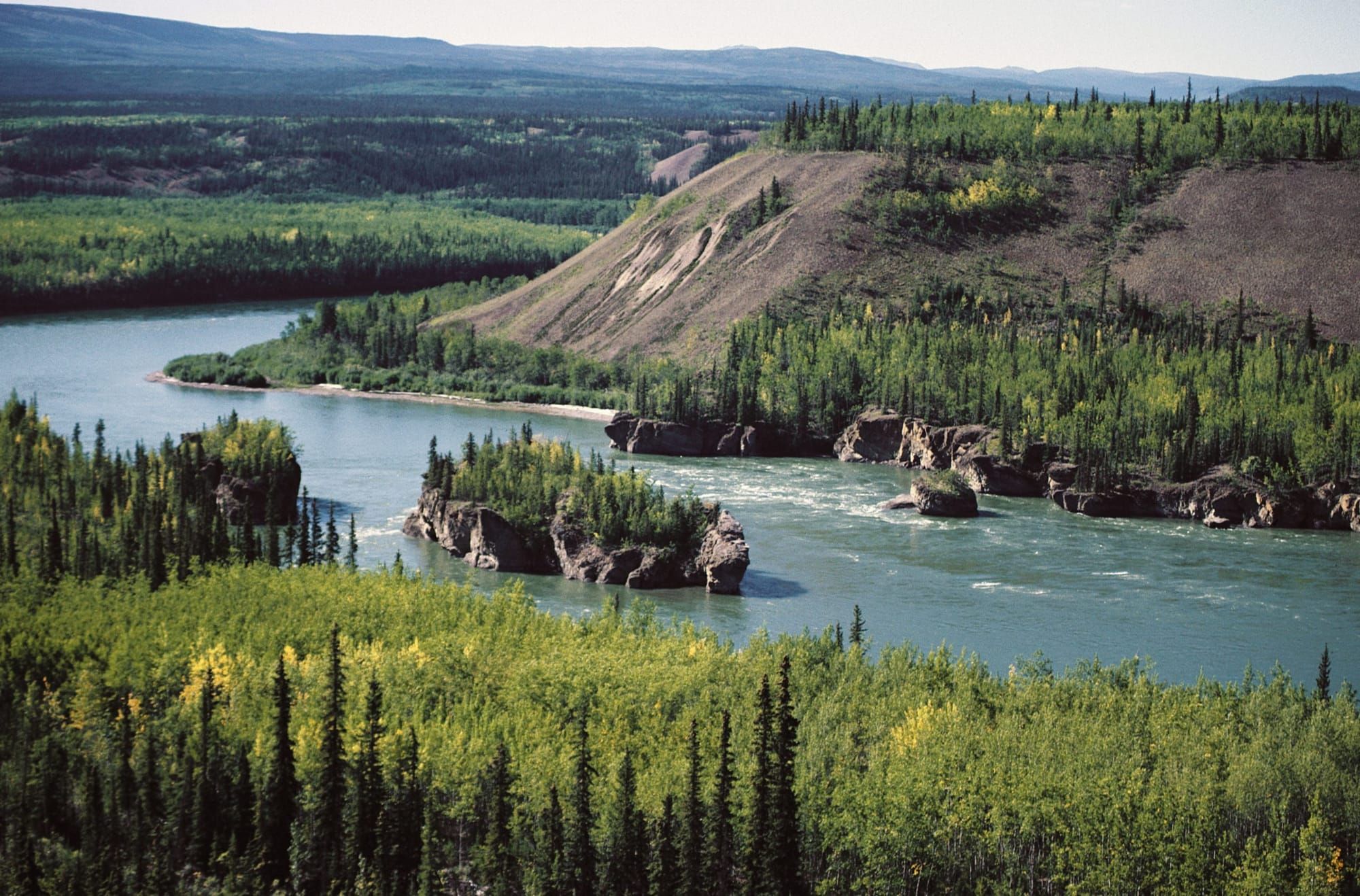
Since time immemorial, 73 Indigenous and First Nations tribal communities in Alaska and Canada have made their homes along the banks of the 1,980-mile Yukon River, whose headwaters are located in northwestern British Columbia and flow into Yukon Territory, across Alaska, and into the Bering Sea.
Efforts to codify legal personhood for the Yukon River require Indigenous leaders and water protectors to navigate a complex and constricting terrain of laws.
Salmon health is predicated on the health of the entire riverine system, but different parts of the river are under different jurisdictions and are therefore subjected to different legal standards. In Canada, for instance, First Nations entered into treaties that uphold their ability to co-manage the river, called the Umbrella Final Agreement, which was enacted in 1990. The work of the Tr’ondëk Hwëch’in to draft a declaration of personhood falls under the Indigenous Protected and Conserved Areas, Indigenous laws that designate land protection first through First Nations and then through co-management agreements with territorial and federal Canadian law.
However, a formal co-management agreement doesn’t exist between Alaska Native tribes and U.S. federal or state governments, which hinders the autonomy of Alaska Natives in fishing and conservation efforts and places a hurdle for the Indigenous-led Rights of Nature efforts in Alaska.
Even treaties, which in the U.S. typically dictate the federal government’s obligations to tribal nations and guarantee other rights that uphold and maintain tribal sovereignty, don’t afford Alaska Native tribes the authority to set standards for how the river should be treated. In other cases, the state of Alaska has argued that “subsistence” fishing only applies to non-navigable bodies of water. Distinctions between state and federal land further splices the Yukon River into individual pieces that the Alaska Department of Fish and Game calls “a complex mosaic,” which advocates say obscures the fact that the river is a continuous whole system rather than an assemblage of parts.
In some ways, the artificial borders created by colonial governments are only strengthening Indigenous peoples’ and First Peoples’ determination to work across boundaries in defense of the Yukon River.
Citizens of the Tr’ondëk Hwëch’in First Nation in Dawson City, Yukon, are drafting a declaration of personhood for the Yukon River and plan to share it with the Council of Yukon First Nations, a political advocacy organization for the territory’s First Nations. Many of the 14 Yukon First Nations are beginning to shape declarations of their own, said Tr’ondëk Hwëch’in Chief Darren Taylor, a leader in the personhood movement. Taylor said the Tr’ondëk Hwëch’in’s plan is designed so that it will not be a detriment to the economy or shut down mining, but simply designate protected areas, building its Indigenous laws to fit around Western frameworks that protect economic interests.
“It’s important that we don’t pollute this river, that we don’t abuse it,” Taylor said. “It’s a living being, from our perspective, that warrants the highest level of protection that we can possibly achieve.”
How the Rights of Nature movement was born
The Rights of Nature movement, where in some cases ecosystems are given personhood status, is global. In 2008, Ecuador became the first country to enshrine Rights of Nature laws in its constitution. In 2014, New Zealand transferred land ownership rights of the Te Urewera forest from the government to the land itself, designating the Māori as legal guardians, the conclusion of a 150-year fight. Now, more than 30 countries recognize these laws in some way.
The first Rights of Nature agreement in North America was in Tamaqua Borough, Pennsylvania, in 2006, when the borough passed an ordinance banning the dumping of toxic sludge in the town’s abandoned coal mining pits, which were leaching into groundwater and the Schuylkill River. The first river in North America to have its legal personhood rights recognized was the Klamath River, formalized by the Yurok Tribe in 2019 in southern Oregon and northern California, according to the University of Arizona Native Nations Institute’s Indigenous Governance Database.
In this case, legal personhood status laid the groundwork for the largest dam removal project in American history, restoring migration routes for chinook salmon and steelhead trout to their spawning grounds. On Nov. 6, 2025, the Colorado River Indian Tribes recognized the legal personhood of the Colorado River. In 2021, a joint agreement between the Innu Nation and the Minganie Regional County Municipality in Quebec recognized the personhood of the Magpie River, also known as Mutehekau-shipu in the Innu language. It was the first agreement of its kind in the country, according to the Earth Law Center.
Jared Gonet, program director of To Swim and Speak With Salmon, explained that the interest in Rights of Nature frameworks is due to two factors: increasing intensity of the collapse of biodiversity brought about by climate change, as well as a rising recognition that Indigenous practices hold the key to avoiding the worst of the climate crisis’ consequences.
Simply put, Gonet said the way someone thinks about a river determines the way they make decisions about it. He said that if people think of the river as a person, they are less likely to make decisions that have an economic benefit for some in the short term, but create an environmental problem that takes generations to reverse.
Mackenzie Englishoe, a Gwichyaa Gwich’in of Gwichyaa Zhee, also known as Fort Yukon, Alaska, foresees the biggest challenge in the fight for personhood from colonial governments, as the advocates work to impart their Indigenous values onto the governments that have stripped them of their rights—which Indigenous people believe are inherent for all living things, differing from the Western concept of rights, which can be bestowed or taken away..
“Indigenous people know that this is the answer, and this is our relationship,” she said. “We view the river as a relation, but how are we going to get that perspective to the U.S. representatives and Canadian representatives in government to where they can understand it from our perspective?”
Rights of Nature frameworks go up against deeply ingrained cultural values. In the U.S., “nature” is legally defined only as property. This dominion over ecosystems laid the groundwork for federal environmental laws like the Clean Water Act to be written in such a way that instructs polluting industries on what acceptable levels of pollution are based on a narrow set of water quality indicators, rather than protecting water bodies based on varying factors of ecological health.
Ben Price, education director for the Community Environmental Legal Defense Fund,said the concept of personhood is “provocative” under American law because it conflicts with the claim that “if you own something, you can do whatever you want with it.” Treating the planet as property, he said, “means that all life on Earth can be put in jeopardy, and that property owners have a right to do it.”
“That’s obviously illogical, and so that’s why things have to change,” he said.
The Rights of Nature movement has allowed Indigenous people to push back against harmful industrial projects, said Carole Holley, managing attorney in the Alaska office of Earthjustice, a nonprofit environmental law organization. She cited an example with the Yurok Tribe’s efforts toward Klamath River personhood, which resulted in four dams being dismantled.
In Canadian and American jurisprudence, the concept of personhood for non-humans is common—but not for nature. Holley explained that legal personhood has been offered to corporations, churches, and nonprofit organizations.
“When we’re talking about personhood in this context, it’s … just giving that river the same right that some corporation might have, to be able to have someone go to court for them and stand up for its rights to exist,” Holley said.
While she does not foresee the current Alaska or U.S. governments recognizing legal personhood for a body of water, Holley said a tribal agreement could be used persuasively in permitting decisions. While a tribal agreement would not be legally binding, she said the message of personhood is important beyond the legal aspects.
“Trying to break down some of the artificial separation between humans and nature is helpful, and to continue that push internationally, I think that helps change—maybe slowly—the way we think about things,” she said.
Protecting the Yukon River and its salmon
For Nicole Rondeau, who was previously known as Nicole Tom and served as the chief of Little Salmon Carmacks First Nation, growing up along the Yukon before the salmon crash meant her childhood summers were defined by large family gatherings, harvesting salmon, and filling their traditional salmon smokehouses, or caches.
“My favorite part was running under all of the fish that was hanging and trying to find the little teeny dry bits at the very, very end, so that I could sneak some before it was done,” she said.
Since the salmon crash, Rondeau buys coho or sockeye salmon caught in the Taku River, about 150 miles away, from a commercial distributor in British Columbia to pass on Indigenous knowledge and Northern Tutchone heritage to her daughters. Her youngest daughter, age 10, has never been to fish camp. Rondeau smokes the salmon in a traditional cache she built.
“It’s not the same,” Rondeau said. “We’re not touching the water. We don’t see the fish head. We don’t see the fish guts. It’s really kind of odd.”
She said that buying a fish meant for consumption erases the connection to the life of the salmon, but she is grateful for the opportunity to show her daughter some aspects of the traditional process.
She was chief when she saw the numbers of salmon sharply decline and had asked the citizens to stop fishing. There is an Indigenous teaching to let a species rest in times of crisis, and she has seen the teaching allow caribou to repopulate.
“That is probably one of the hardest things I’ve ever had to do, when you are requesting your citizens to give up their inherent right of harvesting a species when you know that they need it,” she said.
Rondeau is “Auntie Adviser,” or a mentor to the young leaders of To Swim and Speak With Salmon. She said that personhood is “habitat protection.” She would like to see each of the First Nations develop their own water management plans, enact mining and pollution legislation, and determine consequences for anyone who violates the water with contaminants.
While the movement is gaining momentum, Rondeau said that federal support from Canada will be necessary to update the infrastructure polluting the Yukon. She reflected, “We’re looking at a huge amount of First Nation peoples who need to hold hands and walk like brothers and sisters in order to do what they know in their heart is right.”
Editorial Team:
ray levy uyeda, Lead Editor
Carolyn Copeland, Top Editor
Rashmee Kumar, Copy Editor
Author

Alyssa Choiniere is an independent journalist based in southwestern Pennsylvania. She holds a Master of Arts degree from Columbia Journalism School. Her work has appeared in the Wall Street Journal, A
Sign up for Prism newsletters.
Stay up to date with curated collection of our top stories.