Elon Musk has built the world’s largest supercomputer in Memphis. Residents are fighting back against the exploitation of the city’s resources
Local organizers say they have less of a chance at making climate reforms in the majority Black city than Musk does at imposing environmental harms
The plan to build Colossus, the world’s largest supercomputer, moved so quickly and secretively that officials in Memphis, Tennessee were gobsmacked when billionaire Elon Musk’s project was announced as a done deal in June 2024. No one knew the plan was in development except for the Greater Memphis Chamber of Commerce, the region’s publicly owned utility company Memphis Light, Gas & Water (MLGW), and the city’s mayor.
There were no public information meetings or environmental reviews, and there was no comprehensive outreach to local residents. The artificial intelligence data center would consume water and electricity on the level of whole cities and produce untold and unregulated air pollutants, further entrenching the majority Black city’s status as one of the unhealthiest in the country.
Residents were outraged. By summer’s end, the building on Riverport Road, previously occupied by a household appliance manufacturing company called Electrolux, was transformed. It took just 122 days for Colossus to come online.
Selling Memphis short
More than nine months after officials fast-tracked the endeavor from Musk—who is also now a dangerous White House staffer dismantling federal agencies such as the Environmental Protection Agency (EPA)—Memphis residents are still waiting for answers.
Months of grassroots organizing for accountability from local officials, pollution controls from state agencies, and answers from xAI, the Texas-based company owned by Musk that is behind the supercomputer, has resulted in a few wins. For example, local groups learned that numerous city officials signed nondisclosure agreements with xAI. The company has also come back to the table with tentative plans to belay the water and energy use burden of its operations by agreeing to a slate of infrastructure projects, including a greywater recycling facility, company-funded changes to the utility’s distribution operations, and battery storage to ease pressure on the utility grid.
But “plans are not promises,” said KeShaun Pearson, the director of the grassroots organization Memphis Community Against Pollution (MCAP). A glaring question hangs over Musk’s efforts to reduce pollution: If there was no accountability going into xAI’s construction, what promise for accountability is there now, when Musk’s company already has what it wants?
“The chamber, they’ve been very guarded of xAI,” said Memphis City Council member Pearl Walker, who is also the director of grassroots organization Memphis Has The Power. “xAI pretty much just does what they want to do and they just kind of follow what the chamber tells them, which is not always within the best interest of the public.”
The “do first, apologize later” model that xAI, the region’s utility, and the chamber of commerce—a private non-elected entity—have adopted puts Memphis residents on the back foot. This has essentially forced them to accept a slurry of environmental damages in exchange for “nothing,” according to LaTricea Adams, founder, CEO, and president of the nonprofit environmental justice organization Young, Gifted, and Green. xAI claims that 300 jobs would result from its business operations in the city, but organizers say there’s no guarantee that those jobs would go to Memphis residents. Either way, the jobs come at too high a cost for public and environmental health. The Institute for Energy Economics and Financial Analysis notes that data centers offer far fewer employment opportunities than other industrial sectors, largely because they require minimal staffing despite their extremely high municipal energy burden.
“Memphis leadership sold the city short,” Adams told Prism. “I hate to sound crass, but if you’re gonna pimp the city out, at least go with the highest bidder.”
Pearson and Adams were both born and raised in Memphis and, after brief periods elsewhere, returned to their hometown, drawn back by family and the desire to protect them. Through leadership in their respective organizations, they both make connections between how low-income Black communities of Southwest Memphis are being degraded and sacrificed by xAI—not to mention the public servants who greenlit the project—and the manifold histories of Black life in Memphis since the genesis of the western Tennessee town.
It’s a story of land, people, and water: how the Mississippi River that abuts Memphis’ business district was both a main method of transportation for goods and people, and the riverine highway where Black people were bought and sold as human cargo. Dehumanized by the legal apparatus of slavery, Black peoples’ labor was extracted by force to build the city of Memphis atop land annexed from its Indigenous stewards by orders from the federal government.
The story of how Memphis came to be is inextricable from how xAI came to be in Memphis. Now rooted in the Southwest portion of the city, xAI’s data center is neighbor to T.O. Fuller State Park, the first green space built for Black residents during the Jim Crow era on former plantation land. Just east of the former Electrolux building is Boxtown, a disinvested neighborhood that was once the only area Black residents could legally live in, named for the houses Black workers built out of materials used for boxcars from the nearby railyard. Boxtown is now the most polluted neighborhood in Memphis, surrounded by an oil refinery, a steel mill, a recently shuttered cancer-causing sterilization facility, and a number of Superfund sites.
History never repeats itself, not exactly. Organizing around xAI is less about preventing the repetition of the past and more about intervening in the systems that threaten to bring history’s violence into the present. A history in which Black labor was once seen as a white landowner’s birthright informs a present when job opportunities are offered as incentive for pollution. A history in which the Black vote in Memphis was routinely diluted by incorporating more white suburbs into the city’s polity informs how a massive consumer of the public’s resources can instantiate itself without the public’s input.
And residents want answers.
“Path of least resistance”
On June 5, 2024, when the xAI deal was publicly announced, Pearson of MCAP was in a meeting with Memphis Mayor Paul Young, discussing environmental projects for the city to take on. Pearson said he was “in shock” when Young broke the news to him of xAI’s arrival. It felt ironic, Pearson said, that a Memphis resident has less of a chance to make climate-friendly changes to the city than an out-of-town company does at imposing untold climate harms.
“There should be no way a $5 billion project can move forward without a single community [meeting],” Pearson said, noting that the decision reinforced the community’s feelings of being ignored and disenfranchised, and confirmed suspicions that official discussions were taking place behind closed doors. “This is literally what corporate colonialism looks like.”
You don’t become the moniker for technological innovation because someone comes in and exploits your natural resources, your water, exploits the loopholes that allow them to pollute the air.
KeShaun Pearson, Memphis Community Against Pollution
As for the chamber’s claim that Memphis is slated to become the “Digital Delta” by enticing science and technology businesses, Pearson isn’t buying it. “You don’t become the moniker for technological innovation because someone comes in and exploits your natural resources, your water, exploits the loopholes that allow them to pollute the air,” Pearson said. “That’s not what makes you a technological city. That spin is dangerous because it opens our city up for exploitation even further.”
xAI did not respond to a request for comment.
In the months since the public announcement, community groups and residents have gained access to more details. Water to cool the data center’s equipment will come from the Memphis Sand Aquifer, an underground geologic formation that provides all of Memphis with its drinking water. Sarah Houston, executive director of Protect Our Aquifer, said the aquifer is like a giant sandbox. As water makes its way through the fine sand particles, it is naturally filtered and kept safe between thick layers of clay.
Protect our Aquifer has long worked to fend off threats to the region’s valuable hydrologic ecosystem. Houston told Prism that xAI will withdraw one million gallons of water per day to cool its computers, creating the conditions for chemicals to leach into the underground water storage. As water flows deeper into the aquifer to replenish what’s taken out, chemicals like arsenic from industrial waste buried underground also get pulled down. Pollution sources include millions of tons of coal ash trucked in from the nearby Tennessee Valley Authority (TVA) and dumped in Southwest Memphis. Houston estimated that at this rate of depletion, the public water source will be polluted in 10 to 15 years.
“We really haven’t hit a crisis enough to motivate large-scale change here,” Houston said. “We’re trying to be proactive and avoid a crisis.”
The proactive plan is to build a wastewater treatment facility, Houston said. This goal has been in the works for a couple years, initially suggested as a means of weaning the TVA off the aquifer for its operations, which, during times of extreme cold, puts access to municipal drinking water at risk. The two local and regional utility management agencies— MLGW and TVA—agreed that the federal agency would instead rely on recycled wastewater for its operations.
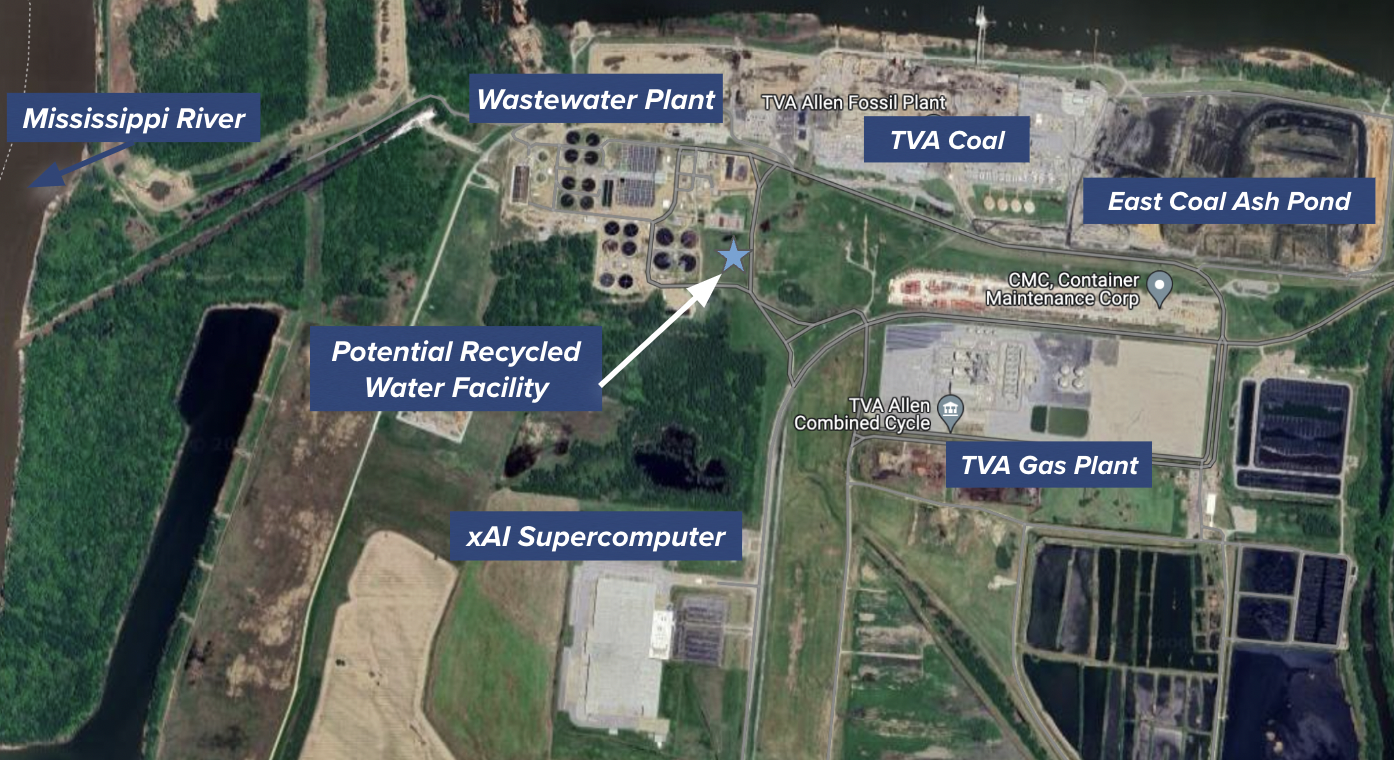
The only problem was that no such facility exists—yet. Until now, there’s been no way to fund the construction of the facility, except for raising rates for MLGW customers—something Protect Our Aquifer would not advocate for, Houston said. The community advocacy group sees xAI’s agreement to build, finance, and operate the nearly $80 million wastewater treatment facility as perhaps the only way Memphis residents stand to benefit from the data center. TVA and a nearby steel manufacturer have signed letters of intent to purchase water from the plant when it is operational.
Even though Protect Our Aquifer managed to secure material benefits that service long-term community needs, Houston isn’t celebrating. Despite the appearance of cooperation with public agencies, xAI has sporadically announced expansion plans on a whim, with little to no details about water, power, and pollution mitigation. In October, an “economic empowerment” board that reports to the city of Memphis and Shelby County approved a 21-year lease for the 500 acres that surrounds the Colossus data center. Houston told Prism that xAI has yet to make the public aware of what that land will be used for.
When it comes to community engagement and benefits, “it’s always too little, too late with what they’re doing,” Houston said. “This is not how community engagement and public transparency should be treated.”
Water isn’t the only concern. The massive data processing facility also intends to use up to 150 megawatts of power. MLGW, the utility in charge of managing the region’s energy grid to mitigate strain and overuse, has the authority to approve up to 50 megawatts of usage. One megawatt can power around 300 homes for a day. But xAI wants to increase its power consumption to about 150 megawatts per day, requiring that the data center connect to an even larger grid operated by the TVA. The TVA has given every indication that it plans to approve the request for usage. For months, xAI relied on its own methane gas-powered generators to supply the plant with power.
Houston is concerned that no local, state, or federal agency appears to be monitoring the use or impact of the generators that produce ground-level ozone, a harmful particulate matter pollutant that is the main component of smog. The EPA previously stated that it’s not required to monitor air pollutants from semipermanent sources like turbines, even if the pollution comes from industrial sources. The EPA and the Shelby County Health Department did not respond to Prism’s requests for comment.
Even before xAI landed in Southwest Memphis, air quality was a concern. Memphis consistently ranks as the leading “asthma challenged” city across the nation’s largest 100 cities. Southwest Memphis is of particular concern as an asthma “hot spot” for its proximity to industrial polluters. Nationally, Black children are more than twice as likely to develop asthma as white children.
It’s not a mystery why health outcomes so often fall along lines of race and class, or why urban planning in high-income areas prioritizes green space, leaving poor areas to contend with industry. Renters and people with low incomes face more environmental disparities and health issues arising from the built environment, such as mold, inadequate or unhealthy water and sewage, or a lack of air conditioning. Neighborhoods where a majority of residents are nonwhite are twice as likely to face environmental harms. BIPOC, regardless of income level, are also disproportionately likely to suffer exposure to particulate matter, which can lead to chronic heart and lung function deficiencies.
Geography as the great predictor of health doesn’t need to be announced to residents of South Memphis.
“I don’t think Germantown, Collierville, and upper-class people would approve for [Colossus] to happen,” said Rose Sims, a lifelong Memphis resident who lives in the southwestern part of the city, told Prism. “I think it’s so unfair.”
For Sims, xAI’s descent into the city is all too reminiscent of previous battles against polluting industries. In 2020, residents formed MCAP—then Memphis Community Against the Pipeline—to defeat plans for a pipeline that would run clear through the southern part of the city, a location chosen because industry saw it as the “point of least resistance.” Residents, familiar with being underestimated, showed Byhalia Pipeline that Memphis and its rich history of civic organizing and protest, was actually a point of resistance.
MCAP then jumped into its next fight against Sterilization Services of Tennessee. For five decades, the company sterilized medical equipment with a chemical called ethylene oxide, which can cause non-Hodgkin’s lymphoma, breast cancer, respiratory illnesses, and other mutagenic illnesses. Many in the Southwest Memphis neighborhood felt their illnesses and chronic pain were a result of continued and unmitigated exposure to chemical emissions from the site.
I don’t care if we have $5 and I don’t care if they got a million, but it isn’t fair to us as human beings that we got to suffer because of what somebody else wants.
Rose Sims, Memphis resident
In 2022, the legal nonprofit Earthjustice filed a Clean Air Act lawsuit against the EPA on behalf of residents. Two years later, in April 2024, Sterilization Services of Tennessee closed its doors permanently. It was the second win in four years. Many locals exhaled, hoping they could finally rest a bit. While the consecutive fights galvanized the renewed and powerful environmental justice movement in Memphis, organizers hoped that going forward, they might be on the offensive footing for once.
Then came xAI.
“I really don’t understand why we back here again and got to deal with this,” said Sims, who was a part of the campaign to shut down Sterilization Services of Tennessee. “I don’t care if we have $5 and I don’t care if they got a million, but it isn’t fair to us as human beings that we got to suffer because of what somebody else wants.”
“Ecological afterlife of slavery”
If one were to superimpose a map of current-day industrial facilities along the Mississippi River onto that of plantations in the antebellum U.S., there’d be little room to question how carceral geographies—and the logics they traffic—foreground contemporary environmental injustices.
Some organizations, like the United Nations, refer to this continuation of enslavement economics as “environmental racism,” according to a 2021 report on the health injustices faced by Louisiana residents living in what’s dubbed as “Cancer Alley.” Organizers with The Descendants Project, which facilitates intergenerational healing for those whose ancestors were forcibly enslaved in Louisiana along the Mississippi, say that polluting facilities exist in the “footprint” of plantations. University of California Berkeley assistant professor of geography Tianna Bruno calls this connection something else altogether: “the biophysical afterlife of slavery.”
“Social and political processes that leave Black communities to disproportionately experience environmental pollution and climate change impacts are deeply informed by plantation logics of dehumanization of Black populations and ecological degradation for the sake of capital accumulation,” Bruno wrote in a 2022 paper.
Anti-Black racism codified by the legal economic structure of slavery brought about real changes to landscapes, Bruno found. Deforestation, soil depletion, and water systems modification along the Mississippi River transmuted into contemporary environmental struggles that those with little geographic freedom were forced to live among. The economic system that rendered plantations economically viable no longer exists, but its legacy does. The area where the Electrolux facility once stood and now houses Colossus has been zoned for industrial usage for nearly a century, meaning that the data center didn’t need to apply for industrial permits prior to moving in. The past, quite literally, laying the foundation for the present.
In some cases, demographic presence is thought to translate into political savvy and power. That was the case for Southwest Memphis, where a majority of residents are Black and low income. Industry believed these facts indicated a relative ease with constructing its fossil fuel infrastructure.
Daniel Faber, a sociology professor at Northeastern University, told Prism that historically, states have chosen the locations for toxic facilities based on where political opposition is thought to live. Neighborhoods where the majority of residents are white are often shielded from debates about the siting of landfills, incinerators, and other polluting entities, while communities of color are forced to take them on because their voices are not seen as politically valuable. One decadeslong study published in 2016 found that this “path of least resistance” approach taken by industry rang true in their study of 319 hazardous facilities.
“The dominant strategy that has been employed by American business over the last 20 or 30 years is to follow the path of least resistance and to increasingly discard greater quantities of pollution or cause greater environmental abuse because it saves them money on investing in pollution control and technology and boosts their profits,” Faber told Prism.
Just as MCAP’s Pearson feared, Faber said that the time-tested result is a wheel of negative consequences that muddle what’s seen as the original and inciting pollutant. At the same time, it becomes exceedingly difficult for a community to extricate itself from a dynamic in which the presence of harmful facilities offers a green light for industry to impose more harmful facilities.
But Faber notes that there’s no federal law preventing communities from the cumulative impact of polluting entities, which is why it’s completely legal for a region like Southwest Memphis to struggle against the menu of pollutants that has resulted in the neighborhood’s life expectancy being 10 years lower than that of the rest of the city’s residents.
“[It’s] no coincidence that a significant amount of pollution [and] where the fossil fuel infrastructure that’s being built out is happening in the South,” said Tennessee state Rep. Justin J. Pearson, who is also KeShaun Pearson’s younger brother “This extractive relationship that this country has with poor people, Black people, Indigenous people, and marginalized communities is rooted in this plantation economy that devalued the lives and now devalues even the air we breathe—especially Black people in the South.”
But as Justin Pearson alluded to, there’s another insidious component of the diluted political power that Black and other communities of color experience across the U.S. and especially in the South, which can make a project like Colossus seem appealing or even paradigm-shifting. The 300 jobs xAI announced it would open at the facility implied that locals would be the recipients of these employment opportunities.
It’s a well-rehearsed element of any corporate pitch to a region: that its presence will lead to more jobs and thus, more economic growth for the city and its residents. Yet it rings different when the city in question is majority Black and when Black people across the U.S. are at once underemployed and underpaid. It also rings differently when historically Black labor has either been coerced or imposed, and later, after emancipation, withheld through legal means of discrimination, tenant farming, mechanization, and militarization. Many researchers have pointed out that for a time, enslavement made Memphis the center of cotton production in the South. An economy predicated on forced labor is one of the central reasons the region would stagnate and struggle to grow.
For most of American history, Black workers have been integral to the white American economy yet also excluded from it, at the mercy of its industries while rarely reaping its rewards. When Black workers do attempt their own economic empowerment through labor organizing, as was the case for the Memphis Sanitation Workers’ Strike, their movements are surveilled and squashed, and their leaders killed.
With the financial precarity wrought by decades of disinvestment, residents want job training and employment opportunities, according to a community survey conducted by Protect Our Aquifer. But whether that will come from xAI remains to be seen.
“The sanitation worker strike is actually the foundation of the environmental justice movement,” Adams, of Young, Gifted, and Green, told Prism. She said that residents are steadfast and motivated, not just by their history of resistance, but also by the understanding of what their rights entitle them to: clean water and air, and livable wages.
“Being able to clearly articulate when those rights have been violated is our strongest sense of power,” Adams said. “Even though this power has been stolen, we are determined to take it back.”
Racism is the means, climate destruction is the end
That privileged institutions have made and continue to make decisions for a low-income, majority Black community without their consent is both angering and unsurprising to residents. The continued extraction and pollution of public resources for private gain is not an anomaly in the U.S. It doesn’t help that the media facilitates biased thinking around what is considered violence; how so often the immiseration of land and healthy environment is seen as the first step in economic well-being that communities are told they need.
The social psychology that premeditates racist city planning, discriminatory housing, and environmental degradation renders some groups and demographics as disposable, or else their neighborhoods as ideal sites of refuse. Black life does not become devalued and disposable with just one law, judicial decision, or comment from those in power, but as a continuous campaign taken up over generations.
Laura Pulido, a qualitative social scientist and professor of geography at the University of Oregon, has said that white supremacy lies in the belief that white people are of greater value than people of color. This belief system is maintained through an “erasure of its violence” that also insists on “the maintenance of white innocence.”
Attacks on critical race theory and initiatives like diversity, equity, and inclusion—which seek to tell true and critical histories of the U.S. and bring latent, quotidian racism to the surface—are in many ways an attack on Black life and Black people.
Attacks on critical race theory and initiatives like diversity, equity, and inclusion—which seek to tell true and critical histories of the U.S. and bring latent, quotidian racism to the surface—are in many ways an attack on Black life and Black people. Pulido told Prism that white supremacist campaigns have another function: anti-environmentalism.
“I think that the whole war [on] wokeness was a really brilliant way of repackaging climate obstruction,” Pulido said.
What she means is that President Donald Trump and his acolytes, Musk included, use racist speech as a cover for enacting climate harm. According to Pulido’s research, during Trump’s first term in office, he overturned 100 Obama administration climate regulations that opened the gates for 1.8 gigatons of carbon dioxide pollution into the atmosphere. On his first day of his second term, Trump continued this strategy by signing a number of executive orders, including declaring a “national energy emergency,” halting funding for renewable wind energy generation, and withdrawing the U.S. from the Paris Agreement. Trump also rescinded executive orders specifically aimed at addressing environmental racism, such as the Justice40 Initiative. Racism is the means; climate destruction is the end.
It would figure, then, that structural racism, the speech that supports it, and intentional climate destruction are shadows of each other. That white supremacy, predicated in part on the civic silencing of Black people and people of color, demands climate destruction. That once again, climate destruction is imposed on Southwest Memphis with opportunities for public input only being marginally met—if at all—after business needs are taken care of.
“Completely ignoring climate science”
What is happening in Memphis is not only a story about nongovernmental organizations or those with vested interests in business operations, like the chamber of commerce, supporting projects that put public health at risk. This is also about the public institutions that support those efforts, like the TVA, which approved xAI’s request for an additional 100 megawatts of power.
Gabriela Sarri-Tobar, an organizer with the Center for Biological Diversity who works on energy transition efforts, told Prism that both the MLGW and TVA “could be doing a whole lot more to speed up the transition to renewable energy and get off fossil fuels. There’s concern that xAI is just going to slow that down.”
Sarri-Tobar is right: Government investment in fossil fuels and projects that rely on them is what entrenches extractive infrastructure. This investment is also what falsely lowers the price of power derived from methane gas. Without public subsidies, renewable energy like wind, water, and solar are far cheaper per kilowatt hour than their fossil fuel counterparts. Renewable energy is increasingly shown to be more efficient and can withstand periods of extreme heat and cold more flexibly than fossil fuels—a concern for Memphians, given that extreme cold and heat in recent years has stunted infrastructure and prompted rolling blackouts.
TVA even admitted that it wasn’t prepared in 2022 for the strain on the grid. But the admission hasn’t prompted a concerted effort to move away from fossil fuel infrastructure, which is what organizers such as Sarri-Tobar want to see.
Instead, the federal agency is expanding methane gas infrastructure across the Tennessee Valley. It seems that approving xAI’s demands for fossil fuels is aligned with the agency’s 25-year plan, which charts a future that includes coal and methane power generation. The agency’s actions around xAI and larger plans for gas power generation fly in the face of climate science, Sarri-Tobar told Prism.
“TVA is well overdue for a wake-up call,” she said. “When you have facilities like [Colossus] that are massive energy draws on the system, it’s people [and] communities in South Memphis [who] will face the steepest of costs, not the industries. I think TVA has a responsibility and a duty to prioritize the health and safety of the 10 million people that rely on them for power.”
Part of the issue is the accountability mechanisms—or rather, that there aren’t any. In his first month during his second term, Trump has slashed a slew of environmental protections, goals, and regulations, effectively leaving the discretion for extractive projects up to local agencies and the lower courts. But Walker, the Memphis City Council member, notes another troubling component at play: Data centers are so new that there’s no law, rule, or statute protecting against them running wild.
Not to mention that it’s completely legal for xAI to move into Memphis as any other business would; the company merely obtained a business license and proceeded from there. And while the lack of transparency bothers Walker, there’s no law saying that businesses or municipal governments have to be an open book.
xAI’s Colossus is now operational and has plans to expand, so what now? Residents want answers.
Editorial Team:
Tina Vasquez, Lead Editor
Carolyn Copeland, Top Editor
Rashmee Kumar, Copy Editor
Author

ray levy uyeda is a staff reporter at Prism, focusing on environmental and climate justice.
Sign up for Prism newsletters.
Stay up to date with curated collection of our top stories.