Wikipedia as a cultural lifeline: How museums are using the free online encyclopedia to archive marginalized art
As public archival institutions fade and the state rewrites curricula, the next generation of cultural workers is stepping up
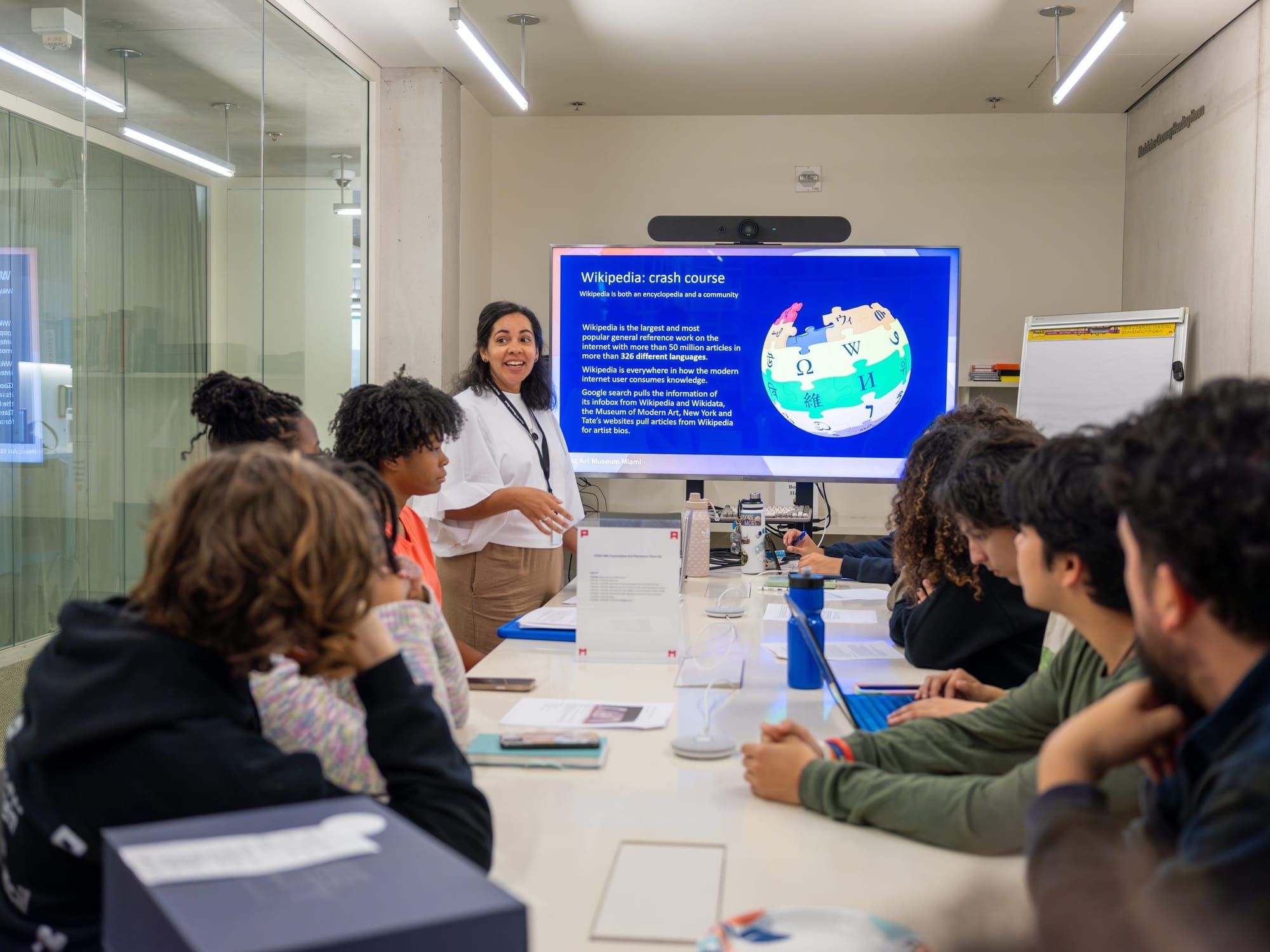
In an era of escalating censorship, disinformation, and the erosion of public trust in institutions, Wikipedia may seem like an unlikely site of resistance. But at the Pérez Art Museum Miami (PAMM), and other institutions across the country, a quiet revolution is taking place, one edit at a time.
PAMM’s Wikimedian in Residence Michaela Blanc has spent the last two years helping the museum’s digital team use Wikipedia to spotlight the work of underrepresented artists from Miami and beyond. From Latinx and Black painters to queer sculptors and feminist photographers, her work is filling gaps on the internet, but more importantly, preserving culture in a moment when history itself is under attack.
“Wikipedia is a role model for collaborative governance. It is basically the only corner of the internet today that is self-reliant and not an advertisement platform,” Blanc said “It’s just really like thinking about how to rescue the stories of these artworks.”
The ripple effects of President Donald Trump’s agenda have been felt deeply in the arts sector, especially with the recent cancellation of hundreds of National Endowment for the Arts (NEA) grants after his administration proposed shutting down the agency. Many community-based arts organizations, particularly those championing historically marginalized voices, were relying on these funds to survive. Programs focusing on Indigenous storytelling, immigrant heritage, and LGBTQIA+ archives have been paused or shuttered altogether due to a lack of support. Days before Trump’s inauguration in January, the NEA announced 1,474 awards totaling nearly $36.8 million to support the arts in communities in all 50 states, Puerto Rico, and Washington, D.C. But the loss is not just financial, it’s cultural.
In February, Trump abruptly fired the head archivist for the National Archives and Records Administration. According to reporting by the Associated Press, senior staffers at the National Archives quit or retired, and an unknown number of staffers at the agency also accepted government-offered deferred resignations or were fired because of their probationary status. Then, in March, the Trump administration issued an executive order directing the elimination of the Institute of Museum and Library Services (IMLS), the nation’s primary federal agency supporting libraries and museums. This decision led to the placement of the agency’s entire 70-person staff on administrative leave, effectively halting its operations. The IMLS had been instrumental in funding literacy programs, digital access initiatives, and cultural preservation projects across the country.
The shuttering of National Archives facilities and the defunding of the IMLS have raised concerns about the preservation of history and access to information. That’s where the work of archivists like Blanc comes in.
Blanc’s pathway to Wikipedia started years before the PAMM residency. With a background in art history and museum studies, Blanc encountered the Wikipedia-based collective Art+Feminism in 2019. The group’s mission is to close the gender gap on Wikipedia.
“At the time, only 10% of Wikipedia’s contributors were women. There was no data on nonbinary or gender-diverse editors,” Blanc said. “That was just very intriguing to me … thinking how can we lessen the gender gap?”
One of the standout moments from her tenure has been creating the Wikipedia page for painter Calida Rawles, whose solo show at PAMM hadn’t previously earned her a Wikipedia entry. “Calida is just this majestic painter and had no Wikipedia page, which was unbelievable to me,” Blanc said. Since the article’s creation, it’s been updated and expanded by other editors, signaling a growing public interest.
Other notable additions include Miami filmmaker Monica Sorelle and artist Magdalene Hunt-Ehrlich, both of whom have seen their public profiles grow in tandem with new recognition on Wikipedia. “Because Madeline was kind enough to grant a portrait of herself, that image is now in Wikimedia Commons,” Blanc said. “Now people know who Madeline is, and the achievements that she has been receiving.”
Inspiring young artists
The gap in representation and its consequences underpin much of Blanc’s work today. With more than 4,000 objects in PAMM’s collection, she realized early on that her role needed to go beyond creating artist biographies. She began building thematic articles, developing Wikidata entries (which link museum records to global research databases), and most notably, mentoring a team of high schoolers through a Wiki Education initiative.
As public archival institutions fade and the state rewrites curricula, the next generation of cultural workers is already stepping up. In Miami, that looks like teenagers transcribing artist interviews after school, and uploading them to a page that will be read by thousands, maybe millions.
Not everybody knows that they can actually act on the internet or actually change the internet, by just adding a hyperlink sometimes.
Michaela Blanc, PAMM’s Wikimedian in Residence
“The goal is actually conducting research in the library. They’re reading academic papers, researching through libraries, analyzing artists’ websites,” Blanc said. “Not everybody knows that they can actually act on the internet or actually change the internet, by just adding a hyperlink sometimes.”
The museum’s focus on community engagement includes its youth program, the PAMM Teen Arts Council (PTAC), where high school students write the history. Through a Wikipedia committee created in partnership with Blanc, PTAC members are learning to conduct interviews, write articles, and document the lives and work of Miami-based artists whose stories are at risk of erasure.
PTAC member Leanne White, a junior at the International Studies Preparatory Academy in Coral Gables, Florida, has found the experience transformative.
“Research is my passion,” she said. “I love the process of interviewing artists, really seeing how their work fits into the bigger picture of culture and history.”
White isn’t alone. Julian Henriquez, a junior at Miami Arts Charter School, originally joined the committee by chance, but he now sees it as vital.
“It sheds more light on local artists who might not otherwise be seen,” he said. “If they have a record of their work, it celebrates them as an artist.”
White, who is researching themes like gender and family dynamics in an AP Research course, understands what it means to have ideas censored.
“I went to a Christian private school before. There were things you couldn’t say to teachers or even peers,” she said. “I’m lucky now that I have a teacher who lets me use keywords in my writing [around gender and the nuclear family] that would be banned elsewhere.”
In Florida, that fear of erasure is warranted. Recent state policies have banned books, censored classroom discussions, and eliminated courses on race and gender. While charter schools sometimes operate in a legal gray area, students say the impact is still felt.
“I haven’t personally seen books removed,” White said, “but I know it’s affected my school. We had classes at risk of disappearing. It’s in the air.”
That’s why, for students like Valentina Zapata, a 10th grader at Design and Architecture Senior High, a Miami-Dade County public school, the act of writing Wikipedia articles on local artists is about more than digital literacy; it’s about justice.
“We don’t remember governments, but we remember culture and art,” she said. “If someone wants to erase a governor, they just remove their name. But art stays there. That’s how we know history.”
Zapata joined PTAC to meet other young artists and expand her creative horizons. She does sculpture and crochets while learning how to conduct archival interviews and preserve stories that might otherwise be lost.
“What if someone’s growing up in a culture that’s being erased?” she said. “They might think something’s wrong with them. That’s why this work matters.”
For Blanc, these students represent the future of cultural memory: tech-savvy, emotionally intelligent, and deeply aware of the political forces shaping their lives. But she’s also clear-eyed about the challenges.
“The current landscape of defunding knowledge not just in the cultural sector, but education and science, it’s very unfortunate that we have to rely on one platform that has been doing this work for a long time,” said Blanc. “But I don’t think it’s fair. It’s an important and amazing moment, and I believe that Wikimedia Foundation will rise to the occasion. But if you’re defunding public organizations or collecting institutions, it’s just really hard for them to think about, OK, now there’s Wikimedia, we have to run there.”
Despite being targeted by public figures like Elon Musk, who criticized the Wikimedia Foundation for investing in diversity, equity, and inclusion initiatives, Blanc believes that the platform’s grassroots model will endure.
“There’s so much work that happens that people don’t know in those institutions and it is a work of love,” Blanc said. “But I do think that the silver lining, if there’s any, is that this is civic engagement. … If at some point some institutions have to sunset their operations, we can have the potential to be that huge storage.”
Editorial Team:
Sahar Fatima, Lead Editor
Carolyn Copeland, Top Editor
Rashmee Kumar, Copy Editor
Author
Alexandra is a Cuban-American writer based in Miami, with an interest in immigration, the economy, gender justice, and the environment. Her work has appeared in CNN, Vice, and Catapult Magazine, among
Sign up for Prism newsletters.
Stay up to date with curated collection of our top stories.