Never eat the candy on your pillow: The ‘what if’ game
When I find myself in a bad place mentally, I try to work my way out of it by playing a little game: I ask myself every question I can think of

Dear Reader,
Today’s topic is mental health. There, I said it.
I can’t begin to tell you how apprehensive I am about discussing this subject. Many people are. But why is this so touchy?
Could it be that from time to time, people have unhealthy thoughts? Do people fear asking themselves hard questions like whether they should speak to someone about what they are going through? Is it normal to feel so angry? So depressed? So uncertain?
Take it from someone who has spent 19 years incarcerated and has seen more sides to people than one would ever think possible: Everyone needs someone to talk to. Sometimes, peace of mind begins with simply opening up.
“Trumbo, can I speak with you for a minute?”
I stopped writing. The person speaking to me had never spoken to me before.
“Sure,” I said. “What do you want to talk about?”
The man’s name was P—–, a young white guy who, at the time, was scheduled to go home in less than 90 days. We lived in the same dorm for several months, but we moved in different circles.
“You know a buddy of mine, Toby,” he said. “I’ve been told you’re a good listener.”
Toby and I had shared more than a few conversations about his relationship issues. Long story short: Absence makes the heart grow fonder, but distance can separate even the strongest of bonds.
“What’s up?” I asked, watching the way he nervously glanced around and looked over his shoulder. He refused to make eye contact and appeared to tremble with each breath. Searching for a way to relax him, I asked about the University of Kentucky bracelet he wore.
“I gave a guy two bags of coffee to make it for me. I’m a big basketball fan,” he said.
I grinned and nodded. “My father could root for the Cardinals and the Cats at the same time,” I said. “He loved both teams.”
The man sat and met my eyes for the first time. “I go home in 90 days,” he said.
“Eighty-nine and a wake-up,” I corrected.
The man considered my words and tilted his head slightly.
“Yeah, a wake-up. It’s funny to think that I’ll wake up in here and go to bed someplace else.”
“Where are you planning to go?”
The man gritted his teeth. “A halfway house.”
“Halfway houses aren’t so bad,” I lied.
I’ve heard nothing but bad things about most halfway houses. The reality is that either a person is ready to be released, or they aren’t. It can’t be a halfway house’s job to keep people free. Freedom has to be a choice, as much as it can be. You have to stay focused on what matters.
“I want to go to a halfway house,” he said. “It’s either that or beg my family for help.”
“Asking for help isn’t easy sometimes.”
“You have no idea.”
“Maybe,” I said, “and maybe not. You came to me, didn’t you? That’s a start.”
He stared at the table and chewed his nails.
“When I think about going back to my family … what if they aren’t the people I remember? What if they take one look at me and see an impostor? I’ve been gone for five years. I’m not the same 18-year-old kid who went to prison for having a 15-year-old girlfriend. What if I run into her? What if she tries to speak to me? What if my dad thinks I’m not trustworthy anymore? I have to go to a halfway house, right?”
“Do you really want to go to one?”
The truth was, he had plenty of time to figure it out. When I find myself in a bad place mentally, I try to work my way out of it by playing the “what if” game. I explained to P—– that I just start asking myself every question I can think of, and I do my best to work my way through them.
“Would you like to play?” I asked.
“I’m not sure.”
“Start there. What aren’t you sure about?” I asked.
“Where to start,” he said.
I reminded him that just a moment ago, he said he wasn’t sure if his family were the people he remembers. But what if they are? What if you don’t even give yourself a chance to find out?
“Toby was right. You are a good listener.”
“Nope. I just pay attention,” I said.
“Why pay attention when no one else does?”
“Because I know what it feels like to be neglected and paid no mind. I asked myself what if I started to do all of the things no one else did, you know?”
P—– admitted that he was scared of going back.
“What if no one wants to have anything to do with me?”
“Ah, now you’re playing the game. Now ask yourself what you’d have more time to do if everyone left you alone to do it.”
“I could find a job, I guess.”
“What else? What if you had all the time in the world to study a certain subject or learn a new skill or pick up a hobby?”
“I see what you’re doing. You’re trying to get me to accept that not everyone will accept me with arms wide open,” he said.
“Is that how you’re taking it? Because I’m just trying to get you to dig deeper. Who you want to be once you’re released needs to be different than who you are now,” I said.
P—– said that he cried himself to sleep every night. He said that even when he dreamed about leaving the prison, all he saw was failure. He’s not the first man in here troubled by those kinds of dreams.
“I dream about going to the grocery store. The funny thing is that even though I’m free, there are still elements of prison everywhere I look,” I said.
“Toby said I need to sign up to see the psychiatrist.”
“Funny,” I said. “I told Toby the same thing.”
“What if I do everything right and still fail?” he asked. “At least I tried, right?”
Shortly after our conversation, P—– started seeing the prison psychiatrist. He was diagnosed with an anxiety disorder. He started taking anti-anxiety medication and attended therapy appointments, which seemed to help.
Eventually, P—– contacted his family. They wanted him to go home when he was released. This whole time, he had a place to go and didn’t even know it.
It was a good reminder for him and me: We can’t know the answers to the questions we don’t ask.
The Right to Write (R2W) project is an editorial initiative where Prism works with incarcerated writers to share their reporting and perspectives across our verticals and coverage areas. Learn more about R2W and how to pitch here.
Author
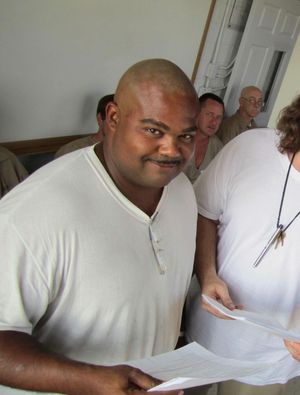
Derek R. Trumbo, Sr., a multiple-time PEN Prison Writing Award winner, is an essayist, playwright, and author whose writing has been featured in "The Sentences That Create Us: Crafting A Writer's Life
Sign up for Prism newsletters.
Stay up to date with curated collection of our top stories.