Uncertainty looms for TV writers a year after historic strike
The streaming boom created more jobs and increased diverse content, yet it’s harder than ever for TV writers to get staffed
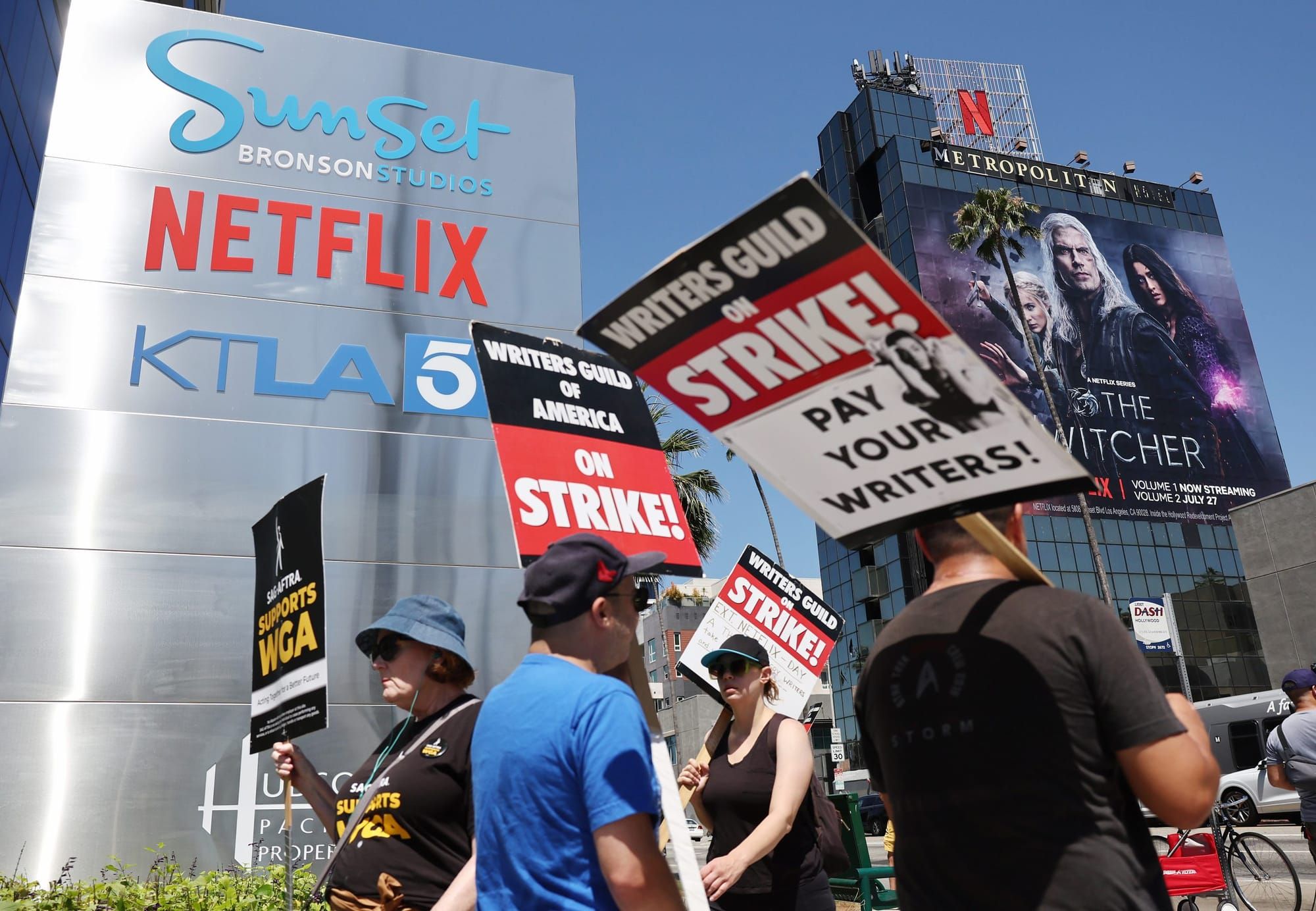
Hollywood was brought to a standstill last year when its writers and actors’ unions took their energy and indignation to the picket line for more than five months to strike for better working conditions. Things had become dire for writers and actors as the bubble of peak streaming TV burst, profits fell, and producers acted accordingly. With shorter episode runs, smaller writers’ rooms, fewer residual payments, and no protections from the looming threat of artificial intelligence, writers were doing more work for less pay. However, the TV and film industry is still in flux a year after the Writers Guild of America (WGA) ratified a new agreement, which granted members pay increases, new requirements for writers’ rooms, residual bases, and AI protections.
Despite important and historic gains made in the final agreement between the Alliance of Motion Picture and Television Producers (AMPTP) and WGA, writers are still struggling to find work due to the ongoing contraction in the industry in the wake of the streaming boom. As networks rethink the future of the industry, gains made over the past decade in diverse representation in Hollywood, both in front of and behind the camera, could reverse, especially in light of the backlash against affirmative action. With Donald Trump’s win, the WGA is also preparing to face more hostility toward union organizing.
In the days following the election, the executive director of WGA-East sent an email to its membership, obtained by Prism, responding to the results.
“While the Guild does not, as a matter of policy, engage in partisan politics, we must nevertheless be clear-eyed about the likely consequences of the second Trump Administration for workers, the Guild, and the broader labor movement,” the email reads.
“We should expect dramatic changes at the National Labor Relations Board, at the Department of Labor, in federal regulations and administrative action, and possibly in federal legislation, all designed to weaken unions and disempower workers,” the email continued. “Guild staff, supported and overseen by your elected leadership, have been preparing to oppose these possible attacks and defend our membership for the last several months, and will now turn to that work in earnest.”
As Manfred López Grem, a screenwriter with WGA-East, explained, “It’s basically telling us that they’re on it.”
As the union prepares for a tougher fight, ongoing issues persist. The end of the streaming bubble, which had led to massive gains in diverse representation among actors and writers, seems to have come paired with a contraction in supporting diverse content generally, said Y. Shireen Razack, a television writer. Last year’s Supreme Court case striking down affirmative action in college admissions had ripple effects in other workplaces, including TV writing, Razack said. In addition, a lawsuit filed by a white writer accusing the TV broadcasting company CBS of passing him over for a promotion that went to a woman of color has producers spooked about diversity, equity, and inclusion (DEI) initiatives in general, she said.
“That Supreme Court ruling really has impacted whether or not historically excluded writers are going to get hired, have careers, be able to tell the stories that need to be told,” Razack said, adding that a platform she had pitched said it wasn’t greenlighting any female-led shows. Producers are also less inclined to greenlight young adult (YA) or genre series, she said, which tend to be more diverse. Data shows that three-quarters of millennials and Gen Zers want more diversity and representation on screen.
Razack is also the co-founder of the Think Tank for Inclusion and Equity (TTIE), which conducts an annual survey of underrepresented writers. This year, nearly 700 people completed the survey, and though the data has not yet been released, Razack shared some of her takeaways so far.
“[Survey respondents] are feeling demoralized because of the lack of jobs and the industry contractions, and also the feeling that diversity doesn’t matter anymore. And it’s very hard to hear that,” she said.
López, who was a WGA captain during the strike, said that the number of available jobs in television had contracted considerably, creating a “gloomy” situation for writers. But on the movies side, he said, things have not changed as much, and he has several feature deals in the works. He is hopeful that things will stabilize in television too.
It’s important to underscore that this uncertainty doesn’t undermine the critical gains made for working writers in Hollywood. Among those gains are script fees, an additional payment when a writer pens an episode, on top of their weekly pay. This has been a lifeline for Anna Mackey, a WGA member since 2022.
Mackey struggled at first to land a writing job in Hollywood and faced the common challenge of having to work several entry-level assistant roles before advancing to a staff writer position. On top of that, the shows she worked on kept getting canceled after just one season.
Since the strike, she has been employed as a staff writer on a show that was ordered to full series after starting in a “mini-room.” Thanks to script fees, Mackey’s pay is higher as a staff writer.
“Being able to get an episode payment is huge in terms of being able to help float you financially for a period of time,” she said.
Mini-rooms were another key issue during the strike. With shorter episode runs, streamers had begun hiring fewer writers for shorter periods than they were during the age of network television when most series had more episodes and longer employment duration. The new WGA contract set a minimum number of writers and duration for writers’ rooms.
Razack said that while the new rules around mini-rooms are helpful, there’s been a kind of race to the bottom where in some cases the “room minimum is now becoming the maximum.”
The new contract also improved benefits for members and increased pension contributions, Razack said, which has made a big difference for some of her colleagues. But without consistent work, some are struggling to meet the minimum compensation requirement to stay on WGA health insurance, which could disproportionately impact disabled and chronically ill writers.
The consequences of the industry contraction are considerable. Razack and López said that showrunners can receive 600 applications for one staff writer job. Overwhelmed showrunners are inclined to hire people they’ve already worked with or people they know, Razack said. Because most showrunners are white and male, this practice perpetuates existing inequities in the industry.
While she searches for a job, Razack has been working on developing new projects without pay. According to the 2022 TTIE survey, 70% of historically excluded writers who developed new series projects between 2017 and 2022 did so unpaid, compared to 53% of non-marginalized writers.
The Entertainment Community Fund, which provides financial assistance and education to those who work in movies and TV, distributed more than $3.25 million in the first quarter of 2024. When both WGA and the Screen Actors Guild (SAG-AFTRA) were striking, the fund gave out $18.8 million.
I think people right now are less afraid of, ‘Is AI gonna take my job?’ as opposed to, ‘Are there any jobs to be taken?’
Y. Shireen Razack, tV writer
As a result of these hardships, many are leaving the industry altogether, Razack said.
The issue of AI, which was so prominent during the strike, has seemed less salient amid the industry’s contraction. As Razack put it, “I think people right now are less afraid of, ‘Is AI gonna take my job?’ as opposed to, ‘Are there any jobs to be taken?’”
The new WGA contract declares that “AI is not a writer,” which is a stronger protection than what the SAG-AFTRA contract achieved. However, there is still some ambiguity around the rules regarding whether scripts can be used to train AI, López said.
The issue is far from resolved. SAG-AFTRA’s video game workers are currently on strike over a lack of adequate protections against AI, and researchers estimate that 20% of Hollywood jobs could be lost by 2026 because of it.
It could take years to understand the impact of the industry’s changing landscape on television writing and, to a lesser degree, film. Viewers, too, have witnessed this shift as they struggle to keep up with the proliferation of streaming platforms. Ads have returned to Netflix, and some platforms are experimenting with live TV events, harkening back to the days of network and cable TV. “It’s funny because it’s like they’re rediscovering the wheel,” López said.
Yet the issue of diversity and representation remains salient ahead of the new Trump presidency. “During his first term … there was a reaction from the industry where we were putting out content that was not just more diverse, but more politically charged,” said Razack.
“I hope that the industry reacts to this moment in time the way that they reacted before and that they stand up and try to tell the stories and change hearts and minds,” she said. “Right now, it just feels like we’re going back.”
Author

Laura Weiss (she/her) is a freelance writer and editor from Berkeley, California, focusing on social justice issues. She previously worked on the digital team at The New Republic and as managing edito
Sign up for Prism newsletters.
Stay up to date with curated collection of our top stories.