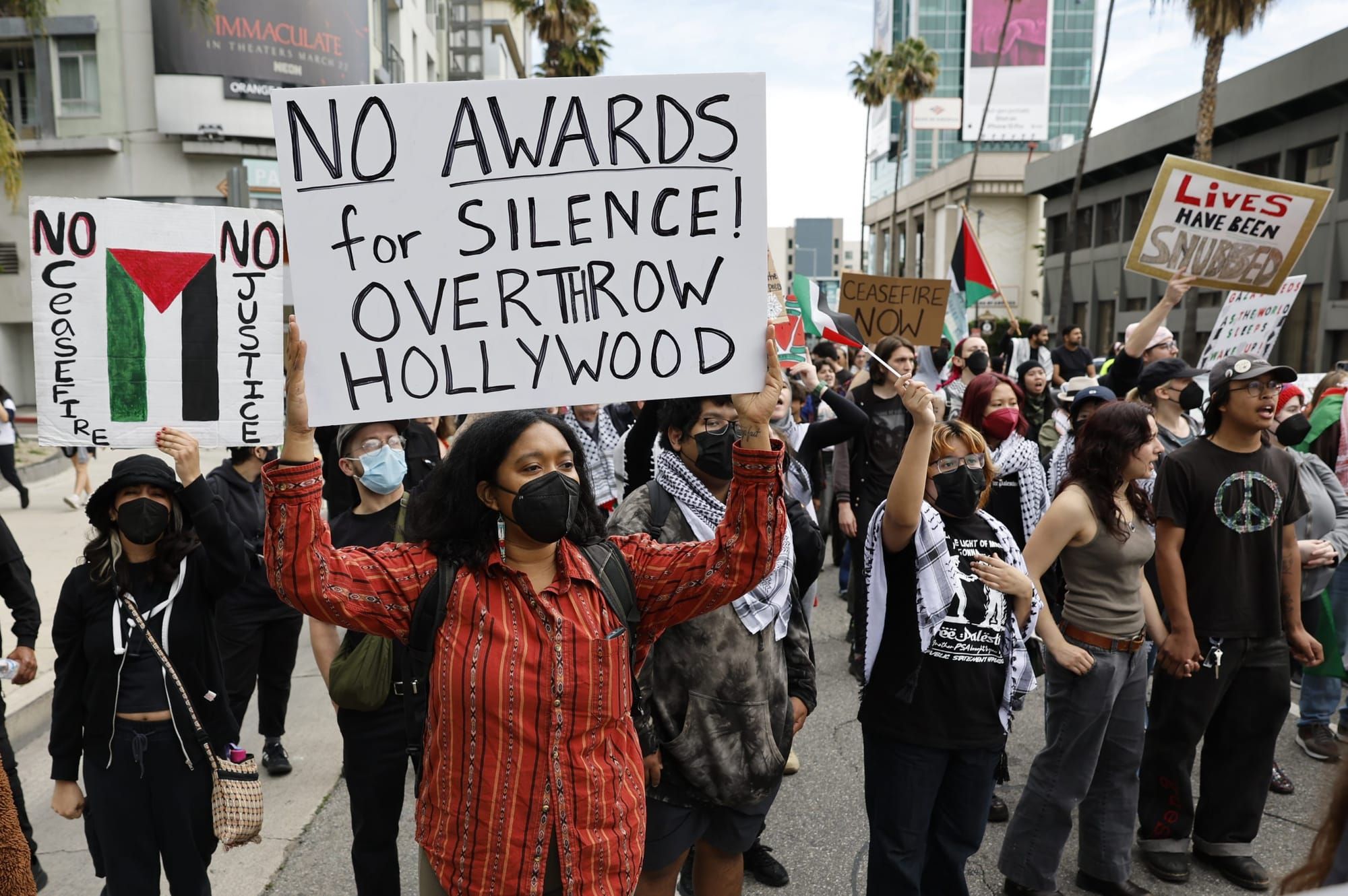
Three of the country’s largest and most visible labor unions are calling for a ceasefire in Palestine. The National Education Association, United Auto Workers, and the Service Employees International Union, altogether totaling more than 5 million American workers, are advocating for a cessation of hostilities in Gaza. But as a growing number of unions speak out against the bombing in Gaza, some organizers are criticizing the unions that have remained conspicuously silent, leaving their individual members to bear the consequences.
Workers with the Writers Guild of America (WGA)—one of the most powerful unions in Hollywood whose members recently wrapped up a historic 148-day strike—are criticizing the union for failing to issue a statement criticizing the attack on Palestine. Palestinian advocate, director, and WGA member Lexi Alexander says the contrast of the industry’s reputation and the union’s inaction speaks loudly.
“Why aren’t our unions already there? Given the fact that we’re always pretending we’re this progressive industry, why is the fucking auto union ahead of us?” she asked. In October, the WGA West posted an internal apology for its initial silence. The statement laments violence in the Middle East but falls short of calling for a ceasefire. It also fails to provide protections for those who might choose to take a stand. Instead its authors ask that everyone “treat each other with respect and patience.” The WGA’s inertia has the greatest impact on its most marginalized members, early career writers of color.
Hollywood Workers for Peace (HWP), a small group of writers originally made up of active WGA members, formed quickly after Israel began its bombardment and siege on Gaza. On Oct. 20, HWP began circulating an anonymous letter on Google Forms with the intention of expressing concern over mounting pressure for the Writer’s Guild, SAG-AFTRA, and the Directors’ Guild to unconditionally support Israel—which has now killed at least 31,000, wounded more than 72,000, and is actively starving nearly 600,000 people. As the death toll rises and public opinion shifts dramatically across the political spectrum, Palestinian advocacy remains contentious and politically volatile. The form garnered intense pushback.
Veteran showrunner Michael Seitzman publicly accused the authors of cowardice for penning the letter.
“You should be brave enough to sign your full name to it,” he wrote in a Deadline op-ed. The authors also received an email from Barry Schkolnick, a prominent showrunner known for his work on “Law & Order” and “The Good Wife.” In the email, Schkolnick demanded the writers out themselves, saying, “If you believe that the Hamas attack on innocent Israelis was justified, please come out and say so publicly, under your names. At least then, everyone will know where you stand.”
The third sentence of the letter acknowledges the human cost to Palestinians and Israelis and makes no mention of Hamas. The letter currently has more than 300 anonymous signatures. With the exception of nine people, everyone who has signed the letter is a Guild member. The authors of the letter argue that their right to express their political beliefs without retaliation is a question of worker protections.
“We can’t publicly say what we feel—that’s a labor issue,” a member of HWP told Prism. Free speech is a particularly salient concern for early career writers lacking the industry tenure and relationships required to rebound from taking unpopular stances.
Alexander was initially surprised when she met the members of HWP. “I didn’t expect it to be some young group of non-established people,” she said.
Unions are built to protect their workers against retaliation and discrimination, and the WGA is no exception. Formed in 1933, the WGA states on its website that its primary goal is to gain better working conditions for its members. Its constitution and bylaws state that the organization exists to “correct abuses to which members may be subjected.” Veena Dubal, a professor of law and labor scholar, says that the WGA is not unique in this regard.
Using the example of a hypothetical worker fired for wearing a Black Lives Matter pin at work, Dubal points to union structure as a solution. “They have legal staff, they have stewards who can intervene. There’s both formal and informal mechanisms … where a union is the intermediary who can help protect a worker,” she said. But retaliation in the entertainment industry is often too vague to be legally actionable, particularly when it comes to agents, who they do and don’t represent, and why.
In November, Rolling Stone reported that Marc Platt, a major producer with credits that include “La La Land” and “The Little Mermaid,” directly contacted a prominent talent agency over its representation of activist film writer-director Boots Riley. On X, Riley had told his followers to boycott a screening of “Bearing Witness,” a 47-minute film of Israeli military-compiled footage of what they say were the results of Hamas’ attacks. Riley called it “murderous propaganda.” In response, Platt, “texted WME leadership about why Boots Riley was still a client.” Industry veteran Susan Sarandon lost her representation after speaking out at several pro-Palestine rallies. On social media, Hollywood writers say they are experiencing similar types of retaliation.
“No showrunner is going to say, I saw your tweet on Palestine. I saw what you did. You were on that letter. I’m not going to hire you,” Alexander said of quieter retaliation and blacklisting.
Retaliation and blacklisting are indicative of ongoing struggles with representation and power in Hollywood. Despite efforts to diversify, a recent report out of the University of Southern California Annenberg’s Inclusion Initiative came to a damning conclusion after surveying the stubborn rate of male and white domination in entertainment.
“The pledges to support inclusion post George Floyd’s murder and #StopAsianHate were performative acts by the entertainment industry and not real steps towards fostering change,” the report states. The study concludes with recommendations that activists use external pressures to call for governmental regulation of employment practices. It further suggests that “studios could simply change their hiring practices.” For the WGA, whose purview has historically been both of these functions, the opportunity looms large.
On the heels of a successful strike and with its social and political power on full display, the WGA seems well positioned to both create and enforce mechanisms that support the members who need it most: those who will pay the greatest price for demanding peace. As commitment to a ceasefire grows, workers say the time for the WGA to act is now.
“Unions have to do more than just represent their membership over wages and benefits. They have to be part of transnational intersectional movements contesting authoritarianism,” Dubal said.
In its apology, the WGA West said that it chooses to speak out in moments that fall “under the umbrella of defending social justice in the U.S. or freedom of expression, and where possible, were connected back to writers’ working lives.” Sustained silence and inaction by the WGA regarding Palestine compromises its ability to protect workers in doing the most basic function of their jobs: tell stories.
Since its formation, the founders of HWP have been joined by members of fellow guilds. A member of HWP explains that their activism is a byproduct of the desire to make art in an equitable way.
“I want folks to know that there are people working to change that system that only platforms certain voices. The world needs all of our stories,” they said.
Despite ongoing turmoil in the WGA, some in the entertainment industry are joining the rest of the country. In February, the Animation Guild became the first in Hollywood to publicly call for a ceasefire in Israel and Palestine.
Despite repeated requests, the WGA did not respond to requests by Prism for comment.
Author

Kim Tran (she/her) is a writer and consultant working at the intersection of race, gender, and social protest. Her research and community organizing experience have been featured in NPR, Slate, Politi
Sign up for Prism newsletters.
Stay up to date with curated collection of our top stories.