Miami’s last sacred spring faces bulldozers as community fights to save the Well of Ancient Mysteries
Tucked behind skyscrapers, a lush quarter-acre site with Indigenous, ecological, and archaeological significance is at risk of destruction. Locals, spiritual leaders, and preservationists rally to protect the spring-fed sanctuary

In the heart of Miami’s downtown, Brickell, the city’s bustling financial district, hides a 1920s bungalow painted in gem-tones surrounded by lush forestry and birds. Buried underneath are ancient Tequesta artifacts. This quarter-acre of land is known to locals as the Well of Ancient Mysteries. It now faces the imminent risk of demolition.
“It is the last undeveloped parcel in the Brickell area that once was a neighborhood,” said Robert Carr, co-founder and executive director of the Archaeological and Historical Conservancy in Florida. “That parcel is a little bit of the historic—and to some degree prehistoric—Brickell that remains.”
The property was sold to Leste Group, a Brazilian investment firm, for $5.9 million last June, 10 times higher than Miami’s average property sale, and against the wishes of its longest resident to date: Ismael Burmudez. Also known as Golden Eagle, Burmudez christened the site the “Well of Ancient Mysteries” after discovering a natural spring under the taproot of a mango tree back in the 1970s. An artist and amateur archaeologist, Burmudez has stewarded the land at 87 SW 11th St. for nearly six decades.
Now, Miami community members, led by longtime Miami resident Claudia Costa, are petitioning Leste to consider a partial preservation plan to protect the property, particularly the spring.
“What we want is that, since the spring is all the way in the corner, that they at least preserve a piece of it,” Costa said. “I would really prefer they leave it completely untouched. There could be something like a commemorative garden.”
Burmudez’s excavations over nearly 50 years have left the land porous and precarious, exposing limestone and resulting in several crude wells dotting the area. Burmudez discovered at a young age that his childhood home held souvenirs from a prehistoric civilization: the Tequesta. Archaeological evidence reveals that the Tequesta lived along the Miami coast for at least 3,000 years—one of the oldest civilizations in North America.
The Well of Ancient Mysteries sits within a historically rich stretch of downtown Miami that was once part of a thriving Tequesta settlement, believed to have existed for over 3,000 years. Archaeological discoveries—including thousands of artifacts and evidence of a large marketplace—suggest that the area around the mouth of the Miami River, including sites like the nearby Miami Circle and 444 Brickell, functioned as a central hub of commerce and ceremony for the Tequesta people. The Well itself, with its natural spring and ancient limestone features, is thought to be a ceremonial site within this broader village complex.
According to Carr, who was the lead archaeologist for the Miami Circle, Burmudez often volunteered at the Miami Circle dig. Costa said Burmudez played a pivotal role in achieving its preservation and eventual National Historic Landmark designation. With the Miami Circle just blocks away, the Well of Ancient Mysteries is part of a City of Miami Archaeological Conservation Area. Its proximity to these landmark excavations links it directly to the larger narrative of Miami’s Indigenous past, forming part of an interconnected archaeological zone that once served as a vital gathering point for the Tequesta.
“The two sites are both parts of the overall Tequesta Village located on the south bank of the river and extending along Biscayne Bay,” Carr said.
A contentious property battle
The Well of Ancient Mysteries had qualified for Homestead Exemption for most of its modern history, a provision that capped annual property tax increases at 3%. Ana Burmudez, mother of Ismael Burmudez, purchased the property in 1969. But in 2023, the exemption was repealed, and the Burmudez family was ordered to pay a penalty of $91,000 within months. Ismael Burmudez, who had lived on the property for over 50 years, argued in court that the situation could have been avoided had the family officially filed him as the permanent resident. Without the exemption, property taxes on the site spiked from just under $3,000 annually in 2022 to about $67,000 in 2023.

Facing financial pressure, Ana, then 92, chose to sell the land. Ismael Burmudez objected, claiming legal rights through adverse possession. However, a Miami-Dade court ultimately rejected his claim, and the sale to Leste proceeded in accordance with Florida law. Burmudez was required to vacate the property in 2023 but forcibly removed in fall 2024.
“This appears to be a fabricated issue, because this could be solved if my family had filed for me as the permanent resident of this property, since I have been living here for over 50 years,” Burmudez said in court records.
“This site continues to serve as a prehistoric landmark and a natural resource,” Burmudez wrote in a court document submitted on May 5, 2023. “I am working diligently to maintain and enhance this site, so this place can continue serving and educating the community. Our goal is to enhance the site, maintain the landmark as a Native American ceremonial site, protect the biodiversity of this micro-ecosystem, and improve the facility. The singularity of this place is worthy of preservation and protection.”
After being displaced in 2024, Burmudez disappeared. While some of his close friends know he has safely relocated, his communication remains scarce.
Miami’s Code of Ordinances requires the city’s archaeologist to review any application for “new construction, excavation, tree removal, or any ground disturbing activity” within archaeological zones. Falling well within this zoning parameter, the Well of Ancient Mysteries is due for a formal inspection. Perhaps its days of excavation are not over just yet.
However, according to public records, Leste has yet to submit any building or zoning permits for the property. Costa and other community members sent a physical copy of the petition to Leste after email versions bounced back. While developers received the petition in early May, they did not respond to organizers’ follow-up emails. Leste did not respond to Prism’s attempts for comment.
“We are not asking for development to stop. They’re going to build what they’re going to build—it’s Miami,” Costa said. “What we need to do is remind them they get a tax break, they can attract tourists and locals. In the meantime, we’re going to be working on declaring it a heritage site with the help of anthropologists and native people.”
A sacred source of inspiration
Costa first visited the Well in 2018, when members of the remote yet renowned Kogi tribe, Indigenous to modern-day Colombia, made a pilgrimage to bless the water of the sacred spring. The spring bubbles up on the land with crisp, clean water from the aquifer below. Burmudez believes that it holds sacred properties—a belief he shares with a larger spiritual community.
“It was really a powerful thing,” said Costa.“When they opened the well, a little frog came out. The Kogi is a group most respected in Indigenous cultures; they are the soothsayers, they use water as one of their divination tools.”
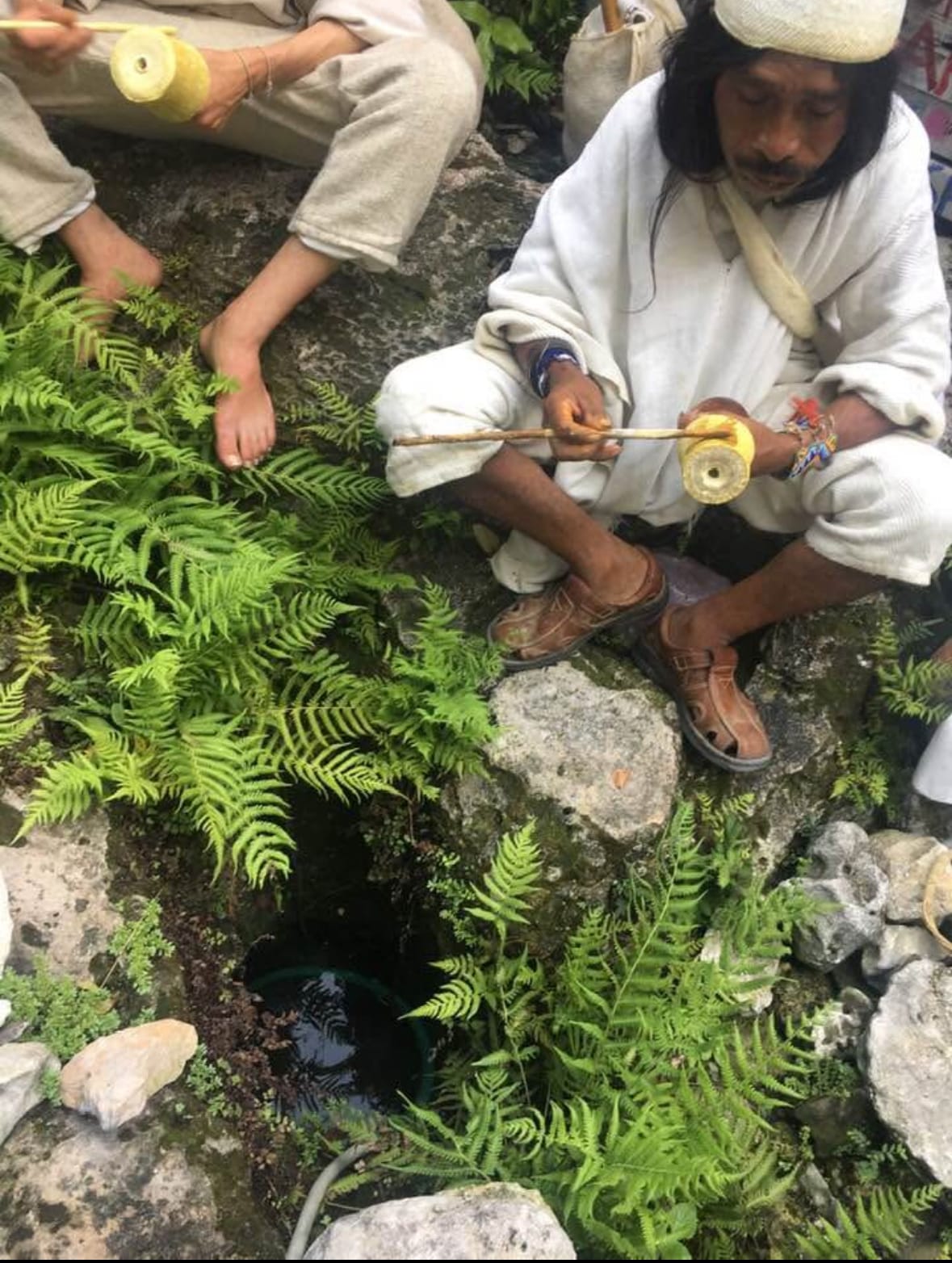
The Well of Ancient Mysteries had a full house for the Kogi water blessing, attracting many local healers and energy workers. Garène Olivia Narcisse, an herbalist and a resident of Miami for 11 years, was also present.
“Everyone there who drank from the water felt healed,” said Narcisse. “[They] felt a new energy surging through them, in some cases, people were overwhelmed. It’s amazing. [The spring] has a cork, which is kind of like Indigenous technology to protect the water so it’s not contaminated,” Narcisse said.
Water protection and purity is a key driver for residents and organizers pushing to preserve the Well. More than 93% of Florida’s population depends on groundwater for drinking water, far more than any other state in the country.
Carr advised Costa earlier this year to seek historical landmark designation for the Well of Ancient Mysteries, which would allow the city’s Historic Preservation Board to review any permits that might affect the property.
“Preserving historic and archaeological sites in Miami is very challenging because private property rights are protected by law in Florida,” Carr said.
Nestled between a 7/11 convenience store and an empty lot on 1st and 11th streets, the Well of Ancient Mysteries is a small, green oasis. It is home to native firebush and ferns, along with a dozen or so well-established trees: gumbo limbo, royal poinsettias, and acerola cherry trees, heavy with fruit.
The Well has long been a source of Miami lore. Local filmmaker Dara Friedman created a documentary about the site, “Ishmael and the Well of Ancient Mysteries,” which screened at Art Basel Miami Beach in 2014.
“Native cultures are everywhere. We’re blind to them; we don’t see them,” Friedman said in a 2017 interview with the Miami New Times. “It’s like racism and inequality: That switch hasn’t been turned on, but once you turn on the switch, you see it everywhere. ‘Ismael’ was helpful in doing that.”
Conor Logan, the director of the “Old World Florida” YouTube Channel, also created a short documentary about the Well, emphasizing its connection to the Tequesta and what he speculates to be a sacrificial altar on the property.
“Ismael used to be a central figure in the downtown Miami hippie scene, for lack of a better word,” Logan said. “That property was a gathering point for things like protests and full-moon gathering.”
Of particular interest to Logan is the ancient capstone that seals off the spring from polluting the aquifer. Carved out of limestone possibly thousands of years ago, the cap prevents contamination from seeping into the water system.
“In that little spring, there’s a capstone, a corkstone, that’s one of a kind in Florida,” Logan said. “Any archaeologist that is not fighting to preserve that does not belong to hold their office. To let it get built over, they’re betraying the people of Miami and Florida.”
A hope for preservation
Organizers list 333 Brickell Ave., another site in the Tequesta village, as an example of the minimum preservation they are hoping for with the Well. 333 Brickell features a circle of land portioned off and developers designed around it.
“It’s not pretty, but it’s preserved to an extent,” said Narcisse, who offered walking tours in 2021 and 2022, to explore downtown Miami’s spiritually significant locations, including the Well of Ancient Mysteries. “Please don’t make [the Well] a dog park like they did the larger Miami Circle.”
Miami’s Historic Preservation Planner Adrian Espinosa responded to the organizers’ inquiries via email with Chapter 23 of the Miami 21 Code of Ordinances, describing how to make a site of historic preservation. According to the Code, for the Well to be considered for preservation, an established stakeholder would have to bring forward the site designation.
“Destroying this access point is like severing an artery,” said Narcisse. “You’re going to bleed out. You’re going to kill the integrity of the very place you are wanting to sell or exploit financially. It is what makes the place that you are wanting to live in, it’s what makes it powerful, it’s what makes it beautiful. You don’t have a magic city if you get rid of all the magic.”
Editorial Team:
Alexandra Martinez, Lead Editor
Carolyn Copeland, Top Editor
Rashmee Kumar, Copy Editor
Author

Kat Grimmett is a writer, educator and herbalist. As a South Florida native, her work explores community-based solutions to issues regarding the food system, environment and urban development.
Sign up for Prism newsletters.
Stay up to date with curated collection of our top stories.