Christian Poulsen grew up along Seattle’s only river, which is rich with vibrant gathering places like locally renowned restaurants and good schools. It’s home, where he is now raising two young children.
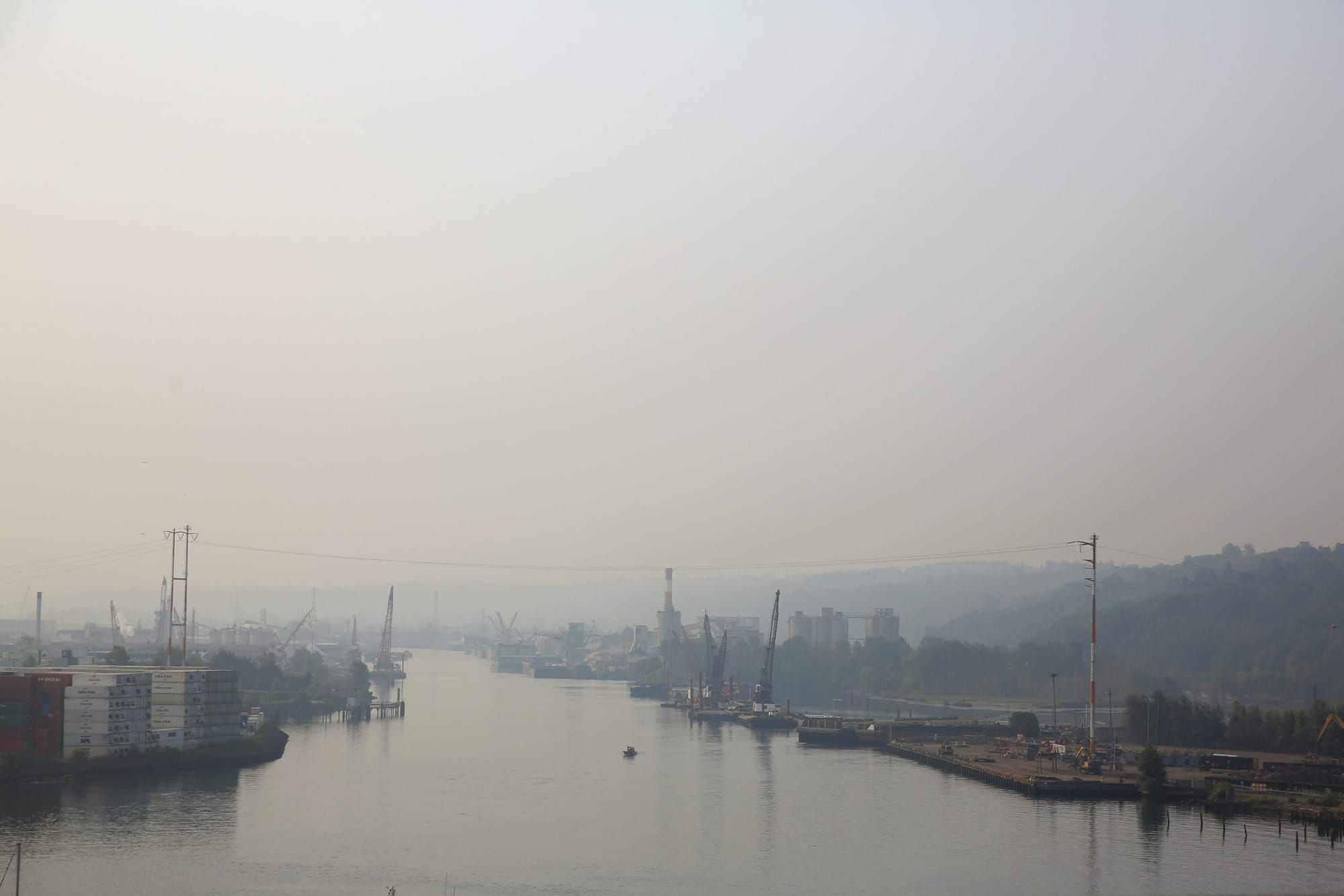
His community in South Park prides itself on being one of the city’s most culturally and racially diverse neighborhoods. But it is also the most overburdened with environmental pollution like black carbon and heavy-metal concentrations. That’s from three freeways, two international airports, an international seaport, and the dozens of manufacturing facilities along the Duwamish River—a 5-mile Superfund site flowing with polychlorinated biphenyls (PCBs), arsenic, and other carcinogens.
The pollution is so severe it may be cutting lives short. A community-led study funded by the Environmental Protection Agency (EPA) found that life expectancies are eight years shorter than the Seattle average. The same study also found that children who live in the area have the highest rates of asthma hospitalization in the city.
Poulsen worries he is watching that unfold for one of his boys, who has developed a persistent cough. Poulsen’s mother also experienced respiratory infections and pulmonary edemas until she left.
“My family seems healthier when they’re not here, and that scares me,” Poulsen said. “I have to prioritize how much I love this community with how much I love my kids and how much I understand [the risks].”
As a policy analyst for the Duwamish River Community Coalition (DRCC), he started looking at a new approach to regulating pollution that centers health. People in other frontline communities around the greater Puget Sound area were doing the same.
Poulsen and other advocates knew an anti-racist approach would have to be at the core of their solution because the root of their problems persist from discriminatory policies like redlining. It’s why this legislative session they are pushing to advance a bill that prioritizes places and people who experience an unfair share of environmental harms.
The Cumulative Risk Burden (CURB) Pollution Act joins a growing movement of environmental justice policies nationwide that go beyond procedural norms and into authoritative action. It does this by creating an enforcement mechanism for a health risk threshold that aggregates stressors from air, water, and waste pollution. For example, rather than just ticking the boxes on an environmental justice checklist, agencies would have the power to deny permits for new facilities whose pollution would exceed the risk threshold.
“What I see this really doing is capping the amount of pollution in the Duwamish Valley and other overburdened communities that is emitted from stationary sources,” Polusen said. “This tool would give us an opportunity to end the practice of overburdening.”
Pollution is “not by chance”
About 30 miles from the Duwamish Valley, South Tacoma, Washington, presents a strikingly similar scenario: pollution from highways, industrial activities, and maritime sources, with the added challenge of hosting a Superfund site.
When a company named Bridge Industrial brought forth a proposal to build a mega-warehouse complex there, residents filed public comments and signed petitions against the additional source of pollution. But last year, the City of Tacoma approved land use permits for 2.5 million square feet of warehouses—comparable to 43 football fields.
“That was a big push for me to do this [bill] this year,” said state Rep. Sharlett Mena, who lives in Tacoma.
She had an idea for legislation to make sure the voices of her neighbors and constituents mattered in future permitting processes. So did her partners at Front and Centered—a coalition of communities of color-led groups across Washington. For years, member organizations like DRCC had worked with the coalition’s pollution prevention workgroup to identify policy needs like the CURB Act.
“It was sort of serendipitous that we both really wanted to work on this and lay the groundwork,” Mena said. “But it’s not by chance that communities of color are often in these areas. An area is developed as an industrial zone, and there’s historical redlining … and who can afford to live there? People that have been historically disenfranchised.”
She and the coalition drafted a bill that would prescribe a stronger permitting process in communities that already have a disproportionate amount of pollution. They took notes from states like New Jersey and New York that have environmental justice laws on the books with cumulative impact assessments.
The bill also builds on Washington state’s three-year-old Healthy Environment for All (HEAL) Act, which aims to address environmental justice by incorporating health and equity considerations into decision-making processes. The CURB Act fills a gap in the HEAL Act, as South Tacoma had recently experienced with industrial permitting.
”HEAL is a lot of information gathering, which can help an agency better think about what the consequences of their actions may be,” said Nico Wedekind, policy counsel for Front and Centered. “But it doesn’t attach at the permit level—the permits are not explicitly called out, and so that’s what we’re trying to get at here.”
Mena introduced the CURB Act on Jan. 8 with 18 co-sponsors who signed onto it. As it kicks off in the environment and energy committee, Wedekind expects challenging discussions and political obstacles.
A balance of priorities
Specifically, the CURB Act would require state, county, and municipal agencies that issue permits under the Clean Air Act, Water Pollution Control, and a handful of other laws to prepare environmental justice impact statements. They would do this under the State Environmental Protection Act (SEPA), which is an environmental impact analysis within itself.
SEPA requires a review process for new development and infrastructure from commercial buildings to interstates. It ensures a thorough and public review of potential impacts before decisions are finalized for implementation. As the CURB Act stands in its current draft, some of those agencies cite a misalignment between the CURB Act and SEPA. They also are unsure about the proposed risk formula and thresholds for permit denial.
“[The Department of] Ecology strongly supports the bill’s intent to improve environmental outcomes for residents of the state by providing more explicit authority to deny permits or place mitigation requirements on applications based on cumulative health impacts,” the department’s Government Relations Director Adam Eitmann said during public comment on Jan. 16. “However, we have several concerns about our ability to operationalize the bill.”
Representatives from the Washington State Association of County and Regional Planning Directors and the Association of Washington Business also testified, mentioning it could affect the economic growth of local economies.
It’s the very feedback that bill authors and advocates anticipated. Mena, Wedekind, and the coalitions are prepared to make revisions in the weeks ahead before a vote, but the bill is struggling to make it through the legislative session. They are trying to move quickly and fairly, balancing a growing region with human health.
For people like Poulsen, who are both working and living through the environmental burden, he underscores that the CURB Act isn’t about turning down new business or jobs.
“You just don’t get to put it in the Duwamish Valley. We’re all booked up here,” he said. “This is really a moral issue. It’s really not about science. It’s really not about the economy or jobs. It’s what are we prioritizing?”
Author

Ashli Blow is a freelance journalist who covers climate and environmental science, policy, and justice.
Sign up for Prism newsletters.
Stay up to date with curated collection of our top stories.