Elite American media never had a ‘war on terror’ reckoning. Palestinians are paying the price
Western journalists’ coverage of the genocide confirms that agenda-setting newsrooms learned nothing from their harmful post-9/11 reporting
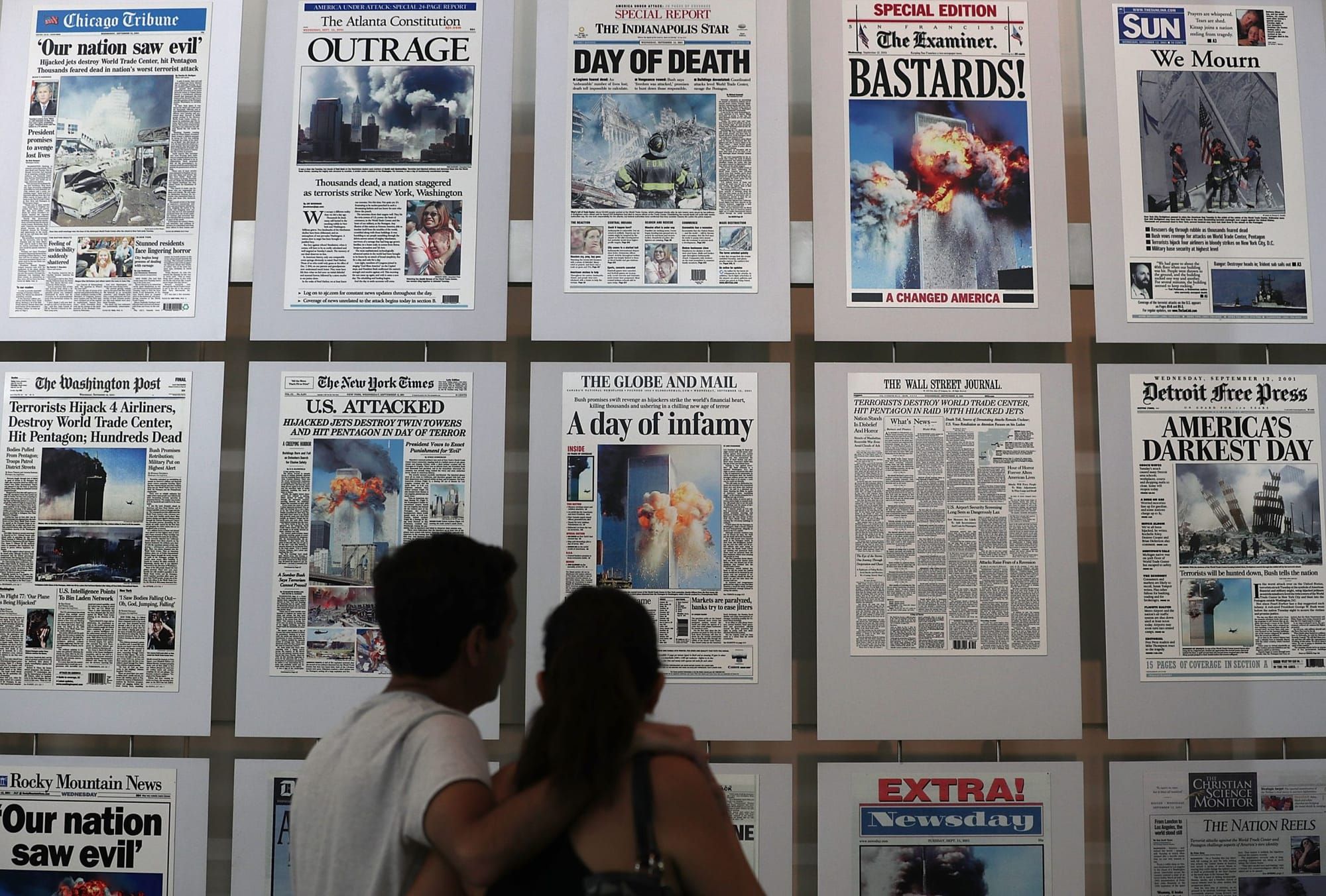
Earlier in Israel’s genocide in Gaza, I taught a course on how American journalists wrote about the “war on terror” following the Sept. 11, 2001 terrorist attacks. As part of the class, I asked students to use a database to find every news article published by a mainstream news outlet on the anniversaries of 9/11. Many of my students were toddlers in 2001, and some hadn’t yet been born. Most hadn’t heard of Abu Ghraib. Their assignment was to use only the news stories to answer the question: What was the reason for these attacks?
Just a few months earlier, Osama bin Laden’s 2002 “Letter to America” was making the rounds on TikTok. There was even a running joke that the youth were mostly fine with his politics, but not that he was a nepo baby. Young people noted that bin Laden had relevant and valid critiques of American empire, particularly given the backdrop of our post-Oct. 7 world that includes the U.S.-backed genocide of Palestinians.
Once they read the narrative of 9/11 contrapuntally, of course, they saw the lack of information everywhere. My students were stunned at how little they actually learned from the anniversary coverage of 9/11. Their main takeaways were that former President George W. Bush said he would never forget the lessons of that day; that Islam is about justice and peace; and that America was attacked for its freedoms. Of the places mentioned as grievances in bin Laden’s letter—Palestine, Chechnya, Kashmir, Sudan—none are mentioned in the 9/11 anniversary stories.
In mainstream coverage, including our angry TV talking heads, there was a lot of “Why do they hate us?” rhetoric. Those who knew the correct answer were not allowed to say it, even though the requirements of objective journalism demand that the question be answered directly and without fear.
Our most resourced news outlets failed us then, and many continue to fail us now.
Manufacturing indistinguishability
Several agenda-setting American news outlets dutifully reported Israel’s claim last month that an airstrike that killed at least 20 Palestinians, including medical workers, civilians, and five journalists, was targeting a “Hamas camera.”
These headlines, almost entirely the same across several national and international outlets, were rightfully excoriated on social media. Not just for uplifting yet another lie from the Israeli military, but for refusing to accurately report on Israel’s actions—striking yet another hospital; murdering more civilians, medical workers, and journalists; and utilizing double-tap strikes—as illegal under international law. At its best, monitorial reporting, as defined by University of Texas at Austin journalism professor Anita Varma, is covering what officials say in order to hold them accountable. Reporting lies by officials without explicitly calling them lies is monitorial reporting at its worst: stenography.
What was most striking to me was a quote published by The Associated Press (AP) from Israeli Prime Minister Benjamin Netanyahu, who, when justifying Israel’s “planned offensive” in Gaza City, said, “It started in Gaza, and it will end in Gaza. … We will not leave these monsters there.”
The AP’s decision to quote a war criminal calling a population against which he’s committing a genocide “monsters” is not just a bad decision, but a notable one. While speaking in Israel in the days after Oct. 7, 2023, then-President Joe Biden characterized the Hamas attack as “15 9/11s.” But as far as Western news organizations are concerned, the post-Oct. 7 period is actually much worse because they have shown readers that they conducted no honest post-9/11 reflection.
We needed a public reckoning and never got one.
Canadian sociologist Erin Steuter explained in a 2010 paper that “monsters” were one metaphor used to dehumanize Arabs and Muslims after 9/11. The monster metaphor “cements fears about the monster’s resilience and ability to spread is found in the rhetoric of terrorist ‘spawning,’ found in media immediately following 9/11, and still frequently employed,” Steuter writes.
What the sustained quoting of dehumanizing language makes exceedingly clear is that newsrooms are not in the habit of reflecting on past coverage, particularly when it comes to critiques of how they covered immigrants, foreigners, or foreign policy. Though they certainly should, few editors sit down to read papers like Steuter’s and reflect on their own coverage, and even fewer implement changes based on this work. Elite American journalism is simply not committed to improving its coverage of these issues.
At times, mainstream news has been forced to acknowledge its irresponsible coverage of women and Black Americans, but rarely Muslims or Arabs. Part of the reason why, Steuter said, is because a reckoning on foreign policy—even by journalists who are meant to be trained in skepticism—would shatter the country’s narrative of itself.
“Journalists, despite all their skepticism about the starving of children of Gaza, will not pull back the curtain and say who’s telling this story and what they have to benefit from that,” she told Prism. “It’s so rare to see that story being punctured in a way that one expects from journalists.”
Steuter said that the monster metaphor is actually high on the dehumanization list. As you go down the list, you get to cockroaches and vermin.
The point of these metaphors is not only to engender disgust, but also to make certain kinds of people indistinguishable from each other and ultimately, to establish a need to eradicate them. The lower down on the food chain, Steuter said, the more effective this kind of metaphor can become to encourage a cleansing.
“[Former Libyan leader Muammar] Gaddafi was always called a ‘mad dog.’ But then you’re moving down to the less indistinguishable vermin—viruses, cancers—that have to be eradicated and cleaned out,” she said. “It would be ludicrous to try to separate out individual bugs or germs from the mass. When the rhetoric of public discourse extends the eradication model to the war on terror, it fails to distinguish between those who harm us and those who seem indistinguishably like them.”
If Palestinian children are indistinguishable from adults—who are indistinguishable from each other—then they all are deserving of death, according to the indistinguishability manufactured by Western newsrooms.
As an example, Steuter recalled something she can still remember reading on an online forum after 9/11: “If a rat bites my baby, I’m not going to go and interview all the rats and find out which rat it was. I’m going to kill all the rats.” And like clockwork, right after the infestation metaphors come the civilian casualties, which are typically underreported by the media. When there are images of people whom the media has made indistinguishable and wretched to you, Steuter said the creation of a new place, a “fresh, clean start,” is much more attractive.
This is, of course, horrifyingly familiar. Others have pointed out all of the genocidal language spoken on the record by Israeli officials, and just last month, one official called the high death toll in Gaza “necessary.” He also claimed that 50 Palestinians must die for every one Israeli killed on Oct. 7, and “it does not matter now if they are children.”
If Palestinian children are indistinguishable from adults—who are indistinguishable from each other—then they all are deserving of death, according to the indistinguishability manufactured by Western newsrooms.
“Not just journalistic malpractice”
I was only 13 years old in 2001, so I didn’t remember all the ways in which the press surrendered autonomy and supposed objectivity after the attacks. For example, exactly one month after the attacks, The New York Times reported that broadcast news executives submitted to national security adviser Condoleezza Rice’s request to edit video statements from Osama bin Laden after 9/11 “to remove language the government considers inflammatory.” One executive called it a “patriotic” decision. Bin Laden’s letter, which has mostly been removed from news sites, is still available to read on Newsweek’s website. However, it’s prefaced with a note that it was “written with propagandistic intent from an international terrorist.”
There is a direct path from this point in history to investigative journalist Jeremy Scahill’s 2024 interview with a senior Hamas official (astonishing to read in any American news outlet), and that path is filled with casualties of journalistic tenets. There are decades of lopsided stories in which newsrooms rely only on quotes from state officials to relay the goings-on of the “war on terror.” Stories in which reporters trust only the American government to define international and domestic terrorism, whether or not it involves any actual violence. Stories where words twist and swerve around facts so that they don’t accidentally run into each other.
In the interview with Osama Hamdan, Scahill critiques this kind of reporting, especially as it relates to coverage of Gaza. “Not just journalistic malpractice,” Scahill writes, “but a fundamental disservice to the public understanding of one of the bloodiest campaigns of annihilation against a people in modern history.”
In 2020, after the police murder of George Floyd, media outlets rushed to publicly assess how they had historically covered police violence and Black communities. News organizations, including where I worked at the time, stopped publishing mugshots, said they’d hire more people of color, and had meetings focused on the need to be more skeptical of police statements. Many called this a racial reckoning. Five years later (maybe even as soon as two years later), whether these changes have endured is a complicated question.
In comparison, the early post-9/11 period contained few public mea culpas, though there’s evidence that Arab and Muslim journalists helped guide newsrooms’ verbiage and sourcing. But in the 25 years since 9/11, American elite media have stubbornly plowed forward without publicly acknowledging their “war on terror” negligence. Among the most powerful newsrooms of our time, there has been no public commitment to improve. No newsroom standards were changed, and no apologies were issued. We’re now seeing the effects of those failures.
I tell my students that in order to get an objective take on what is currently happening in the ongoing and expanding “war on terror,” you must read a few different kinds of outlets in order to “achieve” a sort of objective idea. The genocide has bloated beyond the reach of elite news’ attempts at performing objectivity and will never retreat enough for them to actually grasp it.
When we did have elite self-assessment, it was lukewarm at best. The New York Times critiqued its own Iraq War reporting in 2004, saying that the staff “were perhaps too intent on rushing scoops into the paper.” But even this piece establishes distance between the newsroom and its responsibilities. For example, only Iraqi sources whose motivation was said to be regime change are named and blamed, the rest of the responsibility is vaguely sprinkled over various, unnamed reporters and editors. The Times is framed as if it were duped, not by the American government who almost certainly also wanted regime change, but by Iraqis. “It is still possible that chemical or biological weapons will be unearthed in Iraq, but in this case, it looks as if we, along with the administration, were taken in. And until now we have not reported that to our readers,” the unnamed Times editors wrote.
It’s neither an apology for not being more skeptical of military officials nor a wider reflection on the wickedness of justifying an invasion using flawed reporting; it’s an allegation that the sneaky Iraqis got us. If the Times ever publicly addresses its well-documented biases against Palestinians, perhaps staffers will say that they were duped by Israeli officials who, it turns out, were lying.
To better understand the manufacturing of indistinguishability in our media, Steuter recommended the 2016 “Men Against Fire” episode of the TV show “Black Mirror.” As part of the storyline, a technology called “Mass” is implemented onto the brains of military soldiers to supposedly help them in combat, assess their health, and create maps and directions for troops. A soldier named Stripe is tasked with protecting a village from human-shaped, white-faced, screaming creatures that everyone calls “roaches.” Roaches may look somewhat human—Stripe encounters and kills two—but they carry diseases and commit crimes and are considered an aberration from humankind.
Over the course of the episode, to his horror, Stripe accidentally discovers that the roaches are just normal people the villagers hate. It turns out that the Mass technology actually makes soldiers see mutants instead of people, so that they are incentivized to kill. As one military doctor explains to Stripe, if soldiers were told to just kill people who looked like people, they would be less likely to go through with the murder. When Stripe sees one of the hated roaches as an actual person, he asks her what the villagers see when they encounter a roach.
“They see what you see now. They hate all the same because it’s what they’ve been told,” she tells Stripe.
As he aims his gun at her, she describes the dehumanization process that happened to her people, which sounds eerily like the “cold violence” writer Teju Cole described in 2015 when witnessing Israel’s control of Palestinians in Sheikh Jarrah.
“First, the screening program, the DNA checks, then the register, the emergency measures,” she explains. “And soon everyone calls us creatures, filthy creatures. Every voice. The TV, the computer.”
Her voice, punching through Stripe’s installed Mass technology, is what breaks his trance.
When it comes to Gaza and the West Bank, to achieve objectivity—meaning, a true account of what is happening—we have to listen to what punches through elite news jargon: the voices of journalists and civilians on the ground who’ve managed to survive, telling us in no uncertain terms how many have been killed, who did the killing, and who paid for it.
Editorial Team:
Tina Vasquez, Lead Editor
Carolyn Copeland, Top Editor
Rashmee Kumar, Copy Editor
Author

Nausheen Husain is a writer and professor from Chicago. She researches and reports on Muslim communities and civil rights issues, and teaches journalism at Syracuse University.
Sign up for Prism newsletters.
Stay up to date with curated collection of our top stories.