In ‘Voices of Resistance,’ Palestinian women write to us from the end of the Earth
The devastating anthology reminds us that despite our overwhelming grief, we won’t be alone forever
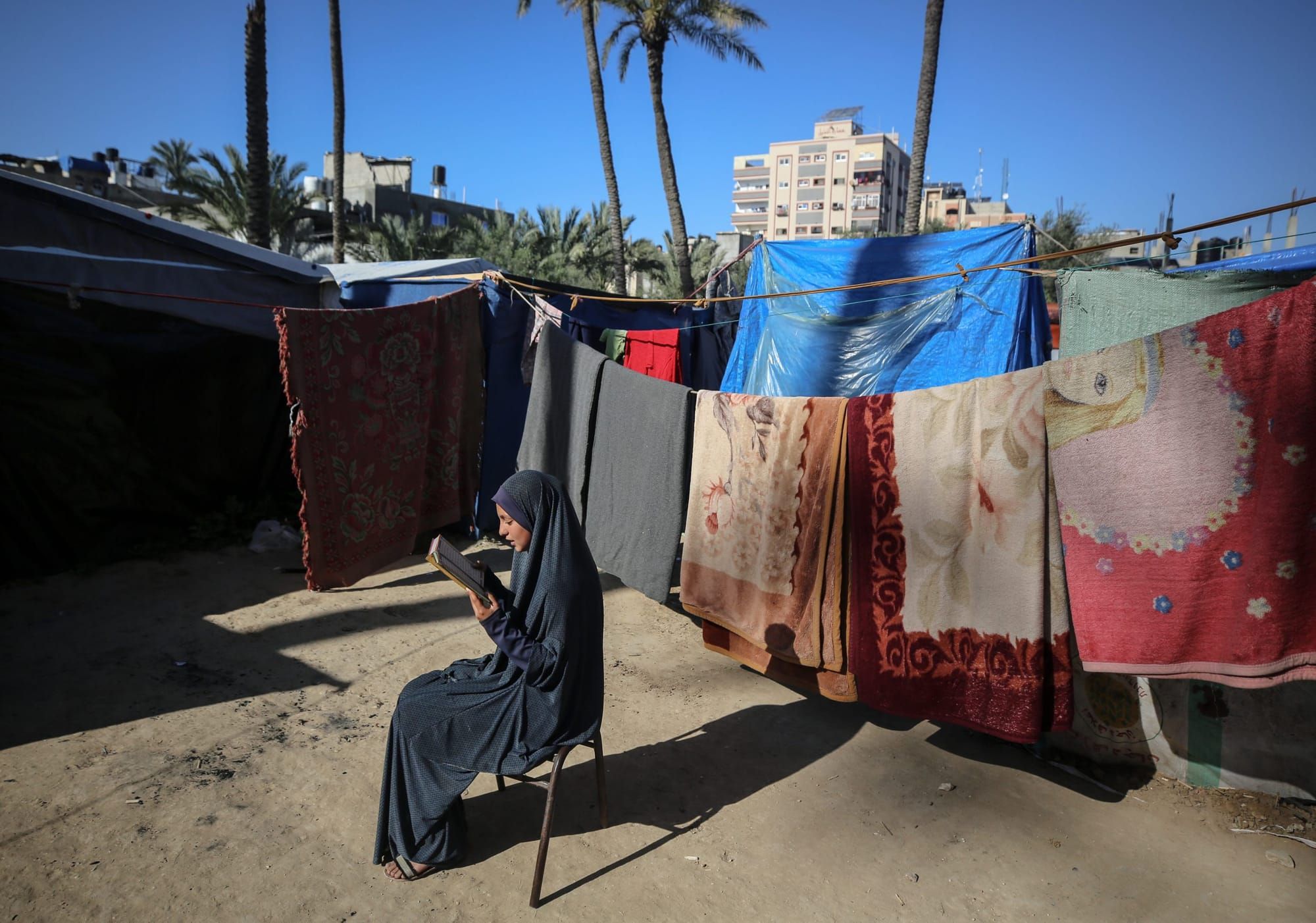
The past two years have been a confirmation that writing cannot save us. And, in any case, I feel like I have no words left.
However, when I received a copy of “Voices of Resistance: Diaries of Genocide,” I decided to search for some. To see if I had anything left to say, to write, to feel.
Published on Oct. 14 by Biblioasis, the four women who make up this collection—Batool Abu Akleen, Nahil Mohana, Ala’a Obaid, and Sondos Sabra—have not given up on language, nor have they given up on life. Despite living through genocide—despite having lost homes, loved ones, running water, moments of silence—they have remained stubborn. As Mohana affirms in one of her diary entries, “Our customs and traditions cannot be abandoned, even if war seems to render them impossible.” Storytelling remains.
In this automated era, in this age of forgetting, all of human cruelty has been compressed into the push of a button, the strike of a drone. The deletion of a name, a village, a history. But the four pieces of this collection, the recountings and reflections, act as a kind of vengeance against the swiftness of the present. Time stands still as you read them, even as the forces of destruction try desperately to usher it along.
Abu Akleen, Mohana, Obaid, and Sabra are not novice writers. They are well-published and widely respected. This is not a book that has been hastily put together amid the mass marketing of works about Gaza. Line by line, the writing is immaculate. There are no plots that could have been spit out by artificial intelligence; there are no corny characters, no comparisons to miniseries in the blurbs, no stylistic experimentations. It is crisp, spare… horribly beautiful. It is better than nearly all the books so carelessly published today. The writers who bare their souls make themselves understood more clearly than nearly every journalist I have translated or edited. Like Atef Abu Saif’s “The Drone Eats With Me: A Gaza Diary” or Dany Laferrière’s “The World is Moving Around Me: A Memoir of the Haiti Earthquake,” “Voices of Resistance” is a book that you will carry around with you for years, slamming it shut when your gratitude turns to guilt, opening it up again when the vapidness of this world has become too much.
“Voices of Resistance” is a book that you will carry around with you for years, slamming it shut when your gratitude turns to guilt, opening it up again when the vapidness of this world has become too much.
This is testimony, this is history. This is life, crushed by power. These scribblings are the words of the vanquished. But this collection is also, unquestionably, literary art. The art that was supposed to save us.
In major media outlets and government press offices, language has been violated. Humanity has become abstract—mere “collateral damage”—and living history continues to be written by cold defenders of ethnic cleansing. The official literature is self-censored, our favorite authors wound us by not uttering a word or signing a letter of protest, while the warmongering pundits speak and type under a spell of utter hysteria. But this banality is briefly erased by four women who, in a slender read, embody all the honesty, love, fear, grief, solitude, and faith that we have not properly honored. They write to us from the end of the Earth.
Abu Akleen shares the most profound, painful honesty. “You rejoice when you realise that the house that was bombed wasn’t yours. You feel a little sad, but you’re still happy about your survival.” This is a truth that most of us are incapable of expressing. It’s refreshing to see. Despite the constant supremacy expressed by our leaders and by the columnists in the so-called papers of record, we are not perfect creatures.
Sabra writes of enduring love. Her father declares that the dearest things he has in this life “are my land, my library and you: my children.” And while sisterhood and motherhood ache in these excerpts, the tenderness of the men—so often forgotten as Israel slaughters tens of thousands of women and children—is never far away. Just after the genocide begins, Sabra describes her father, who gives his family every cent he has before he sends them away from the neighborhood that’s about to be bombed: “I’ve never seen him so stern, so angry, so afraid.” I read this and remembered how frightened of the world I have become.
Some attention is paid to the foot soldiers, the perpetrators. Sabra notes, for the record, how “the very existence of any Palestinian—man, woman, or child—is unsettling for Israel.” She shows us how, with every explosion, every bullet, every indignity, the apartheid state “tried to wring death out of every last second.” But this is not a book about Israelis. It does not attempt to replicate the numerous historical texts that detail 77 years of settler atrocities. In these pages, Gaza is its own universe, its own community, surrounded by more than just a Jewish state. It is surrounded by a complicity that touches all of us. “With my own eyes, I see the remnants of missiles and bombs marked ‘Made in America’ and ‘Made in India.’ Has the entire world united to kill us?” Sabra wonders, as she and her people endure a merciless solitude.
Mohana searches for faith as she endures. Many of her entries begin with a refrain: “Thank God that we are still alive. Thank God for the blessing of a new day.” As the authorities in the West shun believers in Palestine, framing their piety to be an indicator of backwardness—as Big Tech and weapons producers strive to be the new gods—faith is alive and well in these pages. It’s shocking to witness the survival of such touching signs of it as carnage rages, but as lawyers, politicians, and writers seem impotent, perhaps this is the most rational act: to turn toward a higher power.
But Mohana isn’t all about pious forgiveness. “To hell with the occupation,” she curses. Indeed, hell is hopefully waiting for the perpetrators and their supporters. If there is no justice on Earth, perhaps the divine can deal with evil. We certainly haven’t been able to. As my grandmother reminds me in these grim days: Mala hierba nunca muere. Bad weeds don’t die. Just look at our rulers.
It’s frustrating to read on. It makes me feel helpless that women who could be my sisters are so content with the extremely rare “plate of happiness and vitamin C.” But I’m also touched that these masterful writers, like Obaid, are always seeking tidbits and words that have the purpose of “restoring our hope.” More than anything, they are hungry for goodness in the world. And as they are starved, they have miraculously put together a document that will be an important read for those who have been affected by the events of the past two years. “Voices of Resistance” will also prove to be essential reading for all those who enter Gaza in the future, work toward its reconstruction, provide physical and psychological treatment to the victims, receive refugees from the enclave, teach about the genocide in classrooms, and work in the field of memory.
Even when we are gone, storytelling remains.
Obaid and the editors conclude their book without providing the reader any finality. There is no “natural endpoint” for this collection. The genocide continues. Palestine is still being eaten away, day after day. And as much as the lack of finality is terrifying, isn’t that the truest kind of writing? To not pretend that there’s always a happy ending, right when we want it, when we desperately need it?
It’s a privilege to choose a natural endpoint. One of the many parts in the diaries when my heart dropped was when Mohana’s phone died, temporarily putting an end to her notemaking. As I wrote this review, this reflection—as when I’ve written about Rwanda, Partition, the dirty wars—I couldn’t help being very, very aware of my fast internet and my bundle of pens. Of my freedom to go use the bathroom in the middle of a paragraph, to drink water whenever I felt a little thirsty, to peel a tangerine when I was barely hungry, to crush antibiotics into our cat’s food because she was uncomfortable.
It is hard to read something like this when you are so lucky. When you have been spared. When the authors are better writers than I am, and yet, they have to be braver and stronger than I could ever be. Amazingly, when you and I cannot take it anymore, the diary extract suddenly ends. There’s precise timing and pacing. They measure how much we can bear on each page. It’s incredibly generous. Rare is it for writers to consider the reader. These women are far too considerate. I have prayed for them, wept for them.
Grief, as Abu Akleen writes, is individual. But this book, these women, their stories, they can accompany you, us, as we mourn for all that has been razed to the ground: the architecture, the churches, the mosques, the archives, the schools, the hospitals, the people, the rule of law, the sense of decency. We may feel very much alone in our grief, but their words offer the small consolation that we won’t be alone forever.
Editorial Team:
Tina Vasquez, Lead Editor
Carolyn Copeland, Top Editor
Rashmee Kumar, Copy Editor
Author
A historian by training, Avik Jain Chatlani is the author of This Country is No Longer Yours. He has taught in schools and prisons in Latin America and the United States.
Sign up for Prism newsletters.
Stay up to date with curated collection of our top stories.