Abduction for oil: Anti-war protesters and scholars condemn U.S. coup in Venezuela
The Trump administration’s abduction of Nicolás Maduro faces widespread condemnation by legal scholars and rights groups, as well as daily protests from Caracas to New York
Real journalists wrote and edited this (not AI)—independent, community-driven journalism survives because you back it. Donate to sustain Prism’s mission and the humans behind it.
After the U.S. blatantly disregarded international law by entering Venezuela and kidnapping its president, Nicolás Maduro, and his wife, Cilia Flores, on Jan. 3, the response from leaders of several Western governments has been muted and largely uncritical of America’s actions.
A spokesperson for French President Emmanuel Macron, for instance, said on Monday that France “neither supported nor approved” the U.S. military operation to grab Maduro, which killed at least 80 people, including 32 Cubans serving in Venezuela. Macron had earlier posted to X that the Venezuelan people “can only rejoice.” When British Prime Minister Keir Starmer was asked why he felt America might not be in breach of international law, he said that Maduro’s presidency was illegitimate and that a peaceful transition to democracy in Venezuela is what is needed above all else.
The U.S., however, has made little effort to pretend that democracy in Venezuela was its true motivation for abducting the country’s president. Instead, President Donald Trump repeatedly referenced Venezuelan oil in a press conference about the operation on Saturday.
“We’re going to have a presence in Venezuela as it pertains to oil,” he said. “We’re going to be taking out a tremendous amount of wealth out of the ground, and that wealth is going to the people of Venezuela and people from outside of Venezuela that used to be in Venezuela, and it goes also to the United States of America in the form of reimbursement for the damages caused us by that country.”
Later, the U.S. Ambassador to the United Nations, Michael Waltz, told the U.N. Security Council plainly, “You cannot continue to have the largest energy reserves in the world under the control of adversaries of the United States.”
Trump has said that the U.S. will “run” Venezuela, and he threatened to unleash additional strikes if the country’s newly sworn-in interim government, led by Delcy Rodríguez, the vice president under Maduro, did not comply with U.S. demands.
Despite the cover from Western allies, international law experts, rights groups, scholars, and historians widely condemned the U.S. operation. In the U.S., there have been daily protests against the Trump administration’s actions in Venezuela; on Saturday, the day the news of the operation broke, demonstrations took place in more than 70 locations across the country.
In the Venezuelan capital of Caracas, thousands of pro-Maduro protesters took to the streets and rallied against the attack on the country’s sovereignty with placards and chants of “Free Maduro.” Armed Maduro supporters rode through the streets on motorcycles. In a speech before the Venezuelan National Assembly on Monday, Maduro’s son, Nicolás Maduro Guerra, said, “If we normalize the kidnapping of a head of state, no country is safe. Today it’s Venezuela. Tomorrow it could be any nation that refuses to submit.”
Speaking to Prism, a wide range of experts and activists discussed the fallout of the U.S. violations of international law in Venezuela. They placed Maduro’s kidnapping in the context of a long history of attempted regime changes by the U.S. in Latin America and around the world, and analyzed what makes this moment different and especially significant.
Elvira Dominguez-Redondo, a professor at Kingston University in London and an expert on international law, told Prism, “International law is made by the states, and already other states and the European Union seem to have asked for a democratic transition rather than condemn this, which is appalling, to be honest, in terms of upholding the rules that are basic for coexistence.”
She added that under international law, when it comes to prosecution in a foreign country, Maduro should have immunity as head of state.
Dominguez-Redondo said that the U.S.’s actions suggest that because it doesn’t recognize Maduro as Venezuela’s president, he has no immunity under U.S. jurisdiction.
“And this again brings the question of who is the president?” she said. “Is it the person who has effective control over a country, or whoever you like?”
A push to expand U.S. control
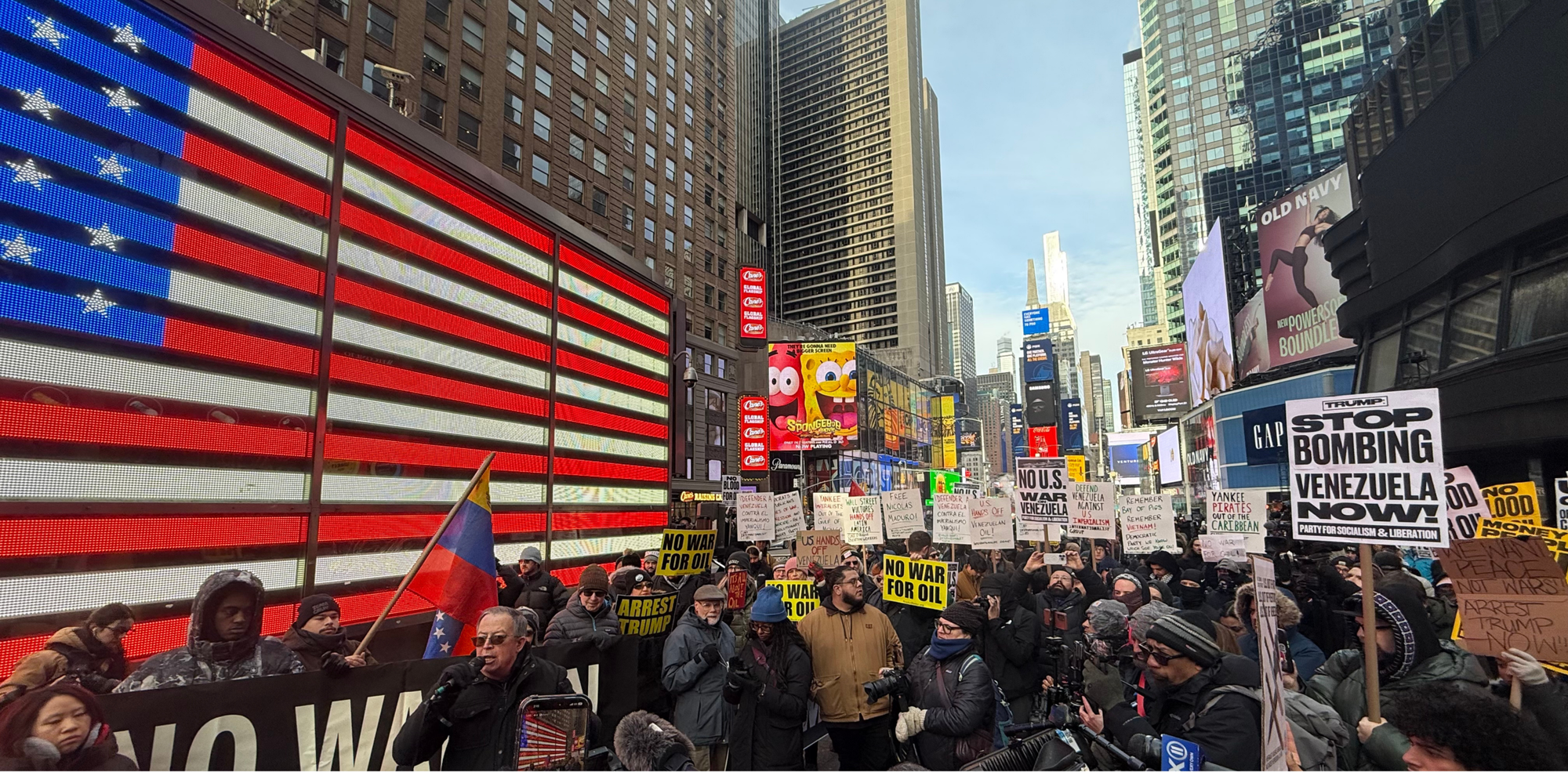
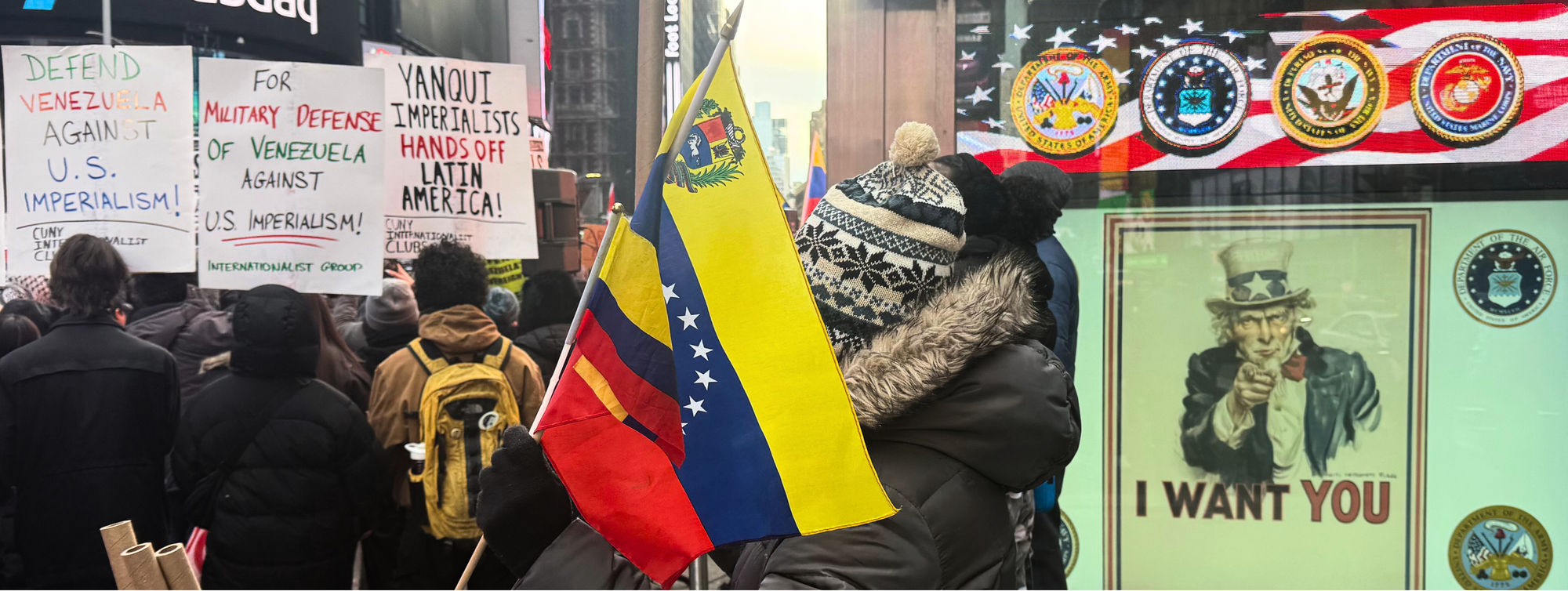
Hours after the announcement of Maduro’s abduction, thousands of New Yorkers took to the streets on Saturday to protest the Trump administration’s kidnapping of the Venezuelan president. Chants of “Hands off Venezuela” rang out next to a giant American flag and an Uncle Sam poster outside the U.S. Armed Forces Recruiting Office in Times Square. Several protesters held aloft the yellow, blue, and red tricolor of Venezuela while chanting, “No more coups, no more wars, Venezuela’s not yours” and “It’s bullshit, get off it, these wars are for profit.”
Gabriela Silva, an organizer for the Party for Socialism and Liberation, said that when she woke up that morning and learned that the U.S. was bombing Venezuela, she knew they had to “pour out into the streets to raise our voices in opposition to this.”
Silva, who was born in Brazil and moved to the U.S. around the age of 4, also felt a personal motivation to be at the protest.
“Our country was directly impacted by U.S. intervention,” she said, referring back to the 1964 military coup that overthrew Brazilian President Jõao Goulart with secret backing by U.S. naval troops and resulted in a military dictatorship. “The United States was directly responsible in enabling a 20-year military dictatorship in Brazil, in which there were horrendous threats against people’s rights, people were disappeared, organizers—much like us—were thrown in prison, tortured, killed.”
More recently, the Trump administration has defended Brazil’s former President Jair Bolsonaro and others convicted of a coup attempt after losing the 2022 election.
The United States has never been a friend to the peoples of Latin America. In fact, it has carried out consistently coup d’etats [and] regime changes, just like we see they’re trying to do in Venezuela.
Gabriela Silva, Party for Socialism and liberation organizer
“The United States has never been a friend to the peoples of Latin America,” Silva said. “In fact, it has carried out consistently coup d’etats [and] regime changes, just like we see they’re trying to do in Venezuela.”
While riding the subway to the Times Square protest, Silva watched clips of Trump’s press conference where he declared that American oil companies would “go in, spend billions of dollars, fix the badly broken oil infrastructure, and start making money for the country.”
“The real truth is that Venezuela is a country that is rich with oil,” Silva said. “They want to control this country, they want to steal its natural resources.”
Venezuela sits on the world’s largest proven oil reserves, totaling approximately 300 billion barrels. The U.S. has imposed sanctions on Venezuelan individuals and entities since 2005, including the state-owned oil company Petróleos de Venezuela, S.A., impacting a major source of revenue for the Venezuelan government.
Miguel Tinker Salas, a Venezuelan American historian and the author of “The Enduring Legacy: Oil, Culture, and Society in Venezuela,” told Prism that the U.S. operation leading to Maduro’s kidnapping occurred in the context of the new National Security Strategy, which according to him, “clearly documents how the U.S. views the Western Hemisphere as its domain, it views its control over natural resources as its purview, and it discounts the presence of any other country involved in trade and commerce with Latin America other than itself.”
In fact, the State Department posted to X on Monday, “This is OUR Hemisphere, and President Trump will not allow our security to be threatened.”
Tinker Salas, whose parents worked in the oil industry in eastern Venezuela and who grew up in the country, said Trump’s press conference made his motives clear.
Trump mentioned oil more than 20 times during the press conference. “Whereas democracy was mentioned zero times,” Tinker Salas said. “They don’t care about Venezuelan democracy. They care about the expansion of their power, the hegemony, and access to the oil industry.”
Speaking to reporters on Saturday, Trump didn’t directly answer how soon he would want democratic elections to replace Maduro. He even downplayed Venezuelan opposition leader and 2025 Nobel Peace Laureate María Corina Machado, a critic of Maduro and a prominent advocate for U.S. military intervention, as a contender to govern the country when he said, “It would be very tough for her to be the leader. She doesn’t have the support or respect within the country.”
“Everything has a price”
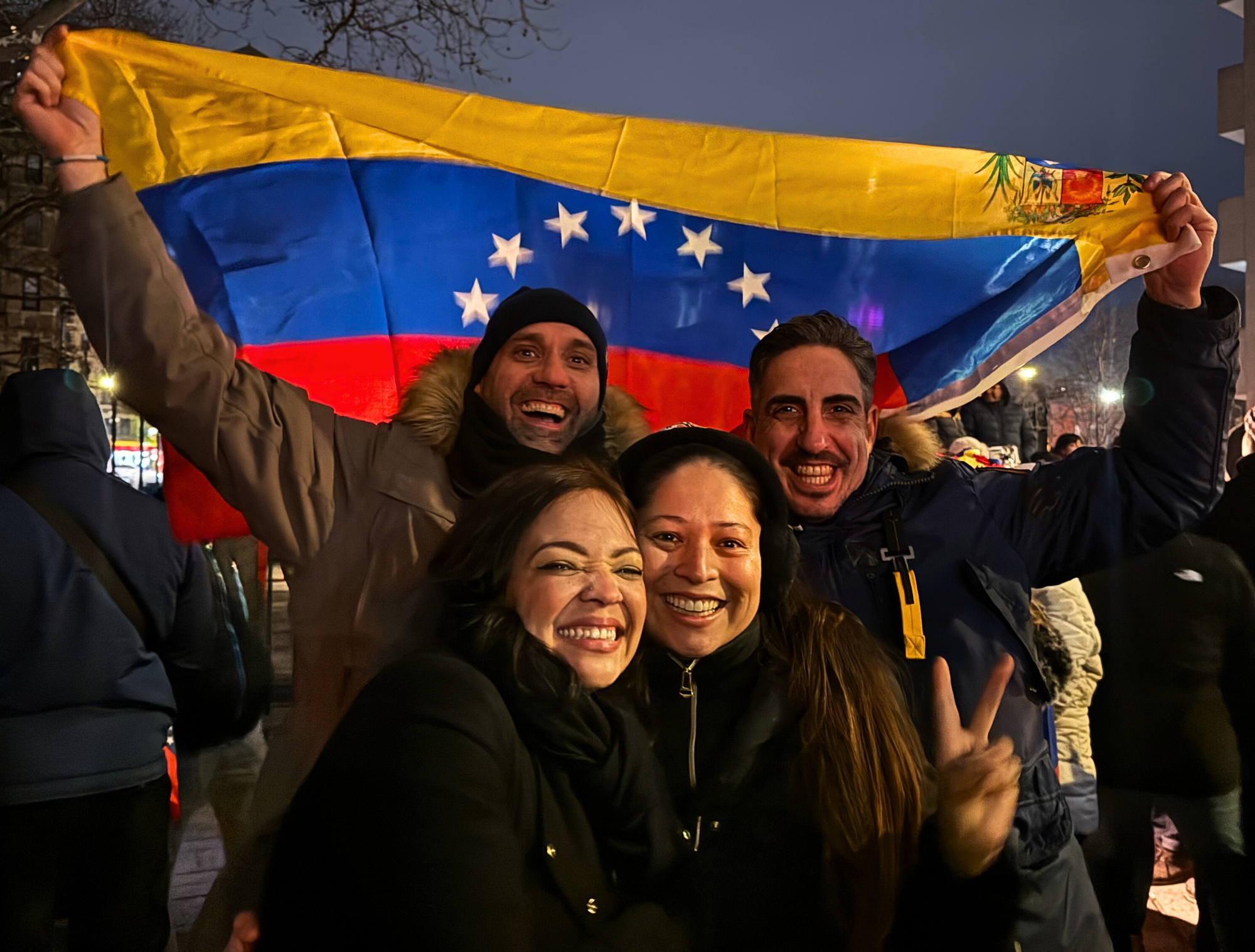
Less than four miles away from the site of the anti-war protest in Times Square, dozens of Venezuelans celebrated Maduro’s removal from power outside the federal court in New York where he was indicted. Just like the protesters, they waved Venezuelan flags, but the mood was one of jubilation rather than indignation. Instead of speeches and slogans, they sang songs and took pictures, wrapped in the colors of the homeland they left behind.
Standing on a park bench, Jorge Torrealba, a 35-year-old Venezuelan artist, held aloft a cartoon of Maduro and Flores in handcuffs and prison jumpsuits. He told Prism, “We are here because we think that we have freedom now, and it’s a special moment. We miss our country.”
Torrealba said he received political asylum in the U.S. after moving 10 years ago to escape persecution in Venezuela for his political cartoons. “It’s impossible to do my job in my country,” he said.
Several people who were celebrating told Prism that they know the U.S. has financial motives behind the operation to remove Maduro, but they were jubilant about his ouster nonetheless.
Leudis Sanchez, a 27-year-old Venezuelan who moved to the U.S. four years ago, told Prism that she remained wary of the motives behind the U.S. military operation. “No government intervenes because they just feel bad for the people. It’s super obvious that they are there for our natural resources,” said Sanchez.
Maria Valentina Moncayo, 27, a Venezuelan residing in Chile who was visiting New York for New Year’s Eve, said she left her homeland nine years ago to escape the humanitarian crisis, lack of work opportunities, and the economic downturn.
Upon hearing the news of the late-night U.S. strike, she said she felt “hope that we can go back, hope we can hug our families.” Moncayo described Maduro as a “dictator” and welcomed a future U.S. presence in Venezuela.
When asked if she was worried that the U.S. government’s intervention was motivated by financial interests in Venezuelan oil and natural resources, she said, “Everything has a price. If our freedom is oil, take it.”
You can be anti-Maduro and be anti-intervention. Unfortunately, that line is not clear for many in the diaspora.
Miguel Tinker Salas, Venezuelan American historian
Tinker Salas, however, expressed caution. “I think we’re falling into the old mistake of ‘celebrate today.’ What’s going to happen tomorrow? There is no plan for tomorrow,” he said. “You can be anti-Maduro and be anti-intervention. Unfortunately, that line is not clear for many in the diaspora.”
There has also been criticism that the views of the anti-Maduro members of the Venezuelan diaspora do not fully represent the views of Venezuelans living in the country.
Almost two-thirds of Venezuelans living abroad supported a U.S. military intervention to topple Maduro, yet only one-third of Venezuelans living in the country gave the same response, according to a poll conducted before the operation by AtlasIntel and reported by the Wall Street Journal.
Additionally, 55% of diaspora Venezuelans surveyed said a U.S.-led military intervention is the most viable way to restore democracy. Only 25% of those living in Venezuela gave the same answer.
A disregard for Venezuelan lives
Critics accuse the Trump administration of showing little regard for Venezuelan lives even within the U.S.
Over the past year, the Trump administration has canceled the Temporary Protected Status of Venezuelans in the U.S., and arrested and deported thousands of them to the country the administration itself deemed to be a reprehensible dictatorship.
“It’s clear that allowing Venezuelan nationals to remain temporarily in the United States is not in America’s best interest,” Matthew Tragesser, spokesperson for the United States Citizenship and Immigration Services, said in a press release in September.
Since Trump returned to office in January last year, there have been more than 14,000 arrests by Immigration and Customs Enforcement (ICE) of Venezuelan citizens. Around half of those arrested were deported by mid-October, and over 43% of those deported had no criminal record, according to Prism’s analysis of government data provided by ICE in response to a public records request by the Deportation Data Project.
“The reality is that they don’t care about Venezuelan immigrants,” Tinker Salas said. “The treatment that the U.S. gives to Venezuelan immigrants is the same notion of how they treat the country itself.”
He added that a key reason for so much immigration from Venezuela was the impact of sanctions placed on the country by the U.S. and some other Western nations.
“Venezuelan immigrants are the result of two factors: the mismanagement of the economy by the government and the sanctions, which have prohibited the sale of Venezuelan oil, curtailed access to credit and their own credit markets, and frozen Venezuelan assets in London,” Tinker Salas said. “Therefore, the country is unable to import infrastructure and capital goods with which to improve the economy and the oil industry, causing shortages and exasperation in large segments of the population, who began to migrate [out of the country].”
Calling on more people to come out and protest against Trump’s efforts to run Venezuela and take over its resources, Silva said, “If you are a person from anywhere in Latin America or anywhere in the world where the United States has played a similar role of trying to carry out regime change and abuse this domination, then you have to empathize with the people of Venezuela right now and feel a sense of urgency to stop it from happening there too.”
Editorial Team:
Sahar Fatima, Lead Editor
Carolyn Copeland, Top Editor
Rashmee Kumar, Copy Editor
Authors

Meghnad Bose is an award-winning investigative journalist based in the U.S. He is a professor of journalism at The University of Memphis, where he heads the MA program in Open Source Investigative Rep

Jerry Elengical is a journalist and arts writer based in New York City who covers design, real estate, and urbanism. He is an alumnus of Columbia University's Graduate School of Journalism.
Sign up for Prism newsletters.
Stay up to date with curated collection of our top stories.