UT-Austin students protesting genocide say they won’t back down following arrests

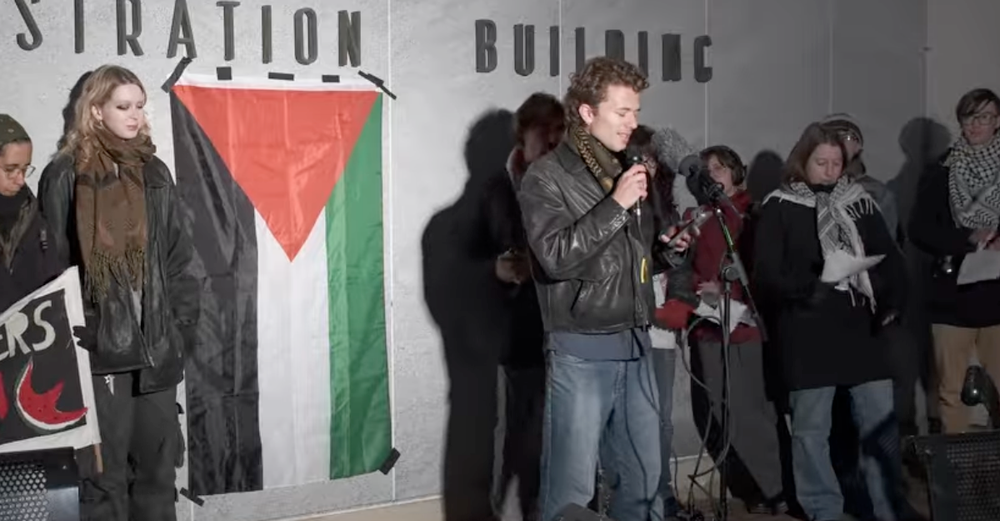
Students across University of Texas System schools have joined campuses nationwide to protest the genocide of Palestinians and demand their university divest from companies funding Israel. The protests have received a harsh response from school administration and law enforcement in recent weeks as the movement builds momentum, but organizers insist they won’t back down.
At the University of Texas at Austin (UT-Austin), the Palestine Solidarity Committee organized a walkout, teach-in, and art workshop for April 24 on the lawn in front of the campus’s main tower. Instead, Texas state troopers and campus police in riot gear and on horses, called by university President Jay Hartzell, violently advanced on the protesters and arrested at least 57 students. The next day, UT-Austin suspended the Palestine Solidarity Committee based on an alleged violation of institutional rules. However, despite the response from law enforcement, protests continue.
“I think it’s important to say that it’s not just a student movement—it is calling for justice in Palestine,” said Jenna Homsi, a member of the Palestine Solidarity Committee at UT-Austin. “We decided to organize this walkout and call attention to what’s happening because the university is complicit. We followed similar events [at other universities] and [took] the lawn because we wanted to make it heard that we are the power in our campus, and we had these educational activities planned. Obviously, it didn’t go that way.”
Homsi said she tried to communicate with police officers the schedule for the day and how they could safely comply with a dispersal order, but she and other Palestine Solidarity Committee members realized they were being shut down immediately.
“[School administrators] were citing different things, like we were violating certain rules or we weren’t allowed to be in that space at that moment … We were trying to talk to them and say that we needed to safely convene on the lawn and stay together as a student body,” Homsi said. “I could tell by their tone that they were not accepting anything … [Administration] had called the police before we even made it [to the lawn] to set up. State troopers kettled us as we were trying to move away from that area.”
That morning, Texas Gov. Greg Abbott responded to a video of the protests on X, formerly known as Twitter. The governor called for arrests until the crowd dispersed and the expulsion of the students involved.
“I tried to act as a deescalator … I just really put myself in [the police’s] line of sight, and so they grabbed me too,” said Citlalli Soto-Ferate, a UT-Austin student who was arrested while trying to protect another protester who was isolated from her friends. “[After getting to the jail], we couldn’t even keep our underwear on … It just felt humiliating because, at that point, you don’t really need to take away people’s underwear. It’s more just for power, just making you feel like you don’t have any control or agency.”
Detained protesters also reported several other cases of humiliation and ignorance by police officers and at the Travis County Jail, such as a lack of access to menstrual products, medical treatment, and food. The University of Texas Police Department denied a request for an interview with Prism but provided a FAQ published on May 3 by UT-Austin.
“Despite being well within our rights, it really goes to show you that no matter what you do, [administration is] going to have a problem with it because it’s not really about free speech,” Soto-Ferate said. “It’s about having monied interests and power and not wanting students to have a voice unless it’s in service of [administration’s] power.”
In response to the last few weeks at UT-Austin, more than 650 faculty members signed an online letter stating they no longer have confidence in Hartzell and that he “violated” their trust. The letter also condemned the firing of more than 40 faculty and staff members after the passing of Senate Bill 17, which banned diversity, equity, and inclusion offices at public universities in Texas.
“What the governor and Jay Hartzell don’t realize is that when you enact so much unnecessary force, unlawful force, and force that violates our rights as students, it angers other students who wouldn’t care before that,” Soto-Ferate said. “When your own rights are being threatened, that’s when people start caring. That’s when a lot more students started joining in, and that’s when they started learning about the movement.”
On the last day of classes at UT-Austin on April 29, police used pepper spray and flash-bangs to disperse students, physically dragging and arresting 79 protesters. Homsi stressed that the focus of the protests shouldn’t be lost amid the overwhelming aggression by police.
“As a public campus, people are going to be here regardless,” Homsi said. “[Administration and police are] not going to scare the community away. The Palestine Liberation Movement is not within a singular organization under UT. They’re not going to stop a movement … There are more important things. We need to prioritize people over profit.”
Companies like Lockheed Martin, Boeing, and Raytheon are all listed on the University of Texas System’s 2023 permanent university fund and provide weapons to Israel. Divestment from Israel in Texas also became significantly harder in 2017 after the governor signed a law prohibiting government entities from working with businesses that boycott Israel. Abbott went even further on X Sunday, stating that divestment would never happen.
“It’s, first and foremost, about what’s happening in Gaza, the West Bank, and in all of Palestine. It’s about holding ourselves and our universities accountable for the harm that they’ve caused across the world where they have no business being. It’s really just about humanity, and what gets in the way is profit, power, and control,” Soto-Ferate said. “It’s important to remember that we’re not doing this to be rioters or whatever. We’re doing this because we believe that we can be better.”
Sit-ins and encampments have only intensified nationwide, with students and community members participating at more than 130 universities. Although administrations continue cracking down on protesters, students’ demands have been heard by a few colleges. Northwestern, Brown, and the University of California, Riverside, came to agreements with protesters involving “disclosure of school investments.” Evergreen State College in Washington committed to exploring divestment from any financial links to Israel by 2026. Additionally, student protesters have not only received support and solidarity from 200 organizations nationwide but also by Palestinians living through bombardment in Gaza.
Author
Neha Madhira is an award-winning gender, health and politics reporter with a focus in South Asia and the Middle East. Previously, she was a breaking news reporter in Austin, Texas, where she broke the
Sign up for Prism newsletters.
Stay up to date with curated collection of our top stories.