Exclusive: The U.S. is exporting Trump’s xenophobia through some of its Latin American embassies
A Prism investigation reveals the State Department’s social media campaign of fear in Venezuela, Brazil, and Mexico, laying bare the anti-immigrant messaging behind the new face of American diplomacy
Real journalists wrote and edited this (not AI)—independent, community-driven journalism survives because you back it. Donate to sustain Prism’s mission and the humans behind it.
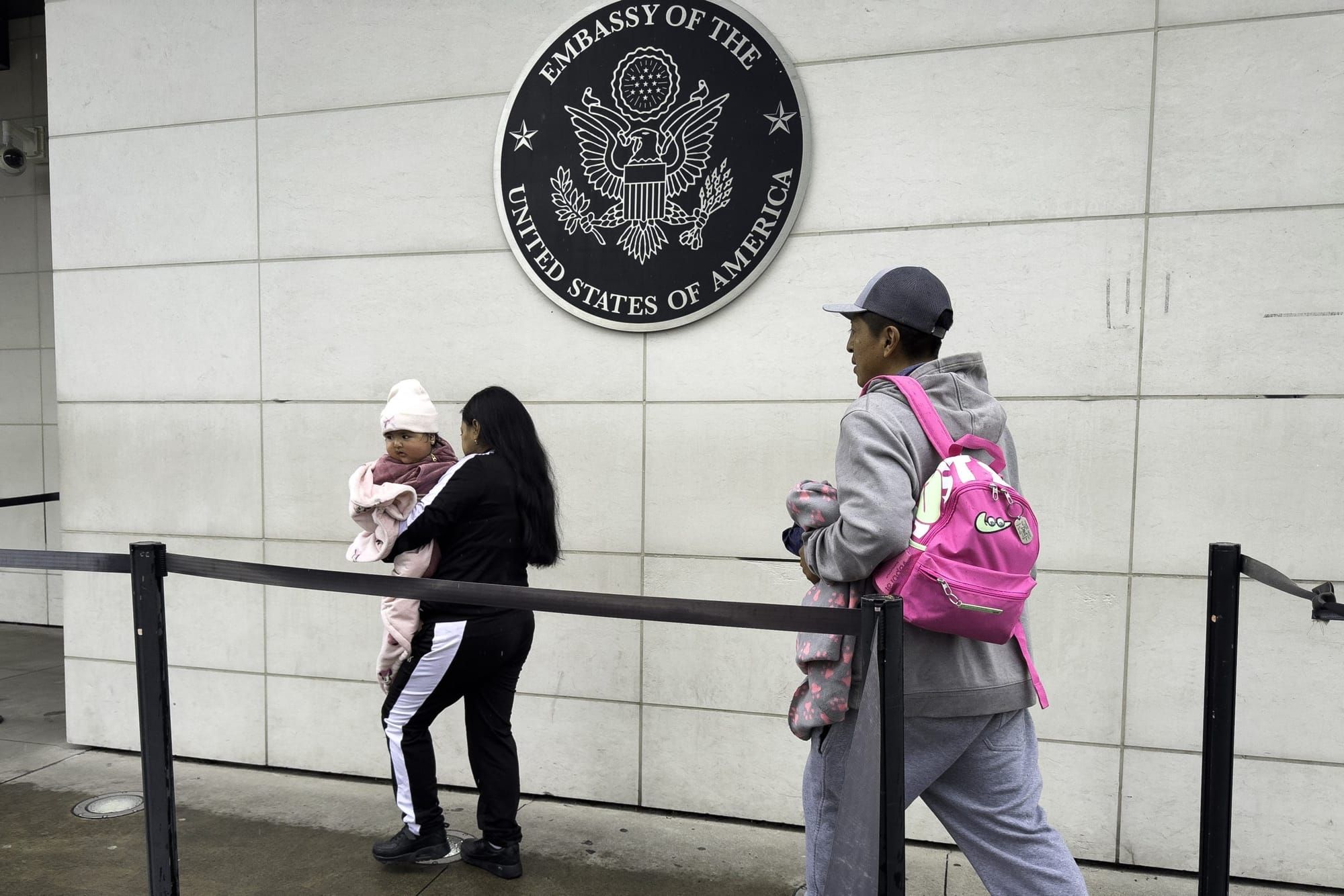
U.S. Embassies are diplomatic institutions meant to aid Americans abroad and process visas for incoming visitors, but social media posts by embassies in three Latin American countries collected and analyzed by Prism show that these government institutions are increasingly using their online presence to promote anti-immigration rhetoric.
“Crossing the border illegally has consequences. The United States has defined certain borderland zones as National Defense Areas,” reads a post in Spanish published by the U.S. Embassy in Venezuela on July 30. “Whoever enters through these zones will face fines, detention, legal charges and prison. Don’t risk your life or your family’s.”
Adopting right-wing discourse that frames unlawful migration as a choice, rather than a result of poverty and broader instability that can be attributed to imperialist resource extraction and U.S. foreign policy, the U.S. embassy used threats to dissuade migration to the U.S. From January to August 2025, the U.S. Embassy in Venezuela posted 348 times, with 45% of these posts featuring anti-immigrant rhetoric. This includes language targeted at undocumented immigrants, urging them to “self-deport” under the Trump administration’s new self-deportation policy. First implemented in July by the Department of Homeland Security (DHS), the policy reportedly provides $1,000 to migrants who use the CBP Home app to return to their home country.
“The immigration laws are now stricter than ever,” reads one caption on a Venezuelan U.S. Embassy post about the myths of immigration. “If you try to enter illegally, you will be arrested, deported, and you will never be able to return. Don’t risk it. Share this information with your friends and family.” Published on Aug. 18 in Spanish, the post is just one example of the messaging the U.S. now commonly disseminates to Venezuelans through its embassy’s social media channels.
According to many international observers, President Donald Trump’s foreign policies have drawn widespread criticism for their severity and unpredictability. The social media strategies of U.S. Embassies abroad appear to align closely with the administration’s approach. However, various departments of the federal government contacted by Prism refused to reveal how their social media strategy is developed and implemented.
This investigation by Prism finds that the U.S. Embassy Instagram accounts for Venezuela, Mexico, and Brazil have increasingly deployed anti-immigrant messaging since Trump returned to office in January. These countries currently have contentious relationships with Trump, in large part due to the president’s unnecessary tariffs and his threats to invade Venezuela and Mexico. The Trump administration has also targeted migrants from these countries with inhumane deportations.
Prism collected and analyzed over 900 Instagram posts created by these U.S. Embassies between January and August 2025. Social media experts who reviewed the data shared their insights to better understand how the Trump administration communicates through diplomatic channels with Latin American countries.
“Tearing down bridges”
Experts who study fascism in the context of social media told Prism that the social media strategies employed by the U.S. Embassies in Latin America counter embassies’ stated goal of building diplomatic bridges between countries.
Historically, the U.S. has advocated for democratic values and building bridges—even if it was largely a mythology. But under the second term of the Trump administration, America’s messaging has decidedly shifted to become increasingly isolationist and openly xenophobic. Given the increasingly violent anti-immigrant policies employed by the administration, one expert who spoke to Prism said the messaging from the U.S. Embassies has the potential to worsen the already poor treatment of immigrants in the U.S.
Jacob Ware, a research fellow at the Council on Foreign Relations who writes about terrorism and counterterrorism, said the current rhetoric from the U.S. Embassies marks a departure from traditional U.S. diplomacy.
“The U.S. diplomatic core has always served to build bridges, build resilience, build connections and expand the image and influence and power of the United States abroad,” he told Prism. “If this is the main narrative the embassy is trafficking in, it indicates a shift away from building bridges towards tearing down bridges and saying, ‘We don’t want a relationship, we don’t want connections. We want [other countries] to take responsibility for breaking down those connections.’ And that’s a real shift.”
Some of the most troubling social media posts from government agencies include memes and references to online trends, which is a component of how right-wing ideology is normalized on the internet, according to Ilana Hartikainen, a political science researcher at the University of Helsinki.
The clearest example of this is a now-deleted July 23 post from the U.S. Embassy in Brazil.
Based on the 1982 film “E.T.,” the post was written in Portuguese and featured the titular character flying on a bike with the caption, “Even E.T. knew when it was time to go home.” The post proved controversial, receiving media attention from multiple Brazilian news publications, including Veja, CNN Brasil, and O Globo. After these reports were published, the post disappeared from the embassy’s Instagram grid.
Prism contacted the Brazilian U.S. Embassy for comment on the post’s deletion, but received no response.
Prior to the E.T. post, Prism contacted the embassy for information about how the agency develops social media content. In response, a spokesperson said: “As a matter of internal policy, the U.S. Embassy does not comment on institutional deliberations.”
For Hartikainen, the E.T. post is a classic manifestation of what she called “banana populism.”
“[They are] using this kind of whimsy and absurdity to mainstream far-right ideas, like doing cutesy things and attaching a far-right messaging into it,” she explained.
The embassy accounts appear to be taking a cue from DHS. In recent months, the federal agency has used X to share drawings of Uncle Sam as part of Immigration and Customs Enforcement (ICE) recruitment efforts. The agency has also posted ASMR videos of immigrants being deported, photos and videos of highly militarized police, and Pokémon memes that say “gotta catch ’em all” in reference to immigrants. On Instagram, DHS posts depictions of an America absent of people of color, alongside appeals for protection.
The hashtags #AmericaSafer and #AmericaFirst were used in half a dozen posts from January to August in all of the Instagram accounts Prism reviewed. Historians have noted that the phrase “America first” was once used by the Ku Klux Klan and other white supremacist fascist movements in the U.S.
Hartikainen connected the use of #AmericaSafer to the GOP’s construction of a security crisis as justification for harsher police and military action. The researcher told Prism that DHS’s use of social media connects to a mythological time in U.S. history when white Americans were safer because they were mostly surrounded by people who looked like them.
Ware agreed, citing a fentanyl public service announcement that largely blames Mexico for American overdose deaths and a Norman Rockwell painting shared by DHS on Instagram that depicts smiling white children saluting the American flag. The caption on the post reads, “Protect our American way of life.”
“On the DHS account, you see a lot of pseudo-white supremacists memeification, often AI-generated pictures of some kind of Halcyon days of old America,” said Ware, noting that federal agencies’ social media accounts should be taken seriously because the messaging makes its way around the world.
“It’s clearly racial dog-whistling, how America is signaling to its own population and how it’s signaling to other populations,” Ware said. “Compare, for example, that picture of the Mexico drug appeal that’s portrayed darkly, showing drugs in the picture, with DHS’s, which is light and showing happy, smiling white children. It’s a really powerful comparison.”
According to experts who spoke to Prism, it isn’t entirely surprising that social media accounts for federal agencies fall in line with xenophobic and racist rhetoric from the Trump administration, but some argue there is an economic interest in how the U.S. government approaches social media.
Trump and the broader right-wing ecosystem around him have spent the last several years decrying so-called cancel culture and “woke” infringements on free speech. Meanwhile, the Trump administration has targeted pro-Palestine journalists, students, and activists with detention and deportation, worked to defund foundations that support left-leaning work, and brought the full force of the federal government down on activists organizing against indiscriminate ICE raids in their communities.
This is illustrated in U.S. Embassy Instagram posts about the Brazilian Supreme Court Justice Alexandre de Moraes. The judge was instrumental in bringing charges against former President Jair Bolsonaro and his co-conspirators after they attempted a 2023 coup d’état at the Brazilian capital, similar to the Jan. 6, 2021 efforts made by American insurrectionists. De Moraes was also partly responsible for the regulation of “fake news” in an effort to ensure the integrity of Brazilian elections.
On Instagram, the U.S. Embassy account for Brazil accused de Moraes of “violating human rights” due to his efforts to convict Bolsonaro and regulate social media disinformation.
“In the minds of the administration, they are protecting this American value of free speech with no restraints, and they are attempting to basically blackmail allied countries into allowing American companies to proliferate what Americans call ‘free speech,’ and what those allied countries would call hate speech,” Ware said.
More broadly, Ware and other researchers argued that the U.S. now exports far-right fascist violence to other countries, a phenomenon evident in Brazil.
Take, for example, the short video posted by the U.S. Embassy in Brazil of a pregnant woman holding her belly in front of an American flag. The video is accompanied by a Portuguese caption that reads, “We will deny your visa if we believe that your primary purpose for traveling is to give birth in the United States or obtain U.S. citizenship for your child.” While scholars have noted that pro-natalism for white populations is frequently embraced and promoted among right-wing groups, the intent of the post is to warn against bringing babies from the Global South to the U.S.
“If you just saw it without the words, then what you would immediately interpret is a pro-life, ‘have more white babies’ messaging,” Hartikainen said. Instead, the image targets pregnant Brazilian women, threatening them with legal action and deportation if they are suspected of traveling to the U.S. for the sole purpose of giving birth on American soil.
Hartikainen noted that, although the post ostensibly addresses those currently in Brazil, the real messaging is “don’t even try to come.”
The core of Trump’s worldview
Social media from the U.S. Embassy in Brazil almost pales in comparison to posts made by the U.S. Embassy in Venezuela, which routinely posts content that openly degrades Venezuela. Out of 348 Instagram posts, 12% contained messaging advocating for free speech and democracy while accusing the Venezuelan government of corruption, dictatorship, and censorship.
“Since the end of 2024, inflation has risen and the Venezuelan bolivar continues to fall in value,” reads one post published in Spanish on July 28. “Prices rise weekly, and wages are not enough to buy food. The Venezuelan regime is solely responsible for the devaluation of its currency, and Venezuelans are paying the price.”
While experts disagree on whether U.S. oil sanctions on Venezuela are solely to blame for the economic decline that began in the country in 2019, the U.S. Government Accountability Office determined that sanctions contributed to the collapse of the Venezuelan economy.
The U.S. Embassy’s social media approach is in line with the last five years of American foreign policy in Venezuela. While the first Trump administration refused to recognize Nicolás Maduro as the president in 2019, the Biden’s administration offered some relief from sanctions in November 2022. However, the Venezuelan U.S. Embassy account under the Biden administration also sometimes posted content warning Venezuelans not to enter the U.S. “illegally.”
“Don’t be fooled! The route isn’t what they tell you,” a Dec. 3 post made during the Biden administration reads. “Crossing the border illegally will prevent you from being accepted for asylum, and you’ll face serious consequences.”
In recent years, Democrats—perhaps looking to replicate the Trump administration’s success courting voters through anti-immigrant rhetoric—made a hard-right turn on immigration. Former Vice President Kamala Harris infamously warned migrants not to come to the U.S. during a 2021 speech in Guatemala.
Over the last 20 years, both Democratic and Republican administrations have generally agreed on enacting oppositional foreign policy toward Venezuela. But Venezuelan American immigration activist and digital strategist Juan Escalante said the current Trump administration is escalating the rhetoric to new heights.
For example, on the campaign trail ahead of the 2024 election, Trump said during an interview that Venezuelan migrants coming to the U.S. are “drug dealers, criminals, murderers, and rapists”—rhetoric that has real-life consequences, Escalante explained.
“It’s like a cat and mouse game, but now the Trump administration is taking a rather unprecedented position, which is the modern-day strikes on boats off the Caribbean, which the administration claims are vehicles for drug trafficking or human smuggling,” Escalante said.
Since September, the Trump administration has carried out a series of airstrikes targeting alleged drug smugglers in the Caribbean Sea and the eastern Pacific Ocean. Human rights groups point out that the attacks have not been accompanied by publicly released evidence of drug smuggling, and international law forbids targeting civilians regardless of alleged criminal involvement. Still, since Sept. 2, the Trump administration has carried out 21 unlawful airstrikes in the Caribbean and Eastern Pacific, killing at least 83 people. The U.S. Embassy in Venezuela published one of the bombings on Instagram.
“Where is the evidence that any of these boats present an international threat to the United States?” Escalante asked. In late October, the Pentagon admitted that the U.S. attacked boats “because they could not satisfy the evidentiary burden” to successfully persecute alleged drug traffickers in court.
Prism’s analysis found that in the months leading up to the Trump administration’s bombing campaign, there was an uptick in rhetoric from U.S. Embassies focused on allegations of drug trafficking in Venezuela and other Latin American countries.
Around 7% of Instagram posts published by the U.S. Embassy in Venezuela since January discuss the dangers of drug trafficking cartels. This includes the announcement of a new executive order classifying drug cartels as “terrorist organizations.” Additionally, the Instagram account for the U.S. Embassy in Venezuela accused Maduro of being the “leader of the Cartel de Los Soles,” a Trump-designated “narco-terrorist” organization that the administration alleges has “taken over” Venezuela. For years, U.S. authorities have alleged that Maduro has ties to Cartel de Los Soles, though it remains unclear if the cartel actually exists.
Ware told Prism in an email that the U.S.’s allegations against the Maduro regime seem “dubious, at best,” in large part because the administration has yet to offer any evidence against the Venezuelan president.
“The allegations will likely heighten the clamors for war among factions of the MAGA movement,” Ware said. “If there is an implication that a leader of a major South American country is a drug-running criminal, the administration will be left with no choice but to remove him, including violently.”
According to Escalante, the Trump administration’s escalation of tensions with Venezuela has broader implications for migrants in the U.S.
“It’s a pattern, to essentially treat South America like it’s this giant web of drug trafficking and human smuggling,” Escalante explained. “It’s a way of continuing this unfortunate narrative that immigrants from South America have to be thoroughly more questioned than others.”
For Ware, Trump’s decision to escalate tensions with Venezuela is a continuation of the rhetoric the president has constructed over the last decade.
“Trump’s initial run for president ten years ago was launched on the narrative that immigrants from Latin America were ‘bringing drugs’ and ‘bringing crime,’ so actually, the rhetoric against Maduro and kinetic action against Venezuelan non-state actors appeals to the very core of Trump’s worldview,” he said.
“Abuses in the homeland”
The Trump administration’s approach to Venezuela—and Latin American countries more broadly—may seem chaotic and shortsighted, but Hartikainen told Prism that there is precedent for Trump’s actions.
The researcher said that the Trump administration’s “crisis narrative” regarding drug trafficking and cartels is an approach commonly used by right-wing populist parties to gain and maintain power.
“I’m sure that the cartel leaders in Mexico are not very good guys and certainly not doing anything to help the U.S., but naming it as ‘terrorism’ then elevates it to a greater level of threat,” Hartikainen told Prism. “It makes [the crisis] more present, and at the same time also justifies more action against it. … By naming something as a big crisis, you also give yourself this great opportunity to solve it.”
Indeed, in early November, former and current U.S. officials confirmed the Trump administration is planning to deploy U.S. troops and intelligence officials to Mexico to target drug cartels. Leading up to the revelation, the U.S. Embassy in Mexico took to Instagram to refute claims that the U.S. planned to invade its southern neighbor. However, in a bizarre incident on Nov. 17, Department of Defense contractors landed on a Mexican beach and reportedly “accidentally declared it United States territory,” The Daily Beast reported.
In a February post, the U.S. Embassy in Mexico posted a clip of Trump’s Secretary of State Marco Rubio claiming that while the U.S. preferred to work with Mexico to share intelligence, federal agencies had a right to take more severe action. “If these individuals ultimately pose an imminent threat to the United States or cross our borders and enter the United States, then that gives us the tools to pursue them using law enforcement, using DHS, using ICE, using the FBI, the [Drug Enforcement Administration], any agency we have available,” Rubio said.
Since his first term, Trump has made a practice of linking drug trafficking to migration. In more recent months, communications from the U.S. Embassies in Mexico and Venezuela have linked the fentanyl crisis to migration and threats to American safety.
In a May Instagram post announcing the arrest of cartel member and drug trafficker Juan José Jacobo Regalado, the U.S. Embassy in Mexico credited Jacobo Regalado’s detainment to a partnership between ICE and the Mexican government, ending the post with the hashtag #AmericaSafer.
The embassy’s narrative and the American immigration policies it justifies have consequences for both domestic and foreign policy, Ware told Prism.
Ware said that when the U.S. government designates a person or group as a foreign terrorist organization, it opens the door to begin charging people in the U.S. with providing “material support” to Trump-appointed foreign terrorist organizations. This “extremely broad” allegation could likely ensnare migrants from Mexico and Venezuela.
“I fear abuses here in the homeland,” Ware said. “The Mexican and Venezuelan governments need to be thinking about the fact that a number of their citizens are now going to be very vulnerable to being charged in the United States as terrorists. I think that would be a serious overreach regardless of the damage that drug cartels wreak.”
Trump’s approach seems to be gaining steam among right-wing actors in Latin American countries. In recent weeks, allegations of “narcoterrorism” have been used to justify an increase in state violence against marginalized populations.
On Oct. 28, the military police of Rio de Janeiro killed at least 121 people during a police operation in the low-income communities of Complexo do Alemão and Complexo da Penha. In the following days, Rio’s right-wing Gov. Cláudio Castro used the term “narcoterrorism” repeatedly in statements to the press, saying the operation was a “decisive strike against crime” and evidence that the state “can win battles.” Claiming that the police’s deadly operation was a success, Castro vowed that the city would continue to wage war against narcoterrorist gangs.
Meanwhile, Amnesty International has called for an investigation of the raid, and local residents are protesting the killings. Recently, Brazilian investigative news outlet Agência Pública reported that a new narcoterrorism bill is in the works that would allow “militia groups, gangs, paramilitary organizations, and criminal groups” to be charged under the crime of “terrorism.” The bill cites the Trump administration as a model to follow, though the author of the bill, Danilo Forte, maintains the bill is a matter of national security. Legal experts and sociologists quickly criticized the legislation, saying that it will “open a path” to international interventions in Brazil, though Forte has also denied that the bill puts Brazilian sovereignty at risk. The last U.S. intervention in Brazil led to a brutal 20-yearlong dictatorship.
In a report about the bill, Marcelo Semer, former president of the Association of Judges for Democracy and judge of the São Paulo Court of Justice, told Agência Pública that the bill “does not help in combating organized crime.” He also called for more investigations and intelligence-based security.
“Let’s not be naive: treating everyone as terrorists will make the United States’ job easier,” Semer said. “[The United States] takes on the role of universal police to carry out acts such as these displays of intimidation that are occurring today, close to Venezuela.”
While the criminalization of Latinx immigrants certainly predates Trump, many experts believe the Trump administration’s rhetoric will continue to worsen conditions in the U.S. for immigrants. But if social media posts from U.S. Embassies abroad are any indication, it seems European immigrants in the U.S. have far less to worry about than those from Latin America, including Columbia, Nicaragua, and Guatemala, countries with U.S. Embassies identified by Prism as also posting xenophobic social media content.
Prism’s review did not find similar anti-immigrant messaging on the social media accounts of U.S. Embassies in countries such as Spain, France, the United Kingdom, and Switzerland. In this corner of the internet, there are no demands for self-deportation or announcements about “criminals” caught by U.S. federal immigration agencies. It’s an entirely different reality.
Editorial Team:
Tina Vasquez, Lead Editor
Carolyn Copeland, Top Editor
Rashmee Kumar, Copy Editor
Author

Nicole Froio is a writer and researcher currently based in Rio de Janeiro in Brazil. She has a doctorate in Women's Studies from the University of York. She writes about gender in pop culture, social
Sign up for Prism newsletters.
Stay up to date with curated collection of our top stories.