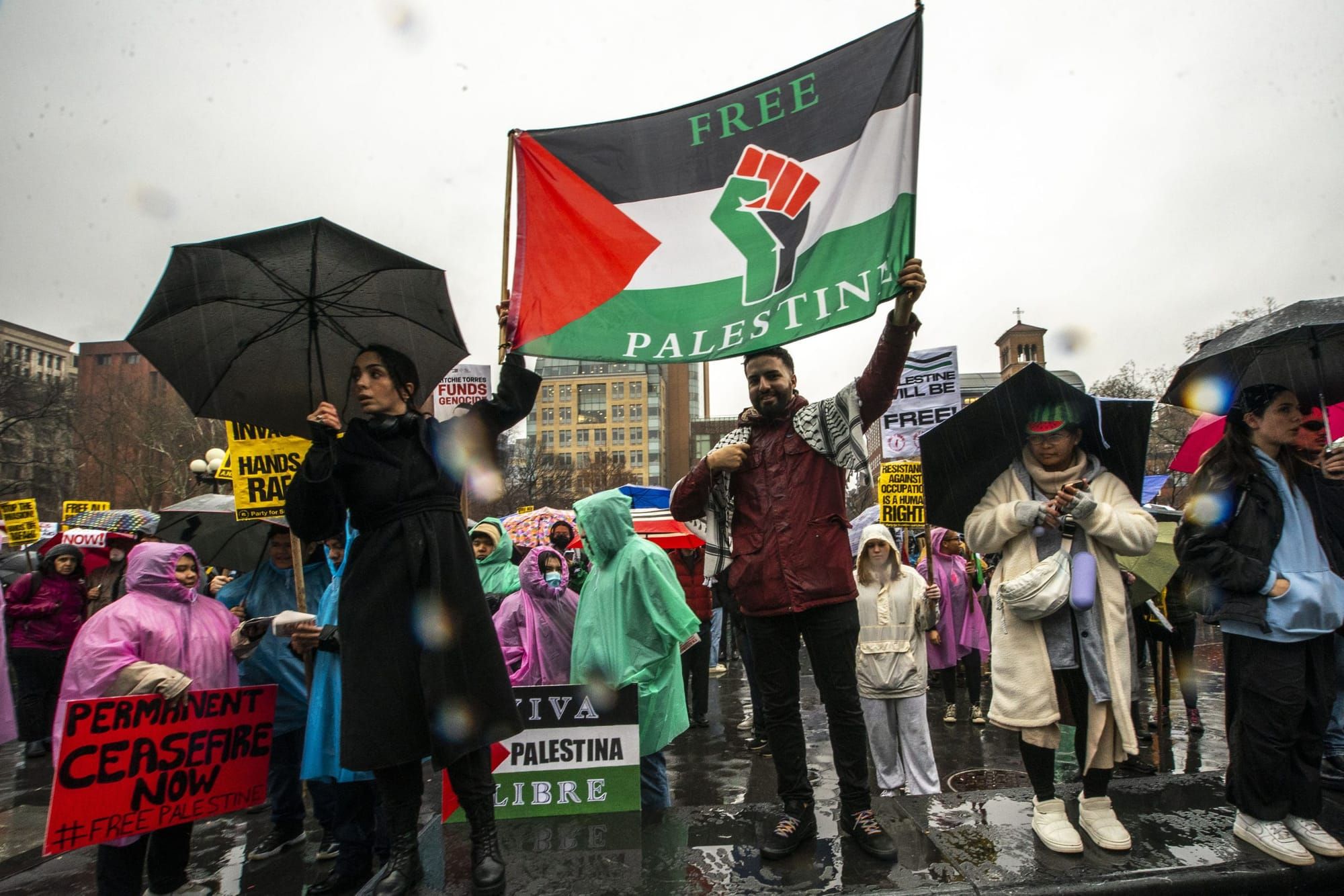
A new report released by Palestine Legal and the Center for Constitutional Rights has found that an anti-Palestinian agenda shaped the inception of anti-terrorism laws.
The report, titled “Anti-Palestinian at the Core: The Origins and Growing Dangers of U.S. Antiterrorism Law,” was researched and written by University of Chicago anthropologist and legal scholar Darryl Li. It offers a comprehensive overview of how the crafting of anti-terrorism legislation has served the purposes of pro-Israel lobbyists in the U.S., as well as the Israeli regime itself, to target the struggle for Palestinian liberation.
Diala Shamas, a senior staff attorney at the Center for Constitutional Rights, said the briefing paper lays the groundwork for understanding the foundation of anti-terrorism laws in the U.S.
“[This will help us] move from a defensive posture to a more proactive posture of articulating policy and advocacy strategies to push back against [these laws] and their expansion,” Shamas said.
The report demonstrates how the weaponization of anti-terrorism has been deployed via a multi-pronged approach, both criminally and civilly. The text reveals that the first mention of the term “terrorism” in federal law occurred in 1969, coupled with language that associated Palestinian refugees with possible acts of terror:
“In that year’s Foreign Assistance Act, Congress required UNRWA, the U.N. body providing humanitarian assistance to Palestinian refugees, to ensure that no U.S. aid dollars would go ‘to any refugee who is receiving military training as a member of the so-called Palestine Liberation Army … or who has engaged in any act of terrorism.’ The law gave no definition for terrorism, but it set down a decades-long pattern that legally inscribed the Palestinian—and especially the refugee—as the default terrorist.”
It goes on to name other legal frameworks that have been codified primarily to target Palestinians and Palestinian organizations, including the implementation of sanctions, deportations, and civil litigation against non-U.S. citizens. Lawyers have faced obstacles in fighting against such discriminatory laws, which have been specifically crafted to silence advocates for Palestine and opponents of the Israeli regime.
“All of this defensive work is important, but it’s a distraction,” Shamas affirmed. “We spend all our time talking about the right to say the things [we want to say], rather than saying the things.”
She points out that these laws can also disrupt political and narrative work. “If you’re successfully attaching the terrorism label to a movement or organization—even if it’s ultimately found to be groundless and meritless—the damage is already done,” Shamas said. “That’s why it’s such an effective tool.”
Zionist organizations in the U.S. have exploited political crises in Palestine to pressure the U.S. government to expand the legal reach of anti-terrorism laws. The designation of the Palestinian Liberation Organization as a terrorist organization, for example, came in the wake of the First Intifada from 1987 to 1993.
Ahmad Abuznaid, the executive director of the U.S. Campaign for Palestinian Rights (USCPR), explained that the goal of these laws is to demonize the Palestine movement:
“When you’re able to demonize an entire movement, you’re able to draw barriers between the movement and the masses [it is] actively seeking, cultivating, and recruiting into the movement,” Abuznaid said. “They limit our ability to build power.”
In 2019, the Jewish National Fund—a Zionist group—sued the USCPR, alleging that its advocacy activities were unlawful. They accused the group of providing “material support” to terrorism. The case was dismissed, and all appeals by the JNF were rejected, most recently by the U.S. Supreme Court.
Pro-Israel lobbying groups—namely, the Anti-Defamation League—have not limited themselves to exploiting crises in Occupied Palestine and the wider Middle East. For instance, they have utilized domestic incidents—such as the aftermath of the 1995 Oklahoma City bombing, perpetrated by white nationalists—to advance legislation that targeted Palestinians instead.
According to the report, allegations of “material support for terrorism” have been “the most commonly charged federal anti-terrorism offense.” It has been widely used against activists and organizations mobilizing for Palestinian liberation. The charge does not necessarily indicate support for violence but rather introduces a deliberately vague set of activities that would have otherwise been constitutionally protected.
As the genocide continues in Gaza, there is concern that Zionist actors will capitalize on ongoing pro-Palestine protests to further expand the chain of discriminatory anti-terrorism laws. The paper presents recommendations aimed at policymakers and university administrators, urging them to protect students and activists against defamation, baseless criminalization, and harassment from Israel-aligned organizations.
Carrie Zaremba, a spokesperson for National Students for Justice in Palestine (SJP), said that the laws weaponized against organizers in the Palestine movement have not been as effective as in the early 2000s.
“All kinds of legal-related action was reactive, but now, there [are] structures in place that enable proactive counter-repression,” she noted.
Zaremba said student organizers have greater awareness of the legal system and know their rights. This is due to access to legal support tools, such as those provided by organizations like Palestine Legal and the Center for Constitutional Rights.
“Students have [also] implemented a strong understanding of security culture that relies on the mantra, ‘We keep each other safe,’” Zaremba said. “Things like deescalation training, know-your-rights training, and telling general [SJP] members how to lock up their social media.”
Zaremba said the intended effect of such laws is “distraction,” an attempt to direct energy and resources away from organizing.
“A strong organizer who has so much to bring to their campus, as soon as they’re subjected to a months-long disciplinary hearing that requires outside legal guidance, that is movement resources and movement energy that could be directed elsewhere,” Zaremba said.
Zaid Khatib, a member of the Palestinian Youth Movement, said the report was timely, revealing that anti-Palestinian sentiment is not a “symptom” of anti-terrorism legislation, but rather “baked into the very core.” He also referred to the unfolding genocide in Gaza and the U.S. government’s unconditional support to the Israeli military.
In the past five months, the U.S. government has approved at least two emergency sales of weapons to Israel while also cutting all aid to UNRWA. The Biden administration is attempting to send a further $14 billion to the Israeli government, on top of the nearly $4 billion it receives from D.C. annually.
Khatib emphasized that “terrorism” has no consistent legal definition in domestic or international law.
“It’s always meant to serve as a flexible framework that can be weaponized to criminalize any form of dissent or protest that the U.S. government deems unacceptable,” he said.
“Mass shootings inflicted by predominantly white men in the U.S. aren’t treated as racially motivated or as acts of terrorism,” Khatib pointed out. “But when we see simple acts of expression—like engaging in a protest in support of Palestine—[those are] treated as terrorist incidents.”
Author

Laura Albast is a Palestinian-American journalist, translator, photographer, and media analyst. Her publications and appearances include The Washington Post, The Nation, Al Jazeera, The New Arab, Pris
Sign up for Prism newsletters.
Stay up to date with curated collection of our top stories.