We’ll come to you: How an urban farm in Little Rock builds community trust
Local organizations in the historically Black neighborhood of South End are using food and wellness to make sure no one goes unseen
In South End, the historically Black neighborhood of Little Rock, Arkansas, generations of community members without access to fresh fruit or produce relied on a singular corner store. Since its closure, limited transportation, among other interlocking oppressions, has further strained food access in the neighborhood.
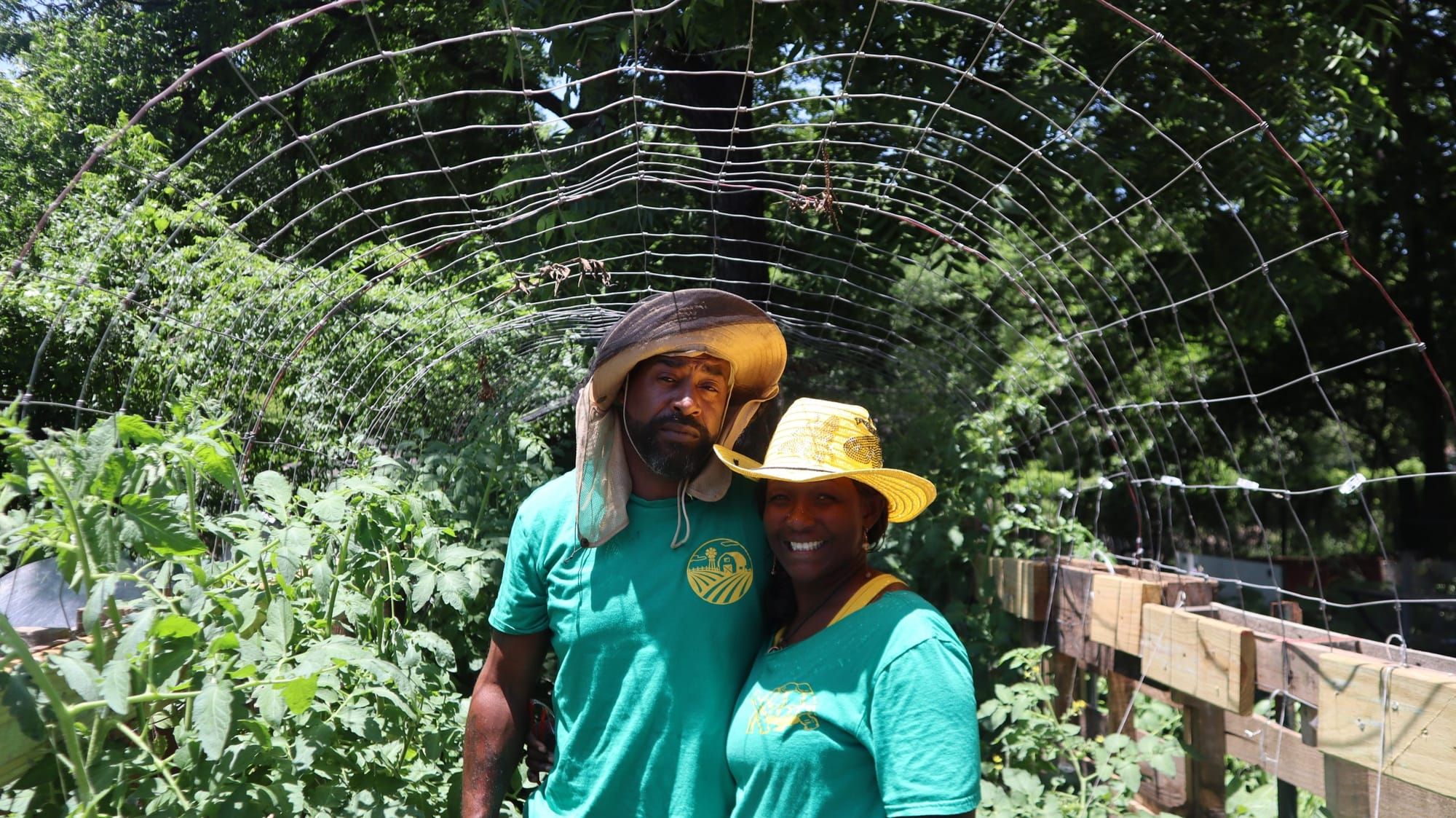
On another corner in the same community stands an ungated lot with a newly constructed greenhouse built in the summer of 2024. Behind the greenhouse is a produce stand complete with index cards that have the names of vegetables and prices written in black. Small pots, benches, and flowers pepper the rest of the lot. Across the street is a backyard with a few rows of lush raised beds and pop-up tables called the cottage house.
This is Turtle Island G.K., an urban farm and food stand started by Gabriyel “Gabe” El-Bey. El-Bey is a Marine veteran and a descendent of the sharecroppers who died in the Elaine Massacre of 1919 when Black sharecroppers who organized for better wages were murdered by white vigilantes. It was one of the bloodiest racial conflicts in the history of Arkansas. More than 100 years later, El-Bey is still doing the vital work of feeding his community, despite many other Black Southern farmers living in rural areas getting away from land work in favor of finding a better life.
Turtle Island G.K. partners with Serenity Urban Wellness to build a community of education and wellness around food. Its founder, Dena Patterson, is also a descendant of Black landworkers in the Arkansas Delta. Patterson’s family owned land in the city of Lakeview for several generations, and they were constantly harassed by white locals because of it. In the mid-1980s, a white neighbor even dropped a bomb on her grandmother’s porch that burned the house down. Patterson has some childhood memories of exploring the land and watching for snakes while fishing, but eventually, everyone moved away to get away, so she didn’t start learning about farming until she met El-Bey.
Both El-Bey and Patterson’s families were violently attacked for working with the land and growing food, and both were encouraged away from agriculture because of the things that happened. Somehow, they found their way back to their roots.
“It’s like, we are our ancestors,” Patterson said.
The movement to restore Black agricultural heritage has boomed alongside urban agricultural (UA) research, as Black communities in urban areas become litmus tests and basecamps for UA projects. This is often due to a combination of the higher rates of food apartheid and environmental racism experienced by Black communities and the ways that community green spaces have become creative resistance efforts. Efforts to reclaim Black land are also efforts to reclaim Black belonging and expertise in tackling agricultural issues. While there are now many stories across the mediasphere focused on the empowerment, agency, and resistance of Black communities fighting inadequate urban food systems, Black Americans’ cultural roots in agriculture descended from the South and did not vanish as part of the Great Migration. It is common for Black American descendents from the South to have seen their elders garden with whatever space they had, which is why collard greens and tomatoes are still commonly grown in Los Angeles backyards.
In the South, there was no food system without Black people, a continued point of pride and grief. Post-slavery, growing food was a way of life for sharecroppers and landowners; it was also how people made money and fed their families. Of course, not everyone had the skills or desire to do land work, which made agricultural workers deeply respected in the community. The racial violence that imposed harsh restrictions on agricultural opportunities for southern Black people and drove the blatant theft of their land pushed many to leave. Some people were sent away, and others left for educational opportunities only to return and adapt what they learned for their rural Black communities. Some stayed and continued to farm. While unstable climates may change how people respond or who support these efforts, in the South, reclamation has always been a way of life.
“None of this is safe”
I met El-Bey and Patterson last summer when reporting a story for Oxford American Magazine that brought me back to my graduate school home in Little Rock. While on assignment, I experienced the lush network of Little Rock gardens and education centers that hold the community together. Working on this feature profile took me through a hidden door that led to grassroots community groups working outside the media spotlight, doing work that was not easily searchable online.
When talking to Patterson and El-Bey about the impact of their work, we clashed frequently over language. At one point, I noted misconceptions that can arise when UA research and policy focus on the sheer quantity of production over the quality of impact, which can minimize community efforts—.though El-Bey himself sometimes downplays just how much Turtle Island produces for the local community.
On its own, Turtle Island can feed 85 families consistently over 12 months. Those 85 families average one adult with 2.5 children, which, by his metrics, comes out to about 250 to 300 people who rely on food from the farm each year. Once the greenhouse is up and running, his yield should be threefold.
A partnership between Turtle Island and Serenity Urban Wellness allowed Serenity Urban Wellness to apply for grants to purchase meat and other food. They’ve also become authorized Supplemental Nutrition Assistance Program (SNAP) retailers, but for the most part, the food they offer is free, and they’ve never asked the community they serve for donations.
“When we first started doing the [weekly] farm stand, we would serve anywhere from 50 to 100 on Sundays. We moved it to Saturday last year, and our numbers started increasing,” Patterson said.
At their fall festival last November, they gave away over 1,000 pounds of produce and meat. During their holiday blitz in December, they gave out over 900 pounds of produce and meat. They also hold canning and preservation classes at the cottage house to educate people about the differences between mass-produced food purchased from a store versus the pesticide-free produce they get from Turtle Island. Patterson said they don’t want to be known as a food bank, given the negative association many community members have with that kind of aid. Instead, they conduct programming—like yoga in the garden or a honey harvest—that coincides with giveaways. After they’ve had a chance to do something fun and connect with each other, participants can walk across the street and get food.
Sometimes in research, the intricacy of the private networks developed by Black communities who have had to rely on subversive ways to keep each other alive are considered meager efforts. There is no good reason to minimize El-Bey and Patterson’s efforts. They provide an extraordinary service as a two-person team that mostly relies on volunteers and has no marketing budget or real government funding. Perhaps they aren’t producing “enough,” but that depends on the language you’re using and whose standards you’re trying to meet.
I pressed further, leading to another language clash.
“If you’re in a community where they’ve closed down all of the grocery stores, there’s a trauma that can come with that,” I said. “How do you make it feel safe?”
“Word it differently,” El Bey replied. “I think I’m struggling with the word ‘safe.’”
“Let’s say ‘comfortable,’” Patterson chimed in.
“That’s a better word,” said El Bey. “None of this is safe. There’s no safe space for us. Safety as far as nonjudgmental, but not safety as far as security.”
When it comes to food advocacy, it’s important to know how people feel about the food they’re receiving, especially in community spaces where values like safety, trust, and sovereignty are advertised. Do communities genuinely feel taken care of? Is data about this collected? What kind of innovation is possible when food distribution comes with care and respect?
The reality is that the creation of more initiatives and policies doesn’t always translate to feelings of safety or even community engagement, especially in Black and brown communities. In 2019, scholars worked with Oakland activists to analyze how investments in gardens, health food stores, and farm-to-table restaurants actually played a role in gentrification. In Detroit, a study of dietary benefits associated with programs designed to cultivate more support for urban gardeners found an increase in produce consumption and food security—undergirded by distrust of industrial food systems. In one promising 2020 study, researchers found that at a multiethnic community farm in Toronto shifted how immigrants participated and engaged in the community.
Getting into the right relationship with the land has direct ties to getting into the right relationships with each other. These recent studies show that “making a dent” in the problem of food insecurity requires a thoughtful approach to engaging local communities. The more a service fits into the lives and the culture of the people who need to be served, and the more it affirms their contributions, the further the impact.
Anticipating needs
In El-Bey and Patterson’s community, residents have many concerns when it comes to trying to nourish themselves. The concerns lie between the community and the government, and the community and the nonprofit. But they also lie between each other. They cannot promise safety or even food security, so for El-Bey and Patterson, the goal is to show people that they can comfortably rely on each other. Rather than posting a call on social media for BIPOC, systems-impacted, underserved, and low-income families to come by the farm and get free food, El-Bey and Patterson simply bring food to people’s houses.
“If you knew somebody was having a hard time, they didn’t have to tell you,” Patterson said about her upbringing. “If you’re not comfortable enough or feel like you don’t want nobody in your business, we’ll bring it to you.”
El-Bey’s approach also highlights the importance of being a longstanding member of the community you serve. According to the urban farmer, when you know your neighbors well enough, they open up to you, telling you they hurt their back, their mother is ill, or they’re having trouble with child care. El-Bey doesn’t wait until they come back to the farmstand. He takes some food to their house and sits on the porch, so he can watch their kids play for a few hours.
“The majority of the conversation is not in the words. You just got to get to know people enough to know how they move. You gotta care enough to know,” El-Bey said, noting that he doesn’t have to ask people if they want free food because he already knows that they need it.
Recently, men have become more involved in the urban farm’s events. They hold an annual men’s wellness event, and they’ve grown partnerships with local organizations like Saving Our Sons, which offers young men in the Little Rock School District opportunities for mentorship, education, and additional support. Patterson said they’ve also partnered with the sister organization, Girls Empowered by Mentoring Sisterhood, which offers educational opportunities and needed services to local girls. Historically, Black women are the lifeblood of these community networks and the most represented at in-person events. However, at a recent fall festival, over 70% of attendees who received food were men.
Patterson attributed their rise in attendance to the space being a no-judgment zone. The men thanked the organizers profusely, noting how much their children needed the food and detailing what they would make with the food they received. One man even stood on the corner, calling other men to get food. As El-Bey said, there isn’t much that can make these men feel completely safe receiving help or otherwise being vulnerable with their community members, but at the very least, they’re getting comfortable relying on each other.
When I asked Patterson what drew her to this work, she said she simply had the urge to grow her own food, and she can’t really explain why. Then she met El-Bey at an herb workshop, and while they fought the whole time, larger forces brought them together. He was actively mentoring youth interested in urban farming and consulting on projects throughout the city. Patterson had a partner who “kicked down” her interest in the food world. At the workshop, El-Bey and Patterson were too busy fussing to see the calibration between them, but Patterson said that someone in the workshop made note of their energy and told them they’d get together eventually.
A year and a half later, that’s exactly what happened.
This time, when Patterson told El-Bey she wanted to grow her own food, he immediately set her up with three trays of sown seeds while she jumped and screamed every time she saw a worm. “I was excited; this is what I wanted to do,” Patterson recounted. “About two weeks later, [El-Bey] said, ‘Look at your babies over there.’ [The plants were] all dead. And that showed me whatever you want, you gotta keep putting the work in.”
Author

Gabrielle (they/she) is a writer and producer based on Tongva, Kizh, and Chumash land, also known as Los Angeles. They specialize in stories rooted in food, human-environment relationships, and bodily
Sign up for Prism newsletters.
Stay up to date with curated collection of our top stories.