Unionizing small nonprofits brings unique challenges and benefits
Tight budgets and managers unfamiliar with unionizing can present hurdles, but unionizing offers workers opportunities to build solidarity and improve workplace conditions and culture
It was 2018, and workers at the Center for Public Integrity (CPI), a nonprofit investigative journalism organization, had been frustrated for a while. CPI had a history of financial ups and downs and numerous layoffs, and workers were increasingly concerned that the organization lacked financial transparency. A diversity committee at the nonprofit found that the proposals they brought to management went unheeded. When some workers decided to start sharing their salaries, they noticed huge pay equity issues.
“We realized that there were several folks who were paid quite a bit less than other workers who had the same level of skill, doing the same jobs, and the same level of experience,” said Joe Yerardi, a data reporter at CPI who was part of the union drive. “We didn’t like that. That struck us as improper, and we figured organizing was a good way to address those pay disparities.”
In just a few months, CPI workers decided to form a union that was then voluntarily recognized by management after a card check. While CPI is part of a rapidly growing trend of unionizing nonprofits, it is unique for a particular aspect: its size. CPI is a small organization with only a few dozen employees.
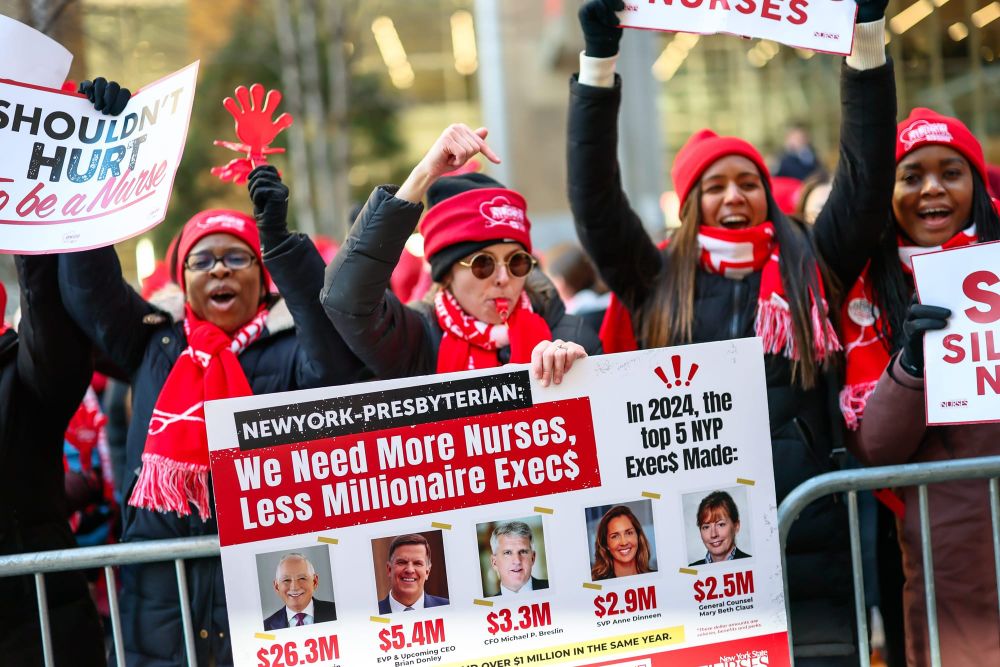
Nonprofit unionization has become increasingly common, but the most prominent organizations whose workers have organized—such as the Southern Poverty Law Center, the American Civil Liberties Union, and the Art Institute of Chicago—are ones with hundreds of employees and that bring in millions of dollars in revenue. At the same time, there is an increasing trend of nonprofits with smaller budgets and fewer staff also trying to use collective bargaining to improve working conditions, overcoming some of the unique challenges that arise when small nonprofits unionize.
The traditional model of unionization imagines a for-profit workplace—a factory, for example—where the owner’s desire to profit is naturally opposed to the worker’s interest in getting paid a fair wage. Nonprofit organizations complicate this story, as the goal of a nonprofit is not to enrich the owners, but to provide a public service.
But nonprofit organizations can still be exploitative. Executive directors and managers often earn a considerably higher salary than lower-level staff. Nonprofits often benefit from idealistic young people who are eager to make a difference and willing to earn less than what they would make in the private sector. This sets up an environment where nonprofit organizations often offer unlivable wages, few benefits, and poor working conditions for their employees.
Some workers at large nonprofits have realized the wage disparities between people working in high-level, executive positions and have taken action to correct them through unionization and contracts. On the other hand, workers at small organizations have been slower to adopt collective bargaining as a process to improve worker well-being. But some small nonprofits workers have successfully overcome real and perceived challenges connected to their size.
While collective people power is widely considered the predominant asset of labor organizations, small organizations can still benefit from the power of unionization. Margaret Poydock, co-president of the staff union at the Economic Policy Institute (EPI), said a union can be as small as two people and still have a more powerful impact than two people working individually to improve their workplace.
Workers at smaller organizations can also build their power by thinking broadly about who is eligible to be represented. While protections in the National Labor Relations Act do not extend to managers, program directors who do not have direct managerial authority may be able to be part of a bargaining unit if their supervisors recognize them as workers. For example, unions at both EPI and The Commonwealth Institute for Fiscal Analysis (TCI) include staff with a director titles who may oversee a program but are not engaged in hiring, firing, or setting workplace conditions. For organizations like TCI, which has about 20 employees, this allows the union to have greater power and more employees to benefit from union protections.
One of the biggest challenges of unionizing in a small nonprofit is finding a labor organization to work with. Negotiating a contract takes about the same amount of resources whether one is working with a small or large organization, but small organizations will naturally contribute less money in union dues. Daniel Perez, former vice president of organizing of the Nonprofit Professional Employees Union, said that the Animal Legal Defense Fund (ALDF) encountered this challenge before successfully organizing with the NPEU.
“It’s really expensive and really time-consuming to negotiate a contract, and I think that is a large source of hesitancy for organizing small nonprofits, which really sucks because there is so much interest in organizing, and a union makes such a difference in a nonprofit,” said Perez.
One of the challenges faced by small nonprofits workers looking to unionize is their particularly tight budgets. Compared to nonprofits that have a nationwide presence, receive government funding, hold large endowments, or have significant business activities, organizations that rely on individual donors and unreliable grants often struggle to maintain their services with the resources they have and are often more fearful and reactive to a union drive. Perez said that some of the most anti-union campaigns he has seen have been run at small nonprofits, including the ALDF.
“Oftentimes you’ll hear the typical anti-union line of ‘we love unions, but unions are not right for our workplace; we are really small, and we don’t have a lot of resources,’ and they’ll cry poverty, but a union contract deals with more than just economic issues,” said Perez. “A union contract is a way to outline professional development or secure things like just cause or a grievance procedure.”
Unionization will not bankrupt an organization—after all, workers have an interest in maintaining financial sustainability so they can keep their jobs. Collective bargaining also opens up the opportunity for bargaining creatively in non-economic areas, such as remote work policies, work-life balance, and weekly work hours. At CPI, workers negotiated to have a four-day work week in the summers included in their contract. At EPI, workers and management recently agreed to adopt a trial hybrid system where workers come in two days a week.
In small organizations, employees often work more closely with their managers. In a new Ford Foundation-commissioned report titled “Beyond Neutrality,” researchers noted that nonprofit managers worried that unionization would disrupt their work culture, “fearing that the union will come between staff and leadership.”
But while some disruption may be inevitable in a workplace that is beginning to unionize, workers said unionization can actually improve the workplace culture.
“Unionizing and collective bargaining do not create conflict and do not create problems,” said Yerardi. “What they do is surface existing conflict and existing problems in an organization that predate unionizing … They bring discussion of those conflicts and those problems out of the shadows and into the light where you can actually accomplish something.”
Collective bargaining is often the most conflict-ridden process in a unionized workplace. But workers and managers at small nonprofits told Prism that their collective bargaining experiences were largely collaborative. While occasional disagreements and tensions emerged, workers said they have found that they usually have similar goals to their employers and just have different ways of trying to achieve them.
“We were able to weigh members’ interests but also management’s interest and get to where we are now,” said Poydock.
Many small nonprofit unions have been voluntarily recognized by management, including TCI, CPI, EPI, and the Congressional Progressive Caucus Center (CPC Center). Managers’ actions at these organizations show that it is possible for nonprofit leadership to recognize their employees’ desire to have better working conditions with minimal conflict.
“This is not personal, it’s not an attack on you, it’s not an attack at all. This is an effort by organizational staff to join the labor movement and to have actual guaranteed power within their organization that will outlast your good faith,” said Deborah Axt, a core team member of the Beyond Neutrality project. “They need something more than just the good faith of leaders trying to do the right thing, and this process can be incredibly valuable to the organization as well.”
The traditional set-up of manager-employee relations often assumes that a worker-manager relationship is inherently antagonistic. But negotiating a bargaining agreement does not have to be confrontational and can earn wins that work for both sides and make the workplace better.
“There will be some growing pains as things get established, but if you really embrace the mechanisms for transparency and communication and openness, it actually ends up being a real productivity and efficiency enhancer and really pays off over the long haul for the organization,” said Heidi Shierholz, president of EPI.
In August 2023, the CPC Center in Washington, D.C., ratified its first collective bargaining agreement with unanimous support, winning employees immediate raises, increases in personal and family leave, and additional resources for training and professional development. The union also won just-cause protection, requiring the CPC Center to provide a fair reason for disciplining or discharging a covered employee.
In October 2023, TCI ratified its first contract, winning a $50,000 salary floor, formalized salary bands, and guaranteed annual salary increases. They also won improvements to family, medical, and bereavement leave policies and a commitment to make retirement benefits more accessible.
“When bargaining with anyone, even if I bargain with my child, there are going to be some moments with tension there, but what’s most important is that we came out on top with the agreements,” said Amy Wentz, a member of the TCI union. “They would bring the agreements back to us as staff, and we would discuss them as staff members and come up with a resolution, and they would take that back to the bargaining table, and ultimately I feel that the end product was an amazing contract.”
But the process of unionization can still sometimes be fraught. Small nonprofits often do not have robust human resources departments, overwhelming those handling the unionization process who may not have the relevant knowledge or experience in working with a union. It can also lead to uninformed errors that can come across as union-busting and damage relations between workers and managers.
For example, Axt and her colleagues found that several executive directors had hired attorneys to handle collective bargaining who they believed to be neutral but actually had a reputation of union-busting. When staff found out, trust in the process rapidly eroded. While some of this behavior is due to simply a lack of knowledge and experience, there is also a severe shortage of labor-friendly firms that will agree to represent management in a bargaining process.
In addition, not all nonprofit unions have benefited from voluntary recognition from their employer. In 2019, when employees at the National Center for Transgender Equality (NCTE) asked management to recognize their union, the majority of employees were fired, pressured out of the organization, or offered voluntary buyouts, including almost all of the policy department, the entire communications department, and the entire outreach and education department.
Management finally voluntarily recognized the union in 2021 after a change in leadership. The significant turmoil and negative press coverage of NCTE in the interim period shows the significant risks of failing to voluntarily recognize a union, especially at organizations that purportedly advocate for social justice.
When workers at nonprofit organizations that are not voluntarily recognized choose to go to an election, the response can be mixed. David Zonderman, a professor of labor history at North Carolina State University, said that nonprofit unions that engage in union-busting early on tend to stop when workers win an election.
“It seems like the nonprofit sector in that way tends to do more what the public sector does,” said Zonderman. “I’m hearing less of ‘fight them on the first contract.’”
But recognition may not mean workers win a contract immediately. Workers at the Animal Legal Defense Fund ratified their first collective bargaining agreement two years after voting to unionize.
Once a union is in place, the smallness of the union can have considerable advantages. Yerardi said the small size of CPI allows for close relationships within the union and strong communication between stewards and members. The union at TCI usually has a membership of about 10 people, allowing everyone to have their voice heard on workplace issues. After finally negotiating their new contract, TCI staff planned a joint holiday party with their board and leadership to celebrate.
“I think the board is also proud that we are an organization that walks it like we talk it,” said Wentz. “We walk it like we talk it, and that’s a big deal.”
Author

Sravya Tadepalli is a freelance writer based in Oregon. Her writing has been featured in Arlington Magazine, Teaching Tolerance, the Portland Tribune, Oregon Humanities, and the textbook America Now.
Sign up for Prism newsletters.
Stay up to date with curated collection of our top stories.