Tucson is the latest battleground for publicly owned electricity
Local activists are canvassing ahead of the Aug. 5 elections for City Council candidates who support public power, as the behemoth private utility company’s contract is up for a renewal
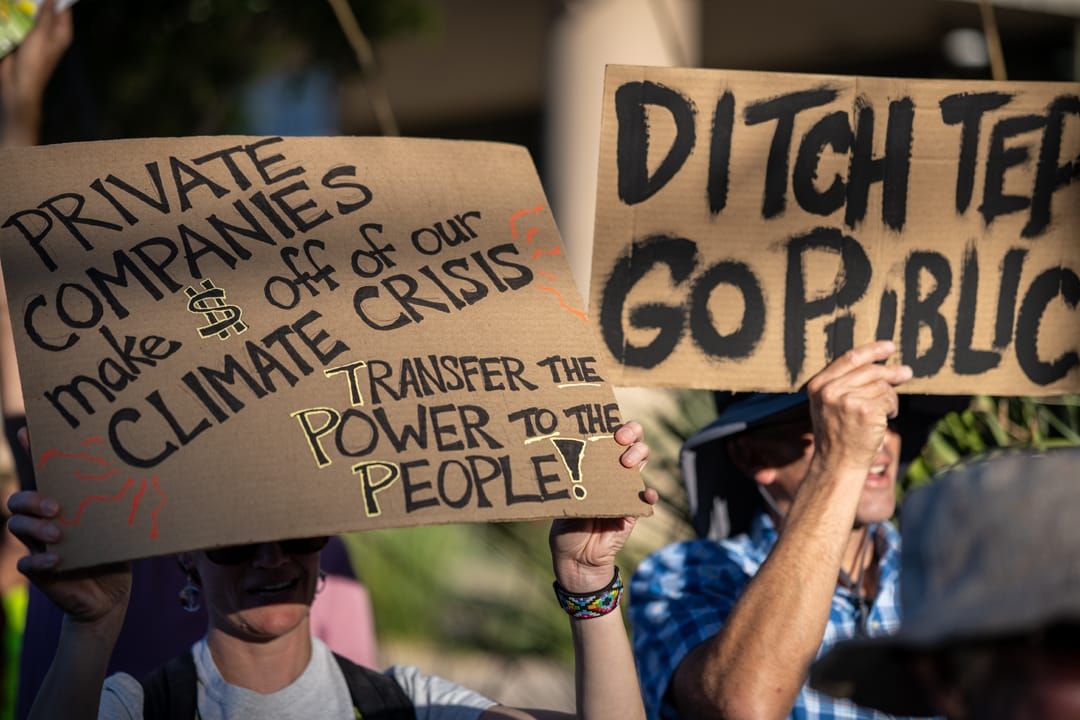
Clifton Mays, a resident of Tucson, Arizona, is on a fixed income, making just over $1,100 a month from Social Security Disability Insurance. With budget billing through Tucson Electric Power (TEP), which allows customers to estimate their electricity usage and pay the same amount year-round instead of paying what they use each month, his electricity bill is just short of $170 a month.
Mays has had to change his diet and eat less often to lower his expenses and to able to afford his bills, he said.
“Some days I’m stuck to canned food, but I would prefer fresh meat and vegetables,” Mays said in an interview.
That’s part of what attracted him to the Tucson chapter of the Democratic Socialists of America (DSA), which is taking on the local power company and advocating for Tucson to make the switch to publicly owned power, said Mays, now an organizer with the group.
“I was excited because I’m not a fan of capitalism,” Mays said. “And to de-commodify our necessities of life would be excellent.”
The Tucson DSA has been pushing for the city to take over TEP, owned by Canadian corporation Fortis Inc., after learning that the city commissioned an energy sourcing study as part of its climate plan that would include considering whether switching to public power could be feasible. Results of the study, released in April, confirmed what DSA members predicted: Not only is public power a feasible option in Tucson, but it could also save residents money, easing the burden on tight budgets for people like Mays. With climate change sending temperatures—and Fortis’ profits—spiking in Arizona and a new city deal with the utility company on the horizon, activists say it’s more urgent than ever to move to publicly owned and operated electricity. An upcoming City Council election provides the perfect opportunity to elect leaders who support such a vision, organizers say.
We don’t think that our electricity should be for profit, and certainly we don’t think that a Canadian company should be making loads of money off of our suffering.
Jeanne Lukasko, tucson DSA organizer
“We don’t think that our electricity should be for profit, and certainly we don’t think that a Canadian company should be making loads of money off of our suffering,” said Jeanne Lukasko, who co-founded the Tucson DSA campaign for public power. Lukasko said they’ve had to keep their air conditioner at 80 degrees in the summer in order to keep their monthly electric bill below $200. “I see people recognizing the injustice and coming together to take a stand against it and exercising collective action.”
Tucson DSA members have been out educating people on the benefits of public power for more than a year, though they’ve needed to slow down in the summer to avoid the extreme heat. Tucson DSA has gathered more than 3,800 signatures on a petition asking Tucsonans to support the switch to public power.
Switching to public power would mean that the city owns and manages its own electric grid. Most cities do this with their water, but when it comes to who owns a city or region’s electricity, it’s a mixed bag. Some people live in areas with publicly owned electricity, others are customers to a private company that gets a city’s permission to use its land to build electricity infrastructure, and other cities have both, meaning either they can choose who they want as a provider or who they pay their electric bill to depends on the neighborhood they live in.
On a recent Saturday morning, Lukasko went door-knocking through the Amphi neighborhood, wearing a bucket hat to help protect them from the heat, which was creeping past 100 degrees.
Lukasko’s goal was to encourage residents to vote in the Aug. 5 City Council election for Sadie Shaw in Ward 3, and to provide flyers with information about public power in Tucson, an effort Shaw has vocally supported.
Having public power would mean that residents’ needs would be prioritized over profits, Lee Ziesche, co-chair of Tucson DSA, told Prism. Private utility companies have also played a major role in climate disasters like the Maui fires, Ziesche said, adding that people in southern Arizona are concerned about the effects of climate change. She said it’s been easy to convince people of the benefits of public power.
“I think there’s a lot of people in Tucson who are very community-oriented anyway,” Ziesche said, “and very quickly understood that it would benefit us so much more if we actually owned our own grid and weren’t having to pay these exorbitant profits on top of everything.”
Lower electric bills
TEP has a big presence in Tucson, sponsoring city-wide festivals and donating regularly to community nonprofits. Its parent company Fortis reported a profit of $1.6 billion in 2024, a $100 million increase from 2023, attributing some of its growth to new customer rates at TEP that started in September 2023. In a news release highlighting its 2024 second quarter earnings, the company credited “higher retail electricity sales associated with warmer weather.”
Meanwhile, the city of Tucson’s study on the feasibility of public power found that making the switch would have customers saving on average up to $241 annually in the first five years, up to $462 annually with 10 years, and more than $1,000 annually 20 years down the road.
“While this feasibility analysis for a public power utility indicates promising outcomes, including forecasted lower customer rates and consistent positive net operating revenues throughout the evaluation period, pursuing and establishing a municipal utility entails significant risks and considerable effort. Ultimately, it would require strong resolve and leadership from City officials,” the study, conducted by an outside consulting firm, says.
Tucson City Council Member Kevin Dahl, the incumbent Shaw is running against, was initially skeptical of whether public power was possible in Tucson. He told Prism in an interview that he was surprised at the results of the feasibility study because he thought it would determine that the city didn’t have the borrowing capacity to buy out TEP.
Dahl said the initial study only told the City Council whether it was possible for the city to take over the utility and that they would need to commission another study to show how the city would do that.
“The voters of Tucson will have to decide,” Dahl said. “And from what we’ve heard from Tucson Electric Power, they’re not going to cooperate.”
In a press release, TEP said the study is flawed. Spokesperson Joseph Barrios told Prism that the study “understates how much time it would take to form a municipal utility and the costs involved in doing that.”
This could lead to higher costs for the city and less reliable electricity, Barrios said.
“We also feel that simply following the study’s recommendations would undermine that continuing collaboration that we have with the city,” he added.
The city’s 20-year franchise agreement with TEP ends in April 2026, and the two parties are working toward a new contract. The city is working on four agreements total with TEP, including an energy collaboration agreement.
If a new agreement does not get on the ballot before the previous one expires, the current agreement could be extended by one year. Dahl said both the city and TEP want another 20-year franchise agreement, but a new agreement would not necessarily stop the city from switching to public power.
However, Ziesche said there won’t be political leverage to build a public power utility without the pressure of an expiring agreement.
“The only reason the city even kind of was like, ‘Oh, let’s look at this,’ is that the franchise agreement was expiring,” she said, adding that DSA might support a five-year agreement as the group continues to organize around a public power option.
On June 17, City Council voted not to place the franchise agreement before voters in the upcoming November election, as TEP had not yet given the city its most recent franchise agreement and had only 48 hours left to do so.
“I feel especially aggravated because I feel that TEP is dragging their feet,” Mayor Regina Romero said during the meeting.
Public power benefits communities
Around 2,000 communities in the U.S. are run by public power, including major cities such as Los Angeles and Phoenix.
Public power utilities are more reliable and their customers have the lowest electricity rates, according to a study by the American Public Power Association.
Ursula Schryver, senior vice president of education, training, and events for the American Public Power Association, told Prism that she hears from about 20 communities each year who want to either start or switch to a public power model. A lot of that interest lately has to do with looking at renewable energy, Schryver said, and having more control over the decisions being made in the community. She said that switching to public power can take anywhere from five to 15 years, with five years being optimistic.
Fortis also owns Central Hudson Gas and Electric in New York, which serves the Hudson Valley area, where residents are also building a movement around public power. New York Assemblywoman Sarahana Shrestha, who won her election in 2022 against a 20-year incumbent, ran a campaign on public power. Shrestha and state Sen. Michelle Hinchey introduced a bill last year to create a publicly owned Hudson Valley Power Authority to take over Central Hudson.
Ziesche of Tucson DSA acknowledged that taking on a multibillion-dollar company is an uphill battle. As she and other DSA members continue to educate the community and lobby City Council members, they are also endorsing and supporting candidates that will champion public power.
“Things are pretty bad right now. There’s a lot of people who cannot afford their bills, and there are a lot of people who are very, very worried about climate change,” Ziesche said. “I don’t think things can continue the way they are right now. We are reaching crisis levels. And that’s what I think that we ultimately have going for us.”
Editorial Team:
Sahar Fatima, Lead Editor
Lara Witt, Top Editor
Rashmee Kumar, Copy Editor
Author
Stephanie Casanova is an independent journalist from Tucson, Arizona, covering community stories for more than 10 years. She is passionate about narrative, in-depth storytelling that is inclusive and
Sign up for Prism newsletters.
Stay up to date with curated collection of our top stories.