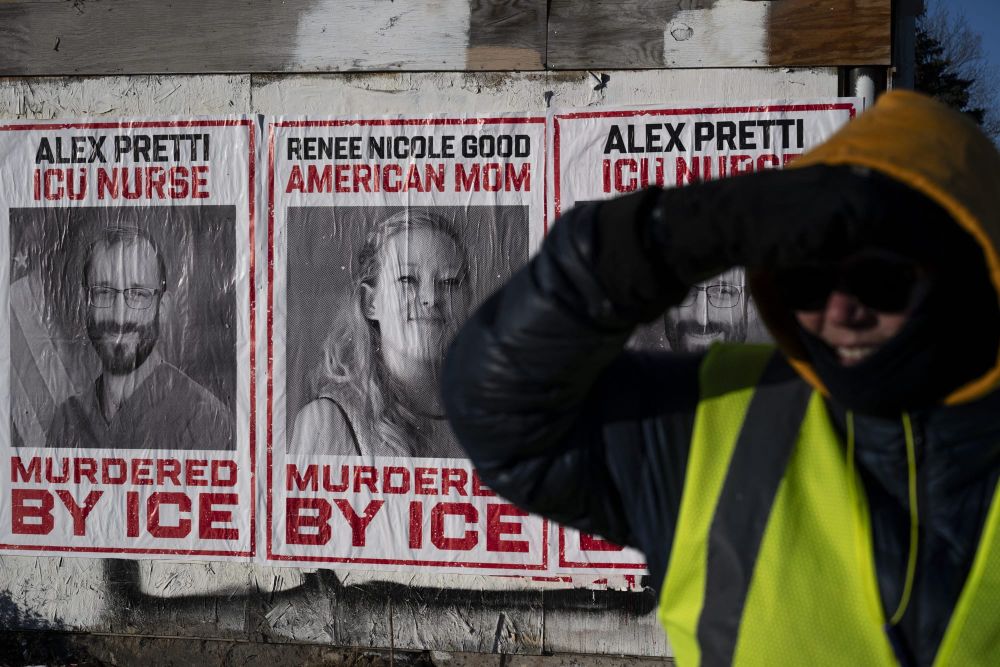
Another way out: Doing what’s right isn’t all about what’s legal
Overemphasizing law is about returning to a normal where the screams were more easily muffled, distant, and ignorable for many
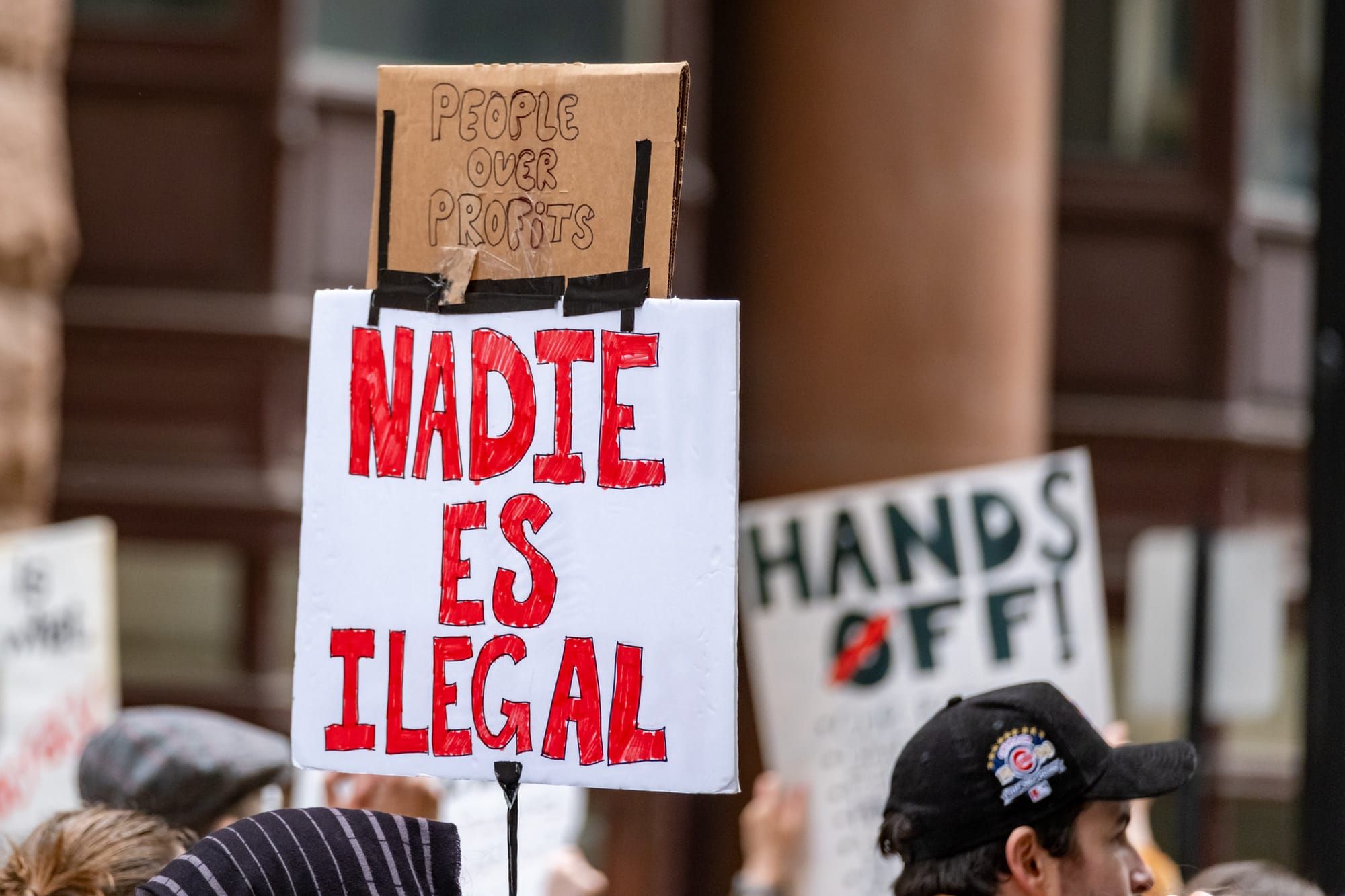
“Come to get me in the mornings, come to get you in the nights/ When they come to get us people, don’t talk about no Bill of Rights.” – Camille Yarbrough
It’s self-defeating to fight a movement that’s oversaturated with arguments that the ruling establishment’s actions are illegal. Litigation strategies shouldn’t be disregarded entirely, but the law is fickle by design. It’s certainly not a neutral, self-correcting mechanism that equally applies to all while bending toward justice. It is rooted in and carries the codification of many of the oppressions we’re fighting against. The deep roots of white supremacy that enabled fascism to overtake U.S. society have primarily been carried out through legal means. That’s why moving beyond a reliance on legalistic thinking is imperative. Ruling autocratic power will completely disregard the law that inconveniences it; even if it doesn’t, that won’t be sufficient to defend us now. A close observation of some of the current tragedies playing out before us makes this abundantly clear. And a question asked by Fox News’ senior White House correspondent Peter Doocy makes this plain: “Deporting American citizens to Central American prisons, is it legal, or do you need to change the law to do it?”
The case of Kilmar Abrego Garcia has stayed in the headlines as a “wrongly” or “mistakenly” deported Maryland man sent to an El Salvador mega-prison. Describing this with any language that suggests the Trump administration didn’t do this intentionally is naive at best. It was intentional, as evidenced by Donald Trump’s policies leading up to this, and it’s also a test. Furthermore, the legal construction of the deportation machine facilitated by the collaboration between the Democratic and Republican parties made it so. As I previously wrote, former President Bill Clinton set the stage for the mass deportation apparatus that exists now, which was bolstered by former President George W. Bush’s creation of Immigration and Customs Enforcement and used to unseen extremes by former President Barack Obama. Joe Biden made things worse during his tenure, and now that Trump is using all of the foundations the previous presidents laid, some are decrying the lack of due process and calling this deportation “kidnapping” and “disappearing.” Those are just synonyms for the deportation structures that preceded this moment and had already carried out these violations.
It’s essential to understand that creating legal tools that can easily be used for despotic terror is never a good idea. This is, in essence, the risk of the formation we know as “the state” as a whole. Look at how easily decades of progress and positive change can be wiped away when you centralize power in one place and grant it a monopoly on violence. Furthermore, the state is where extralegal power becomes legal on behalf of oppressive power. Murder is illegal for you and me, but not for the state that calls it capital punishment and allows public police killings. Robbery is unlawful for you and me, but not for the state, which facilitates wage theft, incalculable wealth, and extraction for the capitalist class. Enslaving someone is illegal for you and me, but not for corporations and prisons using the law to profit. Alexander Berkman once noted the nature of these dynamics: “The entire thing is kept up by educating the people to believe … that the law is just, and that the government must be obeyed.”
So while liberals bemoan a “constitutional crisis” developing as the Trump dictatorship expands, we should consider what that implies. First, the Constitution was already a crisis for many of us whose ancestors were treated as expendable by its authors. What it became with amendments and changes highlights some absurdity in this situation. If the law changes according to who has power, what’s legal and illegal can’t be a significant reasoning for our arguments. The same subjectivity that allows Trump-allied judges to decide how to interpret the law in his favor is the type of resolve we should have in defying unjust laws. What’s right and wrong varies from person to person, but this is where principles and values in adherence to a larger struggle come in.
The detaining of current and former students like Rümeysa Ӧztürk and Mahmoud Khalil, foreign nationals traveling to the U.S., and others is ideological. One thing that unites the powers that be is their determination to use the law to realize xenophobic and fascistic goals. That’s a big difference between them and those of us who want a society that is good to people regardless of race, religion, class, nationality, and gender. Many people being targeted are associated with the Free Palestine movement, which implores us to situate our actions in larger contexts informed by a push for collective liberation. That means doing what’s right is not an isolated decision made by one person; it’s an action taken in connection with others to exemplify a desire for better conditions. Histories throughout the Black radical tradition show that breaking the law is sometimes necessary if the law gets in the way of this sort of push.
Perhaps it’s ironic, but the civil rights movement, labor movement, and other historic struggles are filled with people breaking the law to demand more. Reforms and legislative gains currently being stripped away came from people fighting by any means necessary to achieve change. So there’s no way you can denounce illegality here when it provided such a large basis for institutional change. It is essential to think beyond just trying to remedy these problems within what already exists. Maybe it’s clearer to us now that what compromised yesterday’s achievements was that they were incorporated into discriminatory places that struggled to hold them.
The victories of a centurieslong legal tug-of-war are being removed overnight because the law has been shaped by genocide, colonialism, slavery, and corporate capitalistic interests. One telling, blatant example of this is the Trump administration’s use of the 1798 wartime law, the Alien Enemies Act—something created when I could have been openly sold and traded as a chattel slave. How can other Black people or I rest all our hopes in law that was likewise shaped and designed by other slaveholders, colonizers, or political powers who didn’t have our interests in mind? This is why we have to reshape society, not simply try to make what’s against us work in our favor.
We need to understand that longing for the return to what was already an atrocity will not free us.
On her classic album “The Iron Pot Cooker,” artist and cultural activist Camille Yarbrough prophesied about fascistic futures with her dystopian spoken word track, “All Hid.” She describes an eerily similar scene to the one we’re inhabiting, crying out:
The king is at the ballgame, the people in a cage,
The Constitution’s buried, the jester in a protective reaction rage.
Scared the press and TV stations, you can’t see what they do,
Ain’t to be no fussing when they come for you.
Radio is programmed, been told what to say,
World ain’t gonna hear it when they take you away.
She describes what led to this scenario, reciting, “Last night, night before/ The fearful ran to tyranny’s door.” She frames other lyrics by simply illustrating how fearmongering and scapegoating helped pave the way. Yarborough repeatedly and frantically warns, “Don’t talk about no Bill of Rights” when they come for us. It helps listeners understand the disempowerment of consigning too much hope to the norms and symbols that ultimately fail us. We’re at a turning point where we are being challenged not to rehabilitate and restore what once was. Overemphasizing law is about returning to a normal where the screams were more easily muffled, distant, and ignorable for many. We need to understand that longing for the return to what was already an atrocity will not free us. We can fight to design the world we want, instead of pleading to restore the norms of a previous (also) oppressive arrangement. That law of a time that got us here won’t get us out.
Editorial Team:
Lara Witt, Lead Editor
Carolyn Copeland, Top Editor
Stephanie Harris, Copy Editor
Author
William C. Anderson is a writer and activist from Birmingham, Alabama. His work has appeared in The Guardian, MTV, Truthout, British Journal of Photography, and Pitchfork, among others. He is the auth
Sign up for Prism newsletters.
Stay up to date with curated collection of our top stories.