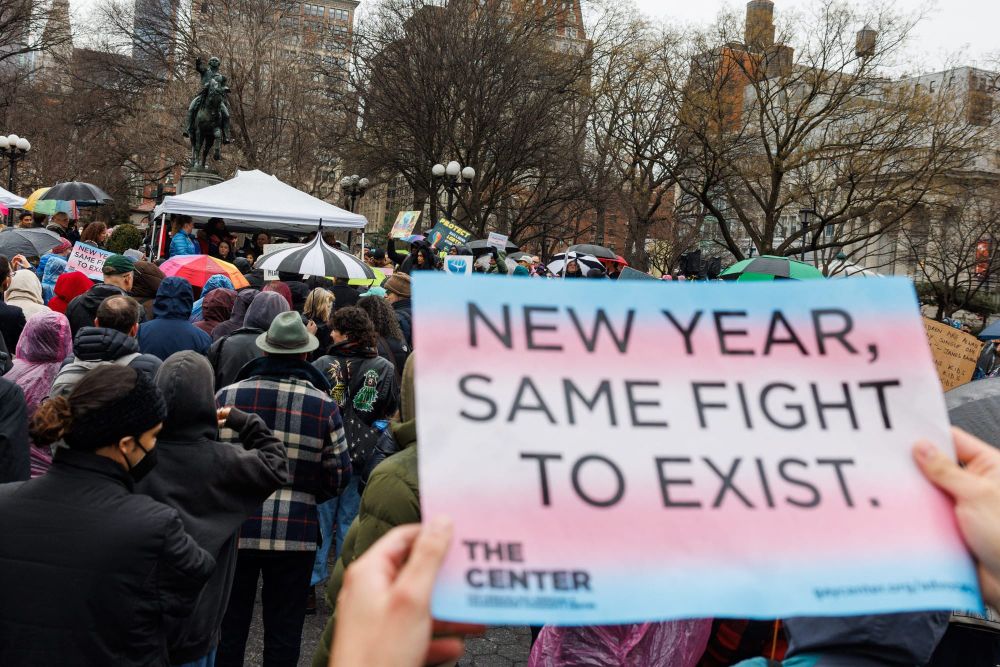
Litigation nation: Trans health at the crossroads of policy and prejudice
A close look at a sex-discrimination case reveals how anti-trans momentum builds, as court challenges lead to a pivotal Supreme Court ruling
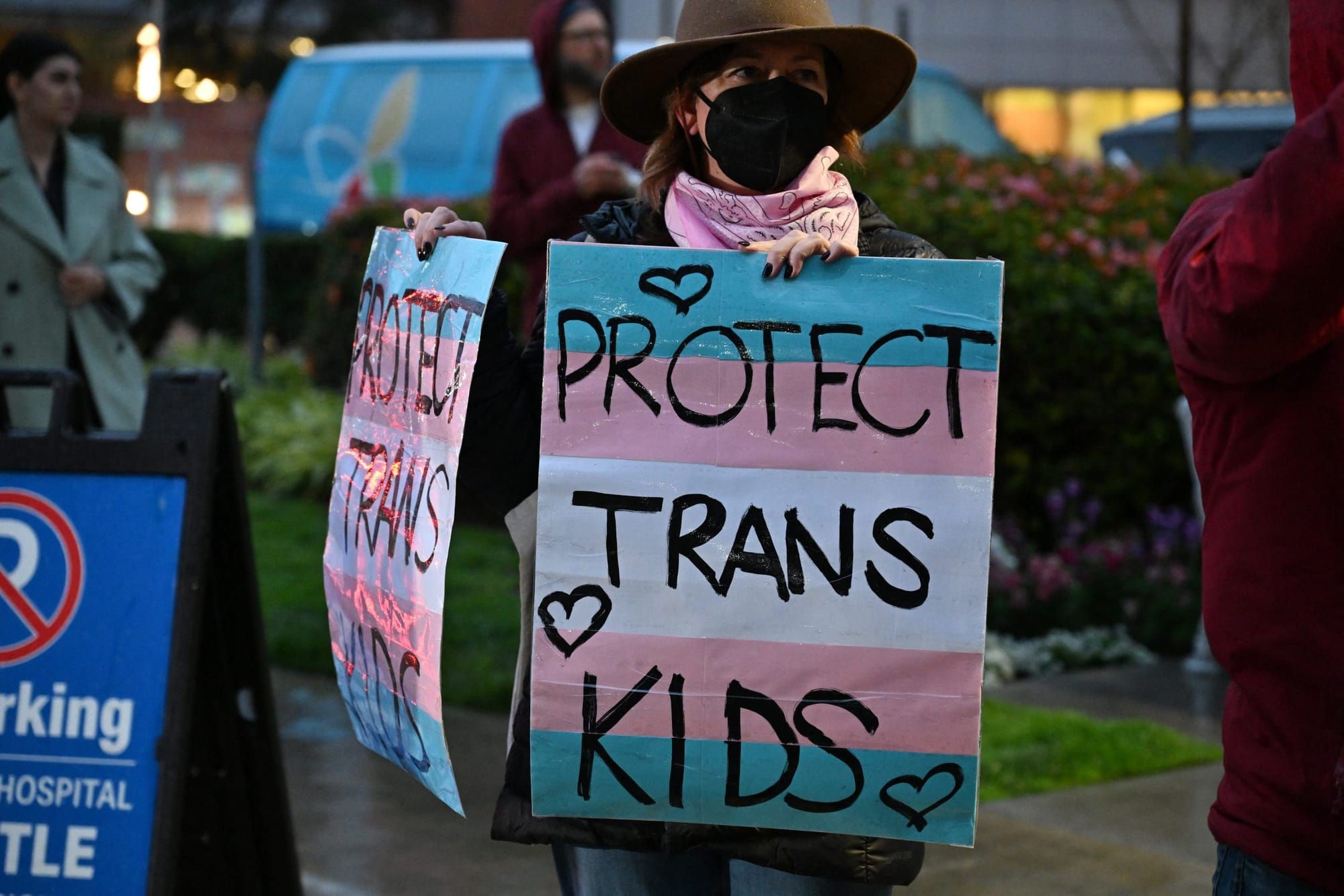
Despite her decades litigating class-action cases, Eleanor Hamburger never saw as much expert testimony as when she brought L.B. et al v. Premera Blue Cross to a district court in Washington state. The lawsuit alleged that health insurance company Premera, which operates in Washington and Alaska, discriminates against transgender minors by denying them coverage for gender-affirming care.
“I’ve been doing class-action work for 30 years and never had a case with the other side hiring seven experts,” Hamburger said. “It was incredibly over-litigated, and the experts were largely people who are affiliated with the effort to exclude trans folks from the health care that they need. That was shocking to me, to see Premera do that.”
“It strikes me because some decision-maker within Premera is prejudiced,” Hamburger continued. “It’s bigotry.”
Hamburger, Lambda Legal, and Denise Diskin formerly of QLaw Foundation of Washington filed suit in June 2023 for two trans teens fighting an insurance policy that barred coverage of their gender-affirming mastectomies.
This past April, the judge declared that Premera’s process to mostly reject trans adolescents’ claims for these surgeries is sex discrimination, a violation of federal law. Premera declined Prism’s interview request about the case, but the company’s director of brand and reputation, Courtney Wallace, said in an emailed statement: “Premera is currently reviewing the court’s decision and evaluating our options moving forward. Premera takes our responsibilities under the Affordable Care Act seriously and strives to ensure that our policies comply with all applicable laws and regulations. We recognize the importance of this matter to our members and the broader community. We remain dedicated to supporting the health and well-being of all individuals we serve.”
L.B. et al v. Premera Blue Cross echoes the central issue in United States v. Skrmetti, a highly anticipated Supreme Court case focused on whether a Tennessee law that went into effect in July 2023 that prohibits gender-affirming care for trans minors and bars treatment for gender dysphoria violates the equal protection clause of the 14th Amendment. The court’s decision, expected any day, could have sweeping consequences for transgender rights nationwide.
“The general thinking is it might negatively impact these cases,” Hamburger said. “Everyone’s waiting with bated breath to see what happens.”
Skrmetti looms over ongoing litigation. Even cases that don’t directly raise equal protection claims could be shaped by the ruling, which may signal whether the legal climate will support or suppress trans rights, uphold bans or strike them down. In the meantime, the legal battles rage on.
Shifting legal terrain
Trans youth, once largely invisible in national discourse, have become central to public debate. Since at least 2016, they have also been a target of anti-trans state legislation and presidential rhetoric. The legal landscape surrounding them is now marked by significant restrictions.
Opponents of trans rights have advanced legislation and policies restricting access to gender-affirming medical care, bathroom facilities, sports participation, and gender and sexuality curriculum. In some cases, as seen in Texas, they have even sought to limit parental custody.
In the federal legislative realm, the Trump administration issued executive orders in January, one focused on redefining sex as binary and fixed at birth, impacting federal recognition and services for trans people. The other restricts federal support for gender-affirming care for individuals under 19, leading some hospitals to pause such treatments. The executive order also directed federal agencies to withhold funding for gender-affirming care for minors. In May, the House of Representatives passed a proposed federal budget that includes a provision barring Medicaid and other federal health programs from covering gender-affirming care for people of all ages, passing by a narrow vote of 215 to 214.
In state legislatures, there have been similar efforts to target trans youth: Twenty-seven states have enacted laws limiting or banning gender-affirming care for minors or prohibiting their access to school facilities or sports.
Many of these state measures are facing legal challenges, with the foremost being United States v. Skrmetti as well as Mahmoud v. Taylor, about gender and sexuality curriculum in Maryland, in the Supreme Court.
These developments have created a complex, confusing, and rapidly evolving legal environment for transgender youth, with repercussions that could reshape the legal landscape.
In addition to state and federal law and policy, insurance coverage is a major barrier to accessing gender-affirming care for trans youth—even in states like Washington that don’t have anti-trans laws. The Premera policy challenged in Washington federal court exemplifies how health insurance opt-outs can act as an extension of broader political and legal hostility.
According to the June 3 Human Rights Watch (HRW) report, “They’re Ruining People’s Lives”: Bans on Gender-Affirming Care for Transgender Youth in the U.S.,” “Legislative bans have exacerbated the impact of pre-existing barriers to initiating gender-affirming care, such as financial constraints, geographic limitations, and insurance challenges.”
For youth living in states where gender-affirming care is restricted, treatment often requires crossing state lines—adding logistical and financial strain, much like the fragmented access to abortion after the Supreme Court’s 2022 ruling that eliminated the federal constitutional right to abortion, giving states more power to regulate care.
The HRW report also noted: “Insurance coverage often becomes an obstacle, with some insurers withdrawing coverage once families sought care across state lines.”
In some cases, “the claim is automatically rejected based on their family’s zip code given the state law,” according to the report.
Motivating factors
According to the HRW report, “The rise in anti-transgender legislation has coincided with an escalation in violence against transgender individuals, even as violent crime overall decreased by approximately 3 percent from 2022 to 2023.” FBI data also shows this trend: Gender identity-based hate crimes rose from 307 offenses in 2021 to 515 in 2022 and to 547 in 2023, the most recent year with complete data.
Surges in anti-trans policymaking and the related rise in public concern and confusion create conditions that insurance companies can capitalize on and detractors can exploit.
“In my years of doing trans civil rights work, the way that private actors move insurance companies, doctors, [and] employers is vibes, not law,” said Diskin, a lawyer for the trans youth plaintiffs in the Premera case.
The attorney told Prism that when “the temperature changes” politically, people “start believing they have permission to discriminate.” These conditions are worsened when the Supreme Court effectively allows for the same.
“The moment these decisions come out, people start treating racial advocacy as suspect, or start treating police violence as more permitted, or start treating immigrants as suspect. These are all of the temperature changes that we have seen,” Diskin said.
Over the past decade, political and cultural shifts in the United States have resulted in a rollback of rights for trans youth and other vulnerable groups.
“Gender and the family are prototypically sites for inducing panic in service of autocracy,” said Libby Adler, a professor of law and women’s, gender, and sexuality studies at Northeastern University, in an email.
Without government protections, minority rights often depend on majority opinion. In the current political climate, a rising Christian nationalist movement has pushed policies that prioritize traditional gender roles and a gender binary.
During oral arguments in United States v. Skrmetti in December, Justice Sonia Sotomayor questioned whether the democratic process alone can protect minority rights. “When you’re 1% of the population or less,” she said in a tense exchange with Tennessee’s solicitor general, it is “very hard to see how the democratic process is going to protect you.”
“Blacks were a much larger part of the population, and it didn’t protect them,” she continued. “It didn’t protect women for whole centuries.”
Insurance coverage denials are typically driven by cost. This was likely a factor in Premera’s exclusion of gender-affirming surgery, but the company’s legal defense raises questions. According to Hamburger, the cost of gender-affirming mastectomies for minors was relatively low compared to many medical procedures—and likely less than the cost of defending the lawsuit.
Courting controversy
The Supreme Court’s review of Skrmetti hinges on whether Tennessee statute 68-33-103(a)(1) violates the equal protection clause of the 14th Amendment. The statute prohibits medical treatments intended to allow “a minor to identify with, or live as, a purported identity inconsistent with the minor’s sex” or to treat “purported discomfort or distress from a discordance between the minor’s sex and asserted identity.”.
The Premera case examined an insurance policy under the Affordable Care Act (ACA), not a law under the equal protection clause. Like Skrmetti, the case also questioned whether federal law forbade the denial of medical treatment for trans patients under 18 while allowing similar treatments for cisgender boys.
The district court ruled that Premera’s policy violated Section 1557 of the ACA, which prohibits discrimination based on sex in federally funded health programs. Specifically, the judge said the policy facially discriminated on the basis of sex by classifying medical treatment predicated on whether a patient is cisgender or transgender. The judge emphasized that requiring a gender dysphoria diagnosis and imposing additional hurdles only for trans youth constitutes unlawful discrimination.
The court also rejected Premera’s attempt to justify its exclusions by citing “medical necessity” and other rationales, via the experts Premera hired. The judge wrote that a “legitimate, nondiscriminatory reason” cannot justify a policy that is facially discriminatory on the basis of sex. As such, the court declined to consider Premera’s argument that concerns about minors’ capacity or scientific uncertainty insulated the company from liability.
Hamburger said that as part of the case, Premera took a stance “far out of the norm,” in part by aligning with anti-trans advocates who are broadly against gender-affirming care and promote conversion therapy, which is illegal in the state of Washington.
“Premera wanted to be able to say, ‘Oh yeah, we provide all this care, just no surgery for people under 18. And to justify it, we are hiring the most prejudiced, bigoted experts we could find,’” Hamburger said.
The Premera decision posits that health insurers cannot categorically deny medically necessary, gender-affirming care to minors, and that these policies might not withstand legal scrutiny. But other federal circuit courts have decided otherwise. For example, an appeal to the 11th Circuit in a similar case has initially reinstated Florida’s ban on gender-affirming medical care for minors and imposed restrictions on adults.
To decide Premera, the judge relied on a landmark 2020 Supreme Court case, Bostock v. Clayton County, which said the Civil Rights Act of 1964’s ban on sex discrimination includes gender identity. He then relied on 4th and 9th Circuit cases that extended Bostock to the ACA.
The Supreme Court could depart from its decision in Bostock, perhaps by distinguishing statutory sex discrimination from constitutional sex discrimination. Court watchers say Justice Neil Gorsuch could be the pivotal vote. “In his decision in Bostock, Gorsuch, on behalf of the majority of the court, recognized the existence of transgender people,” said Arthur Leonard, a New York Law School professor and the publisher of “LGBT Law Notes.”
Gorsuch was conspicuously silent during oral arguments for Skrmetti in December. The outcome of the case is impossible to guess, due also to ambiguity from potential swing justices John Roberts and Amy Coney Barrett.
Next steps in Premera, the 11th Circuit case, and others may hinge on Skrmetti. Hamburger and Lambda Legal are still awaiting a ruling in C.P. v. Blue Cross Blue Shield of Illinois, a 2020 class-action over gender-affirming care for two adolescents and an adult. The plaintiffs won in the same district court as the Premera case. The 9th Circuit heard the insurer’s appeal in January and is possibly waiting for the Supreme Court’s ruling in Skrmetti, Hamburger said.
It’s a precarious situation for young trans people to be in, and it’s worsened that their fates may be sealed this June.
As Diskin put it, “Pride Month is the month where queer people, particularly on the West Coast, wake up at seven in the morning to see whether we still have civil rights or not.”
Editorial Team:
Tina Vasquez, Lead Editor
Carolyn Copeland, Top Editor
Rashmee Kumar, Copy Editor
Author

Lee is a journalist who began reporting in her hometown, Austin, and continued through law school in West Texas. She now covers criminal justice issues and moonlights as a storyteller.
Sign up for Prism newsletters.
Stay up to date with curated collection of our top stories.