The sentencing of Mexico’s former top cop exposes the DEA’s counterproductive war on drugs
Observers of the trial say the sentencing proves the war on drugs is a counterproductive failure
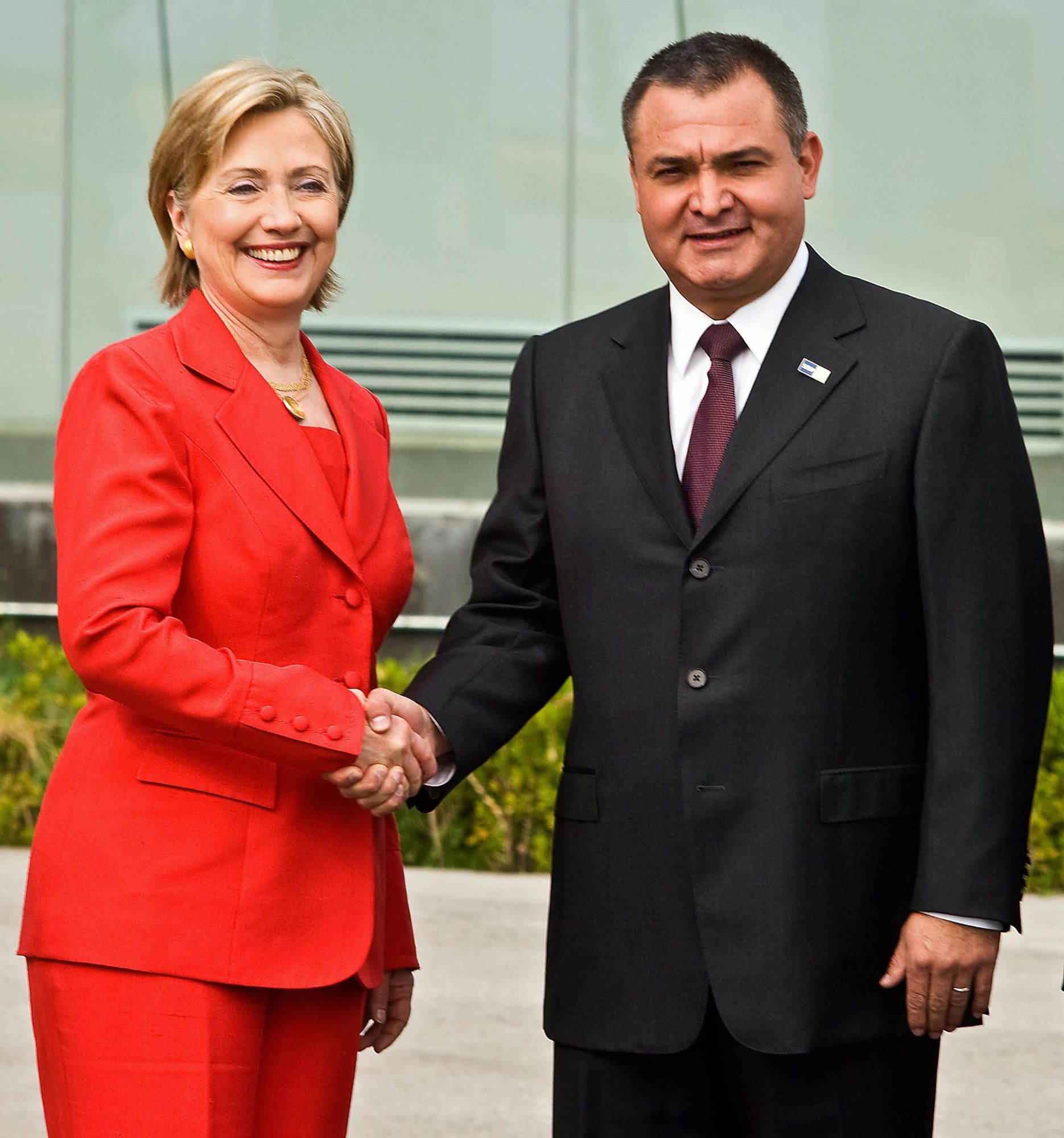
The Mexican official who led the country’s murderous war on drugs from 2006 to 2012 was sentenced to 38 years in prison in a New York federal court on Oct. 16.
After Genaro García Luna was found guilty on all five counts, including six drug-related violations, the Drug Enforcement Administration’s administrator Anne Milgram hailed his sentencing as sending “a clear message” that “no amount of power will shield you from justice.” The sentencing makes García Luna the highest-ranking Mexican official ever tried and convicted in the U.S.
However, observers of García Luna’s case say the conviction only confirmed the DEA’s opacity and lack of accountability when imposing its war on drugs on the world.
For many criminal justice advocates, the war on drugs—the prohibition and criminalization of drugs via a global militarized campaign aimed at reducing violence, corruption, incarceration, and overdose deaths across North America—has been a counterproductive failure.
The prohibition and criminalization of substances has led to an increasingly dangerous drug supply as manufacturers have come up with more potent, cheaper alternatives, said Maritza Perez Medina, the director of federal affairs at the Drug Policy Alliance.
“We’ve seen that dangerous supply with the opioid epidemic and now with the fentanyl analogs,” she said.
The dollars spent militarizing the prohibition have also spawned malfeasance both within the DEA and its partners across Latin America.
“The DEA has a long history of corruption, which I believe is systemic,” Perez Medina said. “It is not only some bad apples: It’s a pattern that we have seen over time.”
The DEA agents’ wrongdoings have been largely overlooked. A Futuro Media investigation found that only 14 DEA agents have been prosecuted for corruption in the last 30 years, compared with more than 900 Customs and Border Protection agents prosecuted for corruption in only three years. Latin American leaders have also been prosecuted. García Luna and the former president of Honduras, Juan Orlando Hernández, were both sentenced this year. Nonetheless, things have not changed on the ground.
García Luna’s arrest did not reduce violence or the drug supply. Instead, it has contributed to portraying Mexico as deeply corrupt even though García Luna was for years the man implementing the DEA’s war on drugs on Mexican territory, said Guadalupe Correa-Cabrera, professor of policy and government at George Mason University and co-author, along with Rice University professor Tony Payan, of a book about García Luna.
García Luna was so powerful as the Secretary of Public Security that he was considered the virtual vice president in the conservative administration of Felipe Calderón. His career would not have been possible without the full-throated support of top U.S. officials even though allegations of his unlawful deals surfaced repeatedly.
During a trial in a federal court in Chicago, one U.S. agent testified that the DEA’s leadership knew that Mexico’s top cop, García Luna, had been collaborating with the Sinaloa Cartel at least since 2010. The agency considered the organization “the primary global threat against the United States.” Still, García Luna was praised by the U.S. administration. He met 180 times with U.S. officials, including the Department of State Secretary Hillary Clinton.
Billions flowed to Mexico for the war on drugs during García Luna’s tenure and onward. From 2008 to 2021, Congress appropriated $3.3 billion for the Merida Initiative, the bilateral security agreement to combat drug trafficking.
At the same time, the DEA maintained contacts with representatives of the Sinaloa Cartel, U.S. prosecutors admitted in 2011. To this day, U.S. federal agents still coordinate with members of the Sinaloa Cartel, as was shown by the arrest earlier this year of the legendary drug lord Ismael “Mayo” Zambada, which has triggered massive violence in the city of Culiacán.
DEA’s shady deals
Public opinion expected that García Luna’s trial would reveal more about the U.S.’s role in Mexico’s war on drugs. Prosecutors claimed to possess “tens of thousands of pages of documentary evidence” against the former top cop.
The conviction, however, relied solely on testimonies, mostly of convicted drug traffickers, who would surely obtain a lighter sentence after cooperating. No documents were presented during the trial.
“The Department of Justice claims to have discovered vast amounts of evidence, including audio recordings, but we have absolutely nothing,” said Correa-Cabrera. So people are left to believe that García Luna was linked to criminal organizations while the US government was unaware of his dealings, she said.
García Luna had previously led the Agencia Federal de Investigación, the equivalent of the Federal Bureau of Investigation (FBI), where Mexico’s Attorney General probed him for misappropriating money in 2002. Since that initial investigation, García Luna deflected accusations of corruption by claiming that he had been vetted by intelligence agencies in the U.S.—an argument he would use again in 2008 when media reports and a top police officer in Mexico accused him of working for the Sinaloa Cartel.
The United States seemed unbothered by the allegations. Its embassy in Mexico considered García Luna “a trusted liaison, partner and friend of the FBI,” according to a 2009 cable. The Central Intelligence Agency’s (CIA) director, David Petraeus, acknowledged him for his “friendship, collaboration and support” in 2012.
Meanwhile, the DEA was directly cutting deals with Sinaloa Cartel operatives. In 2014, the Mexican newspaper El Universal revealed that the relationship between the DEA and the Sinaloans—which violated Mexico’s laws, as it took place without the knowledge of the Mexican government—enabled the cartel to smuggle billions of dollars worth of drugs to the United States.
The DEA “owes an explanation” to Mexico for its collaboration with García Luna, said Mexican President Andrés Manuel López Obrador in March 2023, at the end of the former-top-cop trial in New York. “How to trust the DEA? Have they done a very good job?” he said. “How did they not notice about García Luna [allegedly working for the Sinaloa cartel] for that long?”
The DEA has been impervious to calls for transparency. According to Tom Devine, the legal director of the Government Accountability Project, the DEA agents’ attempts to denounce internal wrongdoings have been swiftly stonewalled. Devine represents Keith McNichols, a former DEA agent who revealed a large kickback scheme in the agency’s operation in Haiti in 2015. Once he came forward as a whistleblower, McNichols was retaliated against and forced to retire.
“The agency circles the wagon to shield and avoid public knowledge of corrupt pockets,” said Devine, who identified the DEA’s offices in Haiti and Mexico as prominently corrupt. “There’s a very well-established buddy system between those in the front lines and DEA’s internal accountability offices, as well as the regional and federal management.”
There are no signs of the DEA changing any time soon. After García Luna’s sentencing, Anne Milgram, the agency’s administrator, said that the “DEA will continue to relentlessly pursue drug trafficking organizations and those who protect them.” She did not mention the DEA’s role in propping him up to the top of its war on drugs in Mexico despite the widespread allegations of corruption.
Some members of Congress have questioned the DEA’s lack of accountability. However, that has not translated into stopping the criminalization of drug users or reducing the agency budget, Perez Medina said. The DEA is on its way to receiving another record budget—$3.7 billion for fiscal year 2025—to continue and expand its war on drugs.
“Every year, they’re getting more and more money with very little oversight,” Perez Medina said.
Author
Maurizio Guerrero is a journalist based in New York City who covers immigration, social justice issues, Latin America, and the United Nations. Follow him on Bluesky at @mauriziogro.bsky.social and on
Sign up for Prism newsletters.
Stay up to date with curated collection of our top stories.