‘There is no ISIS here’: Nigerians in Sokoto state question Trump’s narrative on U.S. airstrikes
The Trump administration said it targeted “Islamic terrorists” in Christmas Day strikes on Nigeria, but local residents question whether any militants were hit
Real journalists wrote and edited this (not AI)—independent, community-driven journalism survives because you back it. Donate to sustain Prism’s mission and the humans behind it.
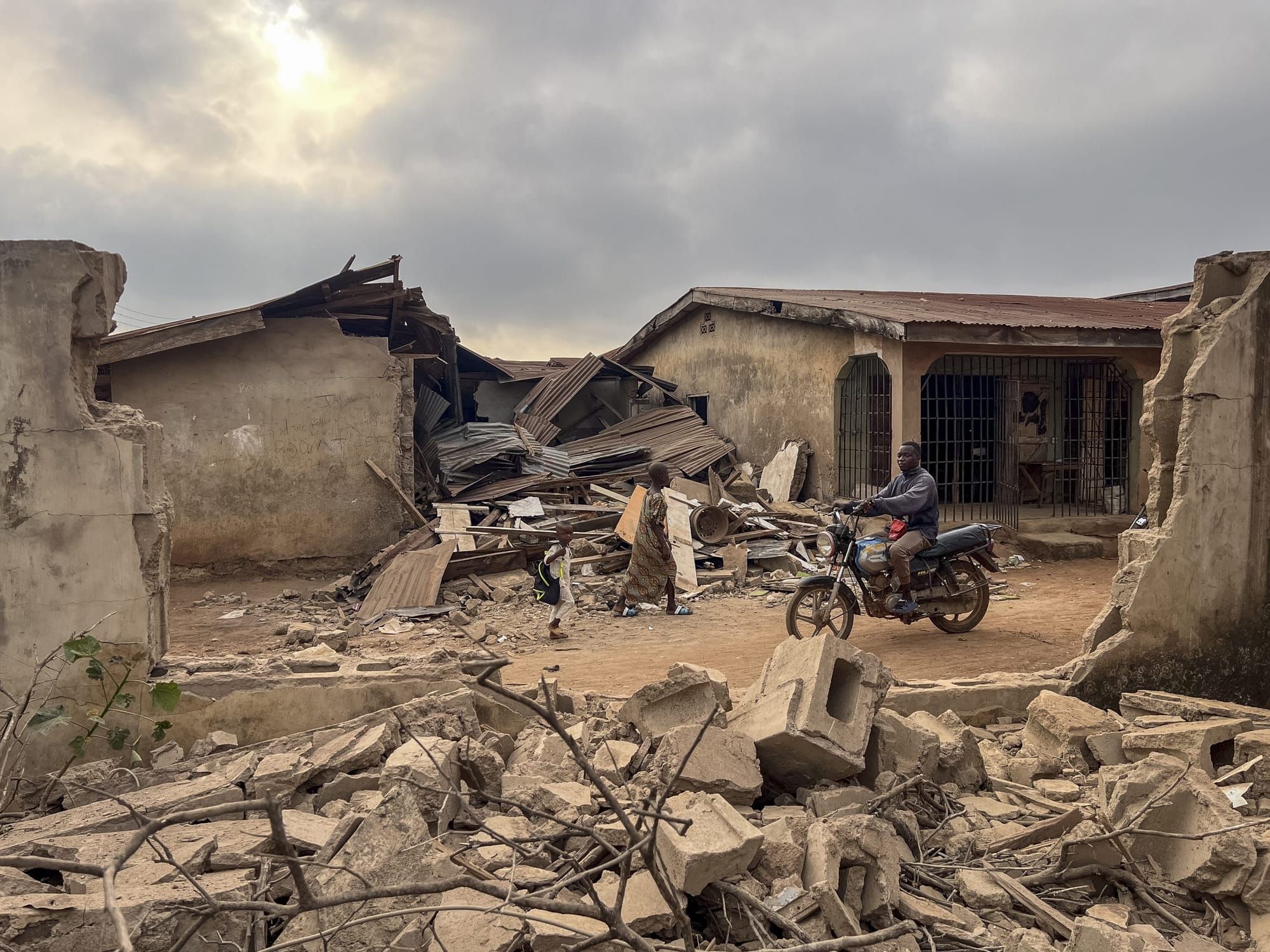
Three weeks after the U.S. carried out airstrikes in northwestern Nigeria, an unexploded munition from the attack destroyed buildings and injured three civilians 600 miles away, leading locals to question the Trump administration’s narrative about the strikes and whether they even hit militant targets.
On Christmas Day last year, President Donald Trump ordered the launch of at least 16 GPS-guided munitions against alleged terrorist enclaves in Sokoto state, specifically the Bauni forest axis of Tangaza Local Government Area. The Nigerian government, which coordinated with the U.S., told media outlets that the airstrikes involved the deployment of MQ-9 Reaper drones and the U.S. Navy warship USS Paul Ignatius, stationed in the Gulf of Guinea.
According to eyewitnesses in the village of Jabo, Sokoto, debris from unexpended munitions fell on an open field, but no civilian casualties were recorded. However, an unexploded munition also made landfall in Offa, Kwara state, nearly 600 miles away from the target area in Sokoto, where it destroyed several buildings, including a hotel.
“Suddenly we heard a loud noise, and when we looked up, we saw something bright and burning in the sky just like a rocket,” Bello Adewale, the director of Solid Worth Hotel, told Prism. By the time the dust cleared, three members of staff were lying injured amid a rubble of cement bricks and torn ceilings.
“A staff was hit on the head and another was seriously injured. A third staff developed a panic attack and had to be rushed to the hospital,” Adewale added.
Adewale said neither the Nigerian authorities nor the U.S. Embassy in Nigeria has offered any compensation for their losses. The U.S. Department of Defense is mandated by law to acknowledge responsibility for civilian harm that has occurred as a result of U.S. military actions and offer compensation to the affected families.
Many Nigerians also wonder why, weeks later, there is still no official confirmation of the exact number of terrorists killed or equipment destroyed during the Christmas Day airstrike. Neither the U.S. nor the Nigerian authorities have provided further details of the strike since December, while a battle damage assessment report promised by Nigeria’s military leaders has yet to be released.
Dispute about anti-Christian violence
The attacks marked the first direct U.S. airstrike on Nigerian soil, following months of tension between Washington and Abuja, the Nigerian capital, after Trump on Oct. 31, designated Nigeria a “country of particular concern” for condoning the “mass slaughter” of Christians at the hands of “radical Islamists.” Days later, he doubled down on the accusations while threatening to withdraw all aid and assistance and “go into that now disgraced country, ‘guns-a-blazing.’”
After the Dec. 25 strikes, Trump warned of more strikes if the killing of Christians in the West African nation did not abate. “I’d love to make it a one-time strike. … But if they continue to kill Christians, it will be a many-time strike,” Trump told The New York Times.
Nigeria’s government promptly denied the accusations, saying that both Christians and Muslims are often victims of violence, while pointing out that Nigeria’s 230 million population is almost evenly divided between adherents of both faiths.
For nearly two decades, Nigeria has battled multiple security threats, which the United Nations Office for the Coordination of Humanitarian Affairs says has resulted in an unprecedented humanitarian emergency, with more than 7.8 million people—approximately 80% of whom are women and children—requiring urgent assistance. However, several security analysts and experts dispute the Trump administration’s characterization of the fighting as religiously motivated, citing data showing that although religion is the background of the country’s complex and overlapping conflicts, it is not always the driving force.
Data from the U.S.-based think tank Armed Conflict Location & Event Data show that despite a spike in anti-Christian attacks between 2020 and 2022, “the Christian community is not one of the predominant targets of political violence in Nigeria. While Christians make up roughly 50% of the population, violence in which Christians have been specifically targeted in relation to their religious identity accounts for only 5% of reported civilian targeting events.”
The U.S airstrike came a day after suicide bombers detonated explosives at a mosque in Maiduguri in northeastern Nigeria, leaving at least five people dead and dozens injured.
“There is no ISIS here”
Immediately after the U.S. bombs landed, Trump, in a post on Truth Social, identified the target as “ISIS Terrorist scum, who have been targeting and viciously killing, primarily, innocent Christians, at levels not seen for many years, and even Centuries!”
But many Nigerians dispute the claim that the Islamic State of Iraq and Syria (ISIS) is present in Sokoto.
“There is no ISIS here. It is only in neighboring Zamfara and Kebbi states that there is insecurity,” Abdulmalik Abubakar, a resident of Jabo, told Prism.
Sokoto is a predominantly Muslim state that has seen far less violence than other parts of the country. Some residents felt that there was not much happening in Sokoto to warrant a U.S airstrike and resented the U.S framing its intervention as a measure to protect Christians. The two factors combined to create a sense of panic among the local Muslim population.
“Some of my neighbors ran away from home because they believed Donald Trump wants to kill all Muslims in Sokoto,” Abubakar said.
Stephen Adewale, a history professor at the Obafemi Awolowo University in Nigeria, told Prism that Trump’s decision to strike Sokoto “raises more questions than it resolves.”
“Also, the publicly stated moral framing often associated with Trump’s posture toward Nigeria, namely the protection of Christians from targeted violence, does not align neatly with Nigeria’s actual conflict geography,” Adewale said.
The epicenter of insurgency in Nigeria has historically been located in the Northeast, particularly in the states of Borno, Yobe, and parts of Adamawa, where groups such as Boko Haram and Islamic State West Africa Province have operated most intensively. Similarly, the zones where Christian communities have suffered the most sustained and large-scale violence in recent years are largely in parts of the Middle Belt, where complex conflicts involving herders and farmers, criminality, and communal tensions intersect. Other perpetrators of violence include armed bandit gangs who raid villages and highways, kidnapping victims for ransom.
Defending the choice of striking Sokoto, Nigerian authorities have said the Bauni forest in Tangaza Local Government Area of the state is a strategic corridor within Nigeria’s border with the neighboring Niger Republic, which foreign ISIS elements together with local affiliates have been using “as assembly and staging grounds to plan and execute large-scale terrorist attacks within Nigerian territory.”
In January 2025, Nigerian authorities designated Lakurawa—a little-known group operating within the borders of Sokoto and Kebbi states—as a terrorist organization. But the group’s activities remain low on the scale of violence rocking the country. In fact, so shadowy is Lakurawa that its international affiliation remains a source of dispute among experts, although a new study views a majority of Lakurawa activities “as being the work of Islamic State’s Sahel Province militants.”
However, according to Confidence MacHarry, senior security analyst at the Lagos, Nigeria-based SBM Intelligence, a crucial factor behind choosing to strike Sokoto might be that it has seen fewer military operations compared with the broader Northwest.
“Most of the Nigerian Air Force’s operations have been around Zamfara, Kaduna, and Katsina,” MacHarry said. “It makes some sense to fill in the gaps left by Nigerian security operations, given that Lakurawa has a solid base in Sokoto from which they expand to Kebbi and other states.”
“No sign that any terrorist was hit”
But official confirmation regarding how many militants were hit remains elusive.
On Jan. 10, local newspaper HumAngle published an investigation into the airstrike, finding “no sign that any terrorist was hit.” The report relied on eyewitness accounts in the village of Bauni in Tangaza LGA and Sokoto state, as well as satellite intelligence and geospatial analysis.
“Not even a single Lakurawa was killed or injured by the U.S. explosion,” a resident of the Bauni Village, Kasimu Hassan, told reporters. “The Lakurawa terrorists are still in our villages hanging around the bush even after the explosion.”
In the faraway town of Offa, life appeared to have moved on since the Christmas Day airstrike. The city center was adorned in bright colors as citizens thronged bars, hotels, and clubs in celebration of the popular Ijakadi festival, an annual event held in the final week of December to showcase the town’s rich culture and usher in the new year.
But this was not the case for the managers and staff of Solid Worth Hotel.
“The patronage is quite low. During the New Year celebrations, we had less than 10% of our usual customers come in to patronize us,” Bello Adewale lamented. “People are afraid. They think the hotel was struck by Trump because it is complicit in terrorism.”
Editorial Team:
Sahar Fatima, Lead Editor
Carolyn Copeland, Top Editor
Stephanie Harris, Copy Editor
Author

Taiwo Hassan is a Nigerian author and freelance journalist who lives in Lagos, Nigeria. Hassan's writing, which sometimes appears under the pseudonym "Obiora Ikoku" focuses on social movements and the
Sign up for Prism newsletters.
Stay up to date with curated collection of our top stories.