The seeds of resistance stolen by Brown v. Board of Education
The mass dismissal of Black educators as part of the landmark case was cataclysmic for Black education—and the impact is still felt today
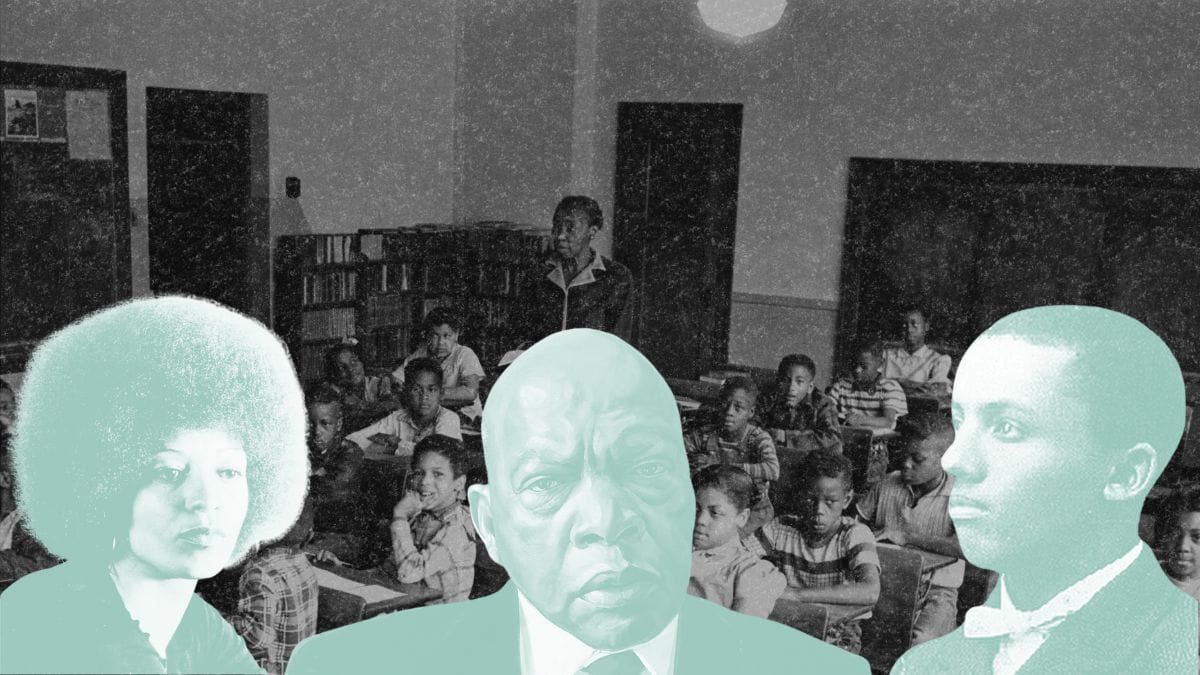
This month marks the 70th anniversary of the Supreme Court’s decision in Brown v. Board of Education. The ruling in the 1954 case was one of the most consequential court decisions in American history, overturning the doctrine of separate but equal—or separate and unequal, depending on who you ask—established by Plessy v. Ferguson. The case also set the stage for Civil Rights Movement activists to dismantle the racial caste system that was Jim Crow.
Many Americans look to the landmark Brown case as an inflection point in our society, one where the U.S. became, in the words of Dr. Martin Luther King, Jr., “true to what [America] said on paper.” Namely that, “All men are created equal, that they are endowed by their Creator with certain unalienable Rights, that among these are Life, Liberty and the pursuit of Happiness,” as written in the Preamble to the Declaration of Independence. But if we’re honest with ourselves, the Brown decision didn’t accomplish these lofty goals. The Brown decision never ensured a true integration where white children attended Black schools and were taught by Black teachers. Only Black students were taken from Black schools and assimilated into white schools, taught by white teachers. Left out entirely were Black educators.
In her book, Jim Crow’s Pink Slip: The Untold Story of Black Principal and Teacher Leadership, Dr. Leslie Fenwick of Howard University explains, “Massive white resistance to the Brown decision prompted the firings, demotions, and dismissals of legions of highly credentialed and effective Black principals and teachers.” This was costly to Black children. This mass dismissal meant Black educators would no longer educate Black children. This shouldn’t be a footnote in American history, but rather understood as a cataclysmic event that severely hindered Black education broadly and, specifically, the role of Black educators as cultivators of Black resistance in Black students.
Consider the Civil Rights Movement activists, who after the Brown decision, were spurred to dismantle Jim Crow. Those activists attended grade school before the Brown decision, meaning they attended Black schools where Black administrators crafted their academic programs of study and where they were taught by Black teachers.
Black students have had to contend with white architects’ framing of Black education. And while teaching in segregated schools, Black educators were subject to white surveillance of their praxis. Yet some Black educators were able to resist through fugitive means.
In his book, Fugitive Pedagogy: Carter G. Woodson and the Art of Black Teaching, Dr. Jarvis Givens of Harvard University explains this resistance as “fugitive pedagogy,” or the practice of teaching that is rooted in affirming, empowering, and equipping Black children to navigate an anti-Black world.
The work of Dr. Carter G. Woodson, the father of Black history, was particularly instrumental. He wrote African American-centered texts, created what’s now called the Association for the Study of African American Life and History (ASALH) that houses both the Journal of African American History and The Black History Bulletin, and established Negro History Week that evolved into Black History Month, providing Black students with resources for resistance.
Black teachers utilized these resources in opposition to resources that framed Black people as stereotypes and caricatures. They empowered Black teachers to affirm, empower, and inspire Black students—students who would become Civil Rights Movement activists like former Rep. John Lewis.
Well before his political career, Lewis was the president of the Student Nonviolent Coordinating Committee (SNCC). He spoke at the March on Washington in 1963 and marched with Dr. King in Selma, Alabama in 1965. Lewis later recounted to Givens stories of cutting out pictures of famous African Americans for Negro History Week as instructed by his teachers.
The efforts of his Black educators helped put Lewis on the road to activism when, at 16 years old, he attempted to register for a library card in Troy, Alabama. The librarian turned Lewis and other family members away, and told them that “the library was for whites only, not for coloreds.” Lewis returned to that library in 1998 and it was then that he finally received his library card.
Another example of an activist inspired by her teachers is Angela Davis. According to Davis, her teachers in Birmingham, Alabama, instructed students vis-à-vis Negro History Week to “cast aside [history textbooks that] did their best to persuade us that our ancestors were much better off during slavery than they would have been had they remained in Africa … and we were allowed then to rely on our own ability to produce knowledge about the conditions surrounding our lives.”
As society struggles with the whitelash to Critical Race Theory, diversity, equity, and inclusion (DEI) initiatives, and the teaching of Black history in schools, the widespread dismissal of Black teachers as a result of Brown has likely lessened potential activism against white supremacy, racial capitalism, settler colonialism, and systemic racism in the U.S. and abroad.
This is because Black teachers benefit Black students by inspiring Black resistance through their social justice, truth-telling, and identity-affirming pedagogy. I know; I’m a Black educator. For some, it may sound far-reaching to assume that white opposition to the Brown decision was rooted in preventing future civil rights movements. However, it isn’t a stretch to conclude that the negligence of Black children and Black education in the U.S. is more a tradition than an anomaly.
Historically, the education of Black people by Black people in the U.S. is rooted in liberation. The same is true now as it was during the periods of enslavement and Jim Crow. However, the Brown decision created another obstacle for Black people in maintaining that purpose.
Educators and policymakers can claim that hiring Black teachers is a priority. But what about hiring teachers with a pedagogy rooted in dismantling the evils of racism, capitalism, and militarism? Likely not. The lack of Black teachers ensures that kind of pedagogy likely never enters the classroom and if saving our democracy is a priority, this is something we should all seriously grapple with.
Author
Rann Miller is an educator and freelance writer based in Southern New Jersey. His Urban Education Mixtape blog supports urban educators and parents of children attending urban schools. Miller is the a
Sign up for Prism newsletters.
Stay up to date with curated collection of our top stories.