The prison in 12 landscapes
Prism looks at the landscapes that prisons shape to better inform our understanding of the carceral continuum
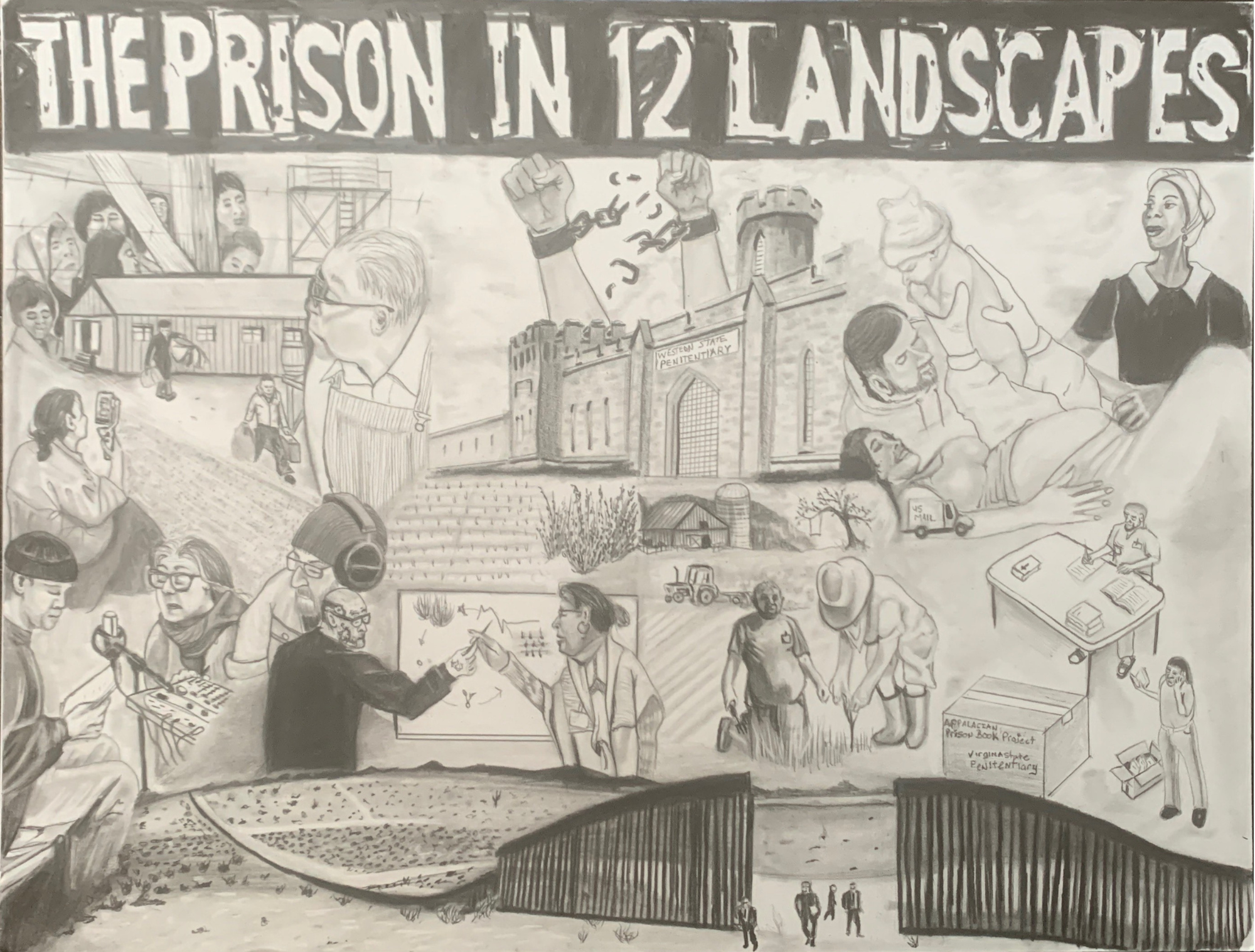
In the 2016 documentary The Prison in Twelve Landscapes, director Brett Story destabilizes the tropes that have come to define the “prison film.” Story quietly illustrates the wide expanse of the carceral system—the built environments and social relationships of those living in cities and towns that lie far beyond the prison walls.
Story notes that many media depictions of prisons and mass incarceration fail to “disentangle the politics of prisons from the closed world of the criminal legal system.”
“They don’t help us make the connections between mass incarceration, racialized incarceration, incarceration [and] policing, with the labor market, with urban change, with disinvestment and other aspects of just living in a capitalist world and a settler colonial society,” Story explained.
The director told Prism that The Prison in Twelve Landscapes was a “thought experiment” in stretching the political boundaries of prison documentaries—an effort she credits the work of abolitionists like Ruth Wilson Gilmore for helping to shape and inform. The result is a meditative journey spanning Appalachia to New York’s Times Square. Viewers spend time in an Eastern Kentucky town whose economy has come to rely on nearby federal prisons following the loss of coal mining jobs. They wait in line alongside residents of St. Louis County, who are saddled with fines and fees that help the municipality operate. In New York City, they tour a local shop that sells items to families with incarcerated loved ones, pre-packaged and designed to the unique and often asinine specifications mandated by the Department of Corrections. Each vignette helps capture a different landscape touched by the prison system—even if that connection lies beneath the surface, rendered invisible to eyes unable or unwilling to see.
Eight years after the film’s release, Story’s narrative approach remains just as important. It prompted a question: How can the film’s approach inform our understanding of the carceral continuum? Throughout the summer, Prism reporters Ray Levy Uyeda and Tamar Sarai set out to explore the prison in 12 different landscapes. Among them, a grassroots archival organization in Texas documenting aftershocks of state violence, volunteers in Appalachia sending books to incarcerated people, movement lawyers organizing to remove police from schools, and leadership of a former Philadelphia prison turned museum. The series, featuring companion pieces from Levy Uyeda and Sarai, will run through September and is organized to introduce readers to subjects beginning with the most—and easing into the least–proximate to prisons’ material form. You can read through the full series here.
To set the stage, Levy Uyeda and Sarai sat down with Story to discuss how her organizing work and her positionality informed her directorial approach, the potential of film to aid in the struggle towards abolition, and her present-day reflections on her documentary.
This conversation has been edited for length and clarity.
Prism: You organized and worked in abolitionist circles for a while before you made the film. Talk to us about the shape and form of the film. How did the manner of storytelling influence the story itself?
Brett Story: When I started to think about making this film, I was doing a PhD in geography, studying the work of really amazing abolitionist geographers like Ruth Wilson Gilmore, and just connecting a lot of things in my own political organizing life and intellectual interests.
I started thinking about the problem of prison films and how there’s a kind of genre of prison films that coexist with the politics of banishment. On the one hand, we’ve got this sort of enforcement of—and insistence on—justice through banishment, the politics of spatial banishment, i.e. stealing people away from their home communities and putting them behind bars and behind walls. And then oversaturating our world with images of prisons, such that many people who think of their lives as having nothing to do with the criminal legal system are also over-influenced by what they see in all this television and media and fiction film—including documentaries. Why do documentaries, even the best-intended ones, replicate the tropes of fiction films—even if their politics are slightly better? [They try] to get access inside a prison, point a camera at an incarcerated person, and then often try to humanize that person through a story of innocence or relative innocence. Some of those films I really love and I think have done meaningful work. But I was thinking a lot about how what they don’t do is disentangle the politics of prisons from the closed world of the criminal legal system. They don’t help us make the connections between mass incarceration, racialized incarceration, policing, the labor market, urban change, and other aspects of just living in a capitalist world and a settler colonial society.
Prism: If I understand you, it was that the form and the approach were prescriptive—and preconceived?
Story: I was just thinking about this as a problem of the form and also a problem insofar as it just means that there’s a lot of prison films that look the same and don’t really push our boundaries politically. It was a thought experiment, deeply informed by and inspired by the work of prison abolitionists whom I’ve studied and learned from and from movements that insist that we think about the prison as an industrial complex and as a set of relationships. What does that mean for someone who works in images? How do you turn that into something meaningful as a cinematic experience, as something that the art form can further? It wasn’t even an idea so much as it was a question: What would happen if we refuse this pressure to get the camera inside and point the camera at incarcerated people and think instead about turning the camera outward and gazing elsewhere? What would we discover? What could we see? And how would those new things that we see help us as a society think differently about prison and maybe implicate people in different ways—especially people who do think of their lives as somehow separate from the politics of incarceration?
Prism: Our gaze—how we look at others and what we want from that looking—is partly informed by our experiences in the world. Can you talk about how you reflected on your identity throughout the process of making this film?
Story: I am a white woman. I grew up in rural poverty with a single mother on welfare, in precarious housing until I was 9. That was politicizing for me. Even when I was 9, we finally moved and had our first apartment, but it was in a working-class town surrounded by Indigenous reservations in northern Ontario, and what I experienced in my childhood was sort of various intersecting politics of poverty, underdevelopment, settler colonial racism, and the relative privileges of whiteness. I’m also a person who has class jumped, and I think a lot about what it means to have a race and class analysis that’s more than just a politics of identification, but that’s [instead about] trying to be a class and race traitor which is hard in this world [because] our interest gets bound up with a set of resources that we have available.
I was thinking a lot about how to make a film that is about the role of the prison system in systematically reproducing whiteness and white advantage rather than just identifying protagonists and antagonists. I think that this is one of the problems that I personally see in even the most well-intended prison documentaries. There’s an awareness of the way in which prisons, at the most basic level, hyper-incarcerate people of color. But it’s still usually through the lens of choosing the right protagonist of the film to showcase the racial injustice in the prison system. Sometimes, that can do a certain amount of good work or open eyes on a basic level, but I don’t think that those projects tend to really help us think about how racism is institutionalized.
Prism: Is there a scene in your film that highlights this in a way that is different from what we typically see in prison documentaries?
Story: I’m thinking about the scene in St. Louis that [asks] why there are 90 different municipalities. In the 1950s, people didn’t want to desegregate the schools, and that led to all of these different municipalities. Now, rich municipalities are holdovers from longstanding white supremacy within the economic system in these communities, [while other] municipalities are compensating for the lack of revenue through fining [residents]. To me, it’s a way to think about how whiteness actually operates in the very organization of space. I’m also very interested in how to help people—especially white people—not just understand their own implication in a racist or rotten system so that they can feel bad about themselves, but [so that they can] find a way to be race traitors or act in solidarity or actually do something to dismantle a system that upholds that racial ordering. The way in which I was thinking about my own complex positionality—which itself has changed over my own lifespan—was to think about how do we make a film that lets people locate themselves in different ways so they can then act and maybe reorient themselves or feel like there’s a way to radically upset these systems.
Prism: You have described the documentary as a “film essay” and it’s clear that while the vignettes speak to one another, the connections aren’t always explicitly clear. What does the film essay form allow for, and did you have any concerns about viewers’ ability to understand what it is you wanted to say?
Story: I’m interested in making the kinds of films that I also like to watch and that I feel have had the most powerful effect on me. By and large, those are films that treat me as an intelligent subject. Not because they assume a level of education, but out of a basic respect for the pleasure of thinking and the pleasure of connecting one’s own experience to an experience you’re seeing on screen. I think the problem with cinema that doesn’t expect its audiences to be intelligent, is that it robs its audiences of a sort of pleasure. Thinking about message versus consciousness is really important to me, and I think coming into consciousness is, by definition, about having new terms available for you to connect what you already know because you’ve lived it in some way. Knowledge doesn’t always appear as knowledge. Sometimes it appears as feeling, or sometimes, you get it partially at one moment, and then you sit with it for weeks and weeks, and then it grows or develops, or you come into it vis-à-vis conversation you have afterward.
In my experience, what cinema can do at its best is occasion space, like bring people together, make you feel and think at the same time, and sort of lodge itself into your being such that it’s not over when it’s over but you’re continuing to make the connections, and you’re continuing to think things through.
The most meaningful part of the experience is holding enough back so that it can mean something even more or different than what I intend. It’s like the best kind of poetry. It’s beyond you, it’s not actually single authored, it is of the world.
Prism: Was it hard to convince others of your larger vision for the film?
Story: I really had a lot of trouble getting support for this film. I didn’t get a lot of money to make it. I made it while in school full-time, and I self-produced it in part because everyone was like, “Oh, this is very heady and abstract. What if people don’t get it?” And even when film programmers would program it, they’d be like, “Well, our worry is that I got it, but what if our audience doesn’t?” [But] I’ve shown it in lots of different places: in churches and prisons, in art house cinemas, in retirement homes. People get it, or they get enough of it, or they feel curious enough to do something else in order to figure it out later. That’s just never been a worry for me.
The most meaningful part of the experience is holding enough back so that it can mean something even more or different than what I intend. It’s like the best kind of poetry. It’s beyond you, it’s not actually single authored, it is of the world. I just was a conduit for some of these images and testimonies and questions and I put them on screen and I’m trying to share them with people.
Prism: What were some of these additional projects, people, or scenes that didn’t ultimately make it into the film?
Story: I didn’t want people to think this film is all about the prison as a metaphor. I began this film with the conceit that we actually might learn and think past some of the ideological confines if we point the camera elsewhere. But I don’t want anyone to ever forget the material fact that at this moment, 2.2 million people are behind bars, which is what informed the decision to end the film with a shot of the Attica prison. An anxiety I had was that this film would somehow offer a comprehensive story, and it doesn’t. There are so many connections and issues that are not included in the film. That’s why I like to think of it as a method or a prompt: Imagine if this was a prison in 50 landscapes; what else would be included?
A scene that wasn’t included took place in New Orleans and was meant to highlight the intersection of immigration enforcement and the criminal legal system. It looked at Immigrations and Customs Enforcement (ICE) raids that were happening at construction sites where undocumented Honduran workers were being arrested by ICE. The work that they were doing was rebuilding the city after Hurricane Katrina. I couldn’t in good conscience include the scenes unless I could promise absolutely everybody that there would be no legal ramifications for them. And while it leaves this void in the film because it doesn’t touch on this intersection between migration control and policing, I decided not to include it in the film at all, which felt like the most responsible way for me to acknowledge my own limitations as a filmmaker and as a journalist.
Prism: What was the process of building relationships with the people featured in the film? Have you kept in touch with anyone?
Story: Sometimes I forge friendships that are long-lasting, and sometimes I don’t. Sometimes my relationships are brief but not transactional. I’m really interested in insisting that different kinds of intimacies are as important to each other, including the intimacy of living and coexisting with strangers that you don’t become friends with. The most important thing for me when I’m meeting new people or describing a project and inviting them to be part of it is to be extremely transparent and honest about who I am, what the project is, and why they may or may not want to participate. I’m open to other people telling me, “Well, I would participate, but on these terms.” I want to ensure they’re in the loop as far as what appears on screen and making sure it does no harm.
Prism: Politically, so much has changed since the film was released eight years ago. How has your thinking evolved? Are there any other changes you would make if given the opportunity to return to the project?
Story: I mainly wish that I had the capacity to build the project out in such a way that it could be more than just the film. It would have been really exciting to build it out so that it could beget more collaborations. I think I would have liked that, rather than just existing as a standalone film. But hopefully, other people sort of connect with it. There’s so much good work being done in media right now; I think much more so than when I made it in 2008. There’s more money to support journalism by incarcerated folks or impacted folks as well as filmmaking by people who have a direct relationship with the prison system and the criminal legal system. I’m gratified to see that, because that reporting is just so essential.
Prism: Over the years, as you’ve done press for the movie, is there a question you like getting or one you wish you got more often?
Story: Making a film is weird. We live in this culture in which we think of authorship in these terms: Someone has a vision, and they make it happen. But I just think filmmaking is inherently collaborative. I’m drawn to nonfiction because I want a pretext to ask questions about the world that will help me connect to people, feel less lonely, and feel like I can act. I, like everyone else who is alive at this moment, feel total despair. There’s a Zoom meeting going on in the other part of my house right now that I’m going to go to afterward, which is about Palestine Solidarity in cinema. I mean, it’s all I can think about right now. I just want to acknowledge what a privilege it was to make a film and to connect to so many people through it. It’s really enriched my life and will continue to enrich my life. That’s also why I do prison organizing work. It’s not just because the work is essential, but it’s because it’s the work that’s brought me closest to the most amazing, most inspiring activists I’ve ever met in my life. I need to stay close to that in order to deal with all the things that make the world intolerable.
Authors
Tamar Sarai is a writer, journalist, and historian in training. Her work focuses on race, culture, and the criminal legal system. She is currently pursing her PhD in History at Temple University where
ray levy uyeda is a staff reporter at Prism, focusing on environmental and climate justice.
Sign up for Prism newsletters.
Stay up to date with curated collection of our top stories.