The end of language
The destruction of Gaza has taken place alongside the surge in AI, an industry that props up an empire of lies that constantly pushes mediocre, propagandistic content into a vast market that’s aching to receive its products
I never scored well in math or science. I have never been good with my hands. I’ve never found the sale of objects interesting; I don’t understand machines or computers. I’m not good at taking photos or filming with my phone. When I run or swim, my form is imperfect, my times, unimpressive.
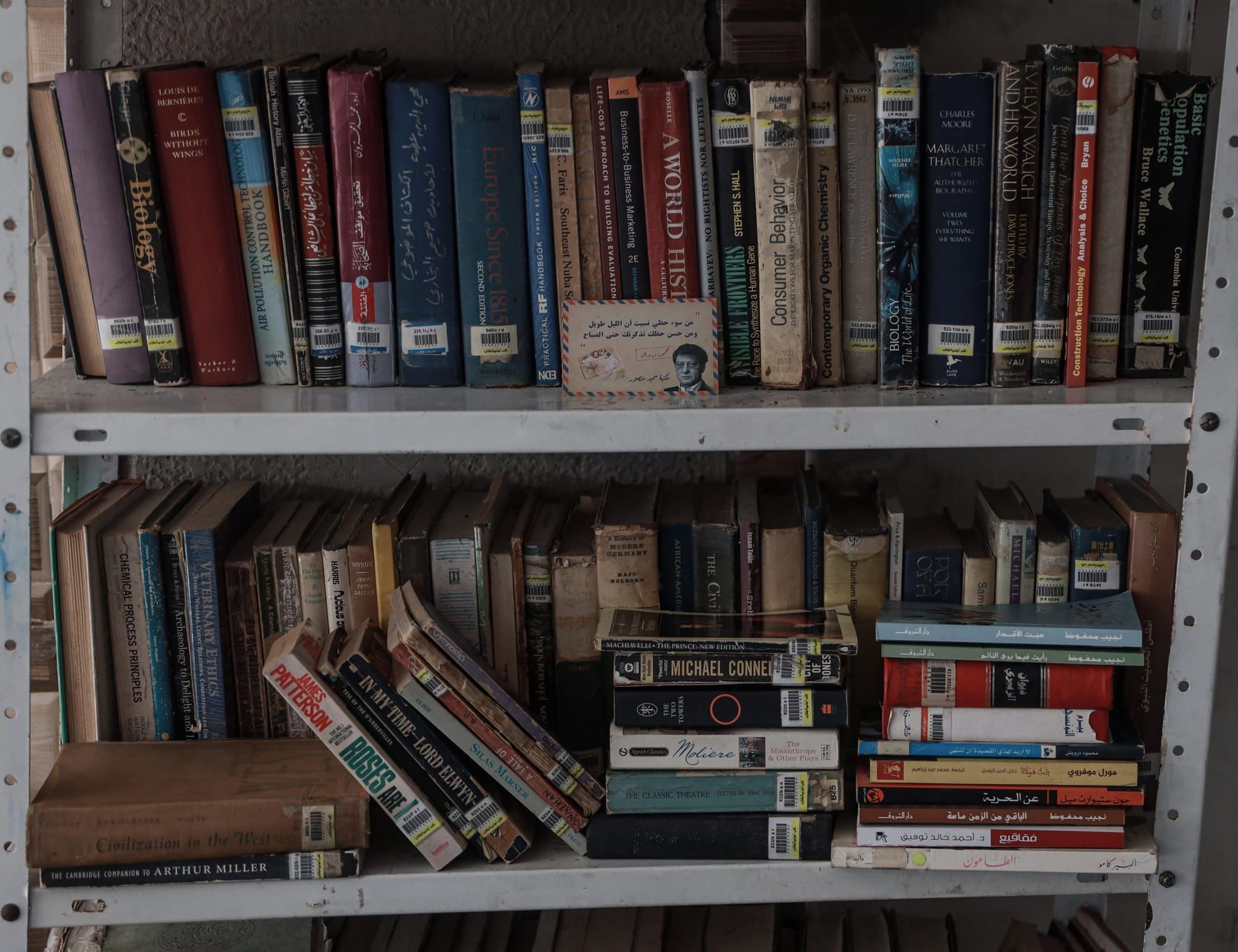
Thanks to the ability to see—and thanks to the fact that I was taught how to read in the years before screens became ubiquitous—physical books have been my primary means of navigating the world. Beyond home care work, the only ways I’ve been able to earn a living have been through writing, editing, teaching, and translating. The study of history and literature—something that’s typically confined to high school or college and meant to be more of a hobby than a life—is the entirety of my capacity. The subjects that nobody really cares if you’re good at are all that I’m good at.
In the public realm, words are all I have. Language is all I have. I’m not savvy enough to pick up arms against injustice; I’m not brave enough to be arrested, jailed, or disappeared. Like my great-grandparents, I’m cautious: I have a nose for exile, for when time has run out, for when the welcome has been overstayed.
I’ve become a person who can process nothing new: I read the same books, teach the same materials, mine the same subjects. I write the same story over and over again, with hundreds of beginnings and endings that meet and part in the same places. I don’t escape into literature or history, no. I only search for myself, for a figure who resembles me, for a topic that I already know everything about. Looking for reassurance that the things I care about still exist. That somewhere—even if it’s on another page, or in another language—the past that I love is still alive, and I still exist.
Over and over again, I have to admit that language fails us. And that the cruelest and stupidest of us all have made a mockery of it.
In the largest, oldest newspapers in the world, Jewish supremacists—who supported the genocide in Gaza for the past two years, who supported the occupation of Palestine since before I was alive—are now slowly starting to admit that the word “genocide” is, indeed, an accurate description of what they have done. And I find myself wondering: Are they scared of hell? Is this acknowledgment simply part of a strategy, to speak about ethnic cleansing as if it’s inevitable, a mere pity? Are they spooked about being completely ostracized from civilized society? Have words become so empty that they can be tossed around without requiring true understanding, true recognition of culpability, true action?
Armenians, Black South Africans, the Maya, Cambodians, Palestinians, the Cree. A genocide, a tragedy, a noun.
Literature may be full of hope and individuality, but history is just repetition, mass, nothingness. The more you study history, the more you realize how little love and justice exist in the world. In most cases, reading the past won’t spur you to action, it will simply make you become more insular, clinging to whatever happiness you have in your life: family, friends, pets, clean water, a home, an identity card, laughter, silence.
When you sift through atrocities, you want to turn your back on the world. You want to stay inside, where—if you have a safe society around you, if you have access to money and passports—you can read Mandela, Said, Baldwin, Ambedkar, Galeano, Carrère, Shibli, Mukasonga. Safely, on a couch, with a coffee and a cat. Words won’t change anything, except maybe you.
Right now, if you’re paid by the word or by the page, the story is becoming particularly grim. Increasingly, media outlets and research institutions are relying on social media followings to determine who gets published, and on editorial teams and artificial intelligence (AI) to make unreadable pieces—written by pseudo-academics who hardly read books or engage with the real world anymore—into passable pieces. And, as language rapidly loses its worth—with my experience as a writer showing me that publishing houses now often rely on rigid models that prioritize word counts, author backgrounds, and catchy themes over narrative voice and line-by-line writing—data centers are sucking up the water from whole communities and countries. This is being done for the sake of cheap, shoddily generated content, so that it can supplant film and literature.
We’re threatened by more than boredom, lost income, lost language, and uprooted greenery: We’re threatened by thirst.
In an interview with El País, Argentine sociologist Milagros Miceli emphasized that the technologies that aim to displace artistic creation and human labor are, in fact, “based on [hidden] work, on precarious work, on the exploitation of millions of workers. But to sell this myth of ultra-powerful and fearsome technology, it’s necessary to erase all traces of humanity.” Despite the much-circulated notion that AI will eliminate tedious work, she points out that “AI wouldn’t be able to work without legions of manual laborers.”
Hundreds of millions of people around the world toil as data workers, earning pennies—or fractions of pennies—for each task completed, each word translated, each image reviewed. “This idea that work is going to be automated is a lie,” Miceli scoffs. “AI requires a lot of manual work.” The same resource-hungry corporations that help the Israelis drone-strike children and aid workers are, on a global scale, engaged in turning the digital realm into the only realm, with the surveilled population dependent on them for scraps and droplets.
It’s true that the Earth has never seen higher literacy rates. And there’s certainly satisfaction to be found in witnessing the decline of corporate media, as it drowns in a saturated market. But this surplus exists alongside the livestreamed slaughtering of journalists. The disappearance of reflection. The widespread use of ChatGPT, even among respectable independent outlets. It’s not uncommon to encounter scholars, publishers, journalists, and directors of research institutions who don’t actually read books anymore. This isn’t to say that reading books makes someone more decent or more intelligent—the last two years have firmly proved that—but one would hope that the few fields that are built on language would still be led by people who are the slightest bit interested in preserving it. Using it, touching it.
The destruction of Gaza—the destruction of an ancient society—has taken place alongside the surge in AI. The extermination of the Palestinian people and the maiming of Lebanese, Iranians, Syrians, and Yemenis have gone hand-in-hand with the rapid implementation of mass drone warfare, robot guns, targets on screens, chatbots, and online “hasbara.” The obliteration of architecture, culture, libraries, bookstores, churches, mosques, craftswomen, fishermen, trees, farmland, animals—the American-funded environmental catastrophe that is Gaza, never mentioned by famed Western author-conservationists such as Jonathan Franzen or Robin Wall Kimmerer—is the most visceral representation of modernity. The losing battles being waged in U.S. courtrooms over copyright law are almost quaint, as the same wealthy authors suing AI firms have little or nothing to say about how their taxes have gone toward the killing and injuring of at least 50,000 children in Gaza.
Ironically, nobody can do greater damage to narrative than a very well-remunerated writer with nothing to say.
Certainly, Israel is still being met with a flurry of condemnation by many, many storytellers. But equally, the terrorist state has been met with the absence of language. There has been calculated silence—from award-winning authors, from whole governments—or, alternatively, the rape of language. Sterilized narratives and phrases try to bury the obvious horror under mounds of dry paragraphs or monologues. In just one high-profile example, Zadie Smith’s May 2024 essay in The New Yorker adeptly deployed utter gibberish to find a way to compare protesting students with Israeli soldiers who rape and kill for sport. In her grasping attempt to be original, she toyed with language, which is nothing more than a game for her. Words for the sake of words, sneeringly deployed to appear clever.
Ironically, nobody can do greater damage to narrative than a very well-remunerated writer with nothing to say. In such a glaring display of ignorance being put to paper, one wonders what kind of ghouls edit this legacy rag, while lamenting the quantity of readers who have faith in it.
How many people, by comparison, have read Isabella Hamad’s excellent response to Smith (and the likes of her) in The New York Review of Books? Surely, far fewer have scrolled through “Acts of Language.” And despite the fact that Smith—a tiresome, aspirational writer at best, a poorly rehearsed bore who traffics in race at worst—has been widely scorned on social media for her nonsensical, dehumanizing writing, has she been dislodged from her perch at the publishing houses or Condé Nast? Won’t she still be marketed to no end; won’t she remain on the bestseller lists?
It’s natural for an eloquent piece of writing—an eloquent defense of victims in the face of dehumanization—to quickly vanish, while a toothless essay or column can make the rounds more easily for far longer, propped up by an industry rather than an organic readership.
But maybe this obscurity is inherently part of meaningful language. In a Harper’s Magazine essay titled “Speaking Reassurance to Power,” essayist and novelist Pankaj Mishra scorns the tendency of famous authors—from David Foster Wallace to Chimamanda Ngozi Adichie—to constantly seek the approval of bloodthirsty politicians. He wonders if the darlings of the American publishing industry will ever be able to “assume the usual condition of writers elsewhere: a bitter but spiritually liberating powerlessness.”
There is something very true, very human, in our frustration. In our screams.
Language isn’t meant to be self-satisfied. Nor is it meant to be a production. It collapses when there’s a saturation of publications, an avalanche of words. In an interview I translated with the philosopher Byung-Chul Han, he described a writing routine that doesn’t match the numerous advice videos uploaded to YouTube: “I work in the garden most of the time and play the piano. And then, maybe I sit at my desk for an hour. Maybe I write three sentences a day, which then becomes a book. But I don’t try to write, no. I receive thoughts.” Han waits for the words to come to him.
Thoughtful language—language that means something—is incompatible with the automated swiftness of the present. It cannot possibly keep up with events. During the ongoing genocide in Palestine—as the Zionist regime has carpet-bombed five different populations and the Israel lobby has completely subjugated the political leaders in D.C., Ottawa, London, Paris, Berlin, Riyadh, and Abu Dhabi—it has been impossible for truthful writing to overcome the bile that is churned out by complicit media conglomerates and tech companies. If the world is aware of the atrocities committed by Jewish supremacists and of the control exerted by their lobbyists, it isn’t because of writing; it is only because of videos, pictures, and audio. Livestreamed devastation of neighborhoods, images of bullets inside the bodies of toddlers, audio recordings of Israel advocates gushing about how their evil is unstoppable.
No words can stop these demons. None of our expressions of rage or sadness or indignation can measure up to billions of dollars in shoddy broadcasts, ink, bots, clickbait. An entire empire of lies—an empire of shit—is constantly pushing mediocre, propagandistic content into a vast market that’s aching to receive the products. And even when we turn to supposedly “higher-brow” audiences, it’s apparent that The New York Times—brimming with Zionist genocidaires—isn’t running out of readers or interviewees. There is a passive, enormous readership that will tolerate brand names and grating writing, that will shrug at Thomas Friedman calling Palestinians animals, that will accept columnist Ephrat Livni as she rubs her hands gleefully at the murder of real journalists in their tents.
There’s a reason that so few people can concern themselves with tragedies in an age of forgetting.
Facts, stories, truth, testimonies. An entire life can disappear in the process of trying to bring these words to a public that, largely, doesn’t give a damn.
There’s a reason that there are so few good shows, books, movies, plays, songs, and paintings. There’s a reason that so few people can concern themselves with tragedies in an age of forgetting. Beautiful language, true language—expressed in many forms—cannot be forced. It cannot be standardized and scaled.
There can only be so much planning and outlining. Visceral creation—desperately wanting to say something, share something, move someone—comes from living, from inspiration. From an element of the spiritual, the unknown. In his analysis of the work of Gabriel García Márquez, Peruvian novelist Mario Vargas Llosa pointed out that the Colombian “wasn’t an intellectual. Rather, he worked like an artist, like a poet. … He worked on the basis of intuition, on instincts. On palpitations.” He went beyond conceptualization. He didn’t need to understand or explain every single thing. A useful practice indeed, particularly as inexplicable evil is broadcasted to us every single day.
I also wish that I could be an artist. That I could spend the time away from my desk in a state of running, swimming, and loving, like how Emmanuel Carrère spends his noncreative moments in “My Life as a Russian Novel.” I also wish for written language to act as escapism for me, as it does for him in “Yoga,” with the ashram as a way of fleeing the noise of the present. I also want to take off, I also want to quiet the news. I also just want to see beauty.
Should I stay silent, knowing that my words are meaningless, and be a coward? Or should I write what I am feeling, as I’m doing now, and be a kind of profiteer, earning money from the misery of our world?
I try to avoid this descent into privileged moral conundrums. I, too, try to write instinctually. But at my most honest, I also want to forget the horrors committed against people who look like me. I want to forget the past and how it manifests itself, bloodily, in the present. I want to read light literature, look at the ocean, listen to birds.
At the end of this urge, however, I realize that my world is richer with language. My heart feels better when someone enunciates what I feel. And I think we can still feel lucky about what we have, while expressing ourselves firmly against the malevolent forces who are happiest when we are too comfortable, too quiet. Hell may be waiting for them, but it would be irresponsible of us to just bum around and run out the clock. We must use language to inscribe what they did to us, to our brothers and sisters, to our elders, our children.
Even if events have truly overtaken us, even if we cannot rewrite what is unfolding, then at least those of us who are fortunate enough—amid the futility—can go looking for a place where we can still exist, with stories and memories as consolation.
Perhaps, in that place, language is all we’ll have left.
Editorial Team:
Tina Vasquez, Lead Editor
Carolyn Copeland, Top Editor
Stephanie Harris, Copy Editor
Author
A historian by training, Avik Jain Chatlani is the author of This Country is No Longer Yours. He has taught in schools and prisons in Latin America and the United States.
Sign up for Prism newsletters.
Stay up to date with curated collection of our top stories.