The case for police-free schools
Despite data showing that police in schools make students less safe, the fight for police-free schools faces challenges. The Advancement Project’s Tyler Whittenberg discusses the ongoing challenges, even in states that have made progress
Regardless of their size, location, or pedagogical approach, schools are spaces where young people learn about others and themselves. They are also places where young people are presented with challenges that model those they will surely encounter in adulthood. Ideally, they are sites of opportunity where students can gain information both directly and implicitly that will help them navigate an ever-changing world.
But in a society where carceral surveillance is omnipresent, it stands to reason that features of the prison system have found themselves in the design of schools all across the country—particularly districts where demographics reflect the communities that are most targeted by mass incarceration. Increasingly, students have to wade through metal detectors before reaching their lockers, deal with punitive measures like suspensions and expulsions, and traverse hallways and classrooms patrolled by police officers.
In 2017, leaders from the alliance for Educational Justice and the Advancement Project’s National Office convened 10 organizations to form the National Campaign for Police Free Schools with the goals of dismantling school policing infrastructure, ending school militarization, and building a new liberatory education system. The national campaign provides an umbrella under which local leaders and organizers have launched their own campaigns. Tying them all together are shared strategies such as the 6 “D’s” : to decriminalize students, deprioritize the use of police in schools, divest funds from policing while investing in student supports, demilitarize existing school police forces, delegitimize the police and our reliance upon them, and dismantle the relationship between school districts and police departments.
As part of this work, Oakland, California, and Madison, Wisconsin, have led campaigns to get police out of schools. In Los Angeles and Phoenix, there have been major divestments in policing in schools. And in Chicago, organizers successfully attained police-free schools. These organizing wins are partly why the Advancement Project had to add a seventh D: defend. In recent years, there have been efforts to put police back in schools where they were taken out, increase the presence of police in schools, and pass policies that require police in school or otherwise make it more difficult to remove them from a school district.
Through ongoing organizing efforts, campaign members also work to uplift their success stories, share learnings, and create resources, including the #AssaultAt Map, an interactive map tracking acts of school police violence against students nationwide since 2007.
Prism spoke to Tyler Whittenberg, the deputy director of the Advancement Project’s Opportunity to Learn, to discuss the true origins of school policing, the genesis of the National Campaign for Police Free Schools, and how the movement to end school policing must also target the myriad forms of surveillance and carceral control that increasingly impact student life.
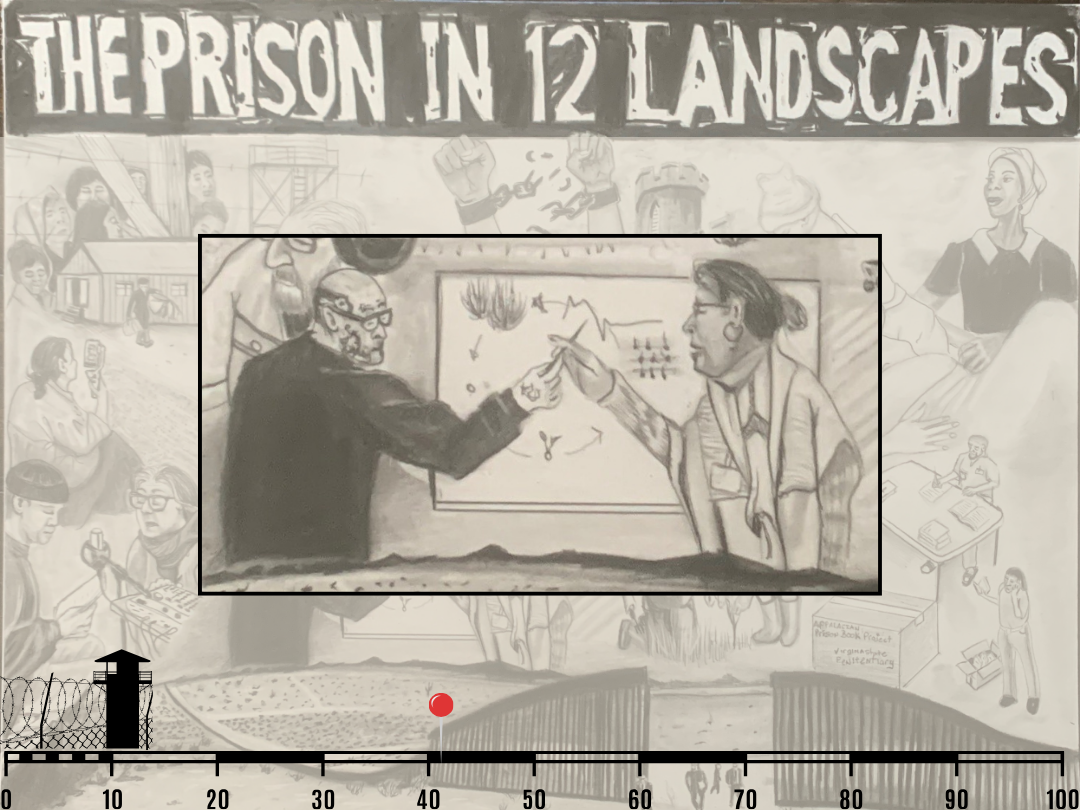
This Q&A is part of a series, Prison in 12 Landscapes, featuring companion pieces from Ray Levy Uyeda and Tamar Sarai. The series runs through September and is organized to introduce readers to subjects beginning with the most—and easing into the least—proximate to prisons’ material form. You can read through the full series here.
This interview has been edited for brevity and clarity
Tamar Sarai: To start, can you share a bit about the origins of school policing in the U.S. and the campaign for police-free schools?
Tyler Whittenberg: People often make the assumption that police in schools began after [the Columbine High School shooting in 1999], but [police presence in schools] is related to the suppression of Black and brown youth protesting throughout the U.S. So [police in schools] started off in Flint, Michigan, in 1953—right before Brown v. Board of Education—and it was tied to trying to control and intimidate Black youth. The purpose was literally to investigate crimes within the schools. You also had a similar program that was piloted a bit earlier in Atlanta, Georgia, another city where you had youth protests and folks trying to stand up for their rights. So you started seeing the proliferation of school policing after Brown, as Black students entered schools that historically only served white students. We had a lot of decision makers and school leaders who were worried about both the violence they might see by letting Black students in, and also the violence and rage of white folks over schools being integrated. So, from that moment on, I think there’s an attitude towards Black children in schools that sees them as a threat and not as people in need of support—not as minors who are there because they have to be.
Then you see more cities start to adopt School Resource Officer (SRO) programs in the 1960s, again, as students are protesting and trying to fight for their right to access things that many of us have access to now, like education and the right to vote. Our #AssaultatSpringValley report shows that places that had more lynchings also had more police assaults against students.
The same way that Black people have been targeted, policed, and criminalized in our community, so too are they in the schools that their children attend.
Sarai: Tell me more about this kind of documenting your organization does in regards to police violence against students. Why is this data so important to capture?
Whittenberg: At the Advancement Project, we chronicle police assault against students of color throughout the U.S. as a way of showing that school policing is an immediate threat to the safety—emotional and physical safety—of students throughout the United States, and not just Black students, but students of color, students with disabilities, and especially girls and women. We’ve been recording that information since 2011 and work with different data scientists to disaggregate it into certain indicators, like race, region, and reason for the assault.
Prism: And what does the data tell you?
Whittenberg: Just last year, we saw that 85% of assaults against students by police were against Black students, and we saw that sexual assault was the third most likely assault against all students. There’s research that looks at school shootings and shows that police being there does not prevent gun violence, and when gun violence occurs, police don’t mitigate that violence. We have no evidence showing that police make schools safer [but] all the evidence showing that they’re harmful to students, both to their physical safety and their overall well being. So I think for us, it’s clear beyond a dog whistle at this point that police want to lock Black and brown children up. They see them as a threat and want to intimidate and control them into submission, not to educate them or empower them with any form of authentic education.
Sarai: I’m curious about any observations that you’ve made since 2020, particularly in cities or school districts that have successfully removed police. What are the updates on the districts that canceled contracts? What challenges have come up that were either expected or unforeseen?
Whittenberg: So, Milwaukee won police-free schools, and then the state passed a law saying any school district with over a certain number of people has to have police in the schools if they have a certain amount of student referrals to law enforcement. The only school district that applied to was Milwaukee, so they were targeted. Florida and Texas passed laws requiring police in schools that also encouraged an infrastructure where school districts can form their own police department. In Tennessee, after the Covenant school shooting, there was a special session to harden their schools. They can fund millions for bulletproof glass and to literally reinforce the structure of the school, but you know, students still need books, teachers are still not getting paid. The more I write about it and read, the less persuasive I try to be because it’s too in front of me for me to even try to pretend like I will meet someone halfway.
Sarai: You have a report about the growing use of surveillance technology. Talk to me about how policing in school extends beyond just the physical presence of officers.
Whittenberg: When we talk about school policing, we don’t mean just the police officer; we mean policing as a verb, policing as an act, the way that you survey, that you watch, that you view individuals and look at them as potential threats and potential doers of crimes, not actual students or actual learners.
We see a lot of surveillance as a really “reformist reform.” Some people may think it’s a good intention, “Let’s get cameras, or we’ll just monitor them on social media, or we’ll just use weapons abatement technology.” [But] all these things are meant to criminalize, and these things also are not effective in what they say they’re going to do. You’re going to get a false flag on just about everything, and it changes the [school] environment, both online and in person. The metal detectors, the cameras, all these things actually make people feel less safe than not having them there. It’s what we call security theater, buying things and doing things to make it look like things are safe when in actuality, all you are doing is building up the policing infrastructure within that space. It is not an improvement to say that [since] we have cameras and we monitor social media, [then] we don’t need police in the classroom, because the truth is, they’re gonna do both. They’re gonna keep the police and they’re gonna have surveillance, and the police will be using all of that information.
So we’re seeing the rise of the school safety industrial complex. It’s a major hurdle for us, and a growing component of the school-to-prison pipeline. The school-to-prison pipeline is a component of the prison industrial complex, and school safety industrial complex is a component of the school-to-prison pipeline. So a part of what we do is think about it in a broad way, taking a look from the balcony view. We have great tools that organizers and folks can use on the ground to help educate their base and then also look at potential legal opportunities.
Sarai: You mentioned this technology is, in some cases, a “reformist reform.” I’m curious if there are other “safety alternatives” that are being promoted or piloted within schools that don’t align with what you are demanding.
Whittenberg: When you take the policing infrastructure and a kind of capital “P” progressive, capitalist outlook, things get co-opted. Abolitionists understand that it’s not just a tit for tat with anything; it’s not just a replacement or an alternative. What we’re doing is trying to build a world where people’s needs are met and where [harm] is less likely to happen because we’re caring for each other. But a lot of the time, policy makers need the tit-for-tat arguments, they need to say, “Oh we’ll take police out and implement something else.” But they also don’t want to pay for it. So we have folks that craft really comprehensive demands that are calling for everything from improved school transportation, comprehensive and transformative sexual and reproductive health education, transformative justice and restorative justice that doesn’t involve law enforcement at all. And [then] policymakers will develop restorative justice programs within the school, but they’ll use it as discipline, or they’ll include the officer, which is all of these things that are not [transformative justice]. Then they’ll say that they’re doing restorative justice, and when it doesn’t work, they’ll say, “Well, we tried,” which puts [us] in a worse position.
Sarai: What would you say is the main thing that’s been co-opted?
Whittenberg: Restorative justice is the main one, but a lot of school districts are also investing in weapons abatement technology and acting like it is different than putting police officers in the building. It is literally different, but that doesn’t mean it’s any better. It also has impacts that are carceral and detrimental to the educational environment and the health of the student.
Mental health is another thing that’s co-opted. We ask for mental health support, and they might invest some money into mental health, but it’s not enough to make a dent. In many school districts, you have to make an appointment with a counselor who is rotated between three high schools. Then a lot of counselors are there more for threat assessments or at-risk students, and through the pressures of mandatory reporting and information sharing, they are deputized because [while] we’re not using the police officer, we’re using this other individual who still makes referrals to law enforcement.
I think right now with the border and immigration being a major discussion around the election, you have people talking about the strain they have on their schools because of undocumented students. So the more that information sharing is wrapped within this infrastructure of school policing, the more those students and their parents are at risk of deportation. Even if they aren’t going to be deported, the experience these young people are going to have in school is detrimental to their overall well being.
Sarai: That point you made around information sharing and the deputization of other school administrators just made me think about school administrators who might be tasked with navigating an ongoing tension between this new protocol and people’s conditioning to call the police for any and everything—how those two things are at odds. In your opinion, what is required to make a broader cultural shift around how we view police and the extent to which we rely on police—even for people who are “well meaning” and don’t necessarily want to call upon the police?
Whittenberg: I think everybody will have a role to play. Right now, there’s a generational divide, I think, with folks not recognizing what we mean by abolition. So, like, an older Black audience thinks that it’s impractical and who maybe aren’t even being communicated with—[or who] are being communicated with, but don’t know what that discussion is. I think we need to get Black folks on board just as much as other folks. There’s the fighting against what exists, and then always trying to base-build and better the conditions of people who are impacted by the prison industrial complex.
Then there’s white people who ask me, “What should I tell people?” or “What do I tell my parents at the dinner table?” I look them straight in the face and say, “You tell me? I don’t know your parents, that’s your crowd, maybe you should think about what they want? Knowing them, how would you develop an argument or try to be persuasive around policing in schools?” It can’t be up to me, or any Black person, really, to do that. There are also Black abolitionists teaching networks and there are abolitionist teaching networks that aren’t all Black, and [they are] all trying to think about how they can bring those principles into the classroom as well.
Author
Tamar Sarai is a writer, journalist, and historian in training. Her work focuses on race, culture, and the criminal legal system. She is currently pursing her PhD in History at Temple University where
Sign up for Prism newsletters.
Stay up to date with curated collection of our top stories.