This Tennessee group created a court-watch program to hold judges accountable
In Shelby County, where court proceedings aren’t recorded, a court-watch program documents judges who too often act with impunity.
“You ought to be ashamed of yourself. At 31 years old, you should be getting your life together.”
“Just keep your mouth shut. I can keep you in jail for 10 days for nothing but running your mouth, so keep that in mind.”
These are just a snapshot of troubling comments made by various Shelby County, Tennessee, court judges that were captured and later published by Just City Court Watch volunteers. Founded in 2015, Just City is a nonprofit based in Memphis that works to transform policies and practices within the criminal legal system through three primary initiatives. The Clean Slate initiative helps guide individuals through the records expungement process, there’s a community bail fund for defendants detained pretrial, and the Court Watch program provides a window into county court proceedings, creating a greater sense of transparency for the general public. In doing so, the program has gradually gained momentum in holding judges accountable and dispelling myths about how the court operates and the ways that judges treat defendants and their lawyers.
During sessions, Just City volunteers jot down direct quotes from judges that highlight areas of necessary improvement and points deserving of praise. The volunteers that observe cases score judges on a rubric, measuring sensitivity toward defendants, willingness to treat defendants with dignity, how well they ensure open access to the court, timeliness, neutrality, and other characteristics. In Tennessee, judges are elected positions with uniquely long terms, making them beholden to voters in order to gain their seats. However, once in these positions, judges often make decisions with little impunity and run their courts in ways that the public rarely sees. Court watchers pull back the curtain, while also offering concrete recommendations to each of the judges they spend hours observing. Suggestions for improvement range from the more easily fixable,“could take less phone and coffee breaks” or “could use less callous language,” to the deeply rooted, “Treat Black and white defendants equally.”
In July, Prism spoke to Just City’s court watch program manager, Yonée Gibson, about her work, the most striking insights from her observation of judges, and the importance of opening up courts to public scrutiny.
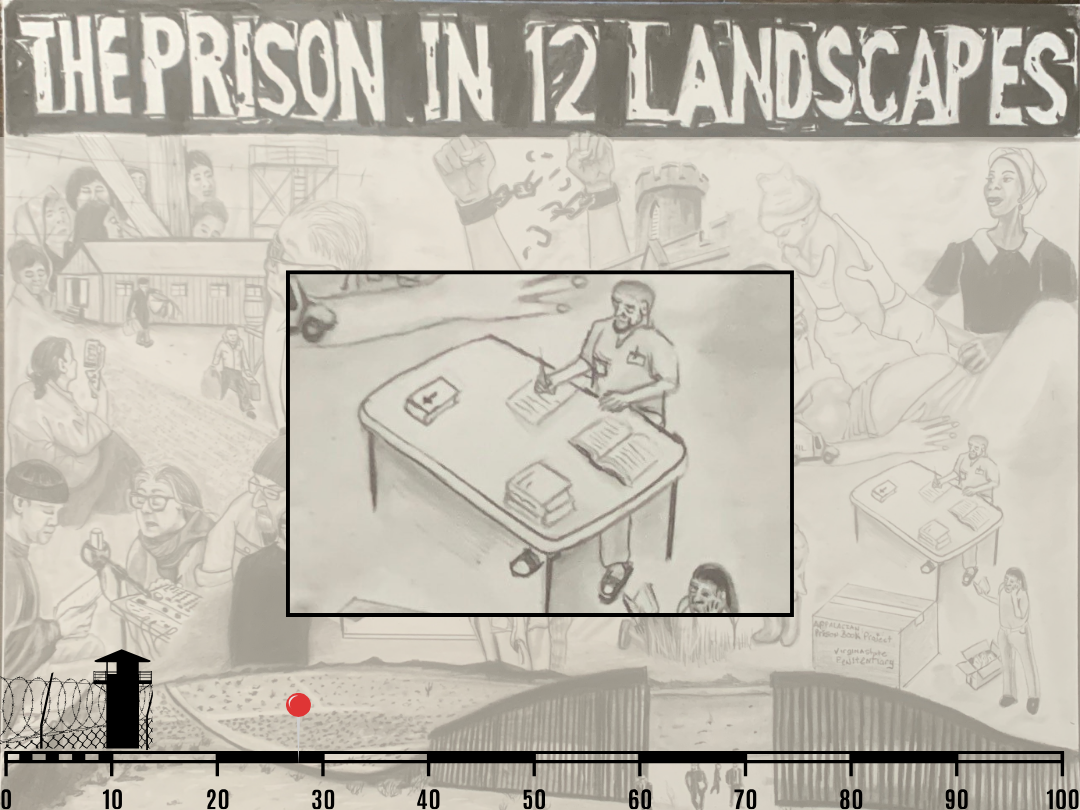
This Q&A is part of a series, Prison in 12 Landscapes, featuring companion pieces from Ray Levy Uyeda and Tamar Sarai, running through September and is organized to introduce readers to subjects beginning with the most—and easing into the least—proximate to prisons’ material form. You can read through the full series here.
This interview has been edited for length and clarity.
Tamar Sarai: To start, I’d love to first hear what a court watching training looks like for volunteers. Also, what is the typical demographic of your volunteer cohort?
Yonée Gibson: We have a 20-minute orientation that is on YouTube. We have people watch that first, and we have a handbook I created with information about what’s going on in court, as well as giving some definitions. That’s what I needed my first few times of court watching [when I was] just writing down words that I had no idea what they meant. I created a glossary from that.
The first time someone court watches, they go with me or somebody else who’s representing Just City. I don’t ask them to write notes the first time because the courts are kind of like a sensory [overload] until you get used to the atmosphere. So we’re there just to answer any questions they might have, and then they’re able to go off on their own. I created a rubric for everyone so that the note taking is standardized and each rubric focuses on the conduct of the judge, as well as follow up questions about what the judge did well, how they can improve, and what the general feel of the courtroom proceedings were. That makes it so that court watches are beginner-friendly; it puts [judge behavior] on a scale, and then people are able to [visit courts] as they’re able to.
Sarai: How many cases do you typically observe on any given day or session?
Gibson: Our court systems are a little bit more convoluted than other places. A lot of places do arraignments, [but] we use Odyssey [court case management software]. Downstairs is the general sessions court, which is the county court that does misdemeanors and a lot of first appearances. They have a lot more cases and they go faster. Upstairs is the criminal court, which is the state court that does jury trials, so there’s a little bit less. On a docket downstairs, there can be anywhere from 50 to over 100 cases. Fifty is usually the max upstairs.
Sarai: After reading some of your reports, I’m curious how you direct volunteers to observe and measure things that can be quite subjective, like a judge’s attitudes, their tone of voice, or their disposition towards defendants and attorneys.
Gibson: Our baseline is that every human has inherent dignity and they should be treated as such, so what we have volunteers write down is anything that sounded like it was condescending. We also look at the way that judges interact with people who have a hearing and [whether] they treat them as if they are dumb or as if they’re experts in the case, even if it’s their first time there. We want to make sure that people aren’t treated as if they should know everything that’s supposed to go on because they don’t, and so we want to make sure that the judges are giving them as much context and information as possible. Sometimes I [tell volunteers]: Treat this like a transcript, write down anything that piques your curiosity. Then I’ll make some judgment calls from there.
Sarai: One of the reasons why I’ve been really interested in Court Watch is because I think a lot of people have this illusion of what happens in a courtroom, but it’s often based on inaccurate portrayals they see on TV or in films. From your perspective, what are some myths that you think court watching has helped to debunk—either for you or for volunteers that you work with? How do you relay that information to the broader public?
Gibson: I think one of the big [myths] is that everybody who can’t afford a public defender gets one. People are always very shocked that it’s up to the judge’s discretion. TV has really warped some of our views. The recording of court proceedings or lack thereof also really surprises people. Downstairs in general sessions, only plea deals get recorded and nothing else is, which is why we’re down there because judges can say almost anything and get away with it when it’s not recorded. That’s why we have those reports and use social media to tell the community.
Sarai: I actually didn’t know that not all of these court proceedings were recorded. Given that, I’m curious what pushback you’ve received outside and inside of court, either from courtroom personnel or judges themselves. Do you ever get the sense that a judge is aware of your presence and changes their behavior because of it?
Gibson: [Defendants] will ask us to come see their hearings, because they say it is a very different feel when we’re there. Some judges don’t really like us, but that’s okay. We just had a judge ask one of our interns to “be nice” last week when she was there. But everything we write is what you did, so that’s on you.
Sarai: And in terms of judges who may be up for reelection, do you have a sense of the degree to which your work is impacting their political aspirations? Does it ever come up in conversations with them or how they interact with Just City in general?
Gibson: That did happen a couple times in 2022, our last election. There are people who [say] the difference in the judges between when they were getting elected and now is like night and day. Before they were like, “I’m available to you for any questions you might have,” or we’d be in the middle court and they’d say, “Do you have any questions? Is there anything I can do?” That’s not happening right now. But Tennessee also has the longest terms in the country, and so the judges won’t get re-elected until 2030. We have eight-year terms for our judges and our district attorney.
Sarai: What are some of the most frequent concerns that come up when you are observing the courts? Are there recurring areas of improvement that you’re identifying for different judges?
Gibson: Of course, everyone has their own bias, but you can see in each courtroom what their bias is. The way that a judge will treat some cases that are typically less harmful in offense as stricter because it [involved] something that they personally don’t like. Also really common is just bias towards the state. While the judge is supposed to be the neutral party, currently we’ve been seeing judges kind of coach the state in open court and say, “Hey, this is what you should say to get a certain outcome.” That’s not great.
Sarai: How do these observations and insights impact your policy work?
Gibson: I think what I’m really excited about with our program is that previously we just created reports to be more informative to the community, but now we are working towards some policy work to get the court downstairs to be a court of record and to be recorded and live streamed so that people have access to the courts. You asked about our volunteers earlier. We spent a lot of time with retired people and students just because court is Monday through Friday, 9 a.m. to 12 p.m., so it’s not really an accessible time for people. Having it live streamed creates more accountability and transparency because if a court watcher writes something down, it’s not just like, “Oh well, we’ll take their word for it.” It will be documented that at a specific time this judge said this. So we want to really advocate for that and really just bring Shelby County into the 21st century.
Author

Tamar Sarai is a writer, journalist, and historian in training. Her work focuses on race, culture, and the criminal legal system. She is currently pursing her PhD in History at Temple University where
Sign up for Prism newsletters.
Stay up to date with curated collection of our top stories.