Never eat the candy on your pillow: Technology and the imprisoned
Powerlessness impacts every aspect of an incarcerated person’s life—including the use of technology
Dear Reader,
I want to discuss with all of you an issue that impacts every aspect of an incarcerated person’s life: powerlessness. This feeling extends to every part of life in prison—including the use of technology.
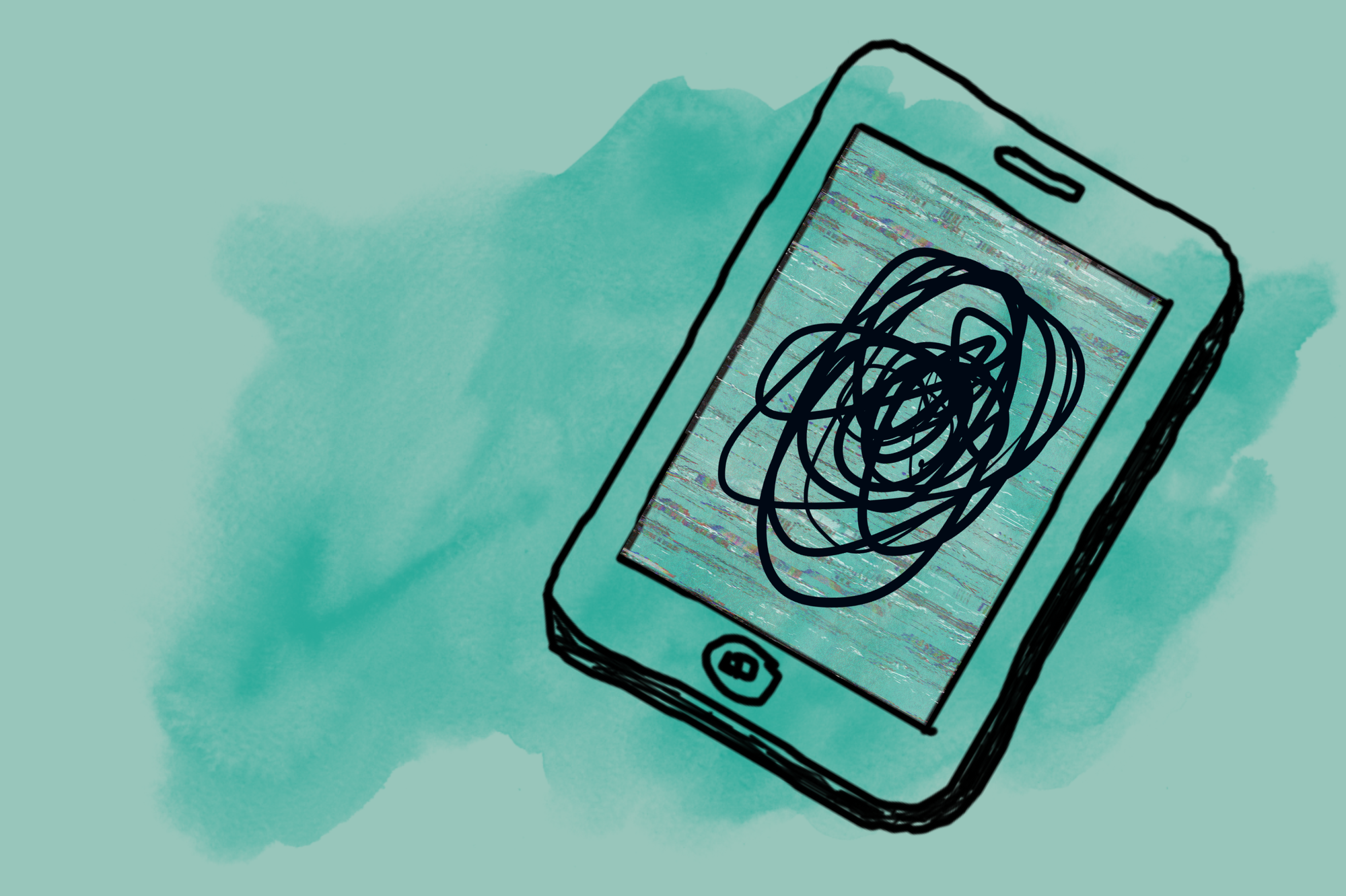
If any of you have experienced the loss of files or data due to a computer crash, first let me say that I extend my deepest and most sincere apology. I can now relate to that anger and frustration, feelings that still linger every time I think of what I lost. Never have I felt more uncertain about the direction of my life than the day an entire year’s worth of hard work was erased because of a glitch.
The date was Sept. 12, 2023. I remember seeing a look of confusion on the face of nearly every person I’m incarcerated with.
“Hey, Trumbo! What’s the matter with the tablets?” they asked.
“I don’t know? Mine isn’t working either.”
I stared blankly at my tablet’s frozen screen, unable to log in, access email, or study.
“But you’re the prison’s IT guy … ”
I had no answers. The problem could have been that the institution hadn’t turned on the Wi-Fi yet. Maybe the staff decided we didn’t need the privilege of our tablets. Or perhaps our service provider, Securus, had done something to our tablets.
The problem wasn’t just confined to my dorm. Word quickly spread that nearly everyone’s tablets were on the fritz. Before long, we learned what happened: Securus issued a middle-of-the-night update, and something went catastrophically wrong.
I’m many things: a writer, college student, playwright, mentor to my fellow imprisoned people, and an IT support tech. But I’ve also been incarcerated for more than 18 years. So, while my line of work here at the prison may have me installing tech and pulling cable for phones, cameras, and computers, I am not computer savvy. At all. When my freedom was first taken, the world was just getting acquainted with Windows 2000!
When the prison issued me a tablet earlier this year to be used for college, sending emails, and making phone calls, I was flabbergasted. At first, I didn’t know how to use it, and then I became totally dependent upon it. I stopped writing anything in longhand. I did everything on my tablet. No more ink stains on my hands and clothes. No more lost papers. Bye-bye wrist pain.
When I woke up on Sept. 12, any proof of life on my tablet was gone. My music—Jay-Z, Red Hot Chili Peppers, Sublime, and Lupe Fiasco—erased. My games? Deleted. Perhaps most devastating: All of my writing for the last year was nonexistent. Erased. It was like I never devoted close to a thousand hours to writing those three full-length plays, two novel drafts, and an entire short story anthology that were erased from my tablet’s temporary memory. I should probably mention here that incarcerated people aren’t allowed backup memory capacity for our devices, as it would assuredly be misused for nefarious purposes by enterprising criminals, or so they say.
The Securus issue was statewide. All tablets in Kentucky’s prisons were impacted by the update problem. When Stephen, a friend and fellow college student, heard I’d be writing about this for my column, he wanted his voice to be heard.
“I want you to reveal how the small things can affect—and effect—us in great ways,” Stephen said. “Most people outside these fences do not know the things we go through, and some people don’t care. I get that. But I’m still human. I have family and friends I like to stay in contact with. The loss of my tablet, even for a few days, took that all away from me yet again.”
On Sept. 16, 2023 the issue was resolved—and by that, I mean that anything that was saved as a temporary file was actually erased. This includes e-books, games, music, family photos, and movies. For me, this also meant my college notes couldn’t be restored. I forever lost my personal observations and musings on Socrates’ belief that an “unexamined life is not worth living.” I lost my public speaking tips and English 102 APA format templates. I lost everything.
“What about your short story about the corrections officer, Sergeant Townsend?” Stephen asked upon hearing I’d lost all my writing. “You going to rewrite it?” “
I introduced Stephen to Sergeant Townsend’s character through my short story “Shift Change.” Stephen had been amazed that a corrections officer character could want more from the prison where he worked than merely to warehouse people.
Stephen had a lot of questions about Townsend’s future. If I didn’t rewrite the story, wouldn’t Townsend’s vision of social justice, equality, and empowerment go unfulfilled? What about the CO’s inner conflict? Would the man ever overcome the introversion and fear that kept him from speaking out against the prison’s bad policies?
I didn’t have any answers. All I knew was that I didn’t write Sergeant Townsend’s stories down.
My catharsis came not from immediately setting out to rewrite everything I’d lost, but from examining the situation. And talking about it. It would be impossible to replace all of my work. I’d never recapture the many stories I’d written. However, I could take a step back and reevaluate. Why did I write the stories I’d written? What college notes should I commit to transcription? What did the future hold for me as a writer?
Most importantly: Could I overcome this loss?
For several days, I’d turn on my tablet and stare at the screen, hoping all of my work would magically reappear.
Stephen tried to encourage me, and he urged me to open up about how I was feeling over the loss of my work.
“It may come back,” Stephen said. “And if not, consider it a fresh start. A chance to begin again.”
Stephen also wouldn’t relent when it came to my short stories and other writing. He told me that my stories showed empathy for prison in a way he’d never read before, including Sergeant Townsend.
“People should be enlightened to some of the things they either don’t understand or do not want to understand about life behind these walls,” Stephen said.
Here he was trying to encourage me when he had also lost so much: his college work and notes. His music. His games that he said were a temporary escape from the monotony of prison.
“This technology means a lot to me, but I’m a bit apprehensive because I now understand that it can all be taken away at any moment,” he said.
I felt the same. There are now times I avoid my tablet entirely. On those days, I awkwardly grasp the pen in my hand and stab down at the page to capture my thoughts.
But over time, Sergeant Townsend’s story—and my confidence—has slowly returned to me in fits and starts.
I’m rewriting now.
The Right to Write (R2W) project is an editorial initiative where Prism works with incarcerated writers to share their reporting and perspectives across our verticals and coverage areas. Learn more about R2W and how to pitch here.
Author
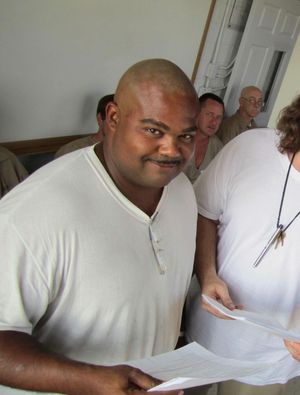
Derek R. Trumbo, Sr., a multiple-time PEN Prison Writing Award winner, is an essayist, playwright, and author whose writing has been featured in "The Sentences That Create Us: Crafting A Writer's Life
Sign up for Prism newsletters.
Stay up to date with curated collection of our top stories.