Beyond the textbook: How educators navigate race and history in the classroom
As debates over critical race theory rage on, educators find creative ways to engage students about the U.S.’s racial past
With debates around critical race theory, changing racial demographics, and calls to more deeply reflect upon the country’s legacy of colonialism, slavery, and racial prejudice, educators, parents, and legislators have been struggling together—and often against one another—to determine how histories of race enter into the classroom. These debates manifest differently across schools and are informed by how teachers engage their students.
In a conversation with three teachers across the U.S. who teach middle and high school history or social studies, Prism sought to explore how these conversations shape classroom life. How are educators engaging their students on the legacies of slavery and segregation, the mid-20th-century struggle for Civil Rights, and the Black Power movement?
Controversies around the content in U.S. history textbooks have often centered around conservative states like Texas. In recent years, reports have highlighted how textbooks used across the state often omit or mute the atrocities of U.S. slavery and fail to mention historical women. Such revelations have fueled outcry from activists, parents, and students. These inaccuracies have resulted in educators across Texas and other states relying less upon classroom textbooks.
“Much of this history has been hidden or actively suppressed, which makes it even more enticing to learners,” said Brandon Grijalva, an eighth grade world studies and geography teacher based in Illinois. “I think it’s important to be open about this: some knowledge is powerful enough to be hidden.”
Tina Tosto, a ninth through twelfth grade teacher in Mississippi, shared that she never uses textbooks. Instead, she chooses to have them available as “a resource, sort of like a reference book in the library when students are working on independent assignments,” but mostly supplementing her classes with primary source excerpts, historical articles, and original lectures.
Seth Billingsley, a Maryland-based eleventh and twelfth grade U.S. history and AP U.S. history teacher, offers his students short background readings based on secondary sources and leans heavily on primary sources.
“I find that students respond better to the primary sources than a textbook retelling or summary,” Billingsley said. “I try to get beyond simple narratives.”
For example, instead of framing a lesson around “Why did Reconstruction fail?” Billingsley uses a lesson that asks students, “Who Killed Reconstruction?”
However, students are getting lessons from more than just the resources provided by their teachers. As middle- and high-school learners spend more time online, the avenues through which they receive information about issues related to race and U.S. history widen, creating both new opportunities and challenges for educators.
“Our students come into the classroom with a wealth of knowledge and perspective that is often well beyond the knowledge I had at their age,” Grijalva said. “This is informed by their classroom experiences but also comes from their engagement with the internet. Typically, students have some level of background knowledge related to the above topics, but it may be from their own exploration on YouTube or TikTok.”
Grijalva notes that this online engagement can be a good starting point but requires deeper conversation to weed out misinformation. He also noted that more media representation of the Black Power Movement, such as the 2021 film Judas and the Black Messiah—about the murder of Chicago Black Panther Party leader Fred Hampton—has also kindled more interest among students to dive into his class material.
For other students, these online resources, as well as the area they live in, have shaped the information they bring into the classroom while exposing gaps that teachers can fill.
“Being in Mississippi, some know the story of Emmett Till, and some know about Black Power, but knowledge of Black history is seriously lacking outside of the topic of slavery, Harriet Tubman, Frederick Douglass, the Civil Rights Movement, MLK, and Rosa Parks,” Tosto said. “Even their knowledge in these categories tends to uphold the dominant, mainstream view and leaves a lot out. Students know nothing about COINTELPRO, which makes teaching about that very satisfying. It blows their minds.”
Despite their geographical distance and political differences, Mississippi, Maryland, and Illinois were among a host of states that have been the site of recent debates around how to teach social studies at the K-12 grade level.
In Maryland, State Delegate CT Wilson has introduced two bills since 2021 to mandate the State Board of Education to develop standards for teaching Black history to public school students. Issues that Wilson highlighted included the history of African people before slavery, the Tulsa Race Massacre, and police brutality. In opposition to more inclusive histories, however, Republican lawmakers introduced HB 1256 which would ban schools from teaching about “discriminatory concepts” such as racism or sexism.
Much like Maryland’s HB 1256, in 2022, Republican legislators in Mississippi introduced similar bills, including HB 437 which would prohibit schools from teaching “divisive concepts.” That same year Governor Tate Reeves signed into law legislation that would ban schools from making a “distinction or classification of students based on race.” A year prior, during the 2021 legislative season, concerns arose that the Mississippi Department of Education was removing civil rights content from its state standards, leading to a series of public forums and conversations, during which additional disappointments with the state’s social studies curricula were discussed.
Meanwhile, in 2022, Republican legislators in Illinois unsuccessfully introduced two bills designed to ban teaching about racism and sexism in schools. That same year conservative lawmakers in the state also proposed three laws to increase parents’ access to what their children are learning in the classroom. Developed amid a wave of “anti-critical race theory” bills, the laws would have required teachers to post their curriculum and lessons online. Opponents argued that such mandates could undermine trust between parents and teachers and erode educators’ self-confidence.
Though these pieces of legislation and conversations they engender among the public shape aspects of classroom life, they don’t necessarily tell the full story. Neither Billingsley, Tosto, nor Grijalva has received pushback from their school administration or district for how they approach their lesson plans. In fact, Illinois-based Grijalva noted that the majority of his support comes from parents and that he uses the fact that students will continue to engage with these topics when they return home each day as an opportunity to bring parents in.
“Parents are the primary educators of our students and have a ton of knowledge and experience to share,” Grijalva said. With this in mind, I try to create opportunities for students to explore the topics we’re covering in class with their parents. This can lead to suggestions from parents on things they’d like to see covered within the topic and other connections they can make with the content.”
At the heart of so much statewide pushback against the teaching of fuller and more comprehensive histories is anxiety around the truth, the discomfort it brings, and its potential to shift the status quo. Thus, for these educators, a part of the lesson for their students is not eradicating that discomfort but ensuring they know how to navigate it and, in the best circumstances, tie those potential anxieties to the curriculum content.
“I give students the preface that I’m not going to whitewash history or try to cover up the bad,” said Billingsley. “I try to highlight the ways that freed people had agency.”
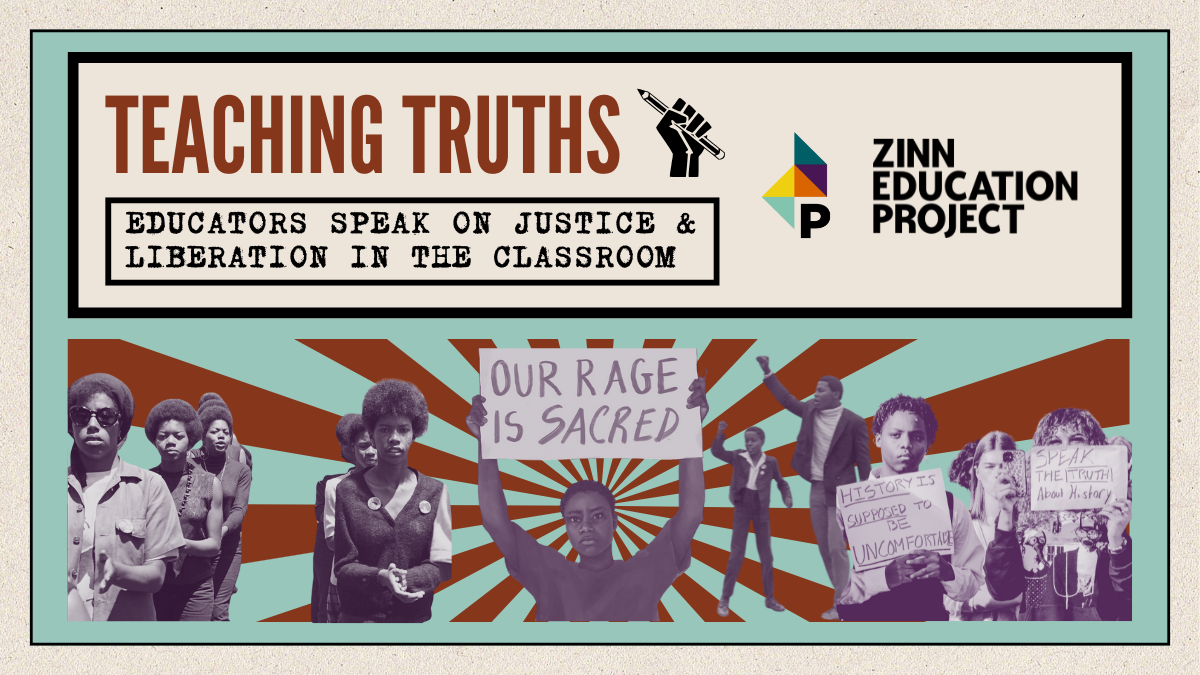
“Teaching truths: Educators speak on justice and liberation in the classroom” will be published through November, and you will be able to find each piece here. Learn more about the Zinn Education Project here.
Author

Tamar Sarai is a writer, journalist, and historian in training. Her work focuses on race, culture, and the criminal legal system. She is currently pursing her PhD in History at Temple University where
Sign up for Prism newsletters.
Stay up to date with curated collection of our top stories.