Teaching Palestine: Educators bring resistance and history to their classrooms
Two teachers share how they’re using Zinn Education Project resources to engage students in critical discussions about Palestine
One year after Israel’s genocide in Palestine began, educators across the U.S. continue to face censorship and pushback when addressing the subject in their lessons. In response, some districts have introduced policy changes.
The topic of teaching about Israel’s war on Gaza and the West Bank was the subject of a congressional hearing in May, when the Committee on Education and the Workforce questioned leaders of three public school districts: New York City, the Washington, D.C., suburbs of Montgomery County, Maryland, and Berkeley, California. Activists say the hearing reaffirmed that teachers are being censored and reprimanded for expressing what the lawmakers call antisemitic rhetoric that makes Jewish students and fellow teachers “unsafe.”
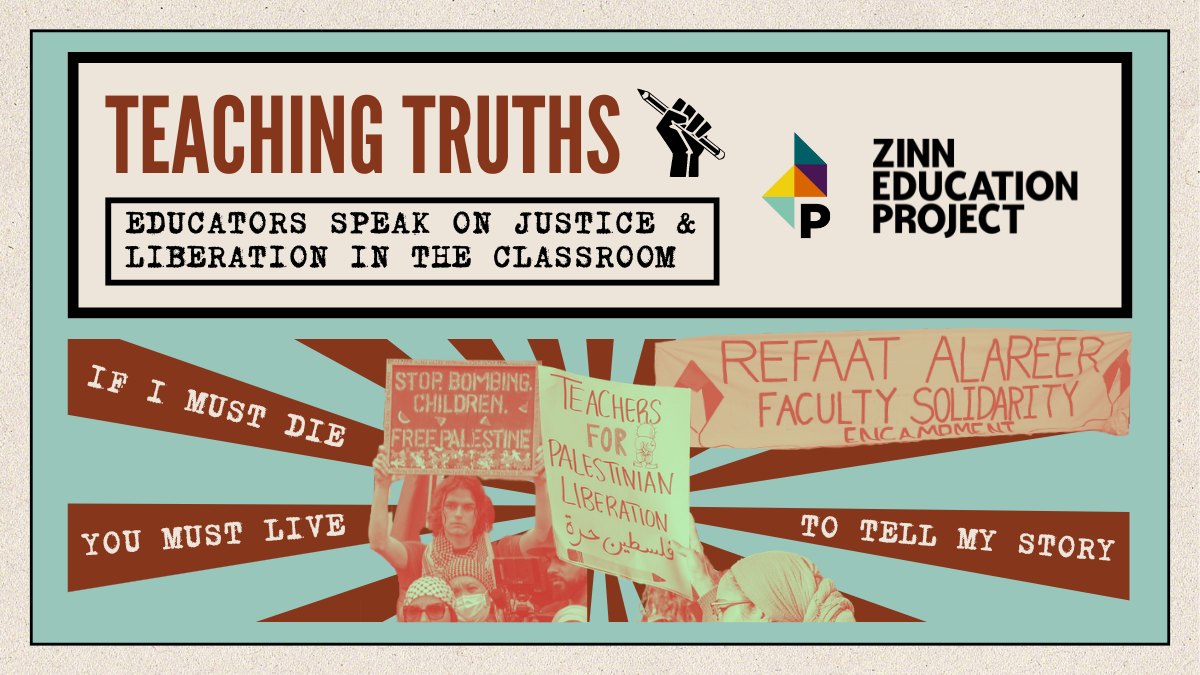
In partnership with the Zinn Education Project, Prism is exploring how educators are utilizing their resources to engage students in meaningful discussions about Palestine. The series, titled “Teaching Truths: Educators Speak on Justice and Liberation in the Classroom,” will be published throughout October and will feature a series of interviews with educators across the country who are working to implement critical topics like Palestine and resistance into their curriculum.
Suzanna Kassouf is an experienced social studies teacher from Portland, Oregon, who has faced both support and significant challenges while integrating these topics into her lessons. Destiny Andrews, a dedicated educator with a decade of teaching experience, currently teaches fourth and fifth graders at Oakland Academy of Knowledge. Andrews’ journey into education was fueled by her own challenging school experiences and the transformative impact of a memorable teacher. Both educators sat down with Prism for a roundtable discussion about their experience teaching about Palestine in the classroom.
This interview has been edited for length and clarity.
Martinez: Can you tell me a bit about yourselves? Why did you decide to go into education?
Andrews: My school experience wasn’t great. I felt like I didn’t belong and struggled academically. But I had one amazing teacher in fourth and fifth grade who made learning fun and memorable. That inspired me to bring that same energy into my own classes. After learning more about my Asian history and culture while studying ethnic studies in college, I wanted to address the injustices I faced in school.
Martinez: Could you elaborate a bit on what you experienced?
Andrews: My K-12 education was void of Asian voices, history, or contributions aside from my music teacher asking me to dance ‘hula’ for multicultural day. My immigrant grandfather was the custodian at my elementary school, and I remember being teased because he would set aside and bring home uneaten cafeteria food. I felt ashamed, and I remember him scolding me for correcting his English. My school experience did little to help me feel proud of this part of my identity. And it wasn’t until college and afterwards when I learned more about my culture that I started to feel proud of who I am and where I come from. I am still learning and connecting with others that have experienced the same. Being a teacher has made me very aware of who is in my classroom, and I lead with the idea that we are co-constructing in the classroom because we are all learning.
Martinez: How did you first learn about the Zinn Education Project, coordinated by Rethinking Schools and Teaching for Change?
Kassouf: I heard about it during graduate school. Bill Bigelow, the [Rethinking Schools] curriculum editor, has been a mentor of mine since then, so I’ve been involved with the project for about seven years.
Andrews: I learned about it during my teacher education program and attended workshops. It has been a valuable resource ever since.
Martinez: How have you incorporated discussions like Palestine and resistance into your classroom?
Andrews: I joined this school partly because of its emphasis on ethnic studies. I’ve been able to teach about Palestine openly, collaborating with colleagues to discuss its relevance. We co-taught lessons, and one of the students even proposed a project titled “The People vs. Israel,” where they created indictments and performed a role play.
Kassouf: Last year, I taught a long unit on Palestine and Israel, starting with a lesson from the Zinn Education Project, called “Seeds of Violence.” Bill Bigelow tested that lesson in my classroom. In the lesson, students take on one of 17 roles related to Zionism, from supporters to opponents. They engage in a mixer to discuss their roles, followed by a debrief where we analyze the root causes of violence in the region. Students choose various factors they believe contribute to the conflict and create posters about their findings.
Martinez: What kind of feedback have you received from students regarding lessons on Palestine?
Andrews: The students engage deeply, discussing historical context and questioning land ownership. They connect these lessons to their own histories, such as Hawai’i and the Philippines.
Kassouf: Students generally enjoyed the activity and learned a lot. However, when I displayed their posters in the hallway, there was a controversy because some were critical of Zionism, leading to intervention from the Jewish Federation.
Martinez: How did the Jewish Federation find out about the posters?
Kassouf: An alumni parent saw them and raised concerns during a Jewish Federation meeting, which prompted a wave of calls and emails to the district. I had to take them down. Initially, I put up posters that said “Censored” in their place, but those were also removed.
Martinez: What was the response from your students regarding the censorship?
Kassouf: They were confused and upset, especially because many understood the importance of discussing these issues.
Martinez: Have you had any parents reach out about your lessons on Palestine?
Andrews: No, I’ve been fortunate to work in a supportive environment. I left my previous school due to pushback on various topics, but here, I feel supported.
Kassouf: My actual curriculum hasn’t been censored. I was allowed to teach it in the classroom.
Martinez: How do you handle any pushback if it arises?
Andrews: It’s hypothetical for now, but I would focus on historical context and encourage open-ended discussions, helping students to analyze perspectives and narratives.
Martinez: Given the climate around restrictive legislation, have you faced censorship in your teaching?
Andrews: Not directly. The biggest challenge is a tight schedule prioritizing core subjects, which can limit time for ethnic studies. Ethnic studies often gets deprioritized due to funding cuts and test score pressures.
Martinez: How do students react to having conversations around Palestine?
Andrews: They find it empowering. Last year, they did a research project on the importance of ethnic studies and created a student council to voice their concerns.
Martinez: What would you like to see for educators teaching about Palestine?
Andrews: I’d like to see more resources and support for teachers to incorporate these lessons, especially around ethnic studies, allowing them to tailor curricula effectively.
Kassouf: I want Palestinians’ stories to be valued. Education should acknowledge the humanity of Palestinians and promote their right to live freely.
Martinez: Do you teach outside the textbook?
Andrews: Yes, especially with ethnic studies. I often bring in outside materials and examples to enrich discussions.
Kassouf: Yes, I don’t even use a textbook.
Martinez: When did you first start including Palestinian resistance in your curriculum?
Andrews: It was after Oct. 7, when students became more aware of current events. That prompted me to make those connections in my teaching.
Martinez: Is there anything else you’d like to highlight before we wrap up?
Andrews: No, just thank you for your time!
Kassouf: I also used lessons from the Zinn Education Project, including Samia Shoman’s “Independence or Catastrophe” and the “Promises” documentary. I’m working on a simulation about the apartheid system in Palestine, which will be published in an upcoming Rethinking Schools edition.
“Teaching truths: Educators speak on justice and liberation in the classroom” will be published through mid-October, and you will be able to find each piece here. Learn more about the Zinn Education Project here.
Author
Alexandra is a Cuban-American writer based in Miami, with an interest in immigration, the economy, gender justice, and the environment. Her work has appeared in CNN, Vice, and Catapult Magazine, among
Sign up for Prism newsletters.
Stay up to date with curated collection of our top stories.