‘They learn that you need to change the rules, the incentives, and the system’
Teachers from Iowa and Illinois discuss the powerful connections students make when given the opportunity to discuss the root causes of climate change
While it may have taken decades for adults to read the writing on the wall as it relates to climate change, young people have long understood the crisis. Ann Finkel, a middle school science teacher in Chicago, Illinois, and Rachel, a middle school teacher in Iowa, incorporate supplementary lesson plans on the root causes and consequences of climate change into their classes. (Rachel is using a pseudonym due to privacy and safety concerns.) Their students learn that individuals aren’t to blame for the climate crisis and that, for some communities, the climate crisis is already here.
Climate justice isn’t often built into official district lesson plans, but both teachers find ways to discuss everything from Just Transition frameworks and climate reparations to what we all lose when we sacrifice the planet’s health.
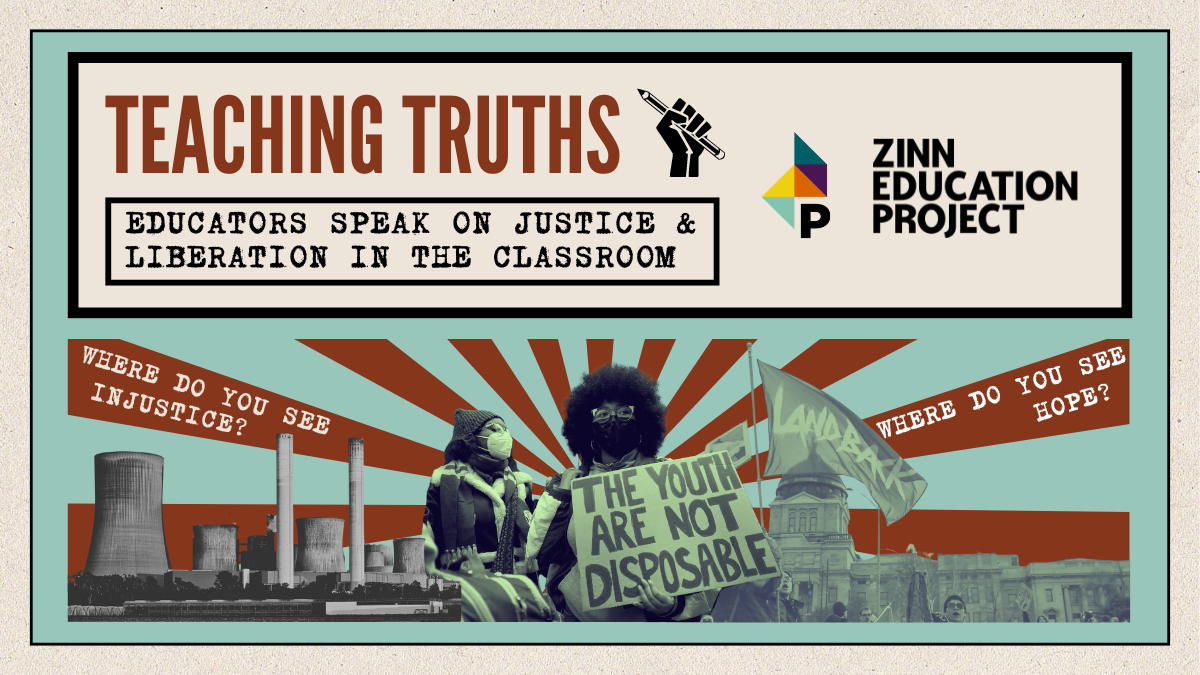
In September, Prism climate justice reporter Ray Levy Uyeda spoke with Finkel and Rachel over the phone about how they teach climate change and climate justice to their middle school students. These discussions are part of a series titled “Teaching Truths: Educators Speak on Justice and Liberation in the Classroom,” where Prism, in partnership with the Zinn Education Project, aims to center teacher experiences as they work to bring critical discussions to the classroom.
This interview has been edited for length and clarity.
Ray Levy Uyeda: What’s it like teaching climate change in your school district and classroom?
Ann Finkel: I’ve been fairly lucky to work at schools where I have a good amount of flexibility to go outside of the given curriculum. I use the curriculum when talking about the science of climate change, like explaining what greenhouse gases, fossil fuels, and renewable energy are. But the curriculum fails when it comes to solutions, which it generally refers to as recycling, taking shorter showers, and turning off lights.
Rachel: In 2021, the Iowa legislature passed House File 802, which says I can’t talk about anything that might make a student feel uncomfortable because of their race, class, or identity. It’s definitely had a chilling effect with other teachers, especially around banning certain books. With climate change lessons, I am extra careful to say, “This source suggests that racism is part of this policy.” I have to attribute it to a source instead of me saying it.
Levy Uyeda: How do you use Zinn Education Project resources in the classroom to discuss climate change?
Finkel: I talk about the corporations that are really responsible for fossil fuel pollution, rather than individuals needing to solve climate change by taking shorter showers. We talk about broad resistance movements and Indigenous resistance movements. For example, I teach one lesson about mountaintop coal removal. Sometimes, students will say that the miners are creating the problem, but we talk about how people working in mines need better treatment too, and how it’s the systems that demand coal extraction that are the problem.
Levy Uyeda: What are student reactions to learning this systemic analysis of climate change ?
Finkel: Students receive it really well. I don’t need to tell them conclusions. They get there on their own. For instance, we do this lesson by Bill Bigelow from the Zinn Education Project called The Thingamabob Game: A Simulation on Capitalism vs. the Climate, where students form their own company to simulate this theory of the tragedy of the commons. The goal of the exercise is to go through rounds of production and make a lot of money. Whoever makes the most money wins.
But at the same time, as we produce more products, we pollute more. And if, as a class, we go over the carbon dioxide threshold, then no one gets any prizes. It illustrates how a profit motive will ultimately lead to destruction. I have the students play two rounds: one with those rules, and then a second round where instead of the winner being the company that makes the most money, the winner is the one who pollutes the least. Sometimes students will say that the company with the most money has to redistribute their money to the three poorest companies.
They come up with really great solutions on their own about incentives and how to change the laws. What I love about this lesson is that students discover quickly that it’s not enough to just beg companies to do the right thing. They learn that you need to change the rules, the incentives, and the system more broadly in order to really cut down on pollution.
Rachel: I do this lesson in my class too, and there’s almost always tears. Eighth-grade boys will be crying because they’re so upset. They’re mad at each other, they feel betrayed if their friends in a different corporation broke a treaty or an agreement. It gets them feeling it on a deeper level. But then I bring it to real-world examples. There’s an amazing book called Rising: Dispatches from the New American Shore by Elizabeth Rush. I have them read an excerpt about how, in Florida, there are neighborhoods that have been impacted by climate change for the last 20 years and nothing has been done to mitigate it. It shows the students that what level of commitment people have to address climate change is based on their positionality.
Levy Uyeda: How do you address negative emotions brought up by discussions of climate change?
Rachel: It’s not uncommon for kids to say, “I hate talking about climate change. It makes me feel really depressed.” They wonder, “What am I supposed to do?”
Finkel: I started bookending the unit and individual lessons with these questions: Where do you see injustice? Where do you see hope? I ask the students to write their answers down. I do think it’s easy to fall into a sense of nihilism. Of course, one of the things the kids bring up is, “Will the world die?” or “Are we all going to die?” And I treat it seriously. I tell them that’s not an option, and that we’re learning about this because we need to make sure that doesn’t happen. We’re learning about people who are fighting against these scary things, and we’re learning that there’s a lot of power when all of us fight climate change together.
Rachel: I’m usually like, “You guys are so smart. You all are going to find a solution.” Sometimes, I’ll go deeper and I’ll read this essay to them where a mom reflects on an instance when she could have helped someone but didn’t, and realizes that everyday things still matter. She writes about how she realizes she can’t give up on everything just because it feels hopeless. So I want my students to know that all is not lost—the things you do still matter, the choices you make still matter.
Levy Uyeda: Especially with your students of color, how do you talk about climate threats they may already be facing? How do you talk about climate justice?
Finkel: One example that comes to mind is our conversations about asthma, which was an extra stresser during the peak of COVID. Kids in East Boston, where I was teaching at the time, have higher levels of asthma than the national average and than nearby white neighborhoods. I had so many parents who told me they didn’t want to send their children back to school after COVID because of the risk that it might aggravate their asthma. And of course, asthma is a concern because they live in extra polluted neighborhoods. I start lessons, for instance, by asking the students to raise their hand if they have asthma or know someone who does. Pretty much everyone raises their hands. We talk about why some neighborhoods might be burdened with more pollution than others. We watch videos of teen activists who are doing work to combat this in their neighborhoods. Then, I’ll have them write letters to our alderman, research what the polluting factors in their neighborhood are, and what could be a solution.
Rachel: I teach in a majority white school district and the environmental challenges that students, their families, and their communities face are different. Eminent domain comes up a lot, especially when it comes to the federal government or other entities wanting to take land for some sort of construction or infrastructure project and destroy a wetland in the process. One thing I want to do is present students with some of the primary sources from the case against Monsanto, a huge farming conglomerate. Monsanto chemicals have been linked to deaths and the chemical Roundup has allegedly given many people cancer. Pretty much everybody here in Iowa knows someone who farms who’s had some sort of intestine, stomach, or colon cancer, which we believe is linked to Roundup.
I want my students to see that how things played out during COVID is very similar to how things play out with climate change. There were some people who were able to insulate themselves from the virus because they worked from home or didn’t live with the elderly generation. These people had very different experiences from those who had to keep going to work, who lived in multi-generational homes, or worked outside of the house. Kids really understand those disparities.
“Teaching truths: Educators speak on justice and liberation in the classroom” will be published through mid-October, and you will be able to find each piece here. Learn more about the Zinn Education Project here.
Author
ray levy uyeda is a staff reporter at Prism, focusing on environmental and climate justice.
Sign up for Prism newsletters.
Stay up to date with curated collection of our top stories.