Tao Leigh Goffe’s new book gives readers the optimism that was ‘missing in the world of climate writing’
The author’s research delves into preexisting blueprints for the battle plan against colonization and climate change from the people who have always been fighting it
It’s well recognized that at this point in the climate fight, the work of lowering emissions, transitioning the U.S. away from a fossil fuel-based economy, and resourcing disinvested communities must include a reckoning of the way the climate movement has been fractionalized in order to weaken it. For instance, movements for climate justice and workers’ rights are largely seen as separate struggles despite ground-up calls for a Just Transition and ample evidence that unions are good for the environment. Conceptual frameworks also remain siloed: Theoretical underpinnings of political philosophy or social movements, arts-based organizing, and Indigenous knowledge of the more-than-human world are not engaged in conversation with one another—even though they all increasingly orient toward the same problem of addressing climate change.
Scholars argue that what’s needed is a multi-scalar approach as vast and multiform as the climate crisis itself—one that values climate organizing as much as degrowth, climate reparations, and activations in the arts.
“I hope that’s what my book can do: emphasize the interdisciplinary nature of what needs to be taking place,” said Tao Leigh Goffe, an associate professor at Hunter College and author of the forthcoming book “Dark Laboratory: On Columbus, the Caribbean, and the Origins of the Climate Crisis.”
Goffe spoke with Prism’s climate justice reporter ray levy uyeda by phone in December about how we all share a common fight, the creation of the author’s Dark Lab, and the texts that shaped her work.
This interview has been edited for length and clarity.
ray levy uyeda: Why did you want to write this book? What gap in existing research and scholarship were you hoping to fill?
Tao Leigh Goffe: It begins through sound. Sound as a way of knowing where we are in the world. Sound as a means of finding our way home—in a diasporic sense. In 2020 I wrote an article called “Unmapping the Caribbean: Toward a Digital Praxis of Archipelagic Sounding” that discussed sound as method; it’s really tied to my practice as a DJ. Writing the book became a way to thread together different songs that I’ve been able to tune into and hear globally. The book’s introduction explores mountain ballads and mountain songs. I feel that there’s a resilience in these ballads that speaks to how we share a common fight. These are the protest songs that we need in order to continue fighting against the climate crisis.
The book was urgent to write because optimism was missing in the world of climate writing. Hope and faith are keywords for me, but that was missing from many of these climate debates, which treated the end of the world as a foregone conclusion. I felt that we needed to rewind these assumptions and consider that there are many people who have survived beyond world-ending events, namely Native peoples across the Americas, as well as Black people in our histories of enslavement. The literature on climate change needed a work to respond to these different timescales of apocalypse, as well as speak to how we can find hope and optimism in the art of survival and what it means to live after the so-called end.
levy uyeda: The book is named after a class, a collective, and an ongoing project of the same name: Dark Laboratory, or Dark Lab for short. Much of the work attempts to imagine and materialize new ways of seeing and new ways of narrativizing history to combat the harm wrought by colonial times, which has warped hegemonic cultures’ sense of self and perspectives on what’s possible. Undercutting colonial time and stretching time into the future is essentially what we’re trying to do by mitigating climate change. How do these themes show up in the Dark Lab? What is the Dark Lab making possible?
Goffe: That question is the essence of what I hope to do: to provide creative time. I founded the lab in 2020. I was inspired by Toni Morrison’s “Playing in the Dark,” which she wrote in 1992. It stands apart from most of her work because it’s a text of literary criticism. There’s a lot of potential when we consider what it means to play in the dark. And that’s a play on dark rooms and photography and early cinema, but it’s also about the kinds of racial reckonings that are ongoing in the United States and across the Western Hemisphere. It’s really an honor to have built this lab, and it’s exciting to work with people from across the globe. I formed the lab to engage in interdisciplinary work at this crossroads of what I describe as stolen land and stolen life. We experiment with different creative forms of storytelling. For me, sound is the primary way in which I tell these stories.
We’ve got an exciting number of collaborators for the new year, and the purpose of funding their practice is to give them some time back because bureaucratic time is the antithesis of art. If the Lab can support these kinds of residencies, then we’re doing something beyond conventional institutions to sustain and nourish different artists who are doing the work of climate activism inherent to their artistic practice. Storytelling through art is such an important part of building into the future; look at COP and the failure to reach these agreements. We can’t even agree on what the crisis is, what the problem is, and that’s even beyond those who are climate deniers. Storytelling really is at the heart of how we get beyond this.
levy uyeda: Many of the book’s sections trace the trade, destruction, and exploitation of different island ecosystems or animal byproducts, like coral and guano. The destruction of these ecosystems—and the exploitation of people’s labor that coincides—is paired with a discussion of Eden. Edenic islands are destroyed by ongoing colonization, or Eden-as-metaphor is used to identify myths chartered by colonizers. Can you talk about your research into guano, coral, and Eden?
Goffe: It really began for me with Ian Fleming and the world of James Bond. In reading the novels, you get the sense that Ian Fleming was a naturalist because he includes random paragraphs about some species of bird or this particular tree. As it turns out, he was a lover of wildlife, and he wrote the James Bond books in Jamaica. He would summer at his estate that he built called GoldenEye. I grew up knowing that that land used to be my family’s land in Jamaica. I was always intrigued by these colonial connections, with Fleming being Scottish coinciding with this occupation of the land.
Jamaica is a kind of Eden for Fleming, and he writes about it in this mythic way, naked women included. So there’s a lot to say about the touristic eye and the pornographic eye within the world of James Bond. In Fleming’s 1958 novel “Dr. No,” he gives us all of this information about guano. [Editor’s note: Guano is bat and bird solid waste. A potent fertilizer, colonial governments legalized the decimation of islands and enslavement of people to mine what was called “white gold.”] The exposition is a throwback to the 19th-century Guano Wars and to tales of guano islands as prisons. I wondered why Ian Fleming was fantasizing about these guano islands and how these ecological systems could be the perfect secret lair for a supervillain like Dr. No.
In terms of my lineage—being Afro-Chinese—I was fascinated to learn that Fleming created these characters called “chigros” that he described as possessing the vices of the Black man and the intelligence of the Chinese. That led me to explore how this kind of racial thinking is also part of naturalist thinking, which gets us to the myth of Eden and these interconnected questions of sexuality, race, whiteness, and innocence.
The questions that arose sent me to Jamaica, where I began research on guano. I ended up in a bat cave, where I experienced this majestic moment of feeling thousands of bats flying past my face at dusk. Connecting guano and U.S. imperialism naturally led me to coral because guano islands are often made through sedimentation on top of coral islands or keys, which are made of limestone. I engaged in a parallel layering process of investigation that reflected back to me that islands are alive because they’re made of biomatter—of extinct animals and plants—but they’re also alive in terms of the frequencies and the vibrations of those who came before.
levy uyeda: You mentioned “Dr. No.” Are there any other texts that shaped your work?
Goffe: It was important for me to look to the Hebrew Bible as a text that has shaped our world in the United States. I wanted to think about the groundwork for assumptions about what weather is a punishment. It occurred to me that the story of Adam and Eve could be interpreted as one where they were the first climate exiles and that they were punished by the climate changing: They lived in a garden of plenty, and they were later sent to these barren lands. But even so, the question of something being barren or not is actually a kind of value judgment because someone might look at the desert and see it as barren, which I guess it is technically based on the English language, with the value that we put on what can be cultivated.
I’ve learned so much from poets like Natalie Diaz (who’s Mojave and Mexican) and the way that she talks about cacti and how we can imagine these kinds of maps underground that show us where the water is in the desert. I think the colonial eye tends to see things in a negative light. To add a value judgment to “good” and “bad” weather or “good” environments is strange because people have been surviving and living and sustaining within these spaces for millennia before they were disturbed by Western colonialism and extraction. I felt like there was a lot that needed to be upended about innocence when it comes to the climate crisis, and analyzing this myth of Eden felt useful to me to understand how it is that we’re structuring these kinds of beliefs and assumptions when it comes to the climate crisis.
levy uyeda: How do you see “Dark Laboratory” and your research more broadly as speaking back to hegemonic archives, museums, and colonial preservation?
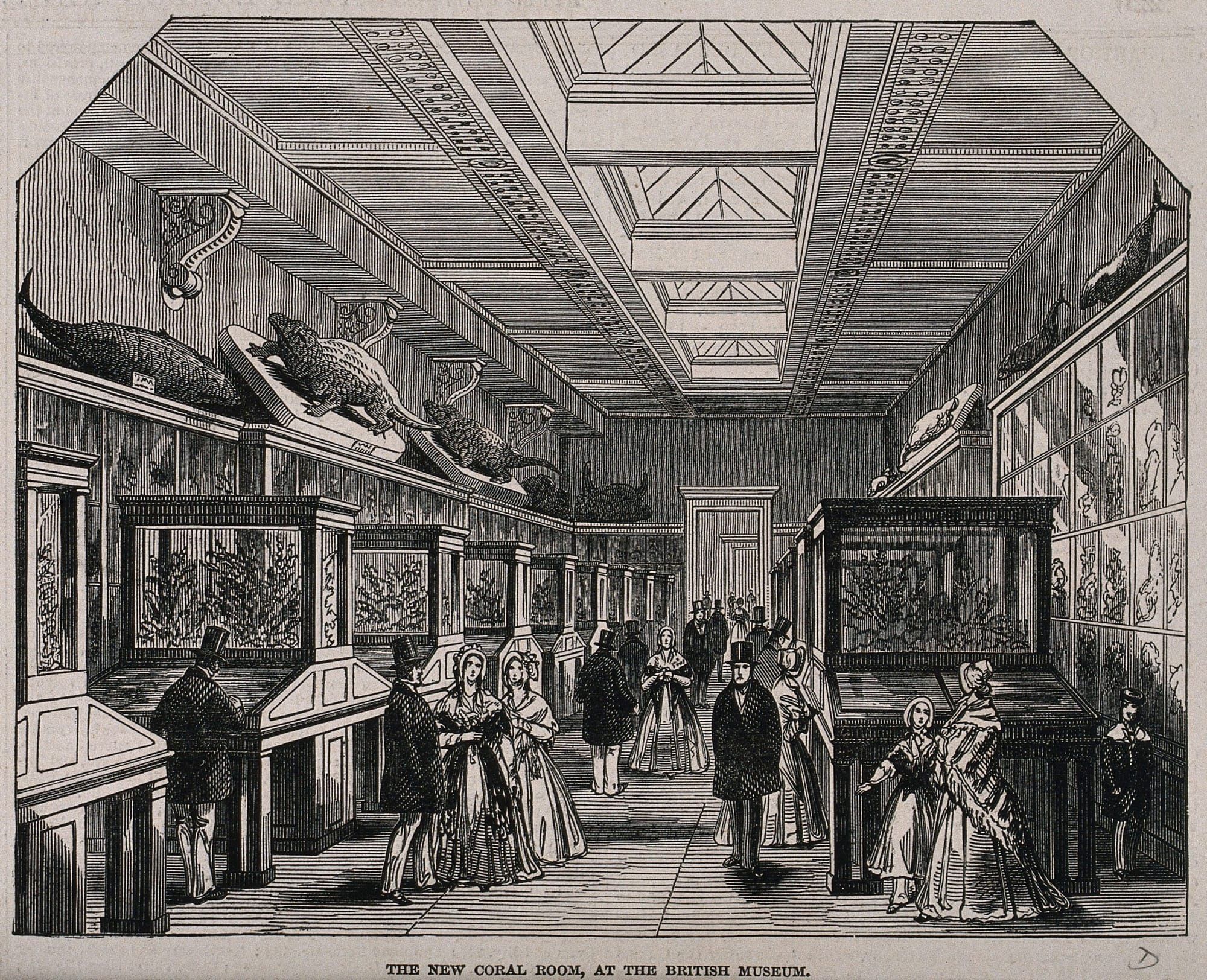
Goffe: I see a lot of potential in holding up a mirror to these institutions. I’m not sure if that falls under the rubric of decolonizing the museum or if that’s even possible, but there’s been a kind of emotion in the work that articulates the way a lot of us feel. In these institutions of higher education, museums, or other spaces of knowledge production, we have to look in the mirror and understand that we were researching not long ago. So much research has been done on us and our ancestors without our consent. I hope that the book provides space to think through the ethics and the contradictions of how we navigate and negotiate future knowledge production because we don’t want to become suspended in the past. We don’t want to become an archive of ourselves or be reduced to a performance of the mythic past.
Amnesia of political movements prevents many people from recognizing that there are cycles taking place, and there are blueprints of struggle.
Tao Leigh Goffe
In many ways, the book is an attempt to grapple with the kind of pressure that is put on people of color to recite intergenerational trauma even while we actively work to fashion a future self that is about a different story, one of sovereignty. It’s a story that we’ve never stopped fighting for. I think we need poets at the policy-making table because they have a kind of necessary political imagination. As I see it, there is a concurrent crisis of political memory in that people feel so hopeless. Amnesia of political movements prevents many people from recognizing that there are cycles taking place, and there are blueprints of struggle.
That’s also what Dark Lab does: conducting archival research that finds those blueprints for the battle plan against colonization because people have always fought. The people have never stopped fighting. The way that history has been told by the colonizer has us believing that this conquest was complete, but that narrative is propaganda. Knowing that gives me hope that maybe we are winning this battle. But we need to activate this political memory to know that we actually haven’t lost yet. We need to keep fighting.
Author
ray levy uyeda is a staff reporter at Prism, focusing on environmental and climate justice.
Sign up for Prism newsletters.
Stay up to date with curated collection of our top stories.