Trump’s Take It Down Act threatens free expression, artists and digital rights advocates warn
The law purports to target “revenge porn,” but experts and activists fear far-reaching censorship
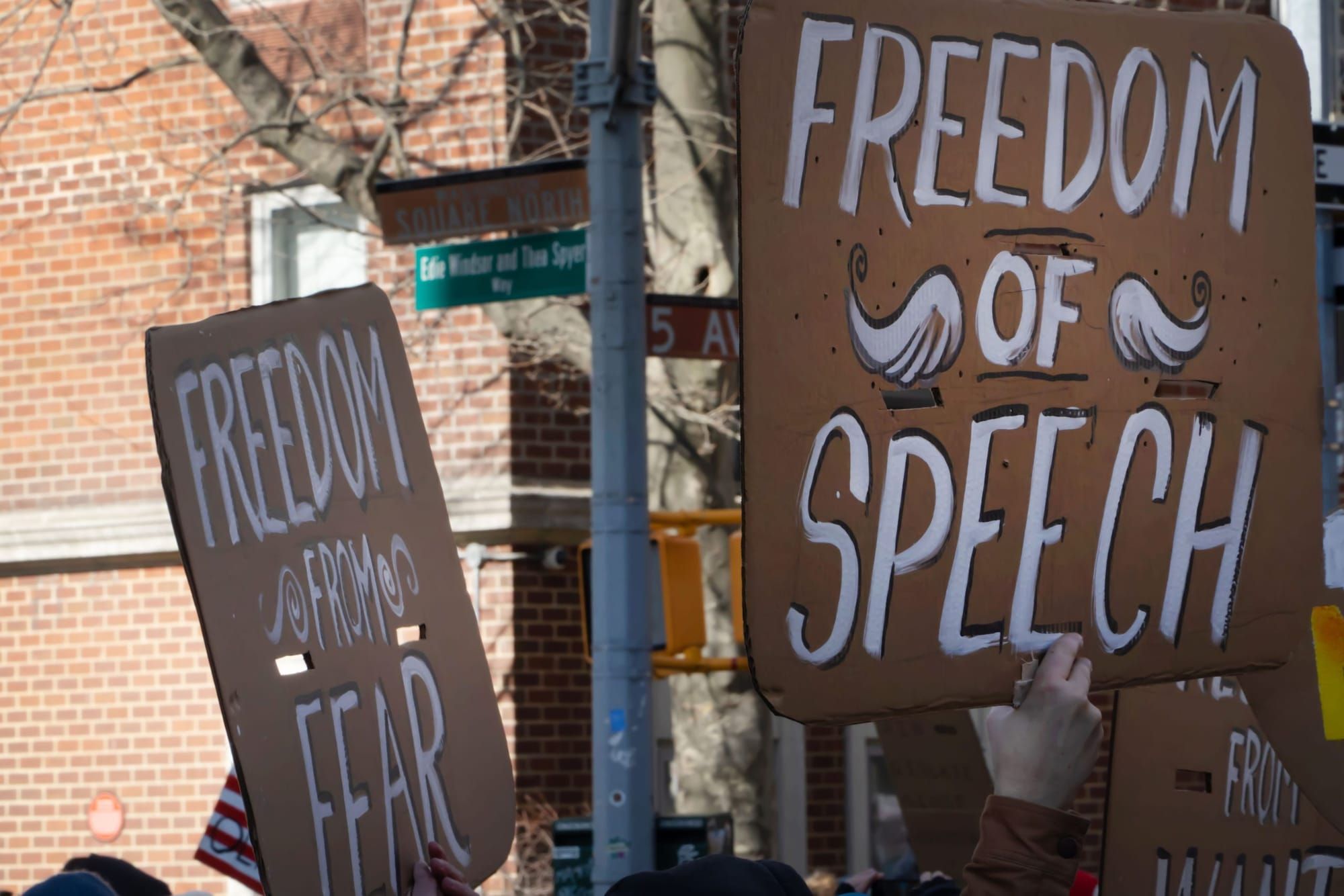
For the artists behind the provocative Finnish collective known as Sampsa, censorship is hardly abstract. Years ago, after they plotted to expose Egyptian President Abdel Fattah el-Sisi’s atrocities, Russia’s security service intervened, wiping Sampsa’s entire interview from RT News’ servers, an erasure so complete it was as if their message had never existed.
But today, it’s not Moscow or Cairo that has them most concerned. It’s Washington, D.C.
The recently signed bipartisan Take It Down Act, billed as a safeguard against nonconsensual intimate imagery (NCII), gives the federal government sweeping new powers to force online platforms to remove any so-called intimate visual depiction within 48 hours of a complaint, or else face liability. With definitions so broad and no robust verification required, Sampsa fears the law is less a shield for victims and more a bludgeon for political suppression.
“The clumsy ambiguity of this [law] puts the first amendment through a meat-grinder,” Sampsa wrote to Prism in an email. “All of a sudden the law looks less about predators lurking on minors with AI porn fakes and a lot more like a tool for the Heritage foundation to run a muck on ideological differences against LGBTQ communities.”
The law, the civil takedown provisions of which go into effect in April 2026, purports to take aim at “revenge porn,” often used against women by current or former partners. But artists like Sampsa, legal experts at the Electronic Frontier Foundation (EFF), and digital rights scholars across the country say the law is a wolf in victim’s clothing. Its definitions are alarmingly vague. Unlike copyright takedowns under the Digital Millennium Copyright Act (DMCA), there is no requirement that a person submitting a takedown certify their claims. No penalties for abuse. No real recourse for artists, journalists, or political critics whose work might be wrongly removed.
“The DMCA has a provision that says a copyright owner can’t abuse the takedown notice, so it actually has to have a real good belief that the material that it’s seeking to take down is, in fact, infringing,” said Aaron Mackey, EFF free speech and transparency litigation director. With the new law, he said, “there’s no check on limiting the possibility of someone to misuse or abuse this takedown procedure.”
Mackey warned that the law’s civil takedown provisions also create liability for platforms if they fail to act. Given the choice between investigating a questionable claim or instantly deleting content to avoid an Federal Trade Commission (FTC) penalty, companies will almost always choose deletion.
“We just know that this system, with those safeguards, and with that process has been massively abused to take down lawful speech, because people recognize that it’s a legal means of censoring speech online,” said Mackey. “When you have experts who have been working hand in hand advocating for victims saying that this law is not going to help them, that’s a real problem,” he said.
President Donald Trump himself hinted at how he might use the law. “The Senate just passed the Take It Down Act,” he told a joint session of Congress in March. “I’m going to use that bill for myself too if you don’t mind, because nobody gets treated worse than I do online, nobody.”
Potential targets for bad-faith actors
Sampsa’s work has always been intentionally provocative. From the streets of Helsinki, their collective gained global attention with large-scale murals critiquing corporate greed and nationalist violence. They’ve painted #sisiwarcrimes in sweeping letters across walls, rallying diasporic communities to speak up against authoritarian abuses.
Their latest work, “Fists for Freedom,” pushes even further. The triptych depicts Trump, Russian President Vladimir Putin, and Israeli Prime Minister Benjamin Netanyahu pleasuring themselves in an ouroboros-like loop of power and victimhood, each leader simultaneously the sadist and the masochist. The imagery draws on psychologist Erich Fromm’s post-World War II studies of Germany, exploring how societies swing from humiliation to cruelty.
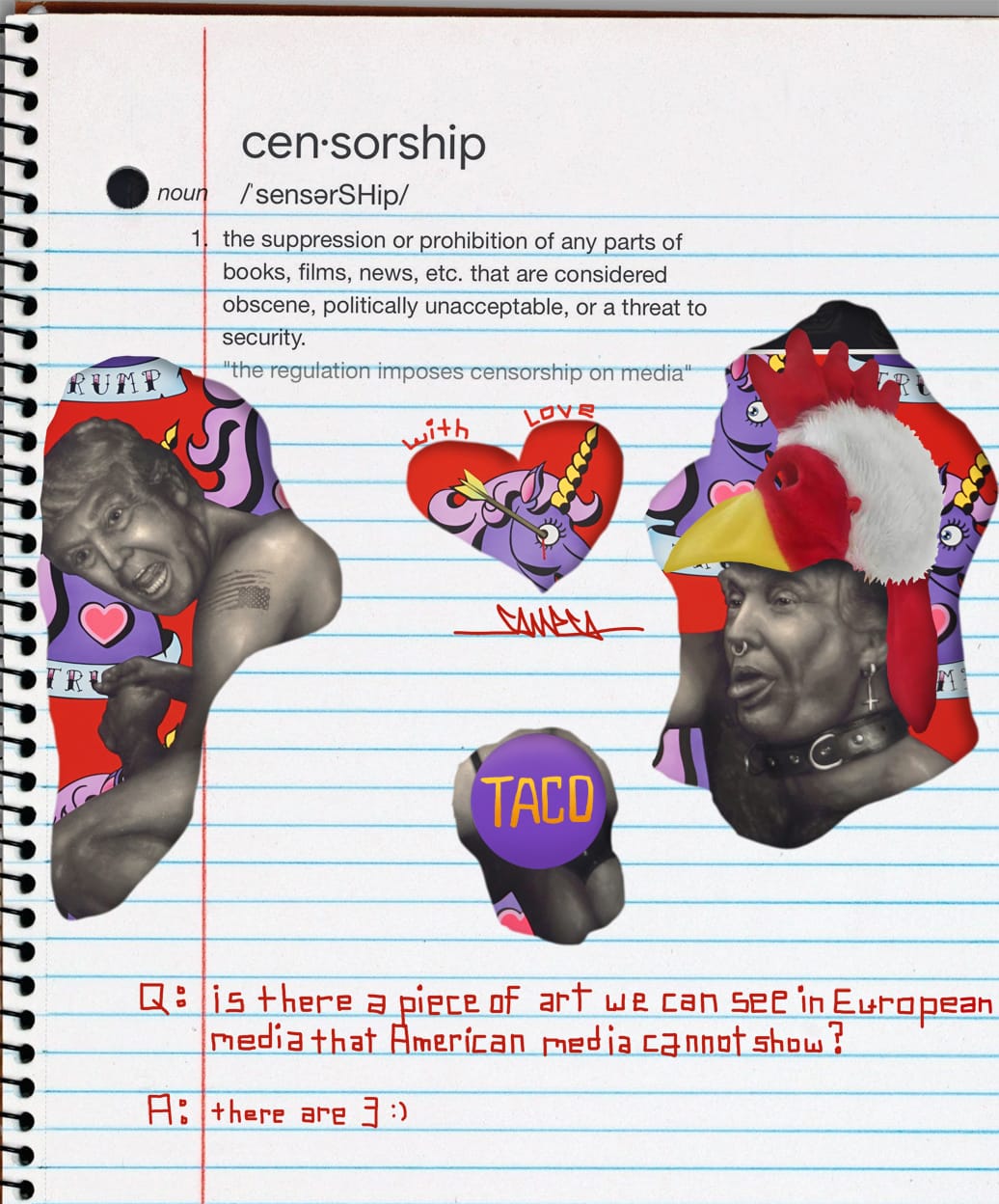
“World leaders are at risk of developing exaggerated pride, contempt for others, and a diminished sense of reality,” said Sampsa. “We need to acknowledge that mere access to certain levels of power can cause personality changes and cognitive biases leading to predictable errors in judgement.”
Fromm argued that when people feel powerless and adrift in modern capitalist systems, they cling to strongmen, even when it means trading freedom for authoritarian comfort. Sampsa’s crew, working with contemporary sociologists like Lynn Chancer, draws a direct line from 1930s Germany to today’s MAGA rallies.
Yet, under the Take It Down Act, Sampsa’s satirical, sexually charged art could be the perfect target for bad-faith takedown requests, especially given the bill’s nebulous definition of “intimate visual depiction.”
“That risks all manner of speech online, including imagery that doesn’t include nudity,” said Becca Branum, deputy director of the Center for Democracy and Technology’s Free Expression Project. “Let’s say that I find some dissident art or just nude imagery that I just don’t want to see online, even if it’s permitted on the platform. I could just submit a complaint and say, yep, this is me, or this is somebody else, and they didn’t consent to it. There’s no mechanism in the bill to make the platform confirm that what is submitted is actually nonconsensual imagery. It doesn’t even need to be nude imagery at all.”
Sampsa told Prism that it’s concerned about such bad-faith use of the law that threatens free speech and due process without addressing the problems the law claims to solve.
“Shortly, we will see social media and legacy media reign in anything that offends the white christian nationalist movement propping Trump up,” Sampsa said.
The fear isn’t hypothetical. In the U.S., book bans are surging. Right-wing groups such as Moms for Liberty, linked to Proud Boys chapters, are pushing to remove works by Black and LGBTQIA+ authors from school libraries.
EFF maintains a “Takedown Hall of Shame” documenting absurd abuses, including copyright claims on static television snow. Under the Take It Down Act, with even fewer safeguards, experts fear the floodgates will open. There’s also a new risk that enforcement itself will be politicized. The FTC, which oversees the law, is now stacked with Trump allies after two Democratic commissioners were ousted. That means selective enforcement could shield friendly platforms and punish critical ones.
“Or they could also refuse to bring an enforcement action against a platform that just happens to have a cozy relationship with this administration, and that would be particularly harmful because it would actually undermine the entire purpose of the Take It Down Act,” Branum said. “The nonconsensual distribution of intimate imagery is a really awful and harmful thing that really suppresses the speech of the people who are depicted and is often intended to humiliate them, and if all it takes is just cozying up to the administration to avoid an enforcement action that harms everyone, including the people, the very people that the authors of the bill intended to protect.”
Impact on marginalized communities
Meanwhile, artists, sex workers, and marginalized communities—the very groups who most rely on the internet to build safe spaces and livelihoods—could see their work vanish with no real avenue for appeal.
In 2018, a pair of laws known as FOSTA-SESTA passed under the banner of fighting sex trafficking. Almost immediately after both the Allow States and Victims to Fight Online Sex Trafficking Act and the Stop Enabling Sex Traffickers Act became law, platforms from Craigslist to Reddit to even specialized harm reduction forums purged countless communities where sex workers had safely shared client screening tips, health resources, and peer support.
Mackey, of EFF, said the Take It Down Act essentially allows censorship of anything sexual, which could disproportionately affect artists, LGBTQIA+ people, and any other communities openly discussing sexuality or gender identity.
When the laws seek to regulate an entire sphere of the internet in the name of, say, protecting victims, it often has these either intended or unintended consequences.
Aaron Mackey, Electronic Frontier Foundation
“The same communities who are disempowered politically or socially, they often use the internet as a means to find community, to find support,” Mackey said. “When the laws seek to regulate an entire sphere of the internet in the name of, say, protecting victims, it often has these either intended or unintended consequences.”
Under the new law, these risks multiply. Unlike the DMCA, the Take It Down Act has no requirement that a complainant attest to the truth of their claim, no explicit fair-use carveouts, and no penalties for fraudulent takedown requests. It also skips the “counter-notification” system that lets a creator argue for reinstatement.
“It has been a long standing goal of the Heritage Foundation’s Project 2025 to police the internet. Take It Down now gives these right wing and white christian groups free reign for over-reach,” Sampa said.
In the past, these types of legal regimes have also disproportionately hit communities already under surveillance. FOSTA-SESTA led to police ramping up stings and raids under the justification of “cleaning up trafficking,” often arresting consensual adult workers, migrants, and trans people at far higher rates. Meanwhile, the platforms that might have provided evidence of entrapment or misconduct had already preemptively purged all records out of liability fear.
Preparing in advance
For Sampsa, the stakes are deeply personal. They’ve spent years dodging regimes that would happily jail or kill them. They travel without SIM cards, avoid social media, and rely on satellite phones. But in the U.S., they believed the Constitution would at least protect the content of their work.
While they haven’t actually yet been threatened with a takedown order, and have several months until the takedown provisions kick in, the art collective is exploring collaborations with groups such as EFF and potentially the American Civil Liberties Union to prepare for legal battles.
Branum’s advice to artists and creators is sobering: Keep working, keep posting, but be prepared.
“[What] I would hope to see is actually something similar to the Take It Down Act, but that’s implemented a lot better,” Branum said. “The takedown of nonconsensual intimate imagery is really important for those people’s own expressive rights and their human rights, and so platforms need to be responsive to requests to take down nonconsensual intimate imagery. … It’s really important instead that platforms invest in those content moderation strategies that are precise and responsive, so that victims themselves are protected.”
She also urged communities to watch the FTC closely. “Participating in those comment opportunities and making the public aware when either platforms are not upholding their obligations to human rights or the FTC itself is in violation of its constitutional obligations will be really important moving forward.”
Meanwhile, Sampsa said they continue to create, paint, and prepare. They see their work not just as canvases, but as live experiments in political psychology.
“At first glance the artwork might just seem like a simple knee-jerk juvenile reaction. If you have played the game long enough, this is the gift that the political street art game teaches you,” said Sampsa. “Art beyond an aesthetic, transitioned into public discourse engagement and measurable action.”
The collective is also painfully aware of the bigger picture. Democracy itself is backsliding worldwide. According to the latest Democracy Index, more than a third of humanity now lives under outright authoritarian regimes. Even in the U.S., immigration sweeps and new loyalty tests for federal hires show creeping illiberalism.
In Sampsa’s minds, the true tragedy isn’t that authoritarian tactics evolve, it’s that so often, the rest of society remains passive. If there’s hope, they believe, it lies in artists willing to test the boundaries and the everyday people who refuse to look away.
“An Artist’s duty is to reflect the times,” they said, quoting Nina Simone. “I think that is true of painters, sculptors, poets, musicians. At this crucial time in our lives, when everything is so desperate, when every day is a matter of survival, I don’t think you can help but be involved.”
Editorial Team:
Sahar Fatima, Lead Editor
Carolyn Copeland, Top Editor
Rashmee Kumar, Copy Editor
Author

Alexandra is a Cuban-American writer based in Miami, with an interest in immigration, the economy, gender justice, and the environment. Her work has appeared in CNN, Vice, and Catapult Magazine, among
Sign up for Prism newsletters.
Stay up to date with curated collection of our top stories.