Filed Under:
Supreme Court Voting Rights Act ruling is a direct attack on Black political power, advocacy groups say
Last week’s decision in a Louisiana redistricting case found that the law’s electoral protections for racial minorities cannot prevent the state from partisan gerrymandering

Biplob Kumar Das
Real journalists wrote and edited this (not AI). Independent, community-driven journalism survives because you back it. Donate to sustain Prism’s mission and the humans behind it.
Real journalists wrote and edited this (not AI)—independent, community-driven journalism survives because you back it. Donate to sustain Prism’s mission and the humans behind it.
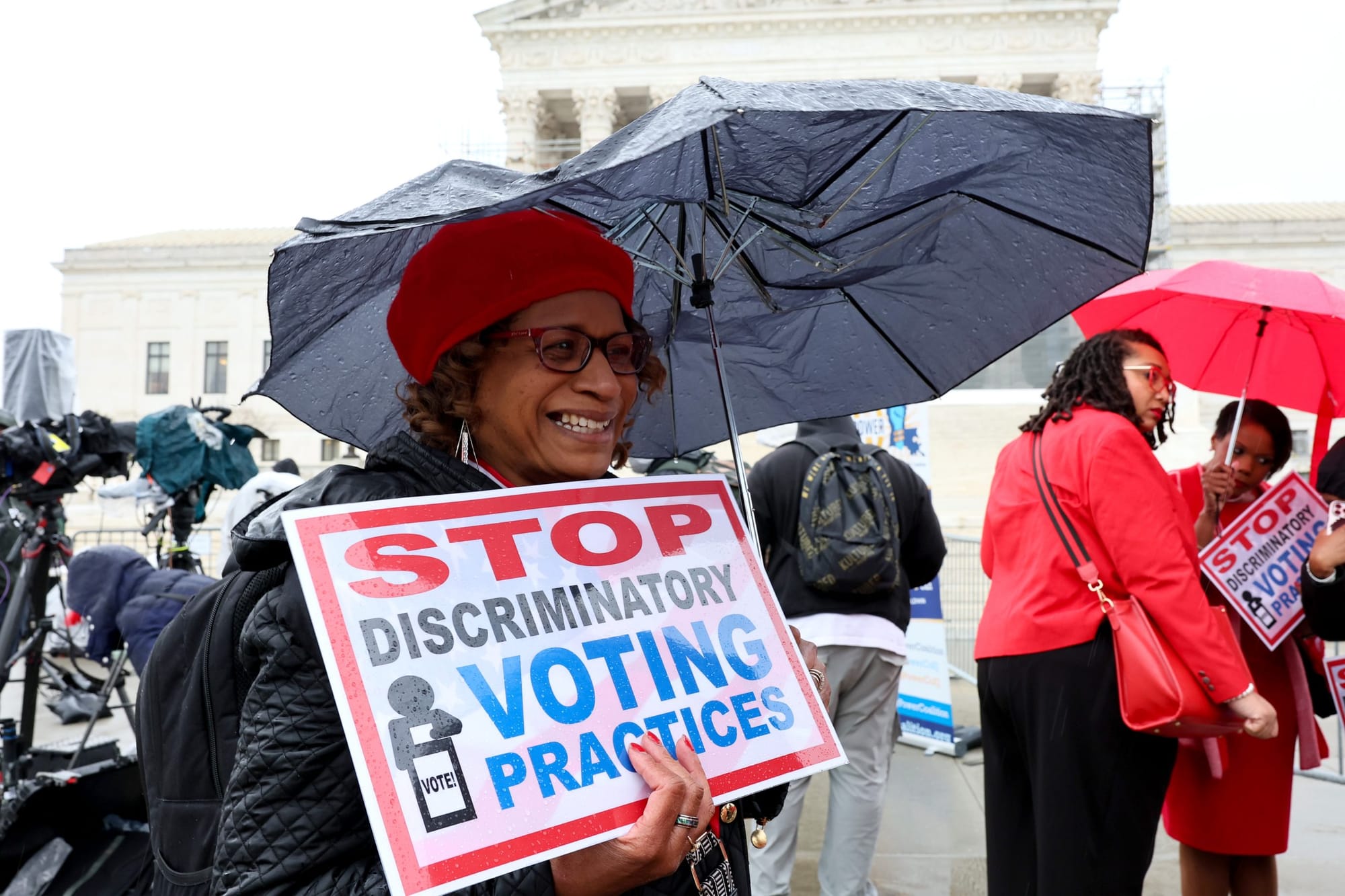
The U.S. Supreme Court’s ruling to allow partisan redistricting of Louisiana’s electoral maps would completely dismantle the Voting Rights Act and disenfranchise millions of Black and brown voters, voting rights groups said, as confusion prevailed over whether the court’s decision would impact primaries in the state set to be held on May 16.
In a sweeping judgment on April 29, the court concluded in Louisiana v. Callais that the state’s current electoral map was unconstitutional and constituted racial gerrymandering, and that Section 2 of the Voting Rights Act cannot prevent the state from partisan gerrymandering. Section 2 restricts creation of electoral maps based on racial grounds among other voting protections for racial minorities.
Advocacy groups argued that the ruling is not rooted in historical context and is an attack on electoral rights enshrined for racial minorities in the Voting Rights Act, which was implemented in 1965 during the peak of the civil rights movement.
“The court was blind to the fact that there is a higher correlation between race and party in the Deep South. It is ahistorical and completely ignores the context in which the Voting Rights Act was brought,” said Bradley Heard, deputy legal director at the Southern Poverty Law Center (SPLC).
The ruling passed 6-3 in the conservative-majority court, with all three of its liberal judges voting against it.
“[The Voting Rights Act] was born of the literal blood of Union soldiers and civil rights marchers,” wrote Justice Elena Kagan in a dissenting note. “It ushered in awe-inspiring change, bringing this Nation closer to fulfilling the ideals of democracy and racial equality.”
In the aftermath of the decision, and a day before early voting was set to begin, Louisiana Gov. Jeff Landry announced on Friday that he would suspend the state’s primaries until a special session is held to redraw the state’s current electoral map.
“They are doing absolutely everything they can to influence the midterm elections,” said Dominik Whitehead, chief of Field, Membership Growth, and Unit Sustainability at the NAACP. “This is a calculated attempt to disenfranchise black and brown voters, and it confirms what we feared would happen after the Supreme Court ruling.”
The NAACP filed an emergency motion against Landry’s decision to suspend the primaries. Several other organizations sued the governor as reports suggest chaos and confusion ensued around the primaries after his decision.
Meanwhile, governors of Alabama, Tennessee, and Mississippi have also called for special sessions to redraw their congressional districts following the Supreme Court ruling. Florida’s state legislature already passed laws to redraw its map. Georgia Gov. Brian Kemp said he would not pursue redistricting in the current election cycle.
“This is a response to Prop 50 in California, and the Supreme Court decision facilitated it,” Whitehead said, referencing the redistricting law introduced last year in California that boosted Democratic seats and was voted in through a popular ballot measure vote. “We are doing everything we can to tell colored people to go out and vote in the primaries in record numbers.”
The Republican Party has a thin majority of 218 to the Democratic Party’s 215 in the House of Representatives, and redrawing even a handful of seats could boost its majority.
“In the Deep South, a white-majority seat is almost ostensibly a Republican seat,” said Heard of the SPLC.
Heard said the ruling comes on the heels of a longer history of an attempt to dismantle the Voting Rights Act and the protections enshrined in it.
In 2013, the Supreme Court struck down the Section 5 of the Voting Rights Act, which required state legislations to run electoral changes by the federal government and judiciary to ascertain protections for minorities.
“At the time, the Supreme Court struck down Section 5, saying that you had Section 2 to protect Black and brown voters. Well now you see what happened to Section 2 without Section 5,” Heard said.
Another element of the Supreme Court’s recent ruling stated that since the introduction of the Voting Rights Act, the Southern states had undergone social progress and that advanced technology allowed the state to redraw electoral maps with accuracy.
But advocacy groups argue that this will instead promote racial discrimination.
“This ruling allows racial discrimination if it also serves overtly hyper-partisan interests,” Michael Waldman, chief executive of the Brennan Center for Justice, said in a statement. “Congress has a duty to respond. It must ban gerrymandering in congressional races, immediately. It should restore and strengthen protections against racial discrimination in voting.”
Heard also believes that the future of Black and brown voters securing fair political representation hinges on Congress introducing and revising the Voting Rights Act to make it more robustly protective of racial minorities.
“I am hopeful that current gerrymandering attempted by the Deep South states will be eventually declared unconstitutional,” he said.
Meanwhile, apart from launching legal challenges to attempted gerrymandering by the Southern states, the NAACP is also moving to mobilize its members and Black and brown communities at large in the South.
“We are hosting community town halls, awareness sessions, and telling our communities on the ground that it is time to raise their voice against discriminatory gerrymandering,” said Whitehead. He also believes that while these measures can prevent discriminatory redistricting in the short-term, it would require Congress’ intervention to ultimately protect Black and brown voters.
In her dissent, Kagan argued that the court does not have the right to weaken the Voting Rights Act.
“It has been repeatedly, and overwhelmingly, reauthorized by the people’s representatives in Congress. Only they have the right to say it is no longer needed—not the Members of this Court. I dissent, then, from this latest chapter in the majority’s now-completed demolition of the Voting Rights Act,” she wrote.
Editorial Team:
Sahar Fatima, Lead Editor
Lara Witt, Top Editor
Stephanie Harris, Copy Editor