Their universities subjected their pro-Palestine encampments to violence. Now, these students distrust the academy
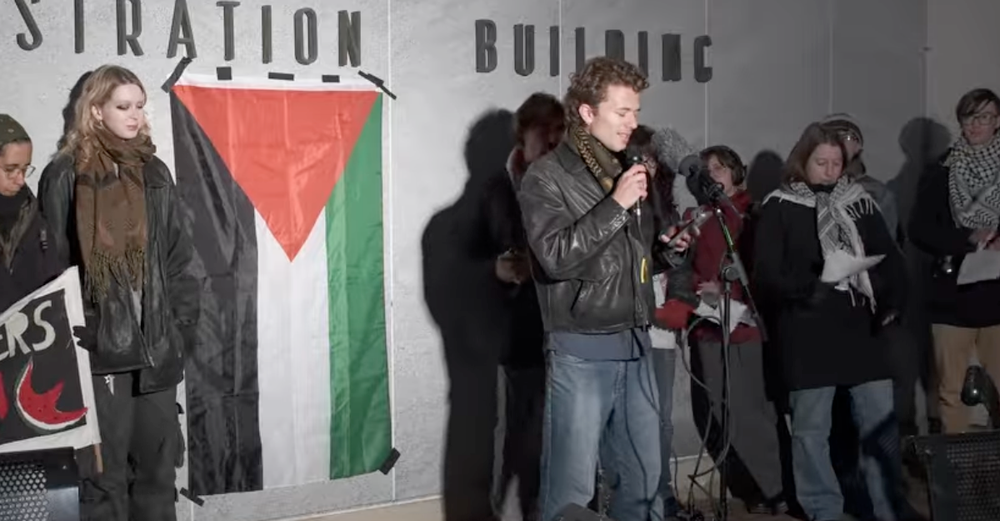
As the Israeli military continues its siege on Gaza, college students nationwide continue to protest in solidarity with the Palestinian people and to demand their universities divest from Israel.
From hunger strikes and rallies to solidarity encampments, college students have joined together for eight months to raise their voices against U.S. support of Israel’s genocide of Palestinians.
But these efforts have been met with extreme resistance.
Students at UCLA’s pro-Palestine encampments, for example, endured violent counter-protests from Zionists, who were effectively allowed by police to physically assault pro-Palestine students and set fire to their encampment using fireworks. In the weeks prior, university leadership made their stance clear, publicly opposing calls to divest from Israel.
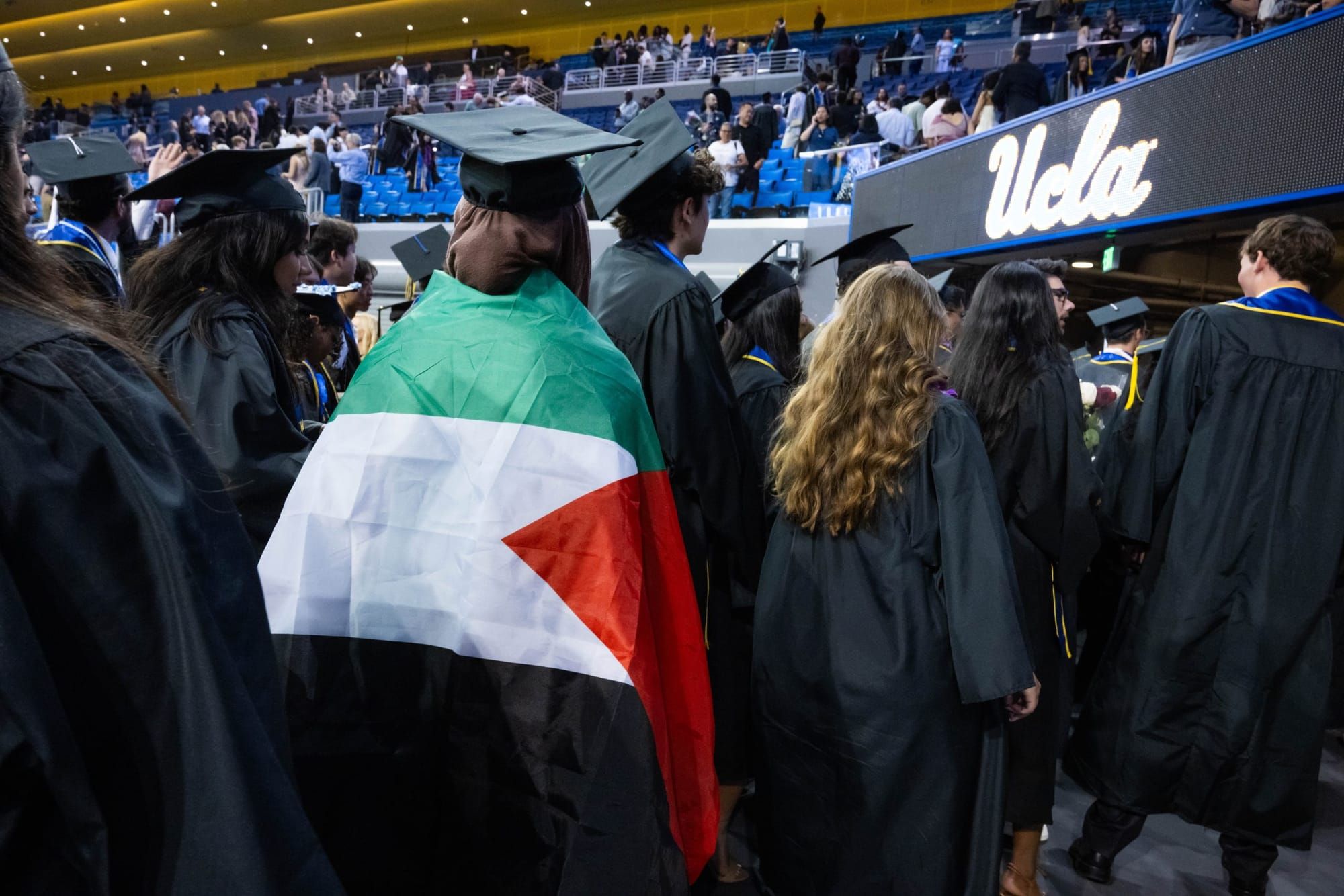
As graduation neared, many students were suspended or blocked from receiving their diplomas due to their involvement in the encampments. Pro-Palestine students who could participate continued their efforts, wearing keffiyehs to ceremonies, turning their backs on the administration, staging walkouts, or crossing graduation stages while waving the Palestinian flag.
These acts of resistance were also met with censorship by university administrations. At Columbia’s Teachers College, students who walked across the stage with any form of Palestinian paraphernalia were blocked from view on the live stream by a placeholder graphic.
As universities have taken drastic and, at times, violent measures to quell pro-Palestine protests, students who spoke to Prism said they are now grappling with larger questions about academia, namely, whether higher education is worth the investment and if their school administrations can be trusted.
“Insidiously violent”
Students often choose their universities for the opportunity to further their career aspirations, but some are looking to utilize their education to facilitate change—a motive that some schools promote to incoming students.
Pro-Palestinian students who spoke to Prism said they simply used the education their universities provided them to promote the change they want to see in the world. But rather than receiving support from school administration and faculty, in many cases they were met with severe crackdowns.
“We are taught and we are empowered as students that we have a lot of ability to pioneer change, and that’s what this education is supposed to teach us,” an anonymous student from the University of California, Riverside, said. “But see that contradiction when you try to pioneer this change, and you’re met with violence, and you’re met with cops beating you down.”
Some students say universities’ responses to peaceful pro-Palestine encampments have made them unsure whether they see a future for themselves in higher education. Others now doubt the careers they set out to pursue when first becoming university students.
“I really wanted to get my Ph.D., maybe in history or focus it on gender studies and look at Black women’s studies,” a student from NYU shared. “But now, I’m not really sure that academia is a space for me.”
University leadership in New York opted to place students in harm’s way, allowing police in riot gear to brutalize those in pro-Palestine encampments. The same NYU student, who chose to remain anonymous for fear of retaliation, describes their experience at the university encampment as a time of intense surveillance.
“It didn’t matter what time of day I went. They always wanted to look at IDs, there were always people around, and every single time I was there, there were a lot of agitators just walking past, threatening, throwing things, putting up signs,” they said.
The student also attended the solidarity encampment at Columbia University and said that the energy there felt “insidiously violent.”
“The police were constantly around us, and there was always that threat of them pepper-spraying or hitting us with batons,” they said. “They always had their hands at their waist either on their guns or on their batons.”
Students were met with untethered violence during an April 30 police raid on the Columbia University encampment. Police officers threw students on the ground, beat them with batons, and arrested them.
Students at CUNY faced a similar fate. Elias Guerra, a freelance journalist and alum of CUNY’s Craig Newmark Graduate School of Journalism, was arrested at the CUNY encampment that started on April 25. Like other encampments, CUNY students performed teach-ins, watched films, and participated in cultural dances, among other peaceful activities. However, five days after the encampment began, City College President Vincent Boudreau called the police to disband it. Officers attacked students, and 34 were arrested.
Following his arrest, Guerra reached out to the graduate school for assistance. He hoped the school administration would provide guidance on press protection because he was at the encampment as a journalist.
In a statement to Prism, Graciela Mochkofsky, dean of the Craig Newmark Graduate School of Journalism, said the school kept in contact with Guerra and others who were reporting at the encampment and requested assistance. But Guerra said that he received no such support after his arrest.
Mochkofsky stated that the school was not aware of any violations of press freedoms experienced by students, and she alleged that “other members of the community who are not current students were there as protesters” and that they were offered safety advice and “rejected it.” Guerra maintained that he was there as a reporter. Furthermore, reporting about the police raid produced by Guerra was shared by numerous publications, contradicting Mochkofsy’s claim that he was protesting.
“The administration wants to write us off as protesters so our criticism [of their response] seems less credible,” Guerra said. “It’s a form of censorship.”
At the University of California, Santa Cruz, where a Palestine solidarity encampment was raided in May, others also shared sentiments rooted in frustration toward school officials and, more broadly, higher education.
“I definitely am still going to pursue education because it’s something that my mother and my father very much want for me,” said one engineering student who wants to remain anonymous for fear of retaliation. But now that the genocide has brought apartheid tech and liberal techno-solutionism into clearer focus, the student now has concerns about entering the industry.
“I want to be in the field. But it’s always about military and not commercial,” they said. “[So it’s been] frustrating trying to find a job that aligns with my values because I just want to help humanity move forward in technology, not for military.”
As of June 17, more than 3,100 people who participated in encampments have been arrested or detained on campuses nationwide. But this hasn’t stopped some students from continuing their demand for divestment.
Columbia’s students, who were brutalized by police just months ago, have come back with a new encampment. While these students may now question their place in higher education, their commitment to a free Palestine remains firmer than ever.
Author
Hafeezat Bishi is a freelance journalist, social media professional, journalism graduate student, and content creator. Her work centers around the discussion and advocacy of underserved communities. Y
Sign up for Prism newsletters.
Stay up to date with curated collection of our top stories.