The U.S. food system needs more than ‘doomsday vaults’ for seeds
Seed keepers are maintaining foodways and building cultural reverence through community networks
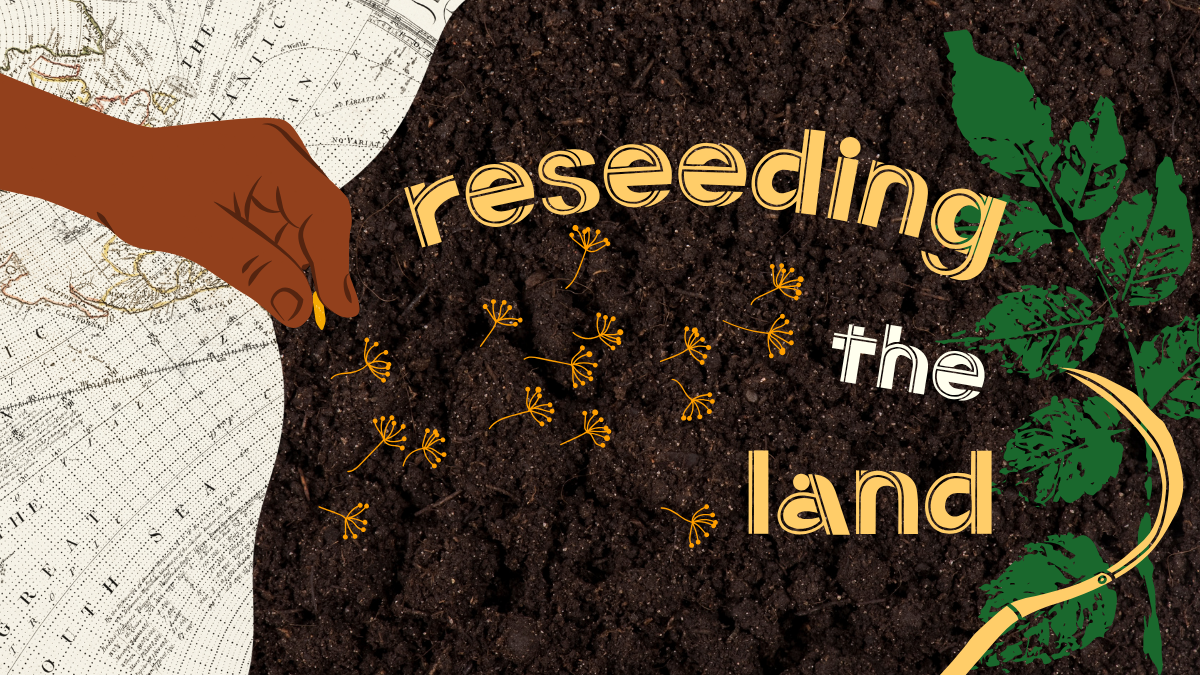
This is the first article in a three-part series called “Reseeding the Land.” This series explores land revitalization, cultural stewardship, and food access in a time of significant decline of ecological health and climate upheaval across the U.S. Read Part 2 and Part 3 here.
On 1.5 acres of land in the Lehigh Valley of eastern Pennsylvania, farmer and seed keeper Amirah Mitchell grows Sea Island red okra, Ethiopian green mustard, Sierra Leone ribbed tomato, Liberian kittley eggplant, and more. Instead of picking the produce, she allows the crops to mature and go to seed. The seeds are carefully harvested, packaged, and then shipped to her customers all over the country.
Mitchell is the owner of Sistah Seeds, a farm and seed company that focuses on heirloom seeds that are culturally important to African American, Afro-Caribbean, and West African food cultures.
As seeds are increasingly consolidated within large institutions—whether for use in commercial agriculture or seed banks—Mitchell belongs to a growing movement of seed keepers who argue that seedkeeping should be decentralized.
Few seed keepers and seed companies serve BIPOC farmers, who themselves represent fewer than 5% of all farmers in the United States. Seed companies tend to prioritize the sale of commodity crop seeds to the industrial farms, leaving out small growers who focus on culturally relevant seeds. Seed banks also tend to prioritize support for breeders and researchers rather than individuals.
Our seeds are stronger when they’re in as many hands as possible.
Amirah Mitchell, owner of Sistah Seeds
Still, Mitchell is committed to teaching people how to safely save, sow, and distribute their own seeds. “Our seeds are stronger when they’re in as many hands as possible,” Mitchell said.
Pushing back against Big Seed
Mitchell’s work counteracts the consolidation of seeds in the U.S., where practices such as monoculture and plant patenting divorce seeds from their ecoregions and culturally relevant stewards. Centralized seed banks such as the U.S. Department of Agriculture’s (USDA) National Laboratory for Genetic Resources Preservation in Fort Collins, Colorado, and the Norwegian Svalbard Global Seed Vault operate as if keeping seeds under lock and key is the best way to safeguard them. Approved depositors, which include gene banks, community stewards, and environmental organizations around the world, can theoretically withdraw seeds in the case of crop destruction due to climate change, war, or other conflicts. These storage facilities house hundreds of thousands of genetic crop varieties under carefully monitored conditions.
The U.S. National Plant Germplasm System (USNPGS) has sent an estimated tens of thousands of seeds for seedkeeping to Svalbard, the largest seed vault in the world. The 2024 World Food Prize-awarded “doomsday vault” is designed for long-term security, but Svalbard has faced challenges related to permafrost thaw and climate change, prompting ongoing improvements to its infrastructure. Additionally, some observers have raised concerns about rising political tension over Arctic resources. Whether climate- or human-induced, potential infrastructural damage disrupts the stable holding environment, risking the viability of the seeds. Svalbard did not respond to requests for comment.
Climate change isn’t the only concern seed vaults now face. In the U.S., the 22 sites operated under the umbrella of the USNPGS face political threat as well. In March, the Trump administration’s Department of Government Efficiency, which was briefly headed by Elon Musk, attempted to eliminate some of USDA’s probationary employees, including many research scientists. Though a court order restored some job positions, the political climate leaves the future of the USNPGS—and public food security—hanging in the balance.
It’s against this environmental and political backdrop that small farm operators and seed keepers fight for seed sovereignty. For seed keepers of color in particular, the practice of tending, saving, and distributing seed offers a tangible avenue of identity affirmation and resistance against austerity measures and the legal and economic domination of Big Seed.
Randy Woodley, a scholar, seed farmer, and Cherokee activist, has observed the rapid commercialization and consolidation of seeds in his lifetime. In 1999, he and his wife Edith Woodley, who is Eastern Shoshone, founded the nonprofit Eloheh Indigenous Center for Earth Justice, an organization that aims to model and disseminate regenerative agriculture principles and land relations rooted in Indigenous knowledge. The organization also operates Eloheh Farm and Seeds, which utilizes Indigenous practices like wild-tending to sustain seeds, promote animal husbandry, and encourage native ecosystem regeneration.
Starting in the 1940s, the federal government distributed seeds for individual households to plant under the Victory Gardens Program. “Then corporations got the idea that they could get the government to stop giving away seeds, and they could sell a lot of seeds [instead],” Woodley said. Decades later, Diamond v. Chakrabarty, a 1980 Supreme Court case, allowed the first genetically modified organism to be patented, paving the way for companies to treat seeds like intellectual property.
The companies Bayer and Corteva own nearly 80% of patents related to GMO crops, which make up over half of U.S.-harvested cropland. Some of these GMO crops are designed specifically to work best with each company’s patented line of pesticides to have high yield, or to bear the impacts of pests or unstable weather conditions. Farmers are legally prevented from saving this seed, which hinders generational adaptation to local soil conditions.
Seed resilience through seed diversity
Within 80 years, the United States lost 93% of food seed diversity.
Today’s seed keepers want to preserve variety in plant genetics, or what many have described as seed or crop diversity. Seed diversity is critical to maintaining balance in different ecosystems like wetlands and forests, which naturally sequester carbon; nourish a variety of animal and plant species; and reduce soil erosion. Seed diversity also increases climate resilience by improving genetic diversity in these ecosystems, allowing individual plant species to better adapt to the effects of a changing climate, such as warming temperatures or increased rainfall.
One of the most prominent criticisms of vault-style seed storage, such as Svalbard, is the lack of active seed planting within the model, which impairs seed diversity. Some varieties of potatoes, cassava, and other tubers must be clonally propagated and grown out to a fully harvestable crop in order to stay viable. In clonal propagation, a portion of the tuber is cut off and replanted. Failing to grow out culturally important seeds like yams and cassava—which are the leading starches in many African diets—may result in inadvertent structural exclusion.
Even if seeds can endure decades in storage, there’s still a risk that they are not able to co-evolve with changes to ecoregions brought about by industrial development and climate change, among other threats. Seeds are living organisms and incorporate information from their surroundings in order to develop genetic traits that are resistant to changing temperature, rainfall, soil quality, and the presence of different pests, which means that if they’re not allowed to evolve, they may not be viable in case of emergency.
Mitchell of Sistah Seeds criticized a practice of stockpiling seed that she calls “seed hoarding,” which she said contributes to the problem of seeds being frozen in time.
“Corn, bean, and squash keep forever under the right conditions,” Woodley said. Still, “those seeds are not changing with the land, which is what they’re made to do. They’re not being regrown so that we can produce more.”
Woodley has observed how a short-term view for environmental restoration and seed preservation, along with Western scientific approaches, can shape institutional priorities. Instead of assessing, managing, and improving the entire ecosystem, which takes much longer, current approaches focus on isolating individual crops or unwanted pests and weeds.
The Woodleys sought aid for native land restoration where Eloheh is based in Yamhill, Oregon. At a community event, they met a conservationist from Yamhill Soil and Water Conservation District, which works with various stakeholders including nonprofits, school districts, and state and federal agencies.
The Woodleys proposed a multiyear strategy that reflected their own agricultural practices and ethos of sustainability. The District, according to Woodley, wanted to use poisons on the land, but the Woodleys decided to first graze the land with goats, then conduct a prescribed burn and plant native species. The state would not fund these methods, Woodley said.
Seeds as kin and cultural archive
When Prism asked the USDA about the most important goals of seed research, the spokesperson emphasized agricultural productivity and practicality. “A wide array of traits is critical to agricultural productivity. USDA supports breeding efforts that emphasize traits addressing the practical needs of producers, growers, and ranchers,” the spokesperson said in an email.
While Western technologists are often motivated by materialist ways of treating seeds, considering their utility as a safeguard against climate catastrophe and objects of scientific research, the seed keepers view seeds as so much more. Seeds are not a commodity, they’re kin.
“Seeds are an extension of ourselves and vice versa. I think of community building not for flora and fauna, but alongside them,” said Nina Raj, founder of the Altadena Seed Library based in California, in an email. The library, inspired by Little Free Library, consists of a series of physical outposts constaining free seeds throughout the city. Raj envisions the library as a site for physical seeds along with seed education.
Nadia Barhoum, a Palestinian American seed keeper and founder of the seed-keeping and land stewardship initiative Thurayya, views her practice as contemporary resistance against oppression. In October 2024, she told Prism of her family’s connection to land and commitment to growing seeds even as their freedoms were curtailed by Israeli occupation and apartheid.
Thurayya is affiliated with the seed collective Second Generation Seeds, co-founded by farmer and seed keeper Kristyn Leach. Through a network of Asian and Southwest Asian North African (SWANA) growers, chefs, and community members, the organization aims to preserve, adapt, and promote culturally significant seeds on diasporic land.
One of Second Generation Seeds’ most important projects involved gaeguri-hamoe, a Korean melon. Leach received the seeds from the USDA, which she said were originally submitted in the early 1940s by Elwyn Meader, a USDA agronomist who, following the Korean War, brought back seeds from Korea during the transition from Japanese occupation. The USDA told Prism that the National Plant Germplasm System currently distributes over 200,000 samples of seeds annually for research, education, and breeding.
“The gaeguri-hamoe was grown extensively during Japanese occupation, when fruits were sent to Japan as gifts for royalty,” Leach said. “Food was weaponized and [that’s] why being able to eat these crops now is so important.”
Working with larger seed institutions
The gaeguri-hamoe melon illustrates how contemporary seed keepers can engage with institutions while critiquing them.
“There are things that we can learn from the seed vaults, and there’s things they can learn from us,” Woodley said.
Leach feels similarly. In April, she received 95 varieties of Korean soybeans from a USDA germplasm repository. Leach wants diasporic farmers in the Second Generation Seeds network to grow out, trial, and adapt the seed to regional soils. “While I have critical thoughts on how seed has been exploited within these larger systems, I also am relieved that they are still alive somewhere,” she said.
There are things that we can learn from the seed vaults, and there’s things they can learn from us.
Randy Woodley, co-founder of Eloheh Indigenous Center for Earth Justice
Through the advantages of institutional resources and reputation, seed banks can often afford to acquire and maintain a larger variety of seeds, Leach said, even if those methods of collection do not always involve obtaining consent from the communities stewarding them. Still, she said that centralized seed banks can serve as an essential archive.
“While there’s a sad irony that seeds are sometimes banked within nations whose military and economic policies have endangered the lands these seeds originate in, I think it’s hopeful for communities in diaspora to be able to access them and the opportunities to rematriate seeds,” Leach said.
A radical future for seeds
The future of seeds is uncertain, but many seed keepers express a sense of cautious optimism and fierce commitment to future generations.
Following the major wildfires that tore through the Los Angeles area, the Altadena Seed Library received seed donations from larger seed companies. As the region recovers from the latest in a series of increasingly frequent climate change-related disasters, these seeds have been distributed to families across the LA area.
“My goal is to provide hope, first and foremost, through the distribution of seeds and seed education,” said Raj, the Altadena Seed Library founder. “My mission stays the same as before the fires, and is rooted in equity: food sovereignty, shade, and access to green space for all Angelenos.”
Mitchell also envisions herself within a rich, interconnected network of local communities, where other farmers exchange and share seeds.
“[It’s about] being a good ancestor myself,” she said, “and continuing to steward these seeds into the future, for future generations to be able to continue to enjoy.”
Author
Annie Faye Cheng is based in Queens, New York City. Her work focuses on the intersection of race, food and power. Connect with her on Instagram at @achg.kitchen.
Sign up for Prism newsletters.
Stay up to date with curated collection of our top stories.